Record Number
1043
PROSEA Handbook Number
12(2): Medicinal and poisonous plants 2
Taxon
Cyathula prostrata (L.) Blume
Protologue
Bijdr. fl. Ned. Ind. 11: 549 (1826).
Family
AMARANTHACEAE
Chromosome Numbers
2n = 48
Synonyms
Achyranthes prostrata L. (1762), Pupalia prostrata Mart. (1825).
Vernacular Names
Indonesia: rumput jarang-jarang (Malay), ranggitan (Javanese), rai-rai fofoheka (Ternate). Malaysia: nyarang, menjarang, keremak. Papua New Guinea: kinjan (Gaikorovi, Sepik Province). Philippines: dayang, tuhod-manok (Tagalog), bakbaka (Iloko). Cambodia: andot ko. Thailand: yaa phaanngu lek (eastern), yaa phaanghu daeng (central). Vietnam: d[ow]n d[or] g[oj]ng, c[or] x[uw][ows]c, b[oo]ng d[or].
Origin and Geographic Distribution
Cyathula prostrata is distributed from Africa to China and Australia, throughout South-East Asia and introduced in Central America.
Uses
In Peninsular Malaysia, Cyathula prostrata is used internally and externally. The aerial parts in decoction are drunk against cough, and a decoction of the roots is used against dysentery. As a plaster, it is used for caterpillar itch, around the neck for cough and on the belly for intestinal worms or shingles. In Indonesia, the leaves mashed with water are a remedy for cholera, and an infusion of the whole plant is taken for fever and dysentery. In Papua New Guinea, the juice of the stem is used as an abortifacient. In Sierra Leone, the roots are used for this purpose. In the Philippines and Guinea, the ash of the burnt plant mixed with water is rubbed on the body for scabies and other skin ailments. In Thailand, the stem in decoction is taken as a diuretic and to increase menstrual discharge; the leaves are used for irritations of the throat, the flowers as an expectorant and the roots against abnormal and frequent urination. In Vietnam, the roots in decoction are commonly drunk for colds and cough, in Indo-China the same preparation is used for rheumatism and dropsy. In China, the stem and leaves are used as a mild laxative. In Taiwan, a decoction of the leaves is applied to snakebites. Throughout Africa, the plant is used to treat dysentery. In Cameroon, the plant is prescribed for articular rheumatism. In Ivory Coast, the sap of the plant is used as ear drops for otitis and for headache, and the pulped plant is used on sores, burns and fractures, as a haemostatic and cicatrizant. In Gabon and Congo (Brazzaville), the leaves are eaten as a vegetable.
The roots of Cyathula capitata DC. are used medicinally in China and Indo-China, to treat rheumatism, backache and paralysis.
The roots of Cyathula capitata DC. are used medicinally in China and Indo-China, to treat rheumatism, backache and paralysis.
Production and International Trade
Chinese herbalists in Peninsular Malaysia stock Cyathula prostrata.
Properties
All parts contain the steroid 'BETA'-ecdysterone and a further undefined saponin.
An ethanol extract of the whole plant at a dose of 0.5 g/kg showed anti-inflammatory activity against carrageenan-induced pedal oedema in rats, and a petroleum extract revealed anti-pyretic activity with yeast-induced pyrexia in rats. In addition, the ethanol extract of the whole dried plant at a dose of 0.5 g/kg showed analgesic activity in the hot plate test and the acetic acid writhing test in mice. The same extracts showed no activity against bacteria, mycoplasma or yeast in culture.
Some compounds from the roots of Cyathula capitata, poststerone and sengosterone, showed metamorphosing effects in insects.
An ethanol extract of the whole plant at a dose of 0.5 g/kg showed anti-inflammatory activity against carrageenan-induced pedal oedema in rats, and a petroleum extract revealed anti-pyretic activity with yeast-induced pyrexia in rats. In addition, the ethanol extract of the whole dried plant at a dose of 0.5 g/kg showed analgesic activity in the hot plate test and the acetic acid writhing test in mice. The same extracts showed no activity against bacteria, mycoplasma or yeast in culture.
Some compounds from the roots of Cyathula capitata, poststerone and sengosterone, showed metamorphosing effects in insects.
Description
An annual to perennial herb, 30—50 cm tall, erect or ascending, rooting at the nodes, stem obtusely quadrangular, thickened above the nodes, often tinged with red, covered with patent, fine hairs. Leaves opposite, simple, rhomboid-obovate to rhomboid-oblong, 1.3—15 cm x 0.7—6.5 cm, base contracted or narrowed, rounded, apex triangular, acute to obtuse, entire, ciliate, margin or blade often tinged red; petiole short. Inflorescence an erect, elongated raceme, terminal and in highest leaf-axils, straight or sinuous, 18—33 cm long, rachis densely pubescent; peduncle 1—12 cm long; flowers in small clusters, in the lower part of the raceme distant, in the higher part crowded, pedicel short, erect before anthesis, reflexed in fruiting, bracts ovate, acuminate; lower clusters with 2—3 bisexual flowers and several sterile ones, with up to 20 red, hooked awns, towards the apex fewer sterile flowers, at apex only solitary bisexual flowers, ripe clusters falling off as a whole. Flowers small; tepals 5, free, in bisexual flowers ovate-oblong, 2.5—3 mm long, strongly mucronate, dull pale green, glabrous within, externally clothed with patent long, white hairs, tepals of sterile flowers 1.7—2.5 mm long, sessile; stamens 5, filaments connate at base, free parts 1 mm long, anthers 2-celled, pseudo-staminodes rectangular-cuneate, apex truncate; ovary superior, obovoid, 1-celled, funicle short, style filiform, stigma capitellate. Fruit an ellipsoid utricle, 1.5—2 mm long, thin-walled, glabrous, 1-seeded, surrounded by stiff perianth. Seed ovoid or ellipsoidal, 1—1.5 mm long, shiny brown. Seedling with epigeal germination.
Image
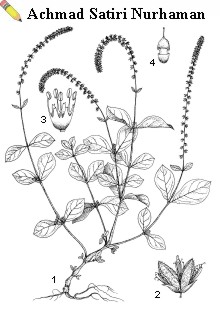 | Cyathula prostrata (L.) Blume - 1, plant habit; 2, flower cluster; 3, stamens; 4, utricle with seed |
Growth and Development
The flowers of Cyathula prostrata are visited by bees for collection of nectar. They are also wind-pollinated. Cyathula prostrata is found flowering throughout the year when sufficient water is available.
Other Botanical Information
Cyathula consists of about 25 species with a tropical distribution. In the Philippines, a variety of Cyathula prostrata with lanceolate to linear-lanceolate leaves occurs.
Ecology
Cyathula prostrata is weedy and occurs in shaded localities, along roadsides, in teak forests, secondary forests, often gregariously, from sea-level up to 1650 m altitude.
Propagation and planting
Cyathula prostrata is propagated by seed or by stem cuttings.
Harvesting
The plant parts of Cyathula prostrata to be used are harvested at the end of the growing season.
Handling After Harvest
In Vietnam, the leaves, stems and roots of Cyathula prostrata are dried in the sun or over a fire.
Genetic Resources and Breeding
As Cyathula prostrata is commonly found as a weedy herb throughout the tropics of the Old World, genetic erosion does not seem a problem.
Prospects
In general, limited information is available on the phytochemistry and pharmacology of Cyathula prostrata. Extracts, however, do have some activity in general screening experiments, and therefore may merit further research to fully investigate their potential.
Literature
Backer, C.A., 1949. Cyathula. In: van Steenis, C.G.G.J. (Editor): Flora Malesiana. Series 1, Vol. 4. Noordhoff-Kolff, Djakarta, Indonesia. pp. 81—83.
Forestieri, A.M., Monforte, M.T., Ragusa, S., Trovato, A. & Iauk, L., 1996. Antiinflammatory, analgesic and antipyretic activity in rodents of plant extracts used in African medicine. Phytotherapy Research 10(2): 100—106.
Forestieri, A.M., Pizzimenti, F.C., Monforte, M.T. & Bisignano, G., 1988. Antibacterial activity of some African medicinal plants. Pharmacological Research Communications Supplement 20(5): 33—36.
Perry, L.M., 1980. Medicinal plants of East and Southeast Asia. Attributed properties and uses. MIT Press, Cambridge, Massachusetts, United States & London, United Kingdom. p. 11.
Quisumbing, E., 1978. Medicinal plants of the Philippines. Katha Publishing Co., Quezon City, the Philippines. p. 272.
Takemoto, T., Ogawa, S., Nishimoto, N., Hirayama, H. & Taniguchi, S., 1968. Constituents of Achyranthes and Cyathula genera. Yakugaku Zasshi 88: 1293—1297. (in Japanese)
Forestieri, A.M., Monforte, M.T., Ragusa, S., Trovato, A. & Iauk, L., 1996. Antiinflammatory, analgesic and antipyretic activity in rodents of plant extracts used in African medicine. Phytotherapy Research 10(2): 100—106.
Forestieri, A.M., Pizzimenti, F.C., Monforte, M.T. & Bisignano, G., 1988. Antibacterial activity of some African medicinal plants. Pharmacological Research Communications Supplement 20(5): 33—36.
Perry, L.M., 1980. Medicinal plants of East and Southeast Asia. Attributed properties and uses. MIT Press, Cambridge, Massachusetts, United States & London, United Kingdom. p. 11.
Quisumbing, E., 1978. Medicinal plants of the Philippines. Katha Publishing Co., Quezon City, the Philippines. p. 272.
Takemoto, T., Ogawa, S., Nishimoto, N., Hirayama, H. & Taniguchi, S., 1968. Constituents of Achyranthes and Cyathula genera. Yakugaku Zasshi 88: 1293—1297. (in Japanese)
Other Selected Sources
[74] Backer, C.A. & Bakhuizen van den Brink Jr, R.C., 1964—1968. Flora of Java. 3 volumes. Noordhoff, Groningen, the Netherlands. Vol. 1 (1964) 647 pp., Vol. 2 (1965) 641 pp., Vol. 3 (1968) 761 pp.
[134] Burkill, H.M., 1985—2000. The useful plants of West tropical Africa. 2nd Edition. 5 volumes. Royal Botanic Gardens, Kew, United Kingdom. Vol. 1 (1985), Families A—D, 960 pp.; Vol. 2 (1994), Families E—I, 636 pp.; Vol. 3 (1995), Families J—L, 857 pp.; Vol. 4 (1997), Families M—R, 969 pp; Vol. 5 (2000), Families S—Z, 686 pp.
[135] Burkill, I.H., 1966. A dictionary of the economic products of the Malay Peninsula. Revised reprint. 2 volumes. Ministry of Agriculture and Co-operatives, Kuala Lumpur, Malaysia. Vol. 1 (A—H) pp. 1—1240, Vol. 2 (I—Z) pp. 1241—2444.
[201] Chuakul, W., Saralamp, P., Paonil, W., Temsiririrkkul, R. & Clayton, T. (Editors), 1997. Medicinal plants in Thailand. Vol. II. Department of Pharmaceutical Botany, Faculty of Pharmacy, Mahidol University, Bangkok, Thailand. 248 pp.
[408] Hikino, H., Nomoto, K. & Takemoto, T., 1970. Sengosterone, an insect metamorphosing substance from Cyathula capitata: structure. Tetrahedron 26(3): 887—898.
[418] Holdsworth, D.K., 1977. Medicinal plants of Papua New Guinea. Technical Paper No 175. South Pacific Commission, Noumea, New Caledonia. 123 pp.
[788] Pételot, A., 1952—1954. Les plantes médicinales du Cambodge, du Laos et du Vietnam [The medicinal plants of Cambodia, Laos and Vietnam]. 4 volumes. Centre National de Recherches Scientifiques et Techniques, Saigon, Vietnam.
[134] Burkill, H.M., 1985—2000. The useful plants of West tropical Africa. 2nd Edition. 5 volumes. Royal Botanic Gardens, Kew, United Kingdom. Vol. 1 (1985), Families A—D, 960 pp.; Vol. 2 (1994), Families E—I, 636 pp.; Vol. 3 (1995), Families J—L, 857 pp.; Vol. 4 (1997), Families M—R, 969 pp; Vol. 5 (2000), Families S—Z, 686 pp.
[135] Burkill, I.H., 1966. A dictionary of the economic products of the Malay Peninsula. Revised reprint. 2 volumes. Ministry of Agriculture and Co-operatives, Kuala Lumpur, Malaysia. Vol. 1 (A—H) pp. 1—1240, Vol. 2 (I—Z) pp. 1241—2444.
[201] Chuakul, W., Saralamp, P., Paonil, W., Temsiririrkkul, R. & Clayton, T. (Editors), 1997. Medicinal plants in Thailand. Vol. II. Department of Pharmaceutical Botany, Faculty of Pharmacy, Mahidol University, Bangkok, Thailand. 248 pp.
[408] Hikino, H., Nomoto, K. & Takemoto, T., 1970. Sengosterone, an insect metamorphosing substance from Cyathula capitata: structure. Tetrahedron 26(3): 887—898.
[418] Holdsworth, D.K., 1977. Medicinal plants of Papua New Guinea. Technical Paper No 175. South Pacific Commission, Noumea, New Caledonia. 123 pp.
[788] Pételot, A., 1952—1954. Les plantes médicinales du Cambodge, du Laos et du Vietnam [The medicinal plants of Cambodia, Laos and Vietnam]. 4 volumes. Centre National de Recherches Scientifiques et Techniques, Saigon, Vietnam.
Author(s)
Wongsatit Chuakul, Noppamas Soonthornchareonnon, Orawan Ruangsomboon
Correct Citation of this Article
Chuakul, W., Soonthornchareonnon, N. & Ruangsomboon, O., 2001. Cyathula prostrata (L.) Blume. In: van Valkenburg, J.L.C.H. and Bunyapraphatsara, N. (Editors): Plant Resources of South-East Asia No 12(2): Medicinal and poisonous plants 2. PROSEA Foundation, Bogor, Indonesia. Database record: prota4u.org/prosea

All texts are licensed under a Creative Commons Attribution-Noncommercial-Share Alike 3.0 Netherlands License
This license does not include the illustrations (Maps,drawings,pictures); these remain all under copyright.