Record Number
11
PROSEA Handbook Number
3: Dye and tannin producing plants
Taxon
Marsdenia tinctoria R. Br.
Protologue
On Asclepiad. 17 (1810), preprint for Mem. Wern. Nat. Hist. Soc. 1: 30 (1811).
Family
ASCLEPIADACEAE
Chromosome Numbers
2n = unknown
Synonyms
Asclepias tinctoria Roxb. (1832).
Vernacular Names
Indonesia: tarum akar (general), aka sanam (Minangkabau), tarum areuy (Sundanese). Malaysia: akar tarum, tarum hutan, tarum akar. Philippines: payangit (Tagalog), tayom-tayom (Ilokano), lamus (Bagobo). Cambodia: dok bonenk. Laos: büak. Thailand: khraam thao.
Origin and Geographic Distribution
Marsdenia tinctoria is widely distributed from the subtropical Himalayas of Nepal and India, through Thailand and Peninsular Malaysia, south to Indonesia (Sumatra; once found on Java), and the Philippines; east and north to southern China, Taiwan, and the Ryukyu Islands. It is rarely cultivated in India, Burma, Thailand, and Indonesia (Sumatra, Java).
Uses
The leaves are used for dyeing textiles blue in the same way as indigo (Indigofera spp.), and for dyeing hair black. In traditional medicine the leaves are applied internally for intestinal disorders, and externally to stimulate hair growth. In Bangladesh an extract of the plant is used to induce abortion.
Properties
The glucoside indican is thought to be present in the leaves, just as in indigo, but this is not certain, because no chemical analyses of the dyeing substances are available. The alcoholic extract of the plant and its alkaloidal fraction show oxytocic action on sensitized uterine horns in rats. Several triterpenes have been isolated. The bark contains fibre.
Botany
A winding shrub or vine, usually up to 5 m tall; leaf-bearing stems slender and green, puberulous, older stems about 1.5 cm thick, (sub)glabrous, with longitudinal corky ridges. Leaves opposite, simple, (broadly) ovate to lanceolate, 5-13 cm x 2-6(-7.5) cm, rounded to subcordate at base, acute or shortly acuminate at apex; petiole 1-4 cm long, puberulous. Flowers in axillary, umbel-like cymes or in many-flowered up to 15 cm long racemes, small, shortly stalked; calyx very small, pubescent; corolla urn-shaped, 2.5-4 mm long, yellow and somewhat fleshy, hairy inside, with distinct corona; stamens united into a tube, anthers with apical membranes, inflexed over the stigma; ovaries superior, 2 per flower, stigma 1, large. Fruit composed of 1 or 2 lanceolate follicles, 4-6(-8) cm long, pubescent, containing numerous, comose seeds.
Image
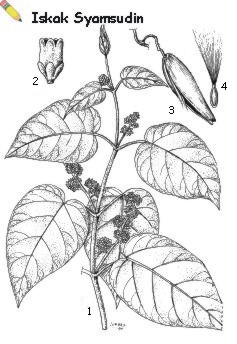 | Marsdenia tinctoria R. Br. - 1, flowering branch; 2, flower; 3, fruit; 4, seed |
Ecology
Marsdenia tinctoria occurs naturally in primary and secondary forests at low and medium altitudes, climbing on trees or sometimes over rocks. It is also found in thickets and on open ground, possibly as remnants of former cultivation. It was formerly especially grown in places where heavy rainfall prevented indigo from being grown successfully.
Agronomy
Plants are propagated by cuttings, layers, and grafts. Weeding and fertilizing are necessary. In plantations in Sumatra, leaves used to be first plucked 4 months after planting. The plantations remained productive for about 5 years. The dye can be extracted from the leaves in the same way as indigo from Indigofera spp., i.e. in tanks containing water and lime. The quality of the dye is comparable to indigo.
Prospects
Marsdenia tinctoria is a little-known dye plant. As far as is known, it has not been used in dyeing processes for many decades, and little has been published on its uses. However, it might be an interesting alternative for indigo if vegetable dyes regain ground from synthetic dyes again. Research priorities could be investigation of the chemical composition of the dye, and the properties and potential uses of the fibre in the bark.
Literature
Backer, C.A. & Bakhuizen van den Brink, R.C., 1965. Flora of Java. Vol. 2. Noordhoff, Groningen, the Netherlands. pp. 271-272.
Chowdhury, A.K.A. & Khaleque, R.A., 1984. Oxytocic principles from Marsdenia tinctoria (herb of Bangladesh). Dhaka University Studies (Bangladesh) 32(1): 85-88.
Crevost, Ch. & Pételot, A., 1941. Catalogue des produits de l'Indochine. Tome 6. Tannins et tinctoriaux. Gouvernement général de l'Indochine, Hanoi. p. 65.
Sastri, B.N. (Editor), 1962. The wealth of India. Raw materials. Vol. 6. Council of Scientific and Industrial Research, New Delhi. p. 306.
Chowdhury, A.K.A. & Khaleque, R.A., 1984. Oxytocic principles from Marsdenia tinctoria (herb of Bangladesh). Dhaka University Studies (Bangladesh) 32(1): 85-88.
Crevost, Ch. & Pételot, A., 1941. Catalogue des produits de l'Indochine. Tome 6. Tannins et tinctoriaux. Gouvernement général de l'Indochine, Hanoi. p. 65.
Sastri, B.N. (Editor), 1962. The wealth of India. Raw materials. Vol. 6. Council of Scientific and Industrial Research, New Delhi. p. 306.
Author(s)
T. Boonkerd, B. Na Songkhla & W. Thephuttee
Correct Citation of this Article
Boonkerd, T., Na Songkhla, B. & Thephuttee, W., 1991. Marsdenia tinctoria R. Br.. In: Lemmens, R.H.M.J. and Wulijarni-Soetjipto, N. (Editors): Plant Resources of South-East Asia No 3: Dye and tannin producing plants. PROSEA Foundation, Bogor, Indonesia. Database record: prota4u.org/prosea

All texts are licensed under a Creative Commons Attribution-Noncommercial-Share Alike 3.0 Netherlands License
This license does not include the illustrations (Maps,drawings,pictures); these remain all under copyright.