Record Number
1113
PROSEA Handbook Number
12(2): Medicinal and poisonous plants 2
Taxon
Harrisonia perforata (Blanco) Merr.
This article should be read together with the article on the genus: Harrisonia in the Handbook volume indicated above in this database.
This article should be read together with the article on the genus: Harrisonia in the Handbook volume indicated above in this database.
Protologue
Philipp. Journ. Sci., Bot. 7: 236 (1912).
Synonyms
Harrisonia paucijuga Oliv. (1868), Harrisonia bennettii Benn. (1875).
Vernacular Names
Indonesia: sesepang (Lampung), garut (Sundanese), ri kengkeng (Javanese). Malaysia: kait-kait (Murut, Sabah). Philippines: asimau, mamikil (Tagalog), muntani (Bisaya). Laos: dok kin ta. Thailand: khonthaa (Central), naam chee (Northern). Vietnam: s[aa]n, da da, h[ar]i s[ow]n.
Distribution
Harrisonia perforata is found in the drier parts from Burma (Myanmar) eastward through Thailand to Indo-China and the Philippines, southward to Peninsular Malaysia (Perlis), South Sumatra, Borneo (Sabah), Sulawesi, Java and the Lesser Sunda Islands.
Uses
In Indonesia, young shoots are considered a remedy against diarrhoea. In the Philippines, a decoction of the root bark is recommended in the treatment of diarrhoea and dysentery as well as against cholera. In Indo-China, ashes of the roasted leaves mixed with oil or simply crushed leaves are applied to relieve itch. In Thailand, the dried root is considered antipyretic and anti-inflammatory, it is used in wound healing and in the treatment of diarrhoea. The stems are also employed in the treatment of diarrhoea.
Observations
A scandent to erect prickly shrub up to 4(—6) m tall, leaves imparipinnate up to 20 cm long, with 1—15 pairs of leaflets; petiole 5—30 mm long; stipulate thorns slightly recurved, accrescent to 7 mm; leaflets rhomboid to ovate-lanceolate, 10—20 mm x 5—15 mm, subentire to lobed, rachis narrowly winged; inflorescence 8—20-flowered, flowers (4—)5-merous, pedicellate, calyx small, lobes triangular, petals lanceolate, 6—9 mm x 2—4 mm, red outside, pale red to white inside, stamens (8—)10, anthers 1.5—4.5 mm long, filaments 7—10 mm long, at base with a ligule which is densely woolly at the margin, disk cup-shaped, ovary slightly lobed, styles 5—8 mm long, pubescent; fruit a berry, 4—9 mm x 11—15 mm, exocarp coriaceous, at least 1 mm thick, endocarp hard, without suture.
Image
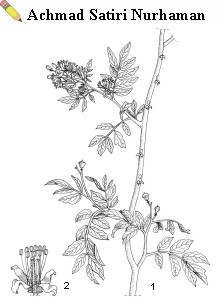 | Harrisonia perforata (Blanco) Merr. - 1, flowering and fruiting twig; 2, flower |
Selected Sources
[74] Backer, C.A. & Bakhuizen van den Brink Jr, R.C., 1964—1968. Flora of Java. 3 volumes. Noordhoff, Groningen, the Netherlands. Vol. 1 (1964) 647 pp., Vol. 2 (1965) 641 pp., Vol. 3 (1968) 761 pp.
[78] Baldé, A.M., 1990. Biological and phytochemical investigations on three plants widely used in Guinean traditional medicine. Thesis University of Antwerp, Belgium. 418 pp.
[135] Burkill, I.H., 1966. A dictionary of the economic products of the Malay Peninsula. Revised reprint. 2 volumes. Ministry of Agriculture and Co-operatives, Kuala Lumpur, Malaysia. Vol. 1 (A—H) pp. 1—1240, Vol. 2 (I—Z) pp. 1241—2444.
[311] Flora of Thailand (various editors), 1970—. The Forest Herbarium, Royal Forest Department, Bangkok, Thailand.
[407] Heyne, K., 1950. De nuttige planten van Indonesië [The useful plants of Indonesia]. 3rd Edition. 2 volumes. W. van Hoeve, 's-Gravenhage, the Netherlands/Bandung, Indonesia. 1660 + CCXLI pp.
[746] Nooteboom, H.P., 1962. Simaroubaceae. In: van Steenis C.G.G.J. (Editor): Flora Malesiana. Series 1, Vol. 6. Wolters-Noordhoff, Groningen, the Netherlands. pp. 193—226.
[786] Perry, L.M., 1980. Medicinal plants of East and Southeast Asia. Attributed properties and uses. MIT Press, Cambridge, Massachusetts, United States & London, United Kingdom. 620 pp.
[788] Pételot, A., 1952—1954. Les plantes médicinales du Cambodge, du Laos et du Vietnam [The medicinal plants of Cambodia, Laos and Vietnam]. 4 volumes. Centre National de Recherches Scientifiques et Techniques, Saigon, Vietnam.
[794] Phan Phuc Thich, Duong Kim Phung & Tran Quoc Khuyen, 1983. Preliminary study of the antibacterial property and chemical composition of Harrisonia perforata (Blanco) Merrill. Tap chi Duoc hoc 5: 5—7.(in Vietnamese)
[810] Quisumbing, E., 1978. Medicinal plants of the Philippines. Katha Publishing Co., Quezon City, the Philippines. 1262 pp.
[868] Saralamp, P., Temsiririrkkul, R., Chuakul, W., Riewpaiboon, A., Prathanturarug, S., Suthisisang, C. & Pongcharoensuk, P. (Editors), 1996. Medicinal plants in the Siri Ruckhachati Garden. 2nd Edition. Siambooks and Publications Co., Bangkok, Thailand. 263 pp.
[948] Soepadmo, E. & Mohamed Azam, A., 1989. Growth rate and reproductive biology of Malaysian anti-hypertensive plants. In: Soepadmo, E., Goh, S.H., Wong, W.H., Din, L.B. & Chuah, C.H. (Editors): Perubatan Tradisi Malaysia [Malaysian traditional
[949] Soepadmo, E., Wong, K.M. & Saw, L.G. (Editors), 1995—. Tree flora of Sabah and Sarawak. Sabah Forestry Department, Forest Research Institute Malaysia and Sarawak Forestry Department, Kepong, Malaysia.
[985] Tanaka, T., Koike, K., Mitsunaga, K., Narita, K., Takano, S., Kamioka, A., Sase, E., Ouyang, Y. & Ohmoto, T., 1995. Chromones from Harrisonia perforata. Phytochemistry (Oxford) 40(6): 1787—1790.
[78] Baldé, A.M., 1990. Biological and phytochemical investigations on three plants widely used in Guinean traditional medicine. Thesis University of Antwerp, Belgium. 418 pp.
[135] Burkill, I.H., 1966. A dictionary of the economic products of the Malay Peninsula. Revised reprint. 2 volumes. Ministry of Agriculture and Co-operatives, Kuala Lumpur, Malaysia. Vol. 1 (A—H) pp. 1—1240, Vol. 2 (I—Z) pp. 1241—2444.
[311] Flora of Thailand (various editors), 1970—. The Forest Herbarium, Royal Forest Department, Bangkok, Thailand.
[407] Heyne, K., 1950. De nuttige planten van Indonesië [The useful plants of Indonesia]. 3rd Edition. 2 volumes. W. van Hoeve, 's-Gravenhage, the Netherlands/Bandung, Indonesia. 1660 + CCXLI pp.
[746] Nooteboom, H.P., 1962. Simaroubaceae. In: van Steenis C.G.G.J. (Editor): Flora Malesiana. Series 1, Vol. 6. Wolters-Noordhoff, Groningen, the Netherlands. pp. 193—226.
[786] Perry, L.M., 1980. Medicinal plants of East and Southeast Asia. Attributed properties and uses. MIT Press, Cambridge, Massachusetts, United States & London, United Kingdom. 620 pp.
[788] Pételot, A., 1952—1954. Les plantes médicinales du Cambodge, du Laos et du Vietnam [The medicinal plants of Cambodia, Laos and Vietnam]. 4 volumes. Centre National de Recherches Scientifiques et Techniques, Saigon, Vietnam.
[794] Phan Phuc Thich, Duong Kim Phung & Tran Quoc Khuyen, 1983. Preliminary study of the antibacterial property and chemical composition of Harrisonia perforata (Blanco) Merrill. Tap chi Duoc hoc 5: 5—7.(in Vietnamese)
[810] Quisumbing, E., 1978. Medicinal plants of the Philippines. Katha Publishing Co., Quezon City, the Philippines. 1262 pp.
[868] Saralamp, P., Temsiririrkkul, R., Chuakul, W., Riewpaiboon, A., Prathanturarug, S., Suthisisang, C. & Pongcharoensuk, P. (Editors), 1996. Medicinal plants in the Siri Ruckhachati Garden. 2nd Edition. Siambooks and Publications Co., Bangkok, Thailand. 263 pp.
[948] Soepadmo, E. & Mohamed Azam, A., 1989. Growth rate and reproductive biology of Malaysian anti-hypertensive plants. In: Soepadmo, E., Goh, S.H., Wong, W.H., Din, L.B. & Chuah, C.H. (Editors): Perubatan Tradisi Malaysia [Malaysian traditional
[949] Soepadmo, E., Wong, K.M. & Saw, L.G. (Editors), 1995—. Tree flora of Sabah and Sarawak. Sabah Forestry Department, Forest Research Institute Malaysia and Sarawak Forestry Department, Kepong, Malaysia.
[985] Tanaka, T., Koike, K., Mitsunaga, K., Narita, K., Takano, S., Kamioka, A., Sase, E., Ouyang, Y. & Ohmoto, T., 1995. Chromones from Harrisonia perforata. Phytochemistry (Oxford) 40(6): 1787—1790.
Author(s)
R. Kiew
Correct Citation of this Article
Kiew, R., 2001. Harrisonia perforata (Blanco) Merr.. In: van Valkenburg, J.L.C.H. and Bunyapraphatsara, N. (Editors): Plant Resources of South-East Asia No 12(2): Medicinal and poisonous plants 2. PROSEA Foundation, Bogor, Indonesia. Database record: prota4u.org/prosea

All texts are licensed under a Creative Commons Attribution-Noncommercial-Share Alike 3.0 Netherlands License
This license does not include the illustrations (Maps,drawings,pictures); these remain all under copyright.