Record Number
1144
PROSEA Handbook Number
12(2): Medicinal and poisonous plants 2
Taxon
Kadsura scandens (Blume) Blume
Protologue
Fl. Javae: 9 (1830).
Family
SCHISANDRACEAE
Chromosome Numbers
2n = unknown
Synonyms
Kadsura cauliflora Blume (1830)
Vernacular Names
Indonesia: mendulai (Palembang), hunyur buut, ki lembur (Sundanese). Malaysia: belabar, akar dama-dama, kerukol akar.
Origin and Geographic Distribution
Kadsura scandens is found in Peninsular Malaysia, Singapore, Sumatra, Java and Bali.
Uses
In Sumatra, a decoction of the roots and stem of Kadsura scandens is used as an expectorant. The sap of the plant is drunk as a remedy for urinary problems, abdominal pains and diarrhoea. In Java, the fruits are used to alleviate skin problems and the bark is further used to combat fever. In Peninsular Malaysia a decoction of the roots is applied as a lotion for rheumatism. In China, the stem bark is used to treat menstrual disorders and blood deficiency. The ripe fruits are edible and have a sour, somewhat aromatic taste.
Production and International Trade
Kadsura scandens is only used on a local scale.
Properties
Detailed research on Kadsura scandens is scant. However, some general remarks on the genus Kadsura can be made. It is known to biosynthesize and accumulate for example biologically active lignans, the most peculiar being bi-benzocyclo-octadienoid compounds (e.g. kadsurin); biosynthetically these seem to be related to bibenzylbutanoid-type lignans. Further characteristic constituents include series of lanostane-type tetracyclic triterpenic acids, and triterpene lactones (e.g. kadsulactone).
Examples of biological activities of these compounds include for example the triterpene lactone lancilactone (from Kadsura lancilimba F.C. How probably Kadsura renchangiana), and the di-benzocyclo-octodiene lignans ineteriotherin A and schisantherin D (from Kadsura heteroclita (Roxb.) Craib), which showed significant inhibitory activity in vitro against HIV replication in H9 lymphocytes with an EC50 value of 1.4 µg/ml and a therapeutic index greater than 71.4, an EC50 value of 3.1 µg/ml and a therapeutic index of 13.1 and an EC50 value of 0.5 µg/ml and a therapeutic index of 50.6, respectively.
Furthermore, the lignan kadsurenone blocked the Platelet-activating-factor (PAF) induced aggregation and degranulation of isolated human polymorphonuclear leukocytes (PMNs), and several other in vitro models. PAF exhibits potent pro-inflammatory properties, and is secreted by numerous cell types, including e.g. endothelial cells, neutrophils and macrophages. PAF receptor agonists therefore might have potential in the treatment of a vast range of allergic and/or inflammatory based pathophysiological conditions.
Finally, triterpenoid acids from Kadsura heteroclita (a species also found in Malesia) and Kadsura longipedunculata Finet & Gagnep., collected in southern China, inhibited cholesterol biosynthesis in primary cultures of rat liver cells.
Examples of biological activities of these compounds include for example the triterpene lactone lancilactone (from Kadsura lancilimba F.C. How probably Kadsura renchangiana), and the di-benzocyclo-octodiene lignans ineteriotherin A and schisantherin D (from Kadsura heteroclita (Roxb.) Craib), which showed significant inhibitory activity in vitro against HIV replication in H9 lymphocytes with an EC50 value of 1.4 µg/ml and a therapeutic index greater than 71.4, an EC50 value of 3.1 µg/ml and a therapeutic index of 13.1 and an EC50 value of 0.5 µg/ml and a therapeutic index of 50.6, respectively.
Furthermore, the lignan kadsurenone blocked the Platelet-activating-factor (PAF) induced aggregation and degranulation of isolated human polymorphonuclear leukocytes (PMNs), and several other in vitro models. PAF exhibits potent pro-inflammatory properties, and is secreted by numerous cell types, including e.g. endothelial cells, neutrophils and macrophages. PAF receptor agonists therefore might have potential in the treatment of a vast range of allergic and/or inflammatory based pathophysiological conditions.
Finally, triterpenoid acids from Kadsura heteroclita (a species also found in Malesia) and Kadsura longipedunculata Finet & Gagnep., collected in southern China, inhibited cholesterol biosynthesis in primary cultures of rat liver cells.
Description
A monoecious, woody liana up to 25 m long. Leaves alternate, simple, elliptical to ovate, (9—)10—15(—21) cm x (4.5—)5—9(—15) cm, (1.3—)1.4—2.1(—2.4) times longer than wide, base obtuse to truncate, apex acute to acuminate, margin entire, intercostal venation prominent, papyraceous to coriaceous; petiole (0.8—)1.2—3.0(—4.8) cm long; stipules absent. Flowers usually solitary in axils of leaves or in axils of fugaceous bracts, occasionally cauliflorous, unisexual, fragrant; pedicel (4—)8—42(—70) mm long; perianth segments (7—)11—18, ovate to elliptical, largest up to (7—)9—16(—19) mm x (5—)7—12(—14) mm, innermost and outermost highly reduced, white, pale yellow or red; male flowers with 24—52 stamens, pink to dark red, anthers almost sessile, closely appressed in a subglobose to ellipsoid androecium, 4—6 mm in diameter, connectives broad with dorso-lateral thecae; female flowers with 50—82(—110) carpels, gynoecium 5—6.5 mm in diameter. Fruit a globose aggregate, about 5 cm in diameter, consisting of 40—100 sessile berries, pericarp greatly thickened distally, ripening red. Seeds 1—2 per berry, pyriform, discoid or reniform, approximately (4.5—)5.5—8.5(—10) mm x (4—)5—9(—11) mm.
Image
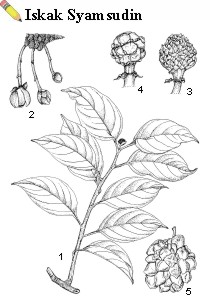 | Kadsura scandens (Blume) Blume - 1, flowering branch; 2, cauliflorous female flowers; 3, gynoecium; 4, androecium; 5, aggregate fruit |
Growth and Development
Kadsura scandens flowers and fruits throughout the year.
Other Botanical Information
Kadsura comprises 16 species, with a southern Chinese centre of diversity, extending from Japan in the north-east to the Moluccas, Sulawesi, Java and the Lesser Sunda Islands in the south, and eastern India and Sri Lanka in the west. In Malesia 9 species occur. Formerly Kadsura, Illicium and Schisandra were incorporated in Magnoliaceae. Separation into two distinct families Illiciaceae (Illicium) and Schisandraceae (Kadsura and Schisandra) is supported by morphological and chemical characters. A recent record of Kadsura scandens for Brunei may well be a misidentified specimen of Kadsura acsmithii R.M.K. Saunders, an endemic in Borneo. The dried fruits of Kadsura japonica (L.) Dunal from temperate Asia are the source of 'Fructus Kadsurae'. The drug is used in traditional medicine as a tonic, stimulant, antitussive, beneficial to kidneys and lungs and is prescribed in cough and asthma. The drug is often used as a substitute for Schisandra chinensis (Turcz.) Baill. In Indo-China, the roasted fruits of Kadsura coccinea (Lem.) A.C. Smith are credited with sedative and hypnotic properties, whereas the seeds are considered a tonic, aphrodisiac and pectoral. Several Kadsura species are well-known in traditional Chinese medicine. The stems and roots of plants called Kadsura lancilimba F.C. How (possibly Kadsura renchangiana S.F. Lan), indigenous to southern China, are used to treat stomach-ache and gastro-enteritis. The stems of Kadsura heteroclita (synonym Kadsura interior A.C. Smith), indigenous from southern China southward throughout Indo-China, Thailand and Peninsular Malaysia to Sumatra and Borneo, are used in southern China for the treatment of menstrual irregularities, blood deficiencies, and other female disorders.
Ecology
Kadsura scandens is found in humid lowland to montane forests from sea-level up to 2400 m altitude.
Propagation and planting
Kadsura scandens can be propagated by seed and most likely by 7—13 cm long semi-ripe stem cuttings. It can possibly be propagated by layering long shoots as well. Plants should be raised in a sheltered location in full sun or partial shade on moderately fertile, well-drained, neutral to slightly acid soils.
Husbandry
In the absence of natural supports for Kadsura scandens trellis or another sort of framework is essential.
Harvesting
Roots, stems and fruits of Kadsura scandens are simply collected whenever the need arises.
Genetic Resources and Breeding
The danger of genetic erosion of Kadsura scandens appears limited. Although of local occurrence in humid forest it has a wide altitudinal range and its exploitation seems very limited.
Prospects
At present, pharmacological research focuses on southern Chinese Kadsura. Several lignans, lactones and triterpenoid acids have been identified, which showed interesting pharmacological effects, including anti-HIV-, PAF-antagonistic- and cholesterol biosynthesis inhibitory activities. Related compounds and related activities can be assumed for Kadsura scandens, but should be confirmed by research.
Literature
Chen, D.F., Zhang, S.X., Chen, K., Zhou, B.N., Wang, P., Cosentino, L.M. & Lee, K.H., 1996. Two new lignans, interiotherins A and B, as anti-HIV principles from Kadsura interior. Journal of Natural Products 59(11): 1066—1068.
Chen, D.F., Zhang, S.X., Wang, H.K., Zhang, S.Y., Sun, Q.Z., Cosentino, L.M. & Lee, K.H., 1999. Novel anti-HIV lancilactone C and related triterpenes from Kadsura lancilimba. Journal of Natural Products 62(1): 94—97.
Kangouri, K., Miyoshi, T., Ikeda, A., Omura, S., Li, L.N. & Xue, H., 1990. Cholesterol biosynthesis inhibitory activities of novel triterpenoid acids from Kadsura heteroclita and Kadsura longipedunculata. Agricultural and Biological Chemistry 54(4): 993—998.
Negro Alvarez, J.M., Miralles Lopez, J.C., Ortiz Martinez, J.L., Abellan, A. & Rubio del Barrio, R., 1997. Platelet-activitating factor antagonists. Journal of Allergology and Immunopathology (Madrid) 25(5): 249—258.
Rossi, A.G., MacIntyre, D.E., Jones, C.J.P. & McMillan, R.M., 1993. Stimulation of human polymorphonuclear leukocytes by leukotriene B4 and platelet-activating factor: An ultrastructural and pharmacological study. Journal of Leukocyte Biology 53(2): 117—125.
Saunders, R.M.K., 1997. Schisandraceae. In: Kalkman, C., Kirkup, D.W., Nooteboom, H.P., Stevens, P.F. & de Wilde, W.J.J.O. (Editors): Flora Malesiana. Series 1. Vol. 13. Rijksherbarium/Hortus Botanicus, Leiden, the Netherlands. pp.185—207.
Chen, D.F., Zhang, S.X., Wang, H.K., Zhang, S.Y., Sun, Q.Z., Cosentino, L.M. & Lee, K.H., 1999. Novel anti-HIV lancilactone C and related triterpenes from Kadsura lancilimba. Journal of Natural Products 62(1): 94—97.
Kangouri, K., Miyoshi, T., Ikeda, A., Omura, S., Li, L.N. & Xue, H., 1990. Cholesterol biosynthesis inhibitory activities of novel triterpenoid acids from Kadsura heteroclita and Kadsura longipedunculata. Agricultural and Biological Chemistry 54(4): 993—998.
Negro Alvarez, J.M., Miralles Lopez, J.C., Ortiz Martinez, J.L., Abellan, A. & Rubio del Barrio, R., 1997. Platelet-activitating factor antagonists. Journal of Allergology and Immunopathology (Madrid) 25(5): 249—258.
Rossi, A.G., MacIntyre, D.E., Jones, C.J.P. & McMillan, R.M., 1993. Stimulation of human polymorphonuclear leukocytes by leukotriene B4 and platelet-activating factor: An ultrastructural and pharmacological study. Journal of Leukocyte Biology 53(2): 117—125.
Saunders, R.M.K., 1997. Schisandraceae. In: Kalkman, C., Kirkup, D.W., Nooteboom, H.P., Stevens, P.F. & de Wilde, W.J.J.O. (Editors): Flora Malesiana. Series 1. Vol. 13. Rijksherbarium/Hortus Botanicus, Leiden, the Netherlands. pp.185—207.
Other Selected Sources
[74] Backer, C.A. & Bakhuizen van den Brink Jr, R.C., 1964—1968. Flora of Java. 3 volumes. Noordhoff, Groningen, the Netherlands. Vol. 1 (1964) 647 pp., Vol. 2 (1965) 641 pp., Vol. 3 (1968) 761 pp.
[130] Bruneton, J., 1995. Pharmacognosy, phytochemistry, medicinal plants. Technique & Documentation Lavoisier, Paris, France. 915 pp.
[135] Burkill, I.H., 1966. A dictionary of the economic products of the Malay Peninsula. Revised reprint. 2 volumes. Ministry of Agriculture and Co-operatives, Kuala Lumpur, Malaysia. Vol. 1 (A—H) pp. 1—1240, Vol. 2 (I—Z) pp. 1241—2444.
[182] Chen, D.F., Zhang, S.X., Xie, L., Xie, J.X., Chen, K., Kashiwada, Y., Zhou, B.N., Wang, P., Cosentino, L.M. & Lee, K.H., 1997. Anti-AIDS agents—XXVI. Structure-activity correlations of gomisin-G-related anti-HIV lignans from Kadsura interior and of related synthetic analogues. Bioorganica and Medical Chemistry 5(8): 1715—1723.
[387] Hao, G., Chye, M.L. & Saunders, R.M.K., 2001. A phylogenetic analysis of the Schisandraceae based on morphology and nuclear ribosomal ITS sequences. Journal of the Linnean Society 135: 401—411.
[407] Heyne, K., 1950. De nuttige planten van Indonesië [The useful plants of Indonesia]. 3rd Edition. 2 volumes. W. van Hoeve, 's-Gravenhage, the Netherlands/Bandung, Indonesia. 1660 + CCXLI pp.
[739] Nguyen Van Duong, 1993. Medicinal plants of Vietnam, Cambodia and Laos. Mekong Printing, Santa Ana, California, United States. 528 pp.
[786] Perry, L.M., 1980. Medicinal plants of East and Southeast Asia. Attributed properties and uses. MIT Press, Cambridge, Massachusetts, United States & London, United Kingdom. 620 pp.
[788] Pételot, A., 1952—1954. Les plantes médicinales du Cambodge, du Laos et du Vietnam [The medicinal plants of Cambodia, Laos and Vietnam]. 4 volumes. Centre National de Recherches Scientifiques et Techniques, Saigon, Vietnam.
[878] Saunders, R.M.K., 1998. Monograph of Kadsura (Schisandraceae). Systematic Botany Monographs 54: 1—106.
[1027] van Steenis, C.G.G.J., 1972. The mountain flora of Java. E.J. Brill, Leiden, the Netherlands. 90 pp. + 72 photographs + 57 coloured plates.
[130] Bruneton, J., 1995. Pharmacognosy, phytochemistry, medicinal plants. Technique & Documentation Lavoisier, Paris, France. 915 pp.
[135] Burkill, I.H., 1966. A dictionary of the economic products of the Malay Peninsula. Revised reprint. 2 volumes. Ministry of Agriculture and Co-operatives, Kuala Lumpur, Malaysia. Vol. 1 (A—H) pp. 1—1240, Vol. 2 (I—Z) pp. 1241—2444.
[182] Chen, D.F., Zhang, S.X., Xie, L., Xie, J.X., Chen, K., Kashiwada, Y., Zhou, B.N., Wang, P., Cosentino, L.M. & Lee, K.H., 1997. Anti-AIDS agents—XXVI. Structure-activity correlations of gomisin-G-related anti-HIV lignans from Kadsura interior and of related synthetic analogues. Bioorganica and Medical Chemistry 5(8): 1715—1723.
[387] Hao, G., Chye, M.L. & Saunders, R.M.K., 2001. A phylogenetic analysis of the Schisandraceae based on morphology and nuclear ribosomal ITS sequences. Journal of the Linnean Society 135: 401—411.
[407] Heyne, K., 1950. De nuttige planten van Indonesië [The useful plants of Indonesia]. 3rd Edition. 2 volumes. W. van Hoeve, 's-Gravenhage, the Netherlands/Bandung, Indonesia. 1660 + CCXLI pp.
[739] Nguyen Van Duong, 1993. Medicinal plants of Vietnam, Cambodia and Laos. Mekong Printing, Santa Ana, California, United States. 528 pp.
[786] Perry, L.M., 1980. Medicinal plants of East and Southeast Asia. Attributed properties and uses. MIT Press, Cambridge, Massachusetts, United States & London, United Kingdom. 620 pp.
[788] Pételot, A., 1952—1954. Les plantes médicinales du Cambodge, du Laos et du Vietnam [The medicinal plants of Cambodia, Laos and Vietnam]. 4 volumes. Centre National de Recherches Scientifiques et Techniques, Saigon, Vietnam.
[878] Saunders, R.M.K., 1998. Monograph of Kadsura (Schisandraceae). Systematic Botany Monographs 54: 1—106.
[1027] van Steenis, C.G.G.J., 1972. The mountain flora of Java. E.J. Brill, Leiden, the Netherlands. 90 pp. + 72 photographs + 57 coloured plates.
Author(s)
J.L.C.H. van Valkenburg & S.F.A.J. Horsten
Correct Citation of this Article
van Valkenburg, J.L.C.H. & Horsten, S.F.A.J., 2001. Kadsura scandens (Blume) Blume. In: van Valkenburg, J.L.C.H. and Bunyapraphatsara, N. (Editors): Plant Resources of South-East Asia No 12(2): Medicinal and poisonous plants 2. PROSEA Foundation, Bogor, Indonesia. Database record: prota4u.org/prosea

All texts are licensed under a Creative Commons Attribution-Noncommercial-Share Alike 3.0 Netherlands License
This license does not include the illustrations (Maps,drawings,pictures); these remain all under copyright.