Record Number
1185
PROSEA Handbook Number
12(2): Medicinal and poisonous plants 2
Taxon
Melanolepis multiglandulosa (Reinw. ex Blume) Rchb.f. & Zoll.
Protologue
Acta Soc. Regiae Sci. Indo-Neerl. 1: 22 (1856).
Family
EUPHORBIACEAE
Chromosome Numbers
2n = unknown
Synonyms
Melanolepis angulata Miq. (1860), Melanolepis moluccana (L.) Pax & K. Hoffm. (1914), Mallotus multiglandulosus (Reinw. ex Blume) Hurus. (1954).
Vernacular Names
Indonesia: daun kapur (Malay, Moluccas), ngalu (Halmahera, Tidore), tutup (Javanese). Malaysia: chawan, jarak kayu (Peninsular). Papua New Guinea: avima (Nangananga, East New Britain). Philippines: alim (Tagalog), alok (Bikol, Bisaya). Vietnam: c[as]nh di[eef]u, h[aws]c l[aa]n nhi[eef]u tuy[ees]n.
Origin and Geographic Distribution
Melanolepis multiglandulosa is widespread over Taiwan, Ryukyu Islands, Marianas, and from southern Thailand throughout Malesia to Papua New Guinea (Bismarck Archipelago). The species is unknown from Sarawak and Brunei and has never been cultivated outside its area of natural distribution.
Uses
In Peninsular Malaysia and Indonesia the leaves of Melanolepis multiglandulosa, sometimes in a mixture with ginger, are used as a poultice against different kinds of scurf. In Peninsular Malaysia and Sumatra (Lampung), a decoction of the leaves, often in a mixture, provides a vermifuge. As a tea the leaves are employed in Sulawesi (Minahasa) against cough; for the same purpose the bark is used in Sabah. In the Philippines, the bark, leaves, and flowers, fresh or slightly heated, are applied to the skin as a sudorific against chest pain and fever. In East New Britain (Papua New Guinea), crushed dried leaves mixed with cold water are drunk to treat constipation, chest complaints and tuberculosis.
The ashes of old leaves are used as an additive to Arenga pinnata (Wurmb) Merr. tinder. These ashes were formerly used as additive to Bixa orellana L. in dyeing. In Sumatra (Lampung) leaves are mixed with tapé (a product of fermented flour from cereals) to sweeten the taste of the tapé. The wood makes good firewood.
The ashes of old leaves are used as an additive to Arenga pinnata (Wurmb) Merr. tinder. These ashes were formerly used as additive to Bixa orellana L. in dyeing. In Sumatra (Lampung) leaves are mixed with tapé (a product of fermented flour from cereals) to sweeten the taste of the tapé. The wood makes good firewood.
Properties
Although in general the bark and leaves of Melanolepis multiglandulosa are used, the only phytochemical information available is for the roots. From the roots have been isolated common triterpenes, e.g. friedelin, 'ALFA'-amyrinacetate, oleanic acid, olean-12-en-3-'BETA',28-diol, as well as steroids including campesterol, stigmasterol, 'BETA'-sitosterol, campesterol-3-O-'BETA'D-glucoside, stigmasterol-3-O-'BETA'D-glucoside, 'BETA'-sitosterol-3-O-'BETA'D-glucoside, 5'ALFA'-stigmastan-3,6-dione, stigmast-4-en-3-one, stigmast-4,22-dien-3-one and 6'BETA'-hydroxystigmast-4-en-3-one. The roots are also known to contain sucrose. At present, no information is available about pharmacological activities supporting the traditional uses of Melanolepis multiglandulosa. A test on antibacterial activity gave negative results.
Adulterations and Substitutes
Allied species of the genera Macaranga and Mallotus are often used in the same way as Melanolepis multiglandulosa, e.g. as a poultice for scurf, and in decoction as a vermifuge.
Description
A shrub or tree, up to 20 m tall; young parts covered with whitish to brown stellate hairs; flowering twigs with a broad soft pith; bark smooth to shallowly longitudinally fissured with many minute lenticels to flaky; latex milky, sticky. Leaves spirally arranged, simple, ovate, sometimes 3-lobed, usually symmetric, 5—38 cm x 5—34 cm, base cordate to cuneate, with a group of protruding glands on the upper surface, apex acute to acuminate, margin dentate, with glands in teeth and smaller ones along the margin, papery, venation palmate with 5(—7) major veins, lower surface often with 2 basal black glandular areas and additional smaller glandular areas along the veins; petiole 2.4—31 cm long; stipules deltoid, 1.2 mm x 0.8 mm, caducous. Inflorescence a terminal panicle, very laxly branched, usually with either staminate or pistillate flowers, erect, up to 26(—54) cm long, side-branches up to 41 cm long; staminate flowers up to 5 together, pistillate flowers single or 2 together. Flowers actinomorphic, sepals (4—)5, valvate, petals absent; staminate flowers 7—13 mm in diameter, sepals ovate, stamens 200—250, free, anthers with apidorsal gland on the connective, disk and pistillode absent, pedicel 5—6 mm long; pistillate flowers 4.5—5.5 mm in diameter, calyx tube about 1 mm long, lobes 1.7—3 mm x 1.2—1.8 mm, ovary 2—3-locular, 1 ovule per locule, style 0—0.6(—2) mm long, stigmas erect, not or slightly split, pedicel 3—6(—13) mm long, accrescent. Fruit a lobed capsule, obcordate in outline, 9—15 mm x 7—9 mm, densely tomentose to subglabrous, greyish-green. Seed 5.5—6 mm x 4.5—5.5 mm, creamy to purplish-magenta; aril grey to orange.
Image
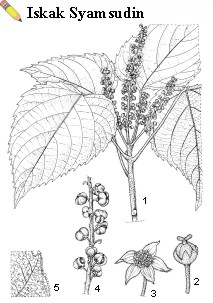 | Melanolepis multiglandulosa (Reinw. ex Blume) Rchb.f. & Zoll. - 1, twig with male inflorescence; 2, female flower; 3, male flower; 4, infructescence; 5, underside leaf with glands along the margin |
Growth and Development
Trees of Melanolepis multiglandulosa are monoecious, but usually only show unisexual inflorescences. It is not known whether both sexes occur at the same time on the same plant or not. A distinct flowering or fruiting season is unknown; flowering and fruiting specimens may be encountered during the whole year. The seeds are distributed by birds.
Other Botanical Information
Melanolepis comprises 2 species, of which Melanolepis vitifolia (O. Kuntze) Gagnep. is restricted to Cambodia. No infraspecific taxa are recognized in Melanolepis multiglandulosa, but the species is somewhat variable in its range. Towards the north (West Pacific Islands) and to the east (Bismarck Archipelago) there is a tendency to more glabrous leaves, while in New Guinea two basal glands at the upper surface protrude further than the other glands and at the lower surface there are always two basal black glandular areas. The latter are usually absent in specimens from other areas.
Ecology
Melanolepis multiglandulosa is rare to usually locally common and is considered to be an invader. It is mainly found in secondary places such as roadsides, regrowth thickets, depleted open secondary forest, forest edges in savanna, coconut plantations, old gardens, but also in primary forest, Barringtonia swamp forest, Eucalyptus deglupta Blume dominated forest, monsoon (deciduous) forest and along mangroves, at altitudes varying from sea-level up to 300(—1335) m. It is often found in poorly drained and/or temporarily inundated alluvial sands, clay, coral(sand), red loam, and volcanic soils.
Propagation and planting
Seed of Melanolepis multiglandulosa shows canopy-induced facultative dormancy but germinates readily under sunny conditions, completing germination within 5 weeks.
Husbandry
Melanolepis multiglandulosa is widely cultivated in Taiwan and the Ryukyu Islands, but there is no information on cultivation within Malesia.
Harvesting
Leaves can be collected year round, except in drier areas where the plants may be deciduous and leaves can be collected in the wet season only.
Genetic Resources and Breeding
In view of its widespread distribution and preference for disturbed habitats, Melanolepis multiglandulosa does not seem to be seriously threatened by genetic erosion. No germplasm collections or breeding programmes are known to exist
Prospects
At present, phytochemical and pharmacological information on Melanolepis multiglandulosa is very limited. Only a thorough pharmacological testing and identification of the active constituents may change the intensity with which the tree is used and cultivated.
Literature
Burkill, I.H., 1966. A dictionary of the economic products of the Malay Peninsula. Revised reprint. Vol. 2 (I—Z). Ministry of Agriculture and Co-operatives, Kuala Lumpur, Malaysia. pp. 1458—1459.
Heyne, K., 1950. De nuttige planten van Indonesië [The useful plants of Indonesia]. 3rd Edition. Vol. 2. W. van Hoeve, 's-Gravenhage, the Netherlands/Bandung, Indonesia. pp. 922—922.
Hsieh, C.-F., Chaw, S.-M. & Wang, C.-F., 1993. Euphorbiaceae. In: Huang, T.-C. (Editor): Flora of Taiwan. 2nd Edition. Vol. 3. Editorial Committee of the Flora of Taiwan, Taipei, Taiwan, Republic of China. pp. 490—492.
Lai, J.S., Liou, H.S. & Huang, K.F., 1996. Constituents of the roots of Melanolepis multiglandulosa. Chinese Pharmaceutical Journal 48(2): 177—183.
Van Welzen, P.C., Kartika Ning Tyas, Eviyarni & Gaerlan, F.J.M., 1999. The Malesian species of Melanolepis (Euphorbiaceae). Blumea 44 : 437—446.
Wang, H.H., Kuo, Y.L. & Pan, S.Y., 1997. Effects of canopy opening on seed germination among twenty species of uplifted coral-reef forest trees at Kenting, Taiwan. Taiwan Journal of Forest Science 12(3): 299—307. (in Chinese)
Heyne, K., 1950. De nuttige planten van Indonesië [The useful plants of Indonesia]. 3rd Edition. Vol. 2. W. van Hoeve, 's-Gravenhage, the Netherlands/Bandung, Indonesia. pp. 922—922.
Hsieh, C.-F., Chaw, S.-M. & Wang, C.-F., 1993. Euphorbiaceae. In: Huang, T.-C. (Editor): Flora of Taiwan. 2nd Edition. Vol. 3. Editorial Committee of the Flora of Taiwan, Taipei, Taiwan, Republic of China. pp. 490—492.
Lai, J.S., Liou, H.S. & Huang, K.F., 1996. Constituents of the roots of Melanolepis multiglandulosa. Chinese Pharmaceutical Journal 48(2): 177—183.
Van Welzen, P.C., Kartika Ning Tyas, Eviyarni & Gaerlan, F.J.M., 1999. The Malesian species of Melanolepis (Euphorbiaceae). Blumea 44 : 437—446.
Wang, H.H., Kuo, Y.L. & Pan, S.Y., 1997. Effects of canopy opening on seed germination among twenty species of uplifted coral-reef forest trees at Kenting, Taiwan. Taiwan Journal of Forest Science 12(3): 299—307. (in Chinese)
Other Selected Sources
[128] Brown, W.H., 1951—1957. Useful plants of the Philippines. Reprint of the 1941—1943 edition. 3 volumes. Technical Bulletin 10. Department of Agriculture and Natural Resources. Bureau of Printing, Manila, the Philippines. Vol. 1 (1951) 590 pp
[207] Corner, E.J.H., 1988. Wayside trees of Malaya. 3rd Edition. 2 volumes. The Malayan Nature Society, Kuala Lumpur, Malaysia. 774 pp.
[418] Holdsworth, D.K., 1977. Medicinal plants of Papua New Guinea. Technical Paper No 175. South Pacific Commission, Noumea, New Caledonia. 123 pp.
[779] Peekel, P.G., 1984. Flora of the Bismarck Archipelago for naturalists. Kristen Press, Madang, Papua New Guinea. 638 pp.
[810] Quisumbing, E., 1978. Medicinal plants of the Philippines. Katha Publishing Co., Quezon City, the Philippines. 1262 pp.
[831] Rao, K.S., 1996. Antibacterial activity of some medicinal plants of Papua New Guinea. International Journal of Pharmacognosy 34(3): 223—225.
[207] Corner, E.J.H., 1988. Wayside trees of Malaya. 3rd Edition. 2 volumes. The Malayan Nature Society, Kuala Lumpur, Malaysia. 774 pp.
[418] Holdsworth, D.K., 1977. Medicinal plants of Papua New Guinea. Technical Paper No 175. South Pacific Commission, Noumea, New Caledonia. 123 pp.
[779] Peekel, P.G., 1984. Flora of the Bismarck Archipelago for naturalists. Kristen Press, Madang, Papua New Guinea. 638 pp.
[810] Quisumbing, E., 1978. Medicinal plants of the Philippines. Katha Publishing Co., Quezon City, the Philippines. 1262 pp.
[831] Rao, K.S., 1996. Antibacterial activity of some medicinal plants of Papua New Guinea. International Journal of Pharmacognosy 34(3): 223—225.
Author(s)
P.C. van Welzen
Correct Citation of this Article
van Welzen, P.C., 2001. Melanolepis multiglandulosa (Reinw. ex Blume) Rchb.f. & Zoll.. In: van Valkenburg, J.L.C.H. and Bunyapraphatsara, N. (Editors): Plant Resources of South-East Asia No 12(2): Medicinal and poisonous plants 2. PROSEA Foundation, Bogor, Indonesia. Database record: prota4u.org/prosea

All texts are licensed under a Creative Commons Attribution-Noncommercial-Share Alike 3.0 Netherlands License
This license does not include the illustrations (Maps,drawings,pictures); these remain all under copyright.