Record Number
1204
PROSEA Handbook Number
12(2): Medicinal and poisonous plants 2
Taxon
Mitragyna speciosa (Korth.) Havil.
Protologue
Journ. Linn. Soc., Bot. 33: 69 (1897).
Family
RUBIACEAE
Chromosome Numbers
2n = unknown
Synonyms
Nauclea speciosa Miq. (1857).
Vernacular Names
Indonesia: kadamba (Kalimantan), puri (Batak Toba). Malaysia: ketum, kutum, biak-biak. Philippines: mambog (Tagalog), lugub (Mandaya), polapupot (Ibanag). Thailand: bai krathom, ee-thaang (central), thom (peninsular). Vietnam: giam d[ef]p, giam l[as] nh[or].
Origin and Geographic Distribution
Mitragyna speciosa is found from Peninsular Malaysia, Sumatra, Borneo, to the Philippines and New Guinea. It is cultivated in southern Vietnam, peninsular Thailand and Burma (Myanmar).
Uses
In Peninsular Malaysia, the pounded leaves of Mitragyna speciosa are widely used to poultice wounds, or to expel worms from children. The leaves, heated with those of Blumea balsamifera (L.) DC., Morinda citrifolia L. and Oroxylum indicum (L.) Kurz, are applied hot to an enlarged spleen. In the Philippines, the aerial parts are used as a local anaesthetic. It is also considered an antihypertensive plant and has been used for chronic cases of hypertension and diabetes mellitus. In Peninsular Malaysia and Thailand, the leaves are taken for diarrhoea, dysentery or stomach-ache and are also used for their analgesic and stimulant properties. Overdoses can cause vomiting and diarrhoea. In Peninsular Malaysia, Thailand, Vietnam and Burma (Myanmar), the leaves are chewed as a substitute for opium, as they cause hallucinations and euphoria. Extended use leads to anorexia, weight loss, darkened and dry skin, and in some cases even to psychosis. They are habit-forming, and reputed to act as a stimulant to help one endure fatigue and go long periods without food. In addition to chewing the leaves or drinking the infusion, the residue may be dehydrated and smoked, or the syrup smoked in a pipe. In Burma (Myanmar), the leaves are known to induce stupor when taken in case of an overdose.
The wood can be used for triplex and boxing.
The wood can be used for triplex and boxing.
Production and International Trade
Mitragyna speciosa is used on a local scale only.
Properties
Mitragyna speciosa is well known for the presence of a series of (monoterpenoid) indole alkaloids, which are biochemically derived from the amino acid tryptophan. The best known compounds, isolated from the leaves, are (—)-mitragynine and mitraphylline. Others include e.g. speciogynine, corynantheidaline, speciociliatine, mitraciliatine, 7-'ALFA'-hydroxy-7H-mitragynine, mitragynalinic acid, corynantheidalinic acid, 3-dehydromitragynine and 3,4,5,6-tetradehydromitragynine. In young Mitragyna speciosa plants the major single indole alkaloid present was the C-3H-'ALFA'-alkaloid speciogynine, but most of the indole alkaloids were of the C-3H-'BETA'-type, viz. isocorynantheidine, isopaynantheine and mitraciliatine. Rhynchociline, ciliaphylline, specionoxeine and isospecionoxeine were also obtained from the stem and root bark but not from the leaves. Besides indole alkaloids, several flavonoids were isolated from the leaves, e.g. apigenin, astragalin, cosmosin, hyperoside and also the polyphenols kaempferol, quercetin and rutin.
The pharmacological activities of mitragynine have been quite well investigated. Its antinociceptive activity, after oral administration, was compared to that of morphine and paracetamol, by using the acetic acid induced writhing model, the hot tail flick- and the cold tail flick tests in mice. Mitragynine, at 200 mg/kg, and morphine, at 5 mg/kg, reduced writhing significantly, but paracetamol did not. All 3 compounds produced significant analgesia in the hot tail flick test, but only morphine and mitragynine also did so in the cold tail flick test.
Furthermore, mitragynine (1—10 µg), injected intracerebroventricularly, exerted a dose-dependent antinociceptive activity in both the tail-pinch and hot-plate tests in mice. The mechanisms of the actions were evaluated using different opioid receptor antagonists. These results indicate that mitragynine can induce antinociception by acting in the brain, and that the supraspinal opioid systems are at least partly involved in the antinociceptive action of mitragynine in mice.
Mitragynine and morphine also inhibited the electrically stimulated contraction of guinea-pig ileum in vitro through the opioid receptor in a concentration-dependent manner. Mitragynine was 10 times less potent than morphine, and furthermore did not show any effect on the smooth muscle contraction induced by acetylcholine or histamine.
In addition, the effects of mitragynine were evaluated for the 5-HT-2A receptor-mediated head-twitch responses in mice. Intraperitoneal injection of mitragynine (5—30 mg/kg), as well as intraperitoneal injection of the 5-HT-2A receptor antagonist ritanserin, inhibited the 5-methoxy-N,N-dimethyltryptamine (5-MeO-DMT at 16 mg/kg)-induced head-twitch response in a dose-dependent manner. In contrast, mitragynine affected neither head-weaving caused by 5-MeO-DMT, nor drug-free spontaneous motor activity. Stimulation of postsynaptic 'ALFA'2-adrenoceptor, blockade of 5-HT-2A receptors, or both, seem to be involved in suppression of 5-HT-2A receptor-mediated head-twitch response by mitragynine.
Effects of a related compound, mitragynine-pseudoindoxyl, on electrically stimulated contractions in guinea-pig ileum and mouse vas deferens, and on its binding affinity in the guinea-pig brain membranes were also studied in vitro. Mitragynine-pseudoindoxyl inhibited the electrically stimulated ileum and mouse vas deferens contractions in a concentration-dependent manner. In the ileum, the effective concentration is 100- and 20-fold smaller than those of mitragynine and morphine, respectively. In the vas deferens, it is 35 times smaller than that of morphine. It was demonstrated that the compound acts on opioid receptors, leading to a potent inhibition of electrically stimulated contraction in the ileum through the µ-receptors and in mouse vas deferens through 'DELTA'-receptors.
In Malaysia, an extract of the leaves of Mitragyna speciosa was found to have strong enzyme inducing properties (cytochrome P450). Therefore, patients with chronic conditions taking these plants should be warned of possible drug interactions which may lead to a decrease in the effectiveness of drugs taken concurrently with such plants.
The pharmacological activities of mitragynine have been quite well investigated. Its antinociceptive activity, after oral administration, was compared to that of morphine and paracetamol, by using the acetic acid induced writhing model, the hot tail flick- and the cold tail flick tests in mice. Mitragynine, at 200 mg/kg, and morphine, at 5 mg/kg, reduced writhing significantly, but paracetamol did not. All 3 compounds produced significant analgesia in the hot tail flick test, but only morphine and mitragynine also did so in the cold tail flick test.
Furthermore, mitragynine (1—10 µg), injected intracerebroventricularly, exerted a dose-dependent antinociceptive activity in both the tail-pinch and hot-plate tests in mice. The mechanisms of the actions were evaluated using different opioid receptor antagonists. These results indicate that mitragynine can induce antinociception by acting in the brain, and that the supraspinal opioid systems are at least partly involved in the antinociceptive action of mitragynine in mice.
Mitragynine and morphine also inhibited the electrically stimulated contraction of guinea-pig ileum in vitro through the opioid receptor in a concentration-dependent manner. Mitragynine was 10 times less potent than morphine, and furthermore did not show any effect on the smooth muscle contraction induced by acetylcholine or histamine.
In addition, the effects of mitragynine were evaluated for the 5-HT-2A receptor-mediated head-twitch responses in mice. Intraperitoneal injection of mitragynine (5—30 mg/kg), as well as intraperitoneal injection of the 5-HT-2A receptor antagonist ritanserin, inhibited the 5-methoxy-N,N-dimethyltryptamine (5-MeO-DMT at 16 mg/kg)-induced head-twitch response in a dose-dependent manner. In contrast, mitragynine affected neither head-weaving caused by 5-MeO-DMT, nor drug-free spontaneous motor activity. Stimulation of postsynaptic 'ALFA'2-adrenoceptor, blockade of 5-HT-2A receptors, or both, seem to be involved in suppression of 5-HT-2A receptor-mediated head-twitch response by mitragynine.
Effects of a related compound, mitragynine-pseudoindoxyl, on electrically stimulated contractions in guinea-pig ileum and mouse vas deferens, and on its binding affinity in the guinea-pig brain membranes were also studied in vitro. Mitragynine-pseudoindoxyl inhibited the electrically stimulated ileum and mouse vas deferens contractions in a concentration-dependent manner. In the ileum, the effective concentration is 100- and 20-fold smaller than those of mitragynine and morphine, respectively. In the vas deferens, it is 35 times smaller than that of morphine. It was demonstrated that the compound acts on opioid receptors, leading to a potent inhibition of electrically stimulated contraction in the ileum through the µ-receptors and in mouse vas deferens through 'DELTA'-receptors.
In Malaysia, an extract of the leaves of Mitragyna speciosa was found to have strong enzyme inducing properties (cytochrome P450). Therefore, patients with chronic conditions taking these plants should be warned of possible drug interactions which may lead to a decrease in the effectiveness of drugs taken concurrently with such plants.
Description
A large tree, 10—30 m tall; bole 60—100 cm in diameter, bark greyish, shallowly sculptured and with pustular lenticels; each node with 2 serial buds; terminal vegetative bud ellipsoid, slightly flattened. Leaves opposite, simple, entire, oblong-ovate, 8—15 cm x 4—10 cm, base broadly rounded, apex abruptly acuminate, glabrous or veins beneath puberulous, veins 12—15 pairs; petiole (1—)2—5 cm long; stipules lanceolate, 2 cm long, pubescent, with 9 veins, inside with colleters at base. Inflorescence terminally on lateral branches, composed of 3(—7) globose heads, 1 head subsessile between 2 others on long peduncles, 5 cm long; head 2.5 cm in diameter when flowering, 1.5 cm when fruiting, receptacle hairy, leafy bracts up to 4 cm long, petiolate, interfloral bracteoles up to 3.5 mm long. Flowers bisexual, 5-merous, sessile; calyx cup-shaped, up to 2 mm long, 5-lobed; corolla yellowish-white turning deep yellow, funnel-shaped, 5—8 mm long, lobes 5, 3 mm long, thickened at apex, margin revolute, a conspicuous ring of hairs inside at base of lobes; stamens 5, on intersection with lobes, anthers lanceolate, cordate, conspicuously protruding from the corolla; ovary inferior, 2-celled, style exserted, 13 mm long, stigma rounded, 2 mm long. Fruit composed of 2 cocci, exocarp thin, splitting loculicidally along its length, 10-ridged; seeds numerous. Seed shortly winged on 2 sides, lower wing shortly bifid or notched.
Image
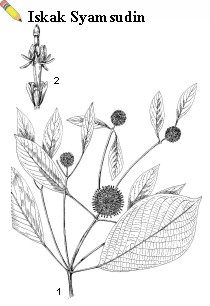 | Mitragyna speciosa (Korth.) Havil. - 1, flowering branch; 2, flower with bracteoles |
Growth and Development
In Thailand, Mitragyna speciosa was grown in orchards until this was prohibited. Mitragyna speciosa flowers in March-BApril.
Other Botanical Information
Mitragyna comprises 10 species from the Old world Tropics, of which 4 species occur in continental Africa and 6 species in continental and South-East Asia.
Ecology
Mitragyna speciosa generally occurs rather sparsely in open savanna and secondary forest, at low altitudes. In Borneo, it is usually encountered in swamp and riverine forests which are periodically flooded, where it is one of the dominant species observed as colonizing vegetation on old ox-bow riverbeds.
Propagation and planting
Mitragyna speciosa is propagated by seed.
Harvesting
The leaves of Mitragyna speciosa are harvested throughout the year.
Handling After Harvest
In Peninsular Malaysia, the leaves of Mitragyna speciosa are dried in the sun until they are crisp. After that there are several possibilities for further use. The leaves can be powdered between the hands, the coarser parts removed, and the rest stored for later use. A small amount of this powder can be swallowed daily to twice daily in a cup of cold water or drunk as a hot infusion. The dry leaves can also be boiled, and the infusion is boiled down to a syrup. This syrup can be kept for a long time. The syrup can be mixed with hot water and drunk or it is put on the tongue and washed down with water. The syrup can also be mixed with finely shredded leaves of the palm Licuala paludosa Griffith, and the resulting sticky pellet is smoked in a bamboo pipe. In southern Thailand, the syrup may also been taken with betel leaf (Piper betle L.).
Genetic Resources and Breeding
There is possibly some danger of genetic erosion, because most leaves are picked from natural Mitragyna speciosa populations in South-East Asia. On the other hand, leaf collection does not seem to be deleterious for the plant. The tree is preserved even when forest is cleared, but information on regeneration is lacking. Many botanical gardens in the region seem to have planted several trees.
There are no known breeding programmes of Mitragyna speciosa.
There are no known breeding programmes of Mitragyna speciosa.
Prospects
Mitragynine shows interesting in vitro and partly in vivo effects on several receptor systems including opioid receptors (antinociceptive activity, pain) and 5-HT-2A (antagonism, anxiolytic, antidepressant). These effects merit further research on Mitragyna speciosa, to fully evaluate the potential of mitragynine or its derivatives for either future medicine, or as biochemical tools in modern pharmacological research.
Literature
Burkill, I.H., 1966. A dictionary of the economic products of the Malay Peninsula. Revised reprint. Vol. 2. Ministry of Agriculture and Co-operatives, Kuala Lumpur, Malaysia. pp. 1506—1508.
Idid, S.Z., Saad, L.B., Yaacob, H. & Shahimi, M.M., 1998. Evaluation of analgesia induced by mitragynine, morphine and paracetamol on mice. ASEAN Review of Biodiversity and Environmental Conservation 4: 1—7.
Matsumoto, K., Mizowaki, M., Takayama, H., Sakai, S.I., Aimi, N. & Watanabe, H., 1997. Suppressive effect of mitragynine on the 5-methoxy-N,N-dimethyltryptamine-induced head-twitch response in mice. Pharmacology, Biochemistry and Behavior 57(1—2): 319—323.
Quisumbing, E., 1978. Medicinal plants of the Philippines. Katha Publishing Co., Quezon City, the Philippines. p. 914.
Ridsdale, C.E., 1978. A revision of Mitragyna and Uncaria (Rubiaceae). Blumea 24: 43-B100.
Yamamoto, L.T., Horie, S., Takayama, H., Aimi, N., Sakai, S.I., Yano, S., Shan, J., Pang, P.K.T., Ponglux, D. & Watanabe, K., 1999. Opioid receptor agonistic characteristics of mitragynine pseudoindoxyl in comparison with mitragynine derived from the Thai medicinal plant Mitragyna speciosa. General Pharmacology 33(1): 73—81.
Idid, S.Z., Saad, L.B., Yaacob, H. & Shahimi, M.M., 1998. Evaluation of analgesia induced by mitragynine, morphine and paracetamol on mice. ASEAN Review of Biodiversity and Environmental Conservation 4: 1—7.
Matsumoto, K., Mizowaki, M., Takayama, H., Sakai, S.I., Aimi, N. & Watanabe, H., 1997. Suppressive effect of mitragynine on the 5-methoxy-N,N-dimethyltryptamine-induced head-twitch response in mice. Pharmacology, Biochemistry and Behavior 57(1—2): 319—323.
Quisumbing, E., 1978. Medicinal plants of the Philippines. Katha Publishing Co., Quezon City, the Philippines. p. 914.
Ridsdale, C.E., 1978. A revision of Mitragyna and Uncaria (Rubiaceae). Blumea 24: 43-B100.
Yamamoto, L.T., Horie, S., Takayama, H., Aimi, N., Sakai, S.I., Yano, S., Shan, J., Pang, P.K.T., Ponglux, D. & Watanabe, K., 1999. Opioid receptor agonistic characteristics of mitragynine pseudoindoxyl in comparison with mitragynine derived from the Thai medicinal plant Mitragyna speciosa. General Pharmacology 33(1): 73—81.
Other Selected Sources
[46] Alini, M. & Safaeh, I., 1989. The effect of Tinospora crispa, Mitragyna speciosa and Andrographis paniculata on the cytochrome content P-450 of rat. In: Soepadmo, E., Goh, S.H., Wong, W.H., Din, L.B. & Chuah, C.H. (Editors): Perubatan Tradisi Malaysia [Malaysian traditional medicine]. Proceedings of the Seminar on Malaysian Traditional Medicine, Kuala Lumpur, Malaysia, June 10—11, 1988. pp. 183—191. (in Malay)
[201] Chuakul, W., Saralamp, P., Paonil, W., Temsiririrkkul, R. & Clayton, T. (Editors), 1997. Medicinal plants in Thailand. Vol. II. Department of Pharmaceutical Botany, Faculty of Pharmacy, Mahidol University, Bangkok, Thailand. 248 pp.
[393] Harvala, C. & Hinou, J., 1988. Flavonol derivatives from the leaves of Mitragyna speciosa. Pharmazie 43(5): 372.
[407] Heyne, K., 1950. De nuttige planten van Indonesië [The useful plants of Indonesia]. 3rd Edition. 2 volumes. W. van Hoeve, 's-Gravenhage, the Netherlands/Bandung, Indonesia. 1660 + CCXLI pp.
[409] Hinou, J. & Harvala, C., 1988. Polyphenolic compounds from the leaves of Mitragyna speciosa. Fitoterapia 59(2): 156.
[523] Kessler, P.J.A. (Editor), 2000. Secondary forest trees of Kalimantan, Indonesia. A manual to 300 selected species. Tropenbos Kalimantan Series 3. MOFEC Tropenbos-Kalimantan Project, Wanariset Samboja, Balikpapan, Indonesia. 404 pp.
[656] Matsumoto, K., Mizowaki, M., Suchitra, T., Takayama, H., Sakai, S.I., Aimi, N. & Watanabe, H., 1996. Antinociceptive action of mitragynine in mice: Evidence for the involvement of supraspinal opioid receptors. Life Sciences 59(14): 1149—1155.
[657] Matsumoto, K., Suchitra, M.M.T., Murakami, Y., Takayama, H., Sakai, S.I., Aimi, N. & Watanabe, H., 1996. Central antinociceptive effects of mitragynine in mice: Contribution of descending noradrenergic and serotonergic systems. European Journal of Pharmacology 317(1): 75—81.
[786] Perry, L.M., 1980. Medicinal plants of East and Southeast Asia. Attributed properties and uses. MIT Press, Cambridge, Massachusetts, United States & London, United Kingdom. 620 pp.
[796] Pizziketti, R.J., Pressman, E.B., Geller, E.B. & Adler, M.W., 1985. Rat cold water tail-flick: a novel analgesic test that distinguishes opioid agonist from mixed agonist-antagonist. European Journal of Pharmacy 119: 23—29.
[904] Shellard, E.J., Houghton, P.J. & Resha, M., 1978. The Mitragyna species of Asia. XXXI. The alkaloids of Mitragyna speciosa Korth from Thailand. Planta Medica 34(1): 26—36.
[905] Shellard, E.J., Houghton, P.J. & Resha, M., 1978. The Mitragyna species of Asia. XXXII. The distribution of alkaloids in young plants of Mitragyna speciosa Korth grown from seed obtained from Thailand. Planta Medica 34(3): 253—263.
[1056] Watanabe, K., Yano, S., Horie, S. & Yamamoto, L.T., 1997. Inhibitory effect of mitragynine, an alkaloid with analgesic effect from Thai medicinal plant Mitragyna speciosa, on electrically stimulated contraction of isolated guinea-pig ileum through the opioid receptor. Life Sciences 60(12): 933—942.
[1066] Whitmore, T.C. & Ng, F.S.P. (Editors), 1972—1989. Tree flora of Malaya. A manual for foresters. 2nd Edition. 4 volumes. Malayan Forest Records No 26. Longman Malaysia Sdn. Berhad, Kuala Lumpur & Petaling Jaya, Malaysia.
[201] Chuakul, W., Saralamp, P., Paonil, W., Temsiririrkkul, R. & Clayton, T. (Editors), 1997. Medicinal plants in Thailand. Vol. II. Department of Pharmaceutical Botany, Faculty of Pharmacy, Mahidol University, Bangkok, Thailand. 248 pp.
[393] Harvala, C. & Hinou, J., 1988. Flavonol derivatives from the leaves of Mitragyna speciosa. Pharmazie 43(5): 372.
[407] Heyne, K., 1950. De nuttige planten van Indonesië [The useful plants of Indonesia]. 3rd Edition. 2 volumes. W. van Hoeve, 's-Gravenhage, the Netherlands/Bandung, Indonesia. 1660 + CCXLI pp.
[409] Hinou, J. & Harvala, C., 1988. Polyphenolic compounds from the leaves of Mitragyna speciosa. Fitoterapia 59(2): 156.
[523] Kessler, P.J.A. (Editor), 2000. Secondary forest trees of Kalimantan, Indonesia. A manual to 300 selected species. Tropenbos Kalimantan Series 3. MOFEC Tropenbos-Kalimantan Project, Wanariset Samboja, Balikpapan, Indonesia. 404 pp.
[656] Matsumoto, K., Mizowaki, M., Suchitra, T., Takayama, H., Sakai, S.I., Aimi, N. & Watanabe, H., 1996. Antinociceptive action of mitragynine in mice: Evidence for the involvement of supraspinal opioid receptors. Life Sciences 59(14): 1149—1155.
[657] Matsumoto, K., Suchitra, M.M.T., Murakami, Y., Takayama, H., Sakai, S.I., Aimi, N. & Watanabe, H., 1996. Central antinociceptive effects of mitragynine in mice: Contribution of descending noradrenergic and serotonergic systems. European Journal of Pharmacology 317(1): 75—81.
[786] Perry, L.M., 1980. Medicinal plants of East and Southeast Asia. Attributed properties and uses. MIT Press, Cambridge, Massachusetts, United States & London, United Kingdom. 620 pp.
[796] Pizziketti, R.J., Pressman, E.B., Geller, E.B. & Adler, M.W., 1985. Rat cold water tail-flick: a novel analgesic test that distinguishes opioid agonist from mixed agonist-antagonist. European Journal of Pharmacy 119: 23—29.
[904] Shellard, E.J., Houghton, P.J. & Resha, M., 1978. The Mitragyna species of Asia. XXXI. The alkaloids of Mitragyna speciosa Korth from Thailand. Planta Medica 34(1): 26—36.
[905] Shellard, E.J., Houghton, P.J. & Resha, M., 1978. The Mitragyna species of Asia. XXXII. The distribution of alkaloids in young plants of Mitragyna speciosa Korth grown from seed obtained from Thailand. Planta Medica 34(3): 253—263.
[1056] Watanabe, K., Yano, S., Horie, S. & Yamamoto, L.T., 1997. Inhibitory effect of mitragynine, an alkaloid with analgesic effect from Thai medicinal plant Mitragyna speciosa, on electrically stimulated contraction of isolated guinea-pig ileum through the opioid receptor. Life Sciences 60(12): 933—942.
[1066] Whitmore, T.C. & Ng, F.S.P. (Editors), 1972—1989. Tree flora of Malaya. A manual for foresters. 2nd Edition. 4 volumes. Malayan Forest Records No 26. Longman Malaysia Sdn. Berhad, Kuala Lumpur & Petaling Jaya, Malaysia.
Author(s)
L.S.L. Chua & G.H. Schmelzer
Correct Citation of this Article
Chua, L.S.L. & Schmelzer, G.H., 2001. Mitragyna speciosa (Korth.) Havil.. In: van Valkenburg, J.L.C.H. and Bunyapraphatsara, N. (Editors): Plant Resources of South-East Asia No 12(2): Medicinal and poisonous plants 2. PROSEA Foundation, Bogor, Indonesia. Database record: prota4u.org/prosea

All texts are licensed under a Creative Commons Attribution-Noncommercial-Share Alike 3.0 Netherlands License
This license does not include the illustrations (Maps,drawings,pictures); these remain all under copyright.