Record Number
1205
PROSEA Handbook Number
12(2): Medicinal and poisonous plants 2
Taxon
Mollugo pentaphylla L.
Protologue
Sp. pl. 1: 89 (1753).
Family
AIZOACEAE
Chromosome Numbers
2n = (18), 36
Synonyms
Mollugo stricta L. (1762), Mollugo sumatrana Gand. (1918).
Vernacular Names
Carpet weed, African chickweed (En). Mollugine, olsine (Fr). Indonesia: jampang kulut, jukut taridi (Sundanese), galingsa (Javanese). Malaysia: tapak burong, rumput belangkas, bunga karang. Philippines: malagoso (Tagalog), sulangkang (Subanun), lepouo (Bontok). Thailand: soi nok khao (southeastern), yaa nok khao (central), yaa khai hao (northern). Vietnam: c[or] b[uj]ng cu, b[if]nk cu.
Origin and Geographic Distribution
Mollugo pentaphylla is distributed throughout the tropics and subtropics of the Old World, from India to New Caledonia and Micronesia, but is rare in Australia.
Uses
In Peninsular Malaysia, the leaves of Mollugo pentaphylla are applied for poulticing sore legs. In Java, they are used for sprue and mouth infections. In India, the whole plant is used as a mild laxative medicine, also as a stomachic, antiseptic and emmenagogue. In China, it is made into a soup to promote appetite, while a decoction of the roots is used to treat eye diseases. In Thailand, the entire plant is used as an antipyretic.
In the Solomon Islands, the whole plant is burnt to make a mosquito repellent. The leaves are eaten as a bitter pot herb in India, Thailand and Java, but they are less popular than those of Glinus oppositifolius (L.) DC. (synonym Mollugo oppositifolia L.), which are larger.
Other Mollugo species are used in a similar way as Mollugo pentaphylla.
Production and International Trade
Mollugo pentaphylla is only occasionally traded on local markets by herbalists.
Properties
Very little is known about the phytochemistry and biological activities of extracts and isolated compounds from Mollugo pentaphylla. Two triterpenes were isolated from the aerial parts. Mollugogenol A exhibited antifungal activity against Cladosporium cucumerinum, while mollugogenol B is inactive. Furthermore, mollugogenol A also exhibits spermicidal action by damaging the sperm membrane through increased lipid peroxidation.
Other components isolated include the flavonoids apigenin-8-C-glucoside and 6,8-di-C-pentosylapigenin, and the anthocyanin pelargonidin.
Mollugo pentaphylla is a component in an important folk medicine in Taiwan, which is used as an anticancer, antitoxic and diuretic agent.
Other components isolated include the flavonoids apigenin-8-C-glucoside and 6,8-di-C-pentosylapigenin, and the anthocyanin pelargonidin.
Mollugo pentaphylla is a component in an important folk medicine in Taiwan, which is used as an anticancer, antitoxic and diuretic agent.
Description
An erect or prostrate, glabrous annual, often much and widely branched from the base, 2—35 cm tall, with a thin taproot, stems thin, angular, when old often tinged brownish-red. Leaves in false whorls of 3—5(—9) or partly opposite, the basal ones in a rosette, oblong-obovate-spatulate, upper leaves smaller, linear-lanceolate, 10—50 mm x 1.5—10 mm, both ends narrowed, margins entire, midrib prominent beneath; petiole short or absent; stipules minute. Inflorescence a lax axillary or terminal cyme, often with long racemiform branches; bracts small, persistent; pedicel 1.5—6 mm long, persistent and recurved till long after the fall of the fruiting perianth. Flowers bisexual, with 5 free, oval-oblong tepals, 1—2 mm long, apex obtuse, inside white, outside green with white margins, during anthesis widely patent, afterwards connivent to a globe; stamens 3, alternate with the carpels, filaments short; styles 3, free, very short, white; ovary superior, 3-locular. Fruit a capsule with 3 carpels, broadly ellipsoid, 2 mm long, thin-walled. Seeds numerous, reniform, 0.8 mm in diameter, finely granulate, dark brown. Seedling with epigeal germination; hypocotyl 3.5—5 mm long, cotyledons 3 mm x 1.5 mm, apex acute, petiole short; first leaf elliptical to ovate, petiolate, glabrous, midvein distinct.
Image
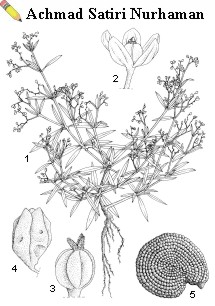 | Mollugo pentaphylla L. - 1, plant habit; 2, flower; 3, pistil; 4, capsule; 5, seed |
Other Botanical Information
Mollugo contains 15—20 species, distributed over the warmer regions of the world. In Malesia only 1 species is known. Mollugo is closely related to Glinus, and they are differentiated by the presence of a filiform appendage and conspicuous caruncle on the seed, and in the dense stellate pubescence of Glinus. The Aizoaceae have been split into 2 families by some authors: Molluginaceae, with a free perianth, and Ficoidaceae, with a gamophyllous perianth. Other authors merge Aizoaceae with Portulacaceae.
Ecology
Mollugo pentaphylla occurs in semi-arid to humid regions, mostly locally abundant as a minor weed in cultivated areas, including rice fields and open grasslands, but also in sandy or stony localities, at low and medium altitudes.
Propagation and planting
Mollugo pentaphylla is propagated by seeds, which are dispersed by water.
Harvesting
Mollugo pentaphylla is collected from the wild whenever the need arises.
Genetic Resources and Breeding
Mollugo pentaphylla is widespread in anthropogenic habitats, and is therefore probably not at risk of genetic erosion.
Prospects
Mollugo pentaphylla remains of local importance, because little is known of the biologically active compounds.
Literature
Backer, C.A., 1951. Aizoaceae. In: van Steenis, C.G.G.J. (Editor): Flora Malesiana. Series 1, Vol. 4. Noordhoff-Kolff, Djakarta, Indonesia. pp. 267—275.
Bogle, A.L., 1970. The genera of Molluginaceae and Aizoaceae in the Southeastern United States. Journal of the Arnold Arboretum 51(4): 431—462.
Hamburger, M., Dudan, G., Nair, A.G.R., Jayaprakasam, R. & Hostettmann, K., 1989. An antifungal triterpenoid from Mollugo pentaphylla. Phytochemistry 28(6): 1767—1768.
Quisumbing, E., 1978. Medicinal plants of the Philippines. Katha Publishing Co., Quezon City, the Philippines. pp. 279—280.
Rajasekaran, M., Nair, A.G.R., Hellstrom, W.J.G. & Sikka, S.C., 1993. Spermicidal activity of an antifungal saponin obtained from the tropical herb Mollugo pentaphylla. Contraception 47(4): 401—412.
Yang, J.-J., Lin, C.-C. & Hsu, H.Y., 1997. The possible use of Peh-hue-juwa-chi-cao as an antitumour agent and radioprotector after therapeutic irradiation. Phytotherapy Research 11(1): 6—10.
Other Selected Sources
[135] Burkill, I.H., 1966. A dictionary of the economic products of the Malay Peninsula. Revised reprint. 2 volumes. Ministry of Agriculture and Co-operatives, Kuala Lumpur, Malaysia. Vol. 1 (A—H) pp. 1—1240, Vol. 2 (I—Z) pp. 1241—2444.
Author(s)
N.O. Aguilar
Correct Citation of this Article
Aquilar, N.O., 2001. Mollugo pentaphylla L.. In: van Valkenburg, J.L.C.H. and Bunyapraphatsara, N. (Editors): Plant Resources of South-East Asia No 12(2): Medicinal and poisonous plants 2. PROSEA Foundation, Bogor, Indonesia. Database record: prota4u.org/prosea

All texts are licensed under a Creative Commons Attribution-Noncommercial-Share Alike 3.0 Netherlands License
This license does not include the illustrations (Maps,drawings,pictures); these remain all under copyright.