Record Number
1305
PROSEA Handbook Number
12(2): Medicinal and poisonous plants 2
Taxon
Soulamea amara Lamk
Protologue
Encycl. 1(2): 449 (1785).
Family
SIMAROUBACEAE
Chromosome Numbers
2n = unknown
Vernacular Names
Indonesia: buwa hati, kayu sulamu (Moluccas), sulamu pohon (Ternate). Papua New Guinea: dschiri pangpang (Tami, Morobe Province).
Origin and Geographic Distribution
Soulamea amara is a coastal species widespread from Borneo eastward to Micronesia and Melanesia, but not found in New Caledonia. In Malesia Soulamea amara is recorded for Borneo, the Moluccas and New Guinea only.
Uses
The roots and fruits of Soulamea amara are the parts usually employed in traditional medicine. They are intensely bitter, and are used especially to treat cholera and pleurisy. The fruits are considered a general febrifuge, and ground with roots and water they are used to treat colic and cough, including asthma. In cases of poisoning the roots are used as an emetic, similar to Eurycoma root, another representative of Simaroubaceae, often as a substitute for snakeroot (Strychnos). As with many other bitter tasting plants the roots are considered to strengthen the stomach, restore appetite, and be a healthy laxative, if taken in appropriate quantities. In Papua New Guinea, juice from heated leaves is applied externally to get rid of lice.
Properties
Though Soulamea amara is reputed for its application in traditional medicine, modern research has focused on the Soulamea species from New Caledonia and Fiji. The quassinoids (sometimes also called simaroubolides) glaucarubolone, holacanthone and isobrucein A were found to be responsible for the cytotoxic and antileukaemic activities observed for extracts of the wood, stem bark, and twigs of the Fijian Soulamea soulameoides (A. Gray) Noot. (synonym: Amaroria soulameoides A. Gray). Other cytotoxic constituents isolated include cleomiscosin A (a coumarinolignan) and a hydroxy canthin-6-one alkaloid. The alkaloid cleomiscosine A showed activity against P-388 lymphocytic leukaemia cells in vitro. Several quassinoids from Soulamea soulameoides were evaluated for growth inhibitory and insecticidal effects against the tobacco budworm (Heliothis virescens) and for antifeedant effects against H. virescens and the fall armyworm (Spodoptera frugiperda). The relative activity of the quassinoids as insect growth inhibitors generally parallelled their known relative potency as antileukaemic and cytotoxic agents.
Soularubinone, the C-15 'BETA'-hydroxy-isovaleric ester of glaucarubolone, isolated from the New Caledonian Soulamea tomentosa Brongn. & Gris showed significant antineoplastic activity against mouse leukaemia P-388 and inhibits cell transformation induced by Rous sarcoma virus. The quassinoids chaparrinone I, isobrucine A, isobrucine B, 15-0-benzoyl brucein D and picrasin B have also been isolated.
Soularubinone, the C-15 'BETA'-hydroxy-isovaleric ester of glaucarubolone, isolated from the New Caledonian Soulamea tomentosa Brongn. & Gris showed significant antineoplastic activity against mouse leukaemia P-388 and inhibits cell transformation induced by Rous sarcoma virus. The quassinoids chaparrinone I, isobrucine A, isobrucine B, 15-0-benzoyl brucein D and picrasin B have also been isolated.
Adulterations and Substitutes
Quassinoids and canthin-6-one alkaloids showing cytotoxic and anticancer activity can also be found in other Simaroubaceae including Brucea, Eurycoma, Picrasma and Quassia. Some species may well used for certain applications of Soulamea amara.
Description
A shrub or small tree up to 5(—15) m tall; young shoots and buds rusty tomentose. Leaves simple, spirally arranged, crowded at the apex of the branchlets, leaving large scars, blade obovate-oblong, 10—35 cm x 4—12 cm, base cuneate, apex obtuse, sometimes mucronate, margin entire, hairy, midrib prominent below, lateral veins parallel ending in an intramarginal looped vein; petiole 3—8 cm long; stipules absent. Inflorescence an axillary erect raceme, 3—12 cm long. Flowers bisexual, 3(—5)-merous, small; sepals puberulous, erect, appressed, 0.5—1 mm long; petals concave, spreading, finally reflexed, accrescent to 2.5 mm x 1 mm; stamens twice as many as petals, up to 2 mm long; intrastaminal disk present; ovary superior, consisting of 2(—3) carpels, not more than 2 fertile, connate, except at the top, stigma sessile. Fruit an obcordate samara, up to 2.5 cm x 2 cm, pericarp hard corky. Seed round, 0.5—1 cm across, testa thin, cotyledons plano-convex.
Image
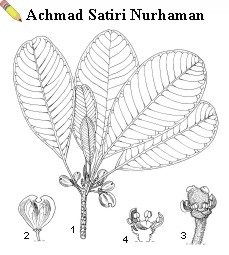 | Soulamea amara Lamk - 1, fruiting twig; 2, fruit; 3, flower; 4, flower in section [pistil removed] |
Other Botanical Information
Soulamea comprises 10 species, with 1 species endemic to the Seychelles, 1 endemic to Fiji, 7 species confined to New Caledonia and 1 widespread species (Soulamea amara). Soulamea amara is a littoral species, whereas all other species of the genus occur inland. Soulamea very much resembles Lunasia (Rutaceae) in habit.
Ecology
Soulamea amara is a typical constituent of the Barringtonia formation, which occurs specifically on sandy beaches and behind coral reefs. It is sometimes found as a scattered treelet more inland. Under the parent plants, seedlings may be found in great profusion. The fruits seem well adapted to dispersal by seawater.
Propagation and planting
Soulamea amara can be propagated easily by seed.
Harvesting
The fruits must be picked when they start to yellow or blacken, since they become less medicinally effective after they have fallen. The roots can be harvested when needed.
Genetic Resources and Breeding
As Soulamea amara is a widespread species, the risk of genetic erosion seems to be limited.
Prospects
In general, quassinoids are known to possess cytotoxic, antimalarial, and insecticidal activities. Although their use as such is often limited by their cytotoxic potential, quassinoids found in Soulamea, including Soulamea amara, might be interesting lead compounds in research and development of future antimalarial or chemotherapeutic agents.
Literature
Arisawa, M., Handa, S.S., McPherson, D.D., Lankin, D.C., Cordell, G.A., Fong, H.H.S. & Farnsworth, N.R., 1984. Plant anticancer agents XXIX. Cleomiscosin A from Simaba multiflora, Soulamea soulameoides, and Matayba arborescens. Journal of Natural Products 47(2): 300—307.
Handa, S.S., Kinghorn, A.D., Cordell, G.A. & Farnsworth, N.R., 1983. Plant anticancer agents XXV. Constituents of Soulamea soulameoides. Journal of Natural Products 46(3): 359—364.
Klocke, J.A., Arisawa, M., Handa, S.S., Kinghorn, A.D., Cordell, G.A. & Farnsworth, N.R., 1985. Growth inhibitory, insecticidal and antifeedant effects of some antileukemic and cytotoxic quassinoids on two species of agricultural pests. Experientia 41(3): 379—382.
Kulip, J. & Wong, K.M., 1995. Simaroubaceae. In: Soepadmo, E. & Wong, K.M. (Editors): Tree flora of Sabah and Sarawak. Vol. 1. Sabah Forestry Department, Forest Research Institute Malaysia and Sarawak Forestry Department, Kepong, Malaysia. pp. 421—442.
Mai Van Tri, Polonsky, J., Merienne, C. & Sevenet, T., 1981. Soularubinone, a new antileukemic quassionoid from Soulamea tomentosa. Journal of Natural Products 44(3): 279—284.
Perry, L.M., 1980. Medicinal plants of East and Southeast Asia. Attributed properties and uses. MIT Press, Cambridge, Massachusetts, United States & London, United Kingdom. p. 390.
Handa, S.S., Kinghorn, A.D., Cordell, G.A. & Farnsworth, N.R., 1983. Plant anticancer agents XXV. Constituents of Soulamea soulameoides. Journal of Natural Products 46(3): 359—364.
Klocke, J.A., Arisawa, M., Handa, S.S., Kinghorn, A.D., Cordell, G.A. & Farnsworth, N.R., 1985. Growth inhibitory, insecticidal and antifeedant effects of some antileukemic and cytotoxic quassinoids on two species of agricultural pests. Experientia 41(3): 379—382.
Kulip, J. & Wong, K.M., 1995. Simaroubaceae. In: Soepadmo, E. & Wong, K.M. (Editors): Tree flora of Sabah and Sarawak. Vol. 1. Sabah Forestry Department, Forest Research Institute Malaysia and Sarawak Forestry Department, Kepong, Malaysia. pp. 421—442.
Mai Van Tri, Polonsky, J., Merienne, C. & Sevenet, T., 1981. Soularubinone, a new antileukemic quassionoid from Soulamea tomentosa. Journal of Natural Products 44(3): 279—284.
Perry, L.M., 1980. Medicinal plants of East and Southeast Asia. Attributed properties and uses. MIT Press, Cambridge, Massachusetts, United States & London, United Kingdom. p. 390.
Other Selected Sources
[110] Bhatnagar, S., Polonsky, J., Sevenet, T. & Prance, T., 1985. Isolation and structure of 15-O-benzoyl brocein D, a new quassinoid from Soulamea amara (X-ray analysis). Tetrahedron Letters 26(9): 1225—1228.
[135] Burkill, I.H., 1966. A dictionary of the economic products of the Malay Peninsula. Revised reprint. 2 volumes. Ministry of Agriculture and Co-operatives, Kuala Lumpur, Malaysia. Vol. 1 (A—H) pp. 1—1240, Vol. 2 (I—Z) pp. 1241—2444.
[304] Fernando, E.S., Gadek, P.A. & Quinn, C.J., 1995. Simaroubaceae, an artificial construct: evidence from rbcL sequence variation. American Journal of Botany 82(1): 92—103.
[407] Heyne, K., 1950. De nuttige planten van Indonesië [The useful plants of Indonesia]. 3rd Edition. 2 volumes. W. van Hoeve, 's-Gravenhage, the Netherlands/Bandung, Indonesia. 1660 + CCXLI pp.
[418] Holdsworth, D.K., 1977. Medicinal plants of Papua New Guinea. Technical Paper No 175. South Pacific Commission, Noumea, New Caledonia. 123 pp.
[746] Nooteboom, H.P., 1962. Simaroubaceae. In: van Steenis C.G.G.J. (Editor): Flora Malesiana. Series 1, Vol. 6. Wolters-Noordhoff, Groningen, the Netherlands. pp. 193—226.
[779] Peekel, P.G., 1984. Flora of the Bismarck Archipelago for naturalists. Kristen Press, Madang, Papua New Guinea. 638 pp.
[135] Burkill, I.H., 1966. A dictionary of the economic products of the Malay Peninsula. Revised reprint. 2 volumes. Ministry of Agriculture and Co-operatives, Kuala Lumpur, Malaysia. Vol. 1 (A—H) pp. 1—1240, Vol. 2 (I—Z) pp. 1241—2444.
[304] Fernando, E.S., Gadek, P.A. & Quinn, C.J., 1995. Simaroubaceae, an artificial construct: evidence from rbcL sequence variation. American Journal of Botany 82(1): 92—103.
[407] Heyne, K., 1950. De nuttige planten van Indonesië [The useful plants of Indonesia]. 3rd Edition. 2 volumes. W. van Hoeve, 's-Gravenhage, the Netherlands/Bandung, Indonesia. 1660 + CCXLI pp.
[418] Holdsworth, D.K., 1977. Medicinal plants of Papua New Guinea. Technical Paper No 175. South Pacific Commission, Noumea, New Caledonia. 123 pp.
[746] Nooteboom, H.P., 1962. Simaroubaceae. In: van Steenis C.G.G.J. (Editor): Flora Malesiana. Series 1, Vol. 6. Wolters-Noordhoff, Groningen, the Netherlands. pp. 193—226.
[779] Peekel, P.G., 1984. Flora of the Bismarck Archipelago for naturalists. Kristen Press, Madang, Papua New Guinea. 638 pp.
Author(s)
J.L.C.H. van Valkenburg
Correct Citation of this Article
van Valkenburg, J.L.C.H., 2001. Soulamea amara Lamk. In: van Valkenburg, J.L.C.H. and Bunyapraphatsara, N. (Editors): Plant Resources of South-East Asia No 12(2): Medicinal and poisonous plants 2. PROSEA Foundation, Bogor, Indonesia. Database record: prota4u.org/prosea

All texts are licensed under a Creative Commons Attribution-Noncommercial-Share Alike 3.0 Netherlands License
This license does not include the illustrations (Maps,drawings,pictures); these remain all under copyright.