Record Number
1348
PROSEA Handbook Number
12(2): Medicinal and poisonous plants 2
Taxon
Trianthema portulacastrum L.
Protologue
Sp. pl. 1: 223 (1753).
Family
AIZOACEAE
Chromosome Numbers
2n = 26, (36)
Synonyms
Trianthema monogyna L. (1767).
Vernacular Names
Horse purslane, carpetweed, giant pigweed (En). Pourpier courant (Fr). Indonesia: krokot, telekan (Java), krajep (Madura). Papua New Guinea: pih-suh. Philippines: toston (Tagalog), ngatug (Ilokano), ayam (Bisaya). Cambodia: chonkuëng' praëhs. Thailand: phakbia hin, phakkhom hin (central). Vietnam: c[or] tam kh[oo]i, d[af]n d[af]n.
Origin and Geographic Distribution
Trianthema portulacastrum is distributed throughout the tropics. In Malesia, it is found in Peninsular Malaysia, the Philippines, Java, Madura, Lesser Sunda Islands, the Moluccas, and Papua New Guinea.
Uses
The roots of Trianthema portulacastrum have cathartic and stomachic properties and in the Philippines, Thailand, India and Africa, they are used to relieve obstructions of the liver, and to relieve asthma and amenorrhoea. In Asia they are given as an emmenagogue, and in large doses as an abortifacient. The leaves are diuretic and applied in the treatment of oedema, jaundice, strangury and dropsy. A decoction of the herb is used as a vermifuge and is useful in rheumatism; it is considered an antidote to alcoholic poisoning. The fleshy nature of the leaves makes them suitable for use as a wound-dressing or poultice. In Nigeria the old leaves are used in a treatment against gonorrhoea, in Gabon the powdered herb is taken for venereal discharge.
In India, Vietnam and in Africa, the young tops and leaves are sometimes eaten, but may cause diarrhoea or paralysis. When used as fodder, they can produce similar effects. The seeds are harmful contaminants in food grains and other crop seeds. The plant has a potential value as a source of organic matter because it contains considerable amounts of nitrogen, potassium and phosphorus.
In India, Vietnam and in Africa, the young tops and leaves are sometimes eaten, but may cause diarrhoea or paralysis. When used as fodder, they can produce similar effects. The seeds are harmful contaminants in food grains and other crop seeds. The plant has a potential value as a source of organic matter because it contains considerable amounts of nitrogen, potassium and phosphorus.
Production and International Trade
Dried plants of Trianthema portulacastrum are only occasionally traded in local markets and by herbalists.
Properties
Trianthema portulacastrum contains the alkaloid trianthemine and the steroid ecdysterone. The flavonoid C-methylflavone has been isolated from the dichloromethane extract of the herb. The seeds contain 12.5% of a fatty oil, and the leaves contain carotene and oxalates.
Pharmacological investigations of extracts of Trianthema portulacastrum revealed effects on the liver. An ethanol extract of the aerial parts showed a significant reduction of CCl4-induced chronic hepatocellular damage of Swiss albino mice. A chloroform extract showed a significant reduction of diethylnitrosoamine-induced hepatocarcinogenesis in Sprague-Dawley rats. In particular the incidence, numerical preponderance, multiplicity and size distribution of visible pre-neoplastic nodules were reduced. An ethanol extract of the plant has also shown some effects on blood pressure of guinea-pigs and on their ileum.
Ecdysterone is a potential chemosterilant, and possesses moulting hormone activity, giving a full pupation-response for larvae of the housefly.
Trianthema portulacastrum also shows allelopathic effects on other weeds and crops including sorghum, pumpkin, eggplant, radish, several pulses and wheat, by inhibiting seed germination and vigour of seedlings. Interestingly, it is also autotoxic as plant extracts reduce its seed germination, shoot length and vigour.
Pharmacological investigations of extracts of Trianthema portulacastrum revealed effects on the liver. An ethanol extract of the aerial parts showed a significant reduction of CCl4-induced chronic hepatocellular damage of Swiss albino mice. A chloroform extract showed a significant reduction of diethylnitrosoamine-induced hepatocarcinogenesis in Sprague-Dawley rats. In particular the incidence, numerical preponderance, multiplicity and size distribution of visible pre-neoplastic nodules were reduced. An ethanol extract of the plant has also shown some effects on blood pressure of guinea-pigs and on their ileum.
Ecdysterone is a potential chemosterilant, and possesses moulting hormone activity, giving a full pupation-response for larvae of the housefly.
Trianthema portulacastrum also shows allelopathic effects on other weeds and crops including sorghum, pumpkin, eggplant, radish, several pulses and wheat, by inhibiting seed germination and vigour of seedlings. Interestingly, it is also autotoxic as plant extracts reduce its seed germination, shoot length and vigour.
Adulterations and Substitutes
Boerhavia diffusa L. (Nyctaginaceae) roots contain the alkaloid punarnavine and are used as an adulterant for the roots of Trianthema portulacastrum.
Description
An annual, succulent, prostrate or ascending herb, up to about 60 cm tall, often much branched, glabrous or finely pubescent, with a firm taproot; branches in the axils of the smaller leaf of the leaf-pair, alternating. Leaves opposite, ovate-obovate to obcordate-oblong, 1—5 cm x 0.5—4.5 cm, those of the same pair very unequal in size, margin entire, purple or green; petiole 4—30 mm long, dilated and sheathing at the base, pairwise connate into a funnel-shaped sheath; stipules small, 1 on each side on the petiole. Inflorescence a single flower in the leaf axils, the lower part hidden by the pouch. Flowers bisexual, actinomorphous; sepals (perianth) 5-lobed, tube fused with the petiolar sheath, with the 2 pointed bracteoles, and even with the stem, lobes obtuse with a long dorsal, subapical mucro, pale pink, rarely white, petals absent; stamens 10—25, filaments white, glabrous; ovary superior, turbinate, truncate, style 1.3 mm long, unilateral stigmatose throughout its length. Fruit a capsule, 5 mm x 3 mm, partly exserted from the persistent perianth, apex truncate, bilobed, operculum fleshy, indehiscent, basal part of capsule thin-walled. Seeds 2—8, reniform, 1.5—2.5 mm long, with faint wavy ribs, black. Seedling with epigeal germination.
Image
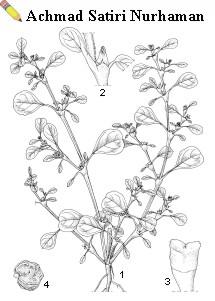 | Trianthema portulacastrum L. - 1, plant habit; 2, flower and secondary bract between petioles; 3, fruit, floral tube removed; 4, seed |
Growth and Development
In Trianthema portulacastrum the production of flowers and seeds starts 20—30 days after germination.
Other Botanical Information
Trianthema is a small genus of about 17 species, and is closely related to Sesuvium and Cypselea. These genera are thought to link the Aizoaceae to the Portulacaceae. The confusing generic limits between Trianthema and Sesuvium in Africa are resolved by re-establishment of the genus Zaleya, containing Zaleya decandra (L.) Burm.f., Zaleya pentandra (L.) Jeffrey and Zaleya sennii (Chiov.) Jeffrey. Zaleya decandra is a widespread weed, and in Africa, India and the Philippines, the leaves are eaten in times of scarcity. The root is used against hepatitis and asthma, and as an aperient. In Australia, Zaleya decandra is suspected of poisoning sheep, due to the triterpenes or steroids it contains. Trianthema and Sesuvium species exhibit structural adaptations of the leaves to xerophytic conditions.
Ecology
Trianthema portulacastrum is a common weed in fields and in open, sunny localities such as roadsides, often found on clayey soils near the sea, up to 200 m altitude. It is an aggressive weed, especially in Thailand, Australia and South America, and can be controlled either by uprooting the plants before flowering, or by spraying the herbicide Fernoxone.
Propagation and planting
Seeds of Trianthema portulacastrum germinate between 20°C and 45°C, with an optimum at 35°C. More than 50% of fresh seeds germinate within 4—8 days of incubation. When stored under field conditions, germination increases during 7—8 months. Optimum sowing depth is 1 cm.
Diseases and Pests
Trianthema portulacastrum is a host for aubergine mosaic virus, tobacco mosaic virus, rice tungro bacilliform virus, rice tungro spherical virus, cucumber mosaic virus and watermelon mosaic virus. It also has its own virus, Trianthema mosaic virus, which causes distinct necrotic lesions on the leaves, and also attacks several other weeds and tobacco. It is attacked by fungi such as Macrophomina phaseoli, causing dry root rot, and by Colletotrichum capsici, Fusarium semitectum, Drechslera sp. and Stemphylium sp., all of which cause leaf spot diseases.
Harvesting
Trianthema portulacastrum is collected from the wild whenever needed.
Genetic Resources and Breeding
Trianthema portulacastrum is extremely widespread and occurs in anthropogenic habitats, which means that there is little risk of genetic erosion. Much effort is made to eradicate it as a noxious weed, but it seems well able to survive since it is resistant to many herbicides.
Prospects
The anti-hepatotoxic effects of Trianthema portulacastrum extracts on the liver in jaundice and alcohol poisoning are interesting. These effects merit further research, as do those of the isolated ecdysterone as a chemosterilant in pest control.
Literature
Backer, C.A., 1951. Aizoaceae. In: van Steenis, C.G.G.J. (Editor): Flora Malesiana. Series 1, Vol. 4. Noordhoff-Kolff, Djakarta, Indonesia. pp. 267—275.
Balyan, R.S. & Bhan, V.M., 1986. Germination of horse purslane (Trianthema portulacastrum) in relation to temperature, storage conditions, and seeding depth. Weed Science 34(4): 513—515.
Bogle, A. L., 1970. The genera of Molluginaceae and Aizoaceae in the Southeastern United States. Journal of the Arnold Arboretum 51(4): 431—462.
Jeffrey, C., 1960. Notes on tropical African Aizoaceae. Kew Bulletin 14: 235—238.
Mandal, A., Karmakar, R., Bandyopadhyay, S. & Chatterjee, M., 1998. Antihepatotoxic potential of Trianthema portulacastrum in carbon tetrachloride-induced chronic hepatocellular injury in mice: reflexion in haematological, histological and biochemical characteristics. Archives of Pharmacological Research 21(3): 223—230.
Ravishankar, G.A. & Mehta, A.R., 1979. Control of ecdysterone biogenesis in tissue cultures of Trianthema portulacastrum (bioassay on the larvae of house-fly Musca domestica). Journal of Natural Products 42(2): 152—158.
Balyan, R.S. & Bhan, V.M., 1986. Germination of horse purslane (Trianthema portulacastrum) in relation to temperature, storage conditions, and seeding depth. Weed Science 34(4): 513—515.
Bogle, A. L., 1970. The genera of Molluginaceae and Aizoaceae in the Southeastern United States. Journal of the Arnold Arboretum 51(4): 431—462.
Jeffrey, C., 1960. Notes on tropical African Aizoaceae. Kew Bulletin 14: 235—238.
Mandal, A., Karmakar, R., Bandyopadhyay, S. & Chatterjee, M., 1998. Antihepatotoxic potential of Trianthema portulacastrum in carbon tetrachloride-induced chronic hepatocellular injury in mice: reflexion in haematological, histological and biochemical characteristics. Archives of Pharmacological Research 21(3): 223—230.
Ravishankar, G.A. & Mehta, A.R., 1979. Control of ecdysterone biogenesis in tissue cultures of Trianthema portulacastrum (bioassay on the larvae of house-fly Musca domestica). Journal of Natural Products 42(2): 152—158.
Other Selected Sources
[74] Backer, C.A. & Bakhuizen van den Brink Jr, R.C., 1964—1968. Flora of Java. 3 volumes. Noordhoff, Groningen, the Netherlands. Vol. 1 (1964) 647 pp., Vol. 2 (1965) 641 pp., Vol. 3 (1968) 761 pp.
[84] Banerjee, G. & Mukherjee, A., 1996. Trianthema portulacastrum L.: an overview. Journal of Living World 3(2): 11—19.
[111] Bhattacharya, S. & Chatterjee, M., 1999. Inhibitory effect of Trianthema portulacastrum L. diethylnitroso-amine-induced phenobarbital promoted hepatocarcinogenesis. Neoplasma 46(2): 105—111.
[215] Council of Scientific and Industrial Research, 1948—1976. The wealth of India: a dictionary of Indian raw materials & industrial products. 11 volumes. Publications and Information Directorate, New Delhi, India.
[312] Flore du Cambodge, du Laos et du Viêtnam [Flora of Cambodia, Laos and Vietnam](various editors), 1960—. Muséum National d'Histoire Naturelle, Paris, France.
[696] Morton, J.F., 1981. Atlas of medicinal plants of Middle America. Bahamas to Yucatan. Charles C. Thomas, Springfield, Illinois, United States. 1420 pp.
[788] Pételot, A., 1952—1954. Les plantes médicinales du Cambodge, du Laos et du Vietnam [The medicinal plants of Cambodia, Laos and Vietnam]. 4 volumes. Centre National de Recherches Scientifiques et Techniques, Saigon, Vietnam.
[937] Singh, S. & Verma, V.S., 1975. Mosaic disease of a medicinal plant: Trianthema portulacastrum. Pflanzenschutzberichte 45(1—3): 1—5.
[1043] Verma, V.S. & Singh, S., 1973. Trianthema portulacastrum - local lesion host for brinjal mosaic and tobacco mosaic viruses. Zentralblatt für Bakteriologie, Parasitenkunde, Infectionskrankheiten und Hygiene. Zweite Naturwissenschaftliche Abteilung: Allgemeine Landwirtschaftliche und Technische Mikrobiologie 128(3): 302—303.
[1116] Yulianto, Hasanuddin, A., Muhsin, M. & Somowijoyo, S., 1997. Identifikasi gulma sebagai inang alternatif virus tungro [Identification of weeds as alternative hosts of tungro virus]. Proceedings of the 14th Congress and National Seminar on Indonesian Phytopathological Society. Vol. 2: 155—159.
[84] Banerjee, G. & Mukherjee, A., 1996. Trianthema portulacastrum L.: an overview. Journal of Living World 3(2): 11—19.
[111] Bhattacharya, S. & Chatterjee, M., 1999. Inhibitory effect of Trianthema portulacastrum L. diethylnitroso-amine-induced phenobarbital promoted hepatocarcinogenesis. Neoplasma 46(2): 105—111.
[215] Council of Scientific and Industrial Research, 1948—1976. The wealth of India: a dictionary of Indian raw materials & industrial products. 11 volumes. Publications and Information Directorate, New Delhi, India.
[312] Flore du Cambodge, du Laos et du Viêtnam [Flora of Cambodia, Laos and Vietnam](various editors), 1960—. Muséum National d'Histoire Naturelle, Paris, France.
[696] Morton, J.F., 1981. Atlas of medicinal plants of Middle America. Bahamas to Yucatan. Charles C. Thomas, Springfield, Illinois, United States. 1420 pp.
[788] Pételot, A., 1952—1954. Les plantes médicinales du Cambodge, du Laos et du Vietnam [The medicinal plants of Cambodia, Laos and Vietnam]. 4 volumes. Centre National de Recherches Scientifiques et Techniques, Saigon, Vietnam.
[937] Singh, S. & Verma, V.S., 1975. Mosaic disease of a medicinal plant: Trianthema portulacastrum. Pflanzenschutzberichte 45(1—3): 1—5.
[1043] Verma, V.S. & Singh, S., 1973. Trianthema portulacastrum - local lesion host for brinjal mosaic and tobacco mosaic viruses. Zentralblatt für Bakteriologie, Parasitenkunde, Infectionskrankheiten und Hygiene. Zweite Naturwissenschaftliche Abteilung: Allgemeine Landwirtschaftliche und Technische Mikrobiologie 128(3): 302—303.
[1116] Yulianto, Hasanuddin, A., Muhsin, M. & Somowijoyo, S., 1997. Identifikasi gulma sebagai inang alternatif virus tungro [Identification of weeds as alternative hosts of tungro virus]. Proceedings of the 14th Congress and National Seminar on Indonesian Phytopathological Society. Vol. 2: 155—159.
Author(s)
N.O. Aguilar
Correct Citation of this Article
Aquilar, N.O., 2001. Trianthema portulacastrum L.. In: van Valkenburg, J.L.C.H. and Bunyapraphatsara, N. (Editors): Plant Resources of South-East Asia No 12(2): Medicinal and poisonous plants 2. PROSEA Foundation, Bogor, Indonesia. Database record: prota4u.org/prosea

All texts are licensed under a Creative Commons Attribution-Noncommercial-Share Alike 3.0 Netherlands License
This license does not include the illustrations (Maps,drawings,pictures); these remain all under copyright.