Record Number
1366
PROSEA Handbook Number
12(2): Medicinal and poisonous plants 2
Taxon
Urena lobata L.
Protologue
Sp. pl. 2: 692 (1753).
Family
MALVACEAE
Chromosome Numbers
2n = 28, 56
Vernacular Names
Congo jute, Aramina fibre (En). Indonesia: pangpulutan (Sundanese), pulutan (Javanese), pulut (Sumatra). Malaysia: pulut-pulut, pepulut, pulut lembu. Philippines: dalupang (Tagalog, Panay Bisaya, Pampangan), kulotan (Tagalog, Bisaya), saligut (Bontok). Papua New Guinea: haritapiraba (Uaripi, Gulf Province), kotokoto (Pokama, Central Province), Bitobito (Oroi, Central Province). Thailand: khamong dong (northern), po seng (peninsular), khee khrok (central). Vietnam: b[as]i l[uw][ow]ng, k[es] hoa d[af]o.
Origin and Geographic Distribution
Urena lobata is widely distributed as a weed in the tropics and subtropics of both hemispheres, including South-East Asia.
Uses
The leaves and roots of Urena lobata are mainly used. In Malaysia, Indo-China, the Philippines, Papua New Guinea, Fiji and Java, the juice of the leaves or roots is widely used for bowel complaints, especially colic, stomach-ache, diarrhoea and dysentery, and to treat gonorrhoea and persistent fever from malaria. The leaves are externally applied as a poultice on wounds and skin diseases as an emollient, a refrigerant and because of their styptic and healing properties. A decoction from the leaves and roots is drunk to relieve pains all over the body due to excessive exertion. An infusion of the roots is given to aid difficult childbirth. A lotion made from the plant is used to treat yaws and headache. In Burma (Myanmar), India and Malaysia, the roots are used to treat rheumatism and lumbago, while the twigs are chewed for toothache. In India, the root is popular as a diuretic, while the leaves are prescribed for inflammation of the intestines and bladder. In China and Fiji, the whole plant is macerated and used externally for treating fractures, wounds, mastitis and snake bites. A decoction of the root is used to treat colds, dysentery, enteritis, goitre, indigestion, leucorrhoea, malaria, rheumatism and tonsilitis. A decoction of a very old plant, boiled with eggs, is said to induce abortion. In Fiji, the roots are also chewed and applied to swellings caused by filariasis, while the bark is used to heal cuts. In Thailand, the leaves and stems are used as a diuretic, while the roots are taken for stomach-ache.
In India and Indo-China, the flowers are considered maturative and are taken in decoction as a pectoral and expectorant in dry coughs. An infusion of the flowers is used as a gargle for aphthae and a sore throat. In Malaysia, a decoction of the seeds is taken as a vermifuge.
Urena lobata is also widely used as a fibre, in tropical Africa, Madagascar, Cuba and Brazil. The seeds are used in Africa in stews, and in India for making soap, while the charcoal of the whole plant is used for blackening teeth. Like Sida rhombifolia L., Urena lobata is considered a magic plant, and is used in similar ways in healing rites, for protection and in wedding and rice ceremonies.
In India and Indo-China, the flowers are considered maturative and are taken in decoction as a pectoral and expectorant in dry coughs. An infusion of the flowers is used as a gargle for aphthae and a sore throat. In Malaysia, a decoction of the seeds is taken as a vermifuge.
Urena lobata is also widely used as a fibre, in tropical Africa, Madagascar, Cuba and Brazil. The seeds are used in Africa in stews, and in India for making soap, while the charcoal of the whole plant is used for blackening teeth. Like Sida rhombifolia L., Urena lobata is considered a magic plant, and is used in similar ways in healing rites, for protection and in wedding and rice ceremonies.
Production and International Trade
Urena lobata is used for medicinal purposes and traded at a local level only. In Peninsular Malaysia, the Chinese herbalists keep the plant in stock.
Properties
Very little is known about the phytochemistry and biological activities of extracts and isolated compounds of Urena lobata. The seeds contain about 7% of a fatty oil, which contains the fatty acids malvalic acid (2.4%), sterculic acid (42%), dihydromalvalic acid (0.5%) and dihydrosterculic acid (1.2%). The aerial parts contain the flavonol quercetin. Quercetin isolates also occur in Phyllanthus emblica L. (Euphorbiaceae) and have shown in vivo hepatoprotective activity in rats and mice. Urena lobata has also been reported as antipyretic, anti-inflammatory and antirheumatic.
Adulterations and Substitutes
The leaves of patchouli (Pogostemon cablin (Blanco) Benth.) have been used as a substitute for Urena lobata. The roots and leaves of Abutilon, Sida and Triumfetta in decoction are used as an emollient in the same way as those of Urena lobata.
Description
An annual, variable, erect, rarely ascendent undershrub, 0.5—2.5 m tall, stems covered with minute stellate hairs and scattered simple hairs, often tinged purple. Leaves alternate, simple, extremely variable in size and shape, suborbicular, ovate, oblong to lanceolate, 1—12 cm x 0.5—13 cm, more or less 3—5-lobed, base cordate to cuneate, apex acuminate, margins serrate to crenate, 3—9-veined, surfaces hairy, with a nectary on base of midrib beneath; petiole 0.5—12 cm long; stipules lanceolate to obovate, 2—4 mm long, acute, caducous. Inflorescence composed of axillary flowers, solitary or in clusters of 2—3, in the upper part seemingly in spikes. Flowers 5-merous, campanulate, 2—3 cm in diameter, pink with a purple centre, epicalyx 7—8 mm long, enveloping the calyx, segments 5, lanceolate, hairy; calyx tubular to campanulate, 5—6 mm x 1.5—2 mm, at 1/3 from the base of the ribs, thickened or with a nectary; petals obovate, apex rounded; staminal column 10—14 mm long, usually curved, anthers purple, pollen white; style arms 10, each 1 mm long, stigmas dark purple. Fruit a subglobular schizocarp, composed of 5 mericarps, 4—5 mm long, covered with barbed bristles. Seed reniform, 2.5—3.5 mm long, minutely hairy to glabrous, brown. Seedling with epigeal germination.
Image
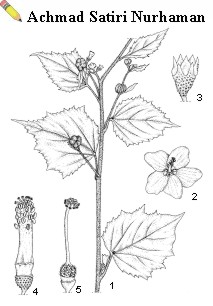 | Urena lobata L. - 1, flowering and fruiting branch; 2, flower; 3, epicalyx with calyx; 4, staminal column with pistil; 5, pistil |
Growth and Development
Urena lobata is a fast grower, and does not branch much when planted close together. It is a short-day plant, flowering starts 4—6 months after sowing, depending on the sowing time, while most viable seed is produced 1—2 months after flowering. The flowers open early in the morning and wither about noon. The nectaries are visited frequently by ants, aphids and various Hymenoptera.
Other Botanical Information
The taxonomy of Urena has not yet been settled. Some authors consider it a genus with 1 polymorphic species only, Urena lobata; others recognize 3 more species. Urena is morphologically very close to Pavonia, which has mericarp bristles that are not barbed, or with 3 hairy awns, and leaves normally without nectaries. It is argued by several authors that the two genera should be merged. Two subspecies have been distinguished in Urena, subsp. lobata, a stout plant with many ovate leaves, lower leaves shallowly lobed, and with a stiff, cupular epicalyx in fruit, segments long-triangular, 4.5 mm long, especially occurring above 400 m altitude, and subsp. sinuata (L.) Borss. Waalk., with lower leaves angular to palmately lobed or deeper incised, and a spreading, flexible epicalyx in fruit, segments linear, 3 mm long, especially occurring below 400 m altitude.
Ecology
Urena lobata is common on roadsides, in waste places, fallow fields, plantations, secondary growths, teak-forests, from sea-level up to 2000 m altitude, in many locations naturalized as a noxious weed.
Propagation and planting
Urena lobata is propagated by seed. Germination can be considerably improved by scarifying the seeds with concentrated sulphuric acid and then washing in running water. It is sown for fibre production at the beginning of the rainy season, up to 2 cm deep. In India, the crop requires 120—150 days to attain maturity.
Diseases and Pests
Urena lobata is a host for cotton stainer bugs (Dysdercus superstitious and Dysdercus voelkeri), cotton spotted bollworm (Earias fabia) and in Thailand it is also attacked by the leaf-sucker Haedus vicarius. Urena lobata is also a host for the okra mosaic virus.
Harvesting
Urena lobata plants, including the roots, can be harvested all year round.
Handling After Harvest
The plants of Urena lobata are washed and then used fresh or dried. They are cut into smaller pieces before being used. Proper drying is necessary before being kept in stock.
Genetic Resources and Breeding
Urena lobata is widespread in anthropogenic habitats, and especially the size and shape of the leaves is very variable, suggesting a broad genetic variability. Breeding programmes, in India and Brazil, focus on fibre production. Some small germplasm collections exist in Bangladesh and the United States.
Prospects
Urena lobata will remain of local importance only. Far more research is needed in order to evaluate its possible medicinal prospects.
Literature
Burkill, I.H., 1966. A dictionary of the economic products of the Malay Peninsula. Revised reprint. Vol. 2. Ministry of Agriculture and Co-operatives, Kuala Lumpur, Malaysia. pp. 2250—2251.
Harris, P.J.C., 1985. Seed production of Urena lobata (Congo jute) in Sierra Leone: effect of harvest date on yield. Tropical Agriculture (Trinidad and Tobago) 62(3): 229—232.
Kittur, M.H., Mahajanshetti, C.S. & Laksminarayana, G., 1993. Characteristics and composition of Trichosanthes bracteata, Urena sinuata and Capparis divaricata seeds and oils. Journal of the Oil Technologists= Association of India 25(2): 39—41.
Pételot, A., 1952. Les plantes médicinales du Cambodge, du Laos et du Vietnam [The medicinal plants of Cambodia, Laos and Vietnam]. Vol. 1. Centre National de Recherches Scientifiques et Techniques, Saigon, Vietnam. p. 106.
Pushparajan, G., Kuriachan, P.I. & Ninan, C.A., 1989. Intraspecific hybrid generations in Urena lobata L. with a note on the taxonomy of the species. Proceedings of the Indian Academy of Sciences, Plant Sciences 99(2): 127—130.
Van Borssum Waalkes, J., 1966. Malesian Malvaceae revised. Blumea 14(1): 1—251.
Harris, P.J.C., 1985. Seed production of Urena lobata (Congo jute) in Sierra Leone: effect of harvest date on yield. Tropical Agriculture (Trinidad and Tobago) 62(3): 229—232.
Kittur, M.H., Mahajanshetti, C.S. & Laksminarayana, G., 1993. Characteristics and composition of Trichosanthes bracteata, Urena sinuata and Capparis divaricata seeds and oils. Journal of the Oil Technologists= Association of India 25(2): 39—41.
Pételot, A., 1952. Les plantes médicinales du Cambodge, du Laos et du Vietnam [The medicinal plants of Cambodia, Laos and Vietnam]. Vol. 1. Centre National de Recherches Scientifiques et Techniques, Saigon, Vietnam. p. 106.
Pushparajan, G., Kuriachan, P.I. & Ninan, C.A., 1989. Intraspecific hybrid generations in Urena lobata L. with a note on the taxonomy of the species. Proceedings of the Indian Academy of Sciences, Plant Sciences 99(2): 127—130.
Van Borssum Waalkes, J., 1966. Malesian Malvaceae revised. Blumea 14(1): 1—251.
Other Selected Sources
[143] Cambie, R.C. & Ash, J., 1994. Fijian medicinal plants. Commonwealth Scientific and Industrial Research Organisation, Canberra, Australia. 350 pp.
[215] Council of Scientific and Industrial Research, 1948—1976. The wealth of India: a dictionary of Indian raw materials & industrial products. 11 volumes. Publications and Information Directorate, New Delhi, India.
[739] Nguyen Van Duong, 1993. Medicinal plants of Vietnam, Cambodia and Laos. Mekong Printing, Santa Ana, California, United States. 528 pp.
[786] Perry, L.M., 1980. Medicinal plants of East and Southeast Asia. Attributed properties and uses. MIT Press, Cambridge, Massachusetts, United States & London, United Kingdom. 620 pp.
[810] Quisumbing, E., 1978. Medicinal plants of the Philippines. Katha Publishing Co., Quezon City, the Philippines. 1262 pp.
[1071] Wijayakusuma, H.M.H., Wirian, A.S., Yaputra, T., Dalimartha, S. & Wibowo, B., 1992. Tanaman berkhasiat obat di Indonesia [Medicinal plants in Indonesia]. Vol. 1. Pustaka Kartini, Jakarta, Indonesia. 122 pp.
[215] Council of Scientific and Industrial Research, 1948—1976. The wealth of India: a dictionary of Indian raw materials & industrial products. 11 volumes. Publications and Information Directorate, New Delhi, India.
[739] Nguyen Van Duong, 1993. Medicinal plants of Vietnam, Cambodia and Laos. Mekong Printing, Santa Ana, California, United States. 528 pp.
[786] Perry, L.M., 1980. Medicinal plants of East and Southeast Asia. Attributed properties and uses. MIT Press, Cambridge, Massachusetts, United States & London, United Kingdom. 620 pp.
[810] Quisumbing, E., 1978. Medicinal plants of the Philippines. Katha Publishing Co., Quezon City, the Philippines. 1262 pp.
[1071] Wijayakusuma, H.M.H., Wirian, A.S., Yaputra, T., Dalimartha, S. & Wibowo, B., 1992. Tanaman berkhasiat obat di Indonesia [Medicinal plants in Indonesia]. Vol. 1. Pustaka Kartini, Jakarta, Indonesia. 122 pp.
Author(s)
H.C. Ong
Correct Citation of this Article
Ong, H.C., 2001. Urena lobata L.. In: van Valkenburg, J.L.C.H. and Bunyapraphatsara, N. (Editors): Plant Resources of South-East Asia No 12(2): Medicinal and poisonous plants 2. PROSEA Foundation, Bogor, Indonesia. Database record: prota4u.org/prosea

All texts are licensed under a Creative Commons Attribution-Noncommercial-Share Alike 3.0 Netherlands License
This license does not include the illustrations (Maps,drawings,pictures); these remain all under copyright.