Record Number
1394
PROSEA Handbook Number
3: Dye and tannin-producing plants
Taxon
Caesalpinia L.
Protologue
Sp. Pl. 1: 380 (1753).
Family
LEGUMINOSAE
Chromosome Numbers
x = 11, 12; 2n = 22: Caesalpinia decapetala; 2n = 24: Caesalpinia coriaria
Major Taxa and Synonyms
Major species and synonyms
— Caesalpinia coriaria (Jacq.) Willd., Sp. Pl. 4th ed., Vol. 2(1): 532 (1799).
— Caesalpinia decapetala (Roth) Alston, Trimen, Handb. Fl. Ceylon 6 (suppl.): 89 (1931), synonyms: Caesalpinia sepiaria Roxb. (1832), Caesalpinia japonica Siebold & Zucc. (1845).
— Caesalpinia digyna Rottler, Ges. Naturf. Freunde Berlin Neue Schrift. 4: 200, tab. 3 (1803), synonym: Caesalpinia oleosperma Roxb. (1832).
— Caesalpinia sappan L., see separate treatment.
— Caesalpinia coriaria (Jacq.) Willd., Sp. Pl. 4th ed., Vol. 2(1): 532 (1799).
— Caesalpinia decapetala (Roth) Alston, Trimen, Handb. Fl. Ceylon 6 (suppl.): 89 (1931), synonyms: Caesalpinia sepiaria Roxb. (1832), Caesalpinia japonica Siebold & Zucc. (1845).
— Caesalpinia digyna Rottler, Ges. Naturf. Freunde Berlin Neue Schrift. 4: 200, tab. 3 (1803), synonym: Caesalpinia oleosperma Roxb. (1832).
— Caesalpinia sappan L., see separate treatment.
Vernacular Names
— Caesalpinia coriaria: divi-divi (general). Thailand: tan yong.
— Caesalpinia decapetala: Mysore thorn (En). Indonesia: areuy matahiyang gunung, secang lembut (Sundanese). Thailand: kamchai. Vietnam: vu'ôt hùm.
— Caesalpinia digyna: teri-pod plant (En). Burma: tari. Cambodia: khvaw bânla. Laos: kachaay. Thailand: kamchaai, khee raet. Vietnam: móc mèo xanh (Dông Nai).
— Caesalpinia decapetala: Mysore thorn (En). Indonesia: areuy matahiyang gunung, secang lembut (Sundanese). Thailand: kamchai. Vietnam: vu'ôt hùm.
— Caesalpinia digyna: teri-pod plant (En). Burma: tari. Cambodia: khvaw bânla. Laos: kachaay. Thailand: kamchaai, khee raet. Vietnam: móc mèo xanh (Dông Nai).
Origin and Geographic Distribution
The large genus Caesalpinia (about 200 species) is pantropical, the greater part of the species occurring in South and Central America, and about 30 species in Asia, indigenous, naturalized, or cultivated.
Caesalpinia coriaria is native to tropical America and the West Indies. It has been introduced and is cultivated in Pakistan, India, Sri Lanka, Burma, Thailand, and rarely in Malaysia and Indonesia (Java); it is also cultivated in Australia and in tropical East Africa.
Caesalpinia decapetala is found naturally in tropical to temperate regions in Asia, from the Himalayas south to Sri Lanka and Malesia, and north and east to China, Korea and Japan.
Caesalpinia digyna has a distribution comparable with the preceding species, but is not found further north than Hainan in China.
Caesalpinia coriaria is native to tropical America and the West Indies. It has been introduced and is cultivated in Pakistan, India, Sri Lanka, Burma, Thailand, and rarely in Malaysia and Indonesia (Java); it is also cultivated in Australia and in tropical East Africa.
Caesalpinia decapetala is found naturally in tropical to temperate regions in Asia, from the Himalayas south to Sri Lanka and Malesia, and north and east to China, Korea and Japan.
Caesalpinia digyna has a distribution comparable with the preceding species, but is not found further north than Hainan in China.
Uses
The pods of Caesalpinia coriaria and Caesalpinia digyna are very rich in tannin, and are used in the tanning industry. For tanning leather, the tan-stuff from the pods is generally used as a blend, mixed with other tanning materials. Divi-divi is often used in the rapid drum tannage of light leathers and in leather dressing. The pods can also serve to prepare a blackish or blueish dye and a black ink, and are sometimes employed as a mordanting agent. The wood is reported to contain a red dye. The bark of Caesalpinia decapetala has tanning properties.
All species are reported to be used medicinally: pods of Caesalpinia coriaria as antiperiodic and for dressing sores, the astringent root of Caesalpinia digyna to treat tuberculosis and diabetes, and the seeds of Caesalpinia decapetala as anthelmintic, antipyretic, analgesic and to treat dysentery and malaria.
The seeds of Caesalpinia digyna can serve as cattle feed, and moreover contain an oil which can be used in lamps. They are sometimes eaten after being roasted. Caesalpinia decapetala is sometimes cultivated as a hedge plant, Caesalpinia coriaria as a shade plant. The wood is rarely used.
All species are reported to be used medicinally: pods of Caesalpinia coriaria as antiperiodic and for dressing sores, the astringent root of Caesalpinia digyna to treat tuberculosis and diabetes, and the seeds of Caesalpinia decapetala as anthelmintic, antipyretic, analgesic and to treat dysentery and malaria.
The seeds of Caesalpinia digyna can serve as cattle feed, and moreover contain an oil which can be used in lamps. They are sometimes eaten after being roasted. Caesalpinia decapetala is sometimes cultivated as a hedge plant, Caesalpinia coriaria as a shade plant. The wood is rarely used.
Production and International Trade
Divi-divi has been used in Central America for many centuries as a tanning material. Commercial supplies of divi-divi pods were obtained almost entirely from tropical America with Venezuela and Colombia as the major suppliers. Recent figures are not available, but in the 1950s exports of dry fruits varied from 3000—10 000 t/year in Venezuela and from 1000—7500 t/year in Colombia. India was much less important as a producing country, exporting 150—400 t/year in the 1910s and 1920s. The largest consumers were the United States and Germany. The use of divi-divi as a tanning material has strongly declined since 1950 in favour of other vegetable materials and synthetic tan-stuffs. Caesalpinia decapetala and Caesalpinia digyna were always of local importance only.
Properties
The pods of Caesalpinia coriaria and Caesalpinia digyna contain very high percentages of tannin, 40—45% and 40—60% (de-seeded pods), respectively. The constitution of tannin from divi-divi pods and teri pods differs. Divi-divi contains gallotannin and the ellagitannin corilagin, whereas teri pods lack ellagitannin and are reported to contain mainly monodigalloyl glucose. The tanning properties are very similar. Divi-divi and teri extracts are liable to deteriorate rapidly, especially in hot climates. They produce a light-coloured leather, which is, however, easily affected by atmospheric conditions, being soft and spongy under damp conditions and lacking pliability under dry conditions. Fermentation takes place readily because of the large amount of sugars present; it often results in reddish stains in the leather. Because of these disadvantages when used alone, divi-divi is usually used in mixtures of tan-stuffs. The extracts closely resemble myrobalans from Terminalia spp. The character of the tannin in the bark of Caesalpinia decapetala is unknown.
When tested in ponds, the tannin from divi-divi pods showed algicidal activity.
The seeds of Caesalpinia digyna contain ca. 15% protein, 40% starch and 25% fat and are suitable for use as cattle feed in admixtures with other pulses. Seeds of Caesalpinia coriaria contain 5—9% oil.
In Caesalpinia coriaria aucubin compounds have been demonstrated; leucoanthocyanins have been demonstrated in Caesalpinia decapetala.
The wood of Caesalpinia coriaria is very hard, reddish-brown and provides a red dye.
When tested in ponds, the tannin from divi-divi pods showed algicidal activity.
The seeds of Caesalpinia digyna contain ca. 15% protein, 40% starch and 25% fat and are suitable for use as cattle feed in admixtures with other pulses. Seeds of Caesalpinia coriaria contain 5—9% oil.
In Caesalpinia coriaria aucubin compounds have been demonstrated; leucoanthocyanins have been demonstrated in Caesalpinia decapetala.
The wood of Caesalpinia coriaria is very hard, reddish-brown and provides a red dye.
Description
Climbers, shrubs or small to medium-sized trees, usually prickly. Leaves alternate, bipinnate, the rachis often prickly; leaflets opposite or alternate, sessile or petiolate. Flowers in axillary or terminal panicles or racemes, usually bisexual, 5-merous; sepals free, imbricate, usually unequal, the lowest one hood-shaped; petals free, unequal, the upper one different in shape and size; stamens 10, free, equal or alternately unequal, filaments hairy at base; pistil sessile or shortly stalked; ovary pubescent or glabrous, 1—10-ovulate; style slender; stigma funnel-shaped or bilobed. Pods dehiscent or indehiscent, thin or thick, winged or wingless, sometimes spiny or twisted or furrowed. Seeds orbicular, ellipsoid or reniform.
Caesalpinia coriaria is an unarmed, crooked and spreading tree, usually up to 10 m tall, but sometimes much larger. Pinnae in 3—9 pairs, leaflets in 12—28 pairs, oblong-linear, 4—9 mm x 1—2.5 mm, sessile, with black dots beneath. Flowers in short panicles, small, with petals 3—4 mm long, pale yellow. Pods flexuous and twisted, (2—)5—8 cm x 1—3 cm, pale to blackish-brown, 1—10 seeded.
Caesalpinia decapetala is a prickly, climbing or scandent shrub, up to 10 m tall. Pinnae in 4—15 pairs, leaflets in 5—12 pairs, oval-oblong, 8—25 mm x 3—10 mm, shortly petiolate. Flowers in long racemes, large, with petals 12—15 mm long, bright yellow. Pods oblong-elliptic, 6—10 cm x 2.5—3 cm, keeled or winged, and beaked, 4—8-seeded.
Caesalpinia digyna is a prickly climber or scandent shrub, 2—5 m tall. Pinnae in 8—13 pairs, leaflets in 6—12 pairs, oblong-elliptic, 5—13 mm x 2.5—5 mm, subsessile. Flowers in long racemes, fairly large, with petals 8—10 mm long, yellow. Pods oblong-elliptic, 3—6 cm x 1.5—2 cm, constricted between the seeds, (1—)2—3(—4)-seeded.
Caesalpinia coriaria is an unarmed, crooked and spreading tree, usually up to 10 m tall, but sometimes much larger. Pinnae in 3—9 pairs, leaflets in 12—28 pairs, oblong-linear, 4—9 mm x 1—2.5 mm, sessile, with black dots beneath. Flowers in short panicles, small, with petals 3—4 mm long, pale yellow. Pods flexuous and twisted, (2—)5—8 cm x 1—3 cm, pale to blackish-brown, 1—10 seeded.
Caesalpinia decapetala is a prickly, climbing or scandent shrub, up to 10 m tall. Pinnae in 4—15 pairs, leaflets in 5—12 pairs, oval-oblong, 8—25 mm x 3—10 mm, shortly petiolate. Flowers in long racemes, large, with petals 12—15 mm long, bright yellow. Pods oblong-elliptic, 6—10 cm x 2.5—3 cm, keeled or winged, and beaked, 4—8-seeded.
Caesalpinia digyna is a prickly climber or scandent shrub, 2—5 m tall. Pinnae in 8—13 pairs, leaflets in 6—12 pairs, oblong-elliptic, 5—13 mm x 2.5—5 mm, subsessile. Flowers in long racemes, fairly large, with petals 8—10 mm long, yellow. Pods oblong-elliptic, 3—6 cm x 1.5—2 cm, constricted between the seeds, (1—)2—3(—4)-seeded.
Image
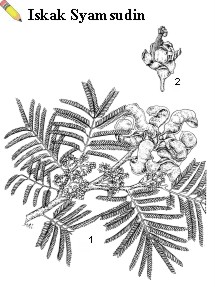 | Caesalpinia coriaria (Jacq.) Willd. — 1, flowering and fruiting branch; 2, flower |
Growth and Development
Divi-divi trees are relatively slow growing and generally commence flowering 5—7 years after sowing. Full crops of pods are produced after about 20 years. Because of their prickly and climbing characteristics, the other species are not cultivated except in hedges.
Other Botanical Information
Three other Caesalpinia species from South America, not cultivated in Asia, are used for tanning or dyeing. The pods of Caesalpinia spinosa (Molina) Kuntze (tara), and Caesalpinia brevifolia (Clos) Baillon (algarobilla) are used for tanning, the wood of Caesalpinia echinata Lamk (brazilwood) for dyeing paper, calico and other materials.
Ecology
Divi-divi tolerates a wide range of soil types and climates. It grows on rich clay soils and poor sandy soils with pH 4.5—8.7, and thrives in dry (warm) temperate climates to wet tropical climates, tolerating an annual precipitation of 600 mm up to over 4000 mm, and a mean annual temperature of 14.7—27.5°C. In natural conditions in Central and South America, it is found in semi-arid, open country. Under very moist tropical conditions trees are reported to yield less than under drier conditions. At higher altitudes they do not yield well either. Caesalpinia decapetala and Caesalpinia digyna are found in thickets, light forests and forest borders, in Indo-China up to 1200 m. In Indonesia Caesalpinia decapetala occurs in mountainous areas at altitudes of 1200—1700 m, Caesalpinia digyna in drier areas, up to 200 m.
Propagation and planting
Plants are propagated by seed. The seeds of teri-pod plant are very hard and must be scarified before sowing. In India, the seedlings of divi-divi are kept in the nursery for 9—15 months, and then transplanted into the field, usually at the beginning of the rainy season, at distances of 7—9 m. During the first two years, watering is necessary in the dry season. Mature trees require no care, and forage crops can be planted between the trees.
Diseases and Pests
Some fungi are known to attack divi-divi: Fomes lucidus, Micropeltis domingensis and Zignoella caesalpiniae. Stored seeds of Caesalpinia decapetala are reported to be attacked by beetles.
Harvesting
The pods of divi-divi are collected before or after they drop from the tree. Trees yield about 45—135 kg pods per year.
The prickles on the branches and twigs of teri-pod plant are a deterrent to the collection of the pods. Because of its prickly nature this plant has never been extensively cultivated, and pods are collected from wild plants.
The prickles on the branches and twigs of teri-pod plant are a deterrent to the collection of the pods. Because of its prickly nature this plant has never been extensively cultivated, and pods are collected from wild plants.
Handling After Harvest
Because divi-divi pods are curved, much space is needed for packing, which makes transport expensive. The pods are usually packed in fine mesh bags. The tannins can easily be extracted. They are mainly present in the white powdery tissue just below the epidermis of the pod, and this tissue is easily collected when the dry pods are ruptured. The powder has the drawback of being slightly hygroscopic and should be packed in sealed containers. It is susceptible to rapid deterioration. Fermentation can be minimized by the use of antiseptics.
In teri pods the seeds constitute a considerable proportion of the weight, and they should be removed because they contain little or no tannin.
In teri pods the seeds constitute a considerable proportion of the weight, and they should be removed because they contain little or no tannin.
Prospects
Teri-pod plant might be an interesting source of vegetable tannin on a larger scale. The species is indigenous in South-East Asia, the tannin is easily extracted and it has excellent tanning properties. The seeds are nutritious with a high protein and oil content. Research priorities should concentrate on the development of cultivation methods that make the collection of pods from the prickly plants less troublesome, and methods of mechanical removal of the seeds.
Literature
Bhatnagar, S.S. (Editor), 1950. The wealth of India. Raw materials. Vol. 2. Delhi. pp. 2—4.
Duke, J.A., 1981. Handbook of legumes of world economic importance. Plenum Press, New York and London. pp. 28—33.
Howes, F.N., 1962. Tanning materials. In: von Wiesner, J. (Editor): Die Rohstoffe des Pflanzenreichs. 5th ed. J. Cramer, Weinheim, Germany. pp. 219—224.
Larsen, K., Larsen, S.S. & Vidal, J.E., 1984. Leguminosae — Caesalpinioideae. In: Smitinand, T. & Larsen, K. (Editors): Flora of Thailand. Vol. 4(1). Bangkok, Thailand. pp. 67, 75.
Duke, J.A., 1981. Handbook of legumes of world economic importance. Plenum Press, New York and London. pp. 28—33.
Howes, F.N., 1962. Tanning materials. In: von Wiesner, J. (Editor): Die Rohstoffe des Pflanzenreichs. 5th ed. J. Cramer, Weinheim, Germany. pp. 219—224.
Larsen, K., Larsen, S.S. & Vidal, J.E., 1984. Leguminosae — Caesalpinioideae. In: Smitinand, T. & Larsen, K. (Editors): Flora of Thailand. Vol. 4(1). Bangkok, Thailand. pp. 67, 75.
Author(s)
T. Boonkerd, B. Na Songkhla & W. Thephuttee
Correct Citation of this Article
Boonkerd, T., Na Songkhla, B.. & Thephuttee, W., 1991. Caesalpinia L.. In: Lemmens, R.H.M.J. and Wulijarni-Soetjipto, N. (Editors): Plant Resources of South-East Asia No 3: Dye and tannin-producing plants. PROSEA Foundation, Bogor, Indonesia. Database record: prota4u.org/prosea

All texts are licensed under a Creative Commons Attribution-Noncommercial-Share Alike 3.0 Netherlands License
This license does not include the illustrations (Maps,drawings,pictures); these remain all under copyright.