Record Number
1398
PROSEA Handbook Number
3: Dye and tannin-producing plants
Taxon
Ceriops tagal (Perr.) C.B. Robinson
Protologue
Philip. J. Sci. Bot. 3: 306 (1908).
Family
RHIZOPHORACEAE
Chromosome Numbers
2n = 36
Synonyms
Ceriops candolleana Arn. (1838; as Ceriops candolliana).
Vernacular Names
Brunei: tengar. Indonesia: tengar (Sumba), tanggala tutu (Gorontalo), tingi (East Kutei, Java). Malaysia: tengar. Philippines: tangal (Tagalog, Bisaya), tongog (Bisaya), sambali-rongon (Ilokano). Singapore: tengar. Cambodia: smaè. Thailand: prong (Samut Sakhon, Chanthaburi), prong daeng (Samut Sakhon), samae (peninsular). Vietnam: dzà vôi, dzà dò.
Origin and Geographic Distribution
It is not known where this widespread and common species originated, but it is now found on coasts from East Africa to the Indian subcontinent, and thence through tropical Asia to Australia and the Pacific. It extends as far as Hong Kong, Taiwan, Yap and Palau in the north-western Pacific, and the Bismarck Archipelago, the Solomon Islands and northern New Caledonia in the south-western Pacific, with an eastern limit on Malakulu Island in the New Hebrides. However, fossils indicate that the species once had a greater range.
Ceriops tagal is commonly found along the coasts throughout South-East Asia.
Ceriops tagal is commonly found along the coasts throughout South-East Asia.
Uses
Its uses are similar to those for Ceriops decandra (Griffith) Ding Hou. The tannin is of high quality and frequently commands a good price, and the bark is therefore still important locally. Both bark and sap yield dyes (red and black respectively) which continue to be of importance to the 'batik' industry from Africa to the Pacific. In central Java the bark is still used in the traditional 'soga-batik'. The bark also serves to preserve and dye fishing nets and matting. The wood is used for tool handles and makes good firewood, but has been said to burn with too hot a flame for domestic use, damaging cooking pots. It makes excellent charcoal. An alcoholic beverage is obtained, illegally, from the bark, e.g. in Sabah. The tannin extract can be used as binder for particle board. The bark was locally used in traditional medicine in Peninsular Malaysia and Indonesia.
Properties
The tannin content of the bark can vary considerably, from 20% to over 40%, a common and notable feature of mangrove barks. The leaves contain less tannin, about 15%. In India, solid block extracts containing 68% tannin and 15% moisture, and powder extracts containing 75% tannin and 5% moisture, have been prepared for use in the tanning industry.
Dyeing with the bark gives brown colours; if combined with indigo, shades of black and purple are obtained.
The sapwood is usually poorly defined, the heartwood is orange when freshly cut, but turns yellowish-brown or sometimes even red on exposure. The wood is heavy with an average air-dried weight of 960 kg/m3. It is moderately durable but in contact with the ground it decays in about 2 years. The timber is not resistant to marine borers. Seasoned wood is comparatively resistant to splitting on shock and it is thus suitable for tool handles. Anatomically the wood tends to be diffuse porous, with more and smaller vessels than in other mangrove Rhizophoraceae. The conductive elements are set in expanses of mechanical tissue with scanty parenchyma. The vessels have scalariform perforation plates in common with other representatives of the family.
Dyeing with the bark gives brown colours; if combined with indigo, shades of black and purple are obtained.
The sapwood is usually poorly defined, the heartwood is orange when freshly cut, but turns yellowish-brown or sometimes even red on exposure. The wood is heavy with an average air-dried weight of 960 kg/m3. It is moderately durable but in contact with the ground it decays in about 2 years. The timber is not resistant to marine borers. Seasoned wood is comparatively resistant to splitting on shock and it is thus suitable for tool handles. Anatomically the wood tends to be diffuse porous, with more and smaller vessels than in other mangrove Rhizophoraceae. The conductive elements are set in expanses of mechanical tissue with scanty parenchyma. The vessels have scalariform perforation plates in common with other representatives of the family.
Description
A tree of variable form, attaining exceptionally a height of 40 m and a diameter of the trunk of 40 cm with a slender stem and a compact crown in favourable sites, but in poorer conditions a tree of small dimensions or even shrub-like; stem base usually surrounded by a tightly appressed conical cluster of short stilt roots; roots superficial, spreading, with looping or knobby pneumatophores in wet situations, but some deeply descending roots may develop from the stem base; bark varying from white and pale grey to reddish-brown, deeply fissured in older specimens; branches conspicuously jointed. Leaves opposite, clustered at the end of the twigs, coriaceous, obovate to obovate-oblong, rarely elliptic-oblong, 5—12 cm x 2—7.5 cm, cuneate at base, obtuse or slightly emarginate at apex, glabrous and glossy; petiole 1.5—3.5 cm long, with 1—2.5 cm long deciduous stipules at base. Flowers in condensed up to 10-flowered cymes on the terminal nodes of new shoots, 5—6—merous, 3—5 mm long, with deeply lobed calyx and white, ca. 3.5 mm long petals, coherent at base and with 3 clavate, apical appendages; stamens twice the number of calyx lobes, anthers much shorter than filaments, explosively dehiscent; ovary semi-inferior, 3-celled. Fruit an ovoid berry 1.5—2.5 cm long, with persistent reflexed calyx lobes, pointed basally, warty over its whole length. Seeds viviparous. Hypocotyl club-shaped, protruding below the fruit while this is still attached to the tree, 15—25(—35) cm long, often deeply fluted.
Image
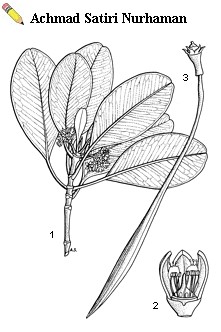 | Ceriops tagal (Perr.) C.B. Robinson - 1, flowering branch; 2, flower with front sepals and petals removed; 3, fruit with protruding hypocotyl |
Growth and Development
Similar to that of Ceriops decandra, except that the seedlings are more robust.
Ecology
Although Ceriopstagal reaches its greatest stature in forests in aseasonal high rainfall regions, it is more important ecologically, where seasonal climates prevail. Typically it occupies sites from the middle to the landward zones of mangrove forests, and may be flooded either by all normal high tides, or only by occasional high tides. It may become dominant in well drained zones, and forms dense low-canopied pure stands along the landward boundaries of some mangrove swamps, where the soil surface may become dry and cracked. However, these belts of Ceriops tagal become open and stunted where salinity is high and in extreme situations the trees give way to open herbaceous areas or to bare saline mudflats.
In most areas, Ceriops tagal is much more common than Ceriops decandra.
In most areas, Ceriops tagal is much more common than Ceriops decandra.
Propagation and planting
In reforestation projects establishment rates approaching 100% have been achieved. Unlike other Rhizophoraceae, the propagules (seedlings) are small and delicate, and must therefore be collected and transported to the replanting sites with care. They will not tolerate excessive desiccation. However, they are easily heeled in and become established very quickly.
Diseases and Pests
Ceriops trees are attacked by some mistletoes. The high tannin content discourages many herbivores, but crabs eat the seedlings, and whereas the magnitude of crab depredations is not immediately apparent in undisturbed forests, it becomes clear if seedlings are planted to reforest clear-felled areas. Then, in some cases, the intensity of crab browsing is, or becomes, so great that entire plantings are destroyed and the forest cannot regenerate. In older plantations monkeys cause minor damage by uprooting seedlings.
Handling After Harvest
In central Java the fine 'soga-batik' is still made using vegetable dyes, although on a small scale. The bark of Ceriops tagal, usually called 'tingi', is one of the ingredients of the dye, together with the wood of Maclura cochinchinensis (Lour.) Corner and the bark of Peltophorum pterocarpum (DC.) Backer ex K. Heyne. Depending on various proportions of the ingredients, cotton cloth is dyed yellowish to brownish shades in traditional patterns, in a process which often takes several weeks. After the dyeing process, a fixing-bath containing lime, sugar, and traditionally also alum and flower buds of Sophora japonica L., is necessary to make the colours more fast and bright.
Using this dyeing process, warm yellowish-brown colours, gradually shading off into one another, are given to the cotton cloth. These effects cannot be achieved when using synthetic dyes.
Using this dyeing process, warm yellowish-brown colours, gradually shading off into one another, are given to the cotton cloth. These effects cannot be achieved when using synthetic dyes.
Prospects
In many parts of South-East Asia, the area of mangrove forest has decreased, largely because of large-scale exploitation for firewood, charcoal, timber, and dyeing and tanning materials. Little reafforestation has been done in most of the areas where naturally occurring mangroves have been exploited. However, Ceriops and many other mangrove trees can be propagated easily, and the seedlings usually grow well without much care. Cutting and management of mangrove should be well-planned.
Literature
Bhatnagar, S.S. (Editor), 1950. The wealth of India. Raw materials. Vol. 2. Delhi. p. 124.
Hou, D., 1958. Rhizophoraceae. In: van Steenis, C.G.G.J. (Editor): Flora Malesiana, Series 1. Vol. 5. pp. 469—470, fig. 24 a—e.
Percival, M. & Womersley, J.S., 1975. Floristics and ecology of the mangrove vegetation of Papua New Guinea. Botany Bulletin No 8, Department of Forests, Division of Botany, Lae, New Guinea.
Sukardjo, S. & Akhmad, S., 1982. The mangrove forests of Java and Bali (Indonesia). Biotrop Special Publication No 17. pp. 113—126.
Hou, D., 1958. Rhizophoraceae. In: van Steenis, C.G.G.J. (Editor): Flora Malesiana, Series 1. Vol. 5. pp. 469—470, fig. 24 a—e.
Percival, M. & Womersley, J.S., 1975. Floristics and ecology of the mangrove vegetation of Papua New Guinea. Botany Bulletin No 8, Department of Forests, Division of Botany, Lae, New Guinea.
Sukardjo, S. & Akhmad, S., 1982. The mangrove forests of Java and Bali (Indonesia). Biotrop Special Publication No 17. pp. 113—126.
Author(s)
R.H. Hughes & S. Sukardjo
Correct Citation of this Article
Hughes, R.H. & Sukardjo, S., 1991. Ceriops tagal (Perr.) C.B. Robinson. In: Lemmens, R.H.M.J. and Wulijarni-Soetjipto, N. (Editors): Plant Resources of South-East Asia No 3: Dye and tannin-producing plants. PROSEA Foundation, Bogor, Indonesia. Database record: prota4u.org/prosea

All texts are licensed under a Creative Commons Attribution-Noncommercial-Share Alike 3.0 Netherlands License
This license does not include the illustrations (Maps,drawings,pictures); these remain all under copyright.