Record Number
1407
PROSEA Handbook Number
3: Dye and tannin-producing plants
Taxon
Impatiens balsamina L.
Protologue
Sp. Pl. 2: 938 (1753).
Family
BALSAMINACEAE
Chromosome Numbers
2n = 14 (+ 2B), but also recorded as 12, 18, 20, 24
Synonyms
Impatiens cornuta L. (1753).
Vernacular Names
Garden balsam, garden balsamine (En). Balsamine des jardins (Fr). Indonesia: pacar air (general), pacar banyu (Javanese), paru inai (Minangkabau). Malaysia: bungatabo, inai ayer, laka kecil. Philippines: kamantigi (Tagalog, Ilokano), solonga (Bisaya). Burma: dau dalet. Thailand: thian dok, thian baan, thian suan (central). Vietnam: moc tai, bông mong tay (southern), nac ne'.
Origin and Geographic Distribution
Garden balsam is a native of India and parts of mainland South-East Asia. It is widely cultivated and often naturalized in tropical and subtropical regions; it is also cultivated in temperate regions. Throughout South-East Asia it is commonly grown in gardens.
Uses
The flowers are used to prepare a red dye for finger nails, as a substitute for henna (Lawsonia inermis L.). Because of its large and usually red flowers, garden balsam is commonly cultivated as an ornamental in gardens. It has several medicinal uses. Leaves and sometimes roots are used in poultices for wounds, skin diseases, pustules, torn nails, and felons. Flowers have fungicidal and possibly also bactericidal properties, and are said to be effective in cases of lumbago, intercostal neuralgia and as haemostatic. The seeds are edible, and contain oil which can be used for burning lamps and in the surface-coating industry. In Bali (Indonesia) the leaves are eaten. In China, the flowers are used as a cosmetic just like henna flowers.
Properties
The flowers of garden balsam contain the same dyeing agent as henna, lawsone or 2-hydroxy-1,4-naphthaquinone, which explains the matching uses. Also present is 2-methoxy-1,4-naphthaquinone (lawsone-methylether) which possesses fungicidal properties. The pigments in the flowers have been investigated extensively, and include leucoanthocyanins, anthocyanins and flavonols. The seeds contain 18—27% of a greenish, viscous oil, largely consisting of parinaric acid (29%) and linolenic acid (30%). The seeds contain about 16% protein and no starch.
Botany
An annual herb, 15—60(—80) cm tall. Stems erect, simple or sparsely branched, with swollen joints, glabrous, or pubescent when young. Leaves arranged spirally, but lower leaves occasionally opposite, (narrowly) lanceolate to narrowly elliptic, 3—10(—15) cm x 1.5—3 cm, cuneate at base, acute at apex, serrate, glabrous, and sessile or shortly petiolate. Flowers 1—3 together in leaf-axils, red, purple, white or variegated, variable in size, up to 3.5 cm long, with slender pedicels; sepals 3, the lowest one larger, petaloid, funnel-shaped and spurred; petals 5, seemingly 3, the upper one free and long-mucronate at apex, the other 4 pairwise connate; stamens 5, fused in the upper half; ovary superior, densely pubescent. Fruit a fleshy 4—5-valved capsule, explosively dehiscent, broadly fusiform, 12—20 mm x 6—8 mm, densely pubescent.
Garden balsam is a very variable species, particularly in the size of leaves and flowers. Many varieties and cultivars have been recognized. Double-flowered plants and dwarf forms have been selected for ornamental purposes.
Garden balsam is a very variable species, particularly in the size of leaves and flowers. Many varieties and cultivars have been recognized. Double-flowered plants and dwarf forms have been selected for ornamental purposes.
Image
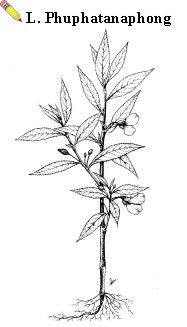 | Impatiens balsamina L. - flowering and fruiting plant |
Ecology
Garden balsam is found naturally from sea-level to 1250 m altitude on wet, rather open places or as forest undergrowth. In cultivation it thrives best in rich, loose soil with water freely available. In the tropics it usually flowers all the year round.
Agronomy
Plants are easily propagated from seed. Seedlings are raised in the nursery. A mixture of coconut dust, coarse sand, and clayey soil in the ratio of 3:1:1 is recommended as potting material, applied with 50 g of castor meal and 20 g of fertilizer per pot. Garden balsam is susceptible to powdery mildew, often caused by Sphaerotheca fuliginea.
Literature
Backer, C.A. & Bakhuizen van den Brink, R.C., 1963. Flora of Java. Vol. 1. Noordhoff, Groningen, the Netherlands. p. 249.
Grey-Wilson, C., 1985. Balsaminaceae. In: Dassanayake, M.D. & Fosberg, F.R. (Editors): A revised handbook to the Flora of Ceylon. Vol. 5. Smithsonian Institution, Washington D.C. pp. 117—118.
Lipiphan, W., 1983. Antimicrobial activities of extracts from medicinal plants. Thai Journal of Pharmaceutical Sciences 8(1): 21—32.
Sastri, B.N. (Editor), 1959. The wealth of India. Raw materials. Vol. 5. Council of Scientific and Industrial Research, New Delhi. pp. 167—168.
Grey-Wilson, C., 1985. Balsaminaceae. In: Dassanayake, M.D. & Fosberg, F.R. (Editors): A revised handbook to the Flora of Ceylon. Vol. 5. Smithsonian Institution, Washington D.C. pp. 117—118.
Lipiphan, W., 1983. Antimicrobial activities of extracts from medicinal plants. Thai Journal of Pharmaceutical Sciences 8(1): 21—32.
Sastri, B.N. (Editor), 1959. The wealth of India. Raw materials. Vol. 5. Council of Scientific and Industrial Research, New Delhi. pp. 167—168.
Author(s)
L. Phuphathanaphong
Correct Citation of this Article
Phuphathanaphong, L., 1991. Impatiens balsamina L.. In: Lemmens, R.H.M.J. and Wulijarni-Soetjipto, N. (Editors): Plant Resources of South-East Asia No 3: Dye and tannin-producing plants. PROSEA Foundation, Bogor, Indonesia. Database record: prota4u.org/prosea

All texts are licensed under a Creative Commons Attribution-Noncommercial-Share Alike 3.0 Netherlands License
This license does not include the illustrations (Maps,drawings,pictures); these remain all under copyright.