Record Number
1849
PROSEA Handbook Number
4: Forages
Taxon
Calliandra calothyrsus Meissn.
Protologue
Linnaea 21: 251 (1848).
Family
LEGUMINOSAE
Chromosome Numbers
2n = 22
Synonyms
Calliandra confusa Sprague & Riley (1923).
Vernacular Names
Calliandra (En).
Origin and Geographic Distribution
Although originally described from Surinam, Calliandra calothyrsus is native in humid and sub-humid Central America from southern Mexico to north-western Panama, between 8—16°N. From Guatemala it was introduced into Java in 1936. During the 1970s it became well established in Indonesia, with over 30 000 ha of plantations. In view of its excellent performance in Indonesian plantations and its multiple uses, it is now being planted in many other countries of South-East Asia and to a lesser extent in other tropical areas.
Uses
Calliandra is used as a high quality protein leaf crop to supplement low quality forages and crop residues. Only the leaves and young stems are used for fodder. In Indonesia calliandra is primarily used for fuelwood for households and small industries. The wood can also be used for pulp and paper production but its small dimensions make handling and chipping difficult. It is widely planted to control erosion on sloping lands and ravines. It is used to improve soils by nitrogen fixation and good litter production by cultivating it in rotation with arable crops. It is also incorporated in alley-cropping systems as a source of green manure, or used as a nurse tree for partially shade-tolerant timber species. Calliandra is also planted in firebreaks. Its beautiful red flower clusters make it a popular ornamental, and the flowers are a good nectar source for bees. It is a suitable host for shellac insects (Kerria lacca). It has shown promise as an understorey in coconut plantations with about 60% light transmission.
Properties
Calliandra leaves contain (DM based): N 3—3.5%, fibre 30—75%, ash 4—5% and fat 2—3%. No toxic substances have been reported, but high concentrations of condensed tannins (up to 11%) are responsible for the rather low in vitro digestibility of 35—40%. The wide range of recorded tannin contents may reflect differences in analytical procedures as much as variation due to growth stage and environment. The digestibility data should also be treated with caution, as when dried, material with a high tannin content can have a marked effect on digestibility and intake by animals. There is increasing evidence that wilted or dried material is less acceptable to animals than fresh material. There are 14—19 seeds/g.
The wood of calliandra is moderately heavy, volumic mass 510—780 kg/m3, strong and easy to saw. It provides good fuelwood (massic energy 18 900—19 950 kJ/kg) and is suitable for charcoal production. Cellulose content varies from 44—56%, fibre length from 0.66—0.84 mm, extractive material 3% DM.
The wood of calliandra is moderately heavy, volumic mass 510—780 kg/m3, strong and easy to saw. It provides good fuelwood (massic energy 18 900—19 950 kJ/kg) and is suitable for charcoal production. Cellulose content varies from 44—56%, fibre length from 0.66—0.84 mm, extractive material 3% DM.
Description
Shrub or small tree, (1.5—)4—6(—12) m tall, with trunk diameter up to 30 cm, blackish-brown bark and a dense canopy. Leaves bipinnate, alternate, rachis 10—17 cm long, without glands, pinnae 4—7 cm long in 15—20 pairs with 25—60 pairs of dark green leaflets each; leaflets linear, 5—8 mm x 1 mm. Inflorescences composed of few to many flowered heads, in terminal raceme-like clusters of 10—30 cm length. Flower showy, purplish-red, 4—6 cm long; calyx 2 mm long; corolla 5—6 mm long, pale green; stamens numerous, 4—6 cm long, purplish-red. Fruit broadly linear, flattened, 8—11 cm x 1 cm, slightly tapering from top to base, margins thickened and raised, finely pubescent or glabrous, brownish, dehiscent, 3—15-seeded. Seed ellipsoidal, flattened, 5—7 mm long, dark brown.
Image
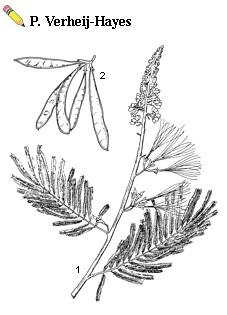 | Calliandra calothyrsus Meissn. - 1, flowering branch; 2, branch with fruits. |
Growth and Development
Mature seeds germinate readily. Seedlings grow quickly up to 2.5—3.5 m in 6 months and up to 3—5 m in the first year. Trees mature rapidly; flowering may start in the first year, but good fruit setting normally starts the second year. Normally large quantities of seed are produced each year. In its native region, flowering is concentrated at the end of the rainy season and the beginning of the dry season, and fruits are set in the dry season. On Java, calliandra flowers and fruits throughout the year, but most seeds are produced in the dry season. Flowers are insect-pollinated and seeds mature 2 months after pollination. Fruits are mature when they turn brown. The stem turns brittle around the age of 12 years, but the rootstock remains vigorous and new sprouts are easily formed. After cutting, trees coppice vigorously. With annual coppicing of stems of 3—5 cm in diameter, plants can survive for many years. Roots develop quickly and may reach 1.5—2 m in plants of 4—5 months old. Both surface and deeply penetrating roots are formed.
In humid climates the tree is evergreen, in areas with a long dry season it is semi-deciduous. In severe dry conditions, trees die back but recover at the beginning of the rainy season.
In humid climates the tree is evergreen, in areas with a long dry season it is semi-deciduous. In severe dry conditions, trees die back but recover at the beginning of the rainy season.
Other Botanical Information
Calliandra Benth. is a genus of about 100 species of shrubs and small trees of tropical and warm temperate regions, some of which are widely cultivated as ornamentals. Together with the introduction of Calliandra calothyrsus in Java, the white-flowered Calliandra tetragona Benth. was also introduced from Guatemala. Because of its slower growth, this species became less popular for plantations.
Ecology
In its native habitat Calliandra calothyrsus grows at altitudes of 400—1800 m in areas with an average annual precipitation from 700 mm to 3000 mm and with 1—7 dry months per year. Best development occurs at moderate elevations below 1300 m. On Java the species is planted up to 1500 m altitude, but it grows best between 250—800 m in areas with 2000—4000 mm annual rainfall and a 3—6 month dry period. The plants require a mean annual temperature of (20—)22—28°C, with mean maximum temperature in the hottest month between 24—30°C and mean minimum temperature in the coldest month between 18—24°C. The species occurs in secondary vegetations, often in thickets. It is an aggressive colonizer on disturbed sites such as recent landslides and roadsides. It grows on a large variety of soil types ranging from deep, volcanic, sandy loams to alluvial soils and shallow or eroded metamorphic sandy clays. It is well adapted to acid soils of poor fertility but can respond to fertilizer application on such soils.
It prefers light soil textures and slightly acid conditions. Best growth is obtained on acid soils of volcanic origin. Growth decreases on compacted soils and trees die after 2 weeks of oxygen depletion due to waterlogging.
It prefers light soil textures and slightly acid conditions. Best growth is obtained on acid soils of volcanic origin. Growth decreases on compacted soils and trees die after 2 weeks of oxygen depletion due to waterlogging.
Propagation and planting
Calliandra is normally propagated by seeds, directly in the field or in the nursery. Seeds germinate without pre-treatment, but best germination is obtained if seeds are briefly treated with almost boiling water and soaked for 24 hours. Seeds retain their viability for at least 2—3 years if stored in a refrigerator but viability decreases within one year at room temperature. Direct sowing in the field can be done in planting holes or by broadcasting on previously ploughed or burned lands. Seedlings usually nodulate with native rhizobia and inoculation is not required. Potted plants and transplants can be raised with standard nursery techniques. Potted plants are transplanted when they are 20—50 cm tall and have a root collar of 0.5—1 cm. Plants approximately 1 m tall can be transplanted after cutting the stem back to 30 cm and the roots to 20 cm. Spacing within plantations varies according to purpose. For firewood, planting distances are 1 m x 1 m to 1 m x 2 m; in alley-cropping, spacing of 25—50 cm in the contour lines is used. Areas to be planted are cleared completely. To provide fodder calliandra is often planted in fences, rows or in small blocks, usually under a cut-and-carry regime. For optimal leaf production dense stands of up to 40 000 trees/ha can be used.
Husbandry
Because seedlings grow quickly, no special plantation management is needed, except for weeding in the first year. As yet there is not much specific knowledge on management practices for optimal fodder and wood production from Calliandra calothyrsus. Neither is much known about the feasibility of combining calliandra and cultivated forage grasses.
Diseases and Pests
There are no serious diseases or pests recorded in Indonesia, but in the Philippines trees are damaged by a stem-borer. In Kenya, damage from Pachnoda ephippiata (a rose flower beetle) has restricted seed production to the extent that it has been suggested that the insect could limit the use of Calliandra calothyrsus.
Harvesting
Harvesting of calliandra can normally start after the first year. Forage is usually cut by hand. In Indonesia a cutting height of 35 cm is commonly used, although forage yields may be slightly larger with a cutting height of 100 cm.
Yield
In plantations, forage DM yields are typically in the range of 7—10 t/ha per year, although yields will be lower in areas of low rainfall or infertile soil. In one experiment, leaf yields were slightly higher when harvested at intervals of 12 weeks instead of 6 weeks. When grown as fences, fodder DM yields of 1.8—3.2 t/km in 10 months have been obtained. In one trial, yields of Panicum maximum Jacq. cultivar 'Riversdale' were similar to those of Calliandra calothyrsus, Leucaena leucocephala (Lamk) de Wit and Gliricidia sepium (Jacq.) Kunth ex Walp. Yields of the three legumes were also similar. When plots were harvested every 6 weeks, grass yields were higher at denser tree spacings, but when harvested every 12 weeks, grass yields were higher at the wider tree spacings. On reasonable soils on Java first wood harvests produced 5—20 m3/ha per year of fuelwood. On favourable sites annual coppice harvests continued for 10—20 years with yields of 35—65 m3/ha per year.
Genetic Resources
A collection of Calliandra calothyrsus germplasm has been made by CATIE (Turrialba, Costa Rica) and the Oxford Forestry Institute (United Kingdom).
Breeding
Calliandra calothyrsus was introduced in Java as part of a trial of green manure crops for timber plantations. Its introduction was based on only two seed samples from Guatemala. All existing plantations in Indonesia are derived from this first introduction. In Central America the species did not receive any attention until its success as a firewood crop in Indonesia became known in the early 1980s. The species in Central America has a wide geographic distribution and is quite variable. It seems that the seeds introduced from Guatemala to Indonesia were derived from a fast-growing, lesser branched and taller ecotype. In some trials specific calliandra accessions have been observed which produce root suckers, but this seems to be exceptional. Further provenance trials are needed to assess species variability, forage quality, and adaptability to different environmental conditions.
Prospects
Calliandra calothyrsus has become popular because it can readily produce high-quality fuelwood in annual coppice rotations, can be used in different farm systems as an auxiliary crop, and can grow under a wide range of soil fertility. Special attention has been given to the use of this species as an alternative to Leucaena leucocephala on acid lands or areas infested with Leucaena psyllid. Its high potential production and high protein content make it a promising fodder species to supplement low-quality forages. However, due to high tannin content, the palatability of calliandra is less than that of L. leucocephala or Gliricidia sepium. Further studies are needed to ascertain its full potential as a fodder crop, including its true nutritive value and its value as a plant for grazing. Care must also be taken that this hardy species does not become a weed.
Literature
Ahn, J.H., Robertson, B.M., Elliott, R., Gutteridge, R.C. & Ford, C.W., 1989. Quality assessment of tropical browse legumes: tannin content and protein degradation. Animal Feed Science and Technology 27: 147-156.
Baggio, A. & Heuveldop, J., 1984. Initial performance of Calliandra calothyrsus Meissn. in live fences for the production of biomass. Agroforestry Systems 2: 19-29.
Ella, A. & Blair, G.J., 1989. Effect of tree density and cutting frequency on the production of four tree legumes and understorey grass. Nitrogen Fixing Tree Research Reports 7: 14-16.
Ibrahim, T.M., Palmer, B., Boer, M. & Santhes, M., 1988. Shrub legume potential for integrated farming systems in northern Sumatra - nutritional constraints and palatability. In: Maximizing livestock productivity. Proceedings of the 11th Annual Conference, Malaysian Society of Animal Production. pp. 128-132.
National Academy of Sciences, 1983. Calliandra, a versatile small tree from the humid tropics. National Academy Press, Washington, D.C., United States. 52 pp.
Verhoef, L., 1941. Voorlopige resultaten met enige uit tropisch Amerika ingevoerde Leguminosae [Preliminary results with some Leguminosae introduced from tropical America]. Tectona 25(10): 711-719.
Baggio, A. & Heuveldop, J., 1984. Initial performance of Calliandra calothyrsus Meissn. in live fences for the production of biomass. Agroforestry Systems 2: 19-29.
Ella, A. & Blair, G.J., 1989. Effect of tree density and cutting frequency on the production of four tree legumes and understorey grass. Nitrogen Fixing Tree Research Reports 7: 14-16.
Ibrahim, T.M., Palmer, B., Boer, M. & Santhes, M., 1988. Shrub legume potential for integrated farming systems in northern Sumatra - nutritional constraints and palatability. In: Maximizing livestock productivity. Proceedings of the 11th Annual Conference, Malaysian Society of Animal Production. pp. 128-132.
National Academy of Sciences, 1983. Calliandra, a versatile small tree from the humid tropics. National Academy Press, Washington, D.C., United States. 52 pp.
Verhoef, L., 1941. Voorlopige resultaten met enige uit tropisch Amerika ingevoerde Leguminosae [Preliminary results with some Leguminosae introduced from tropical America]. Tectona 25(10): 711-719.
Author(s)
K.F. Wiersum & I.K. Rika
Correct Citation of this Article
Wiersum, K.F. & Rika, I.K., 1992. Calliandra calothyrsus Meissn.. In: Mannetje, L.'t and Jones, R.M. (Editors): Plant Resources of South-East Asia No 4: Forages. PROSEA Foundation, Bogor, Indonesia. Database record: prota4u.org/prosea

All texts are licensed under a Creative Commons Attribution-Noncommercial-Share Alike 3.0 Netherlands License
This license does not include the illustrations (Maps,drawings,pictures); these remain all under copyright.