Record Number
1851
PROSEA Handbook Number
4: Forages
Taxon
Calopogonium mucunoides Desv.
Protologue
Ann. Sci. Nat. Sér. 1, 9: 423 (1826).
Family
LEGUMINOSAE
Chromosome Numbers
2n = 36
Vernacular Names
Calopo (En). Indonesia: kacang asu (Javanese), kalopogonium (Indonesian). Philippines: santing (Sulu), karaparapak sara naw (Mar.). Thailand: thua karopo.
Origin and Geographic Distribution
Calopo is indigenous to tropical America and the West Indies. It was introduced in the early 1900s to tropical Africa and Asia. Calopo was used as a green manure and cover crop in the central and eastern parts of Java from 1922 onwards. It was brought to Malaysia soon after that as a cover crop for rubber. It became naturalized in Malaysia and Indonesia, and has spread to most humid tropical areas of the world. It was introduced to Australia in 1930, but has not been widely used there.
Uses
Calopo is used as forage for animals during the latter part of the dry season, and is an important cover crop for plantations and as green manure for soil improvement. It is well recognized as being a valuable pioneer legume to protect the soil surface, reduce soil temperature, fix nitrogen and improve soil fertility.
Properties
Considering that calopo is widely used as a green manure crop, there are few published data on its chemical composition. Nitrogen percentages of 2.6—3.8% have been recorded, but lower values can be anticipated in older, stemmy material. Calopo forage is not very palatable to cattle, but animals are forced to eat it during the dry season when little green feed is available. Its low palatibility is usually ascribed to the abundance of hairs on the stems and leaves. There are 70—75 seeds/g.
Description
A vigorous, creeping, twining or trailing herb, up to several m long, forming a tangled mass of foliage 30—50 cm deep, with densely pilose stems with long spreading ferruginous hairs. Leaves trifoliolate, petiole up to 16 cm long, pilose; leaflets elliptic, ovate or rhomboid-ovate, (1.5—)4—10(—15) cm x (1—)2—5(—9) cm, the laterals oblique, adpressed pilose or pubescent on both surfaces. Inflorescence a slender raceme, up to 20 cm long, peduncle 0—17 cm long, ferruginous pilose; flowers in fascicles of 2—6, blue or purple; calyx campanulate, unequally 5-lobed; corolla with emarginate standard, about 1 cm long. Pod linear-oblongoid, 2—4 cm x 3.5—5 mm, straight or curved, softly pilose with coarse reddish-brown hairs, impressed between the seeds. Seeds 3—8, compressed squarish, 2—3 mm long, yellowish or reddish-brown.
Image
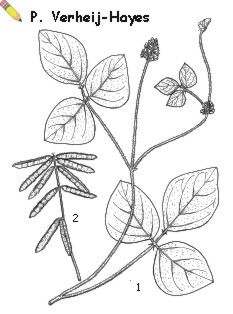 | Calopogonium mucunoides Desv. - 1, flowering branch; 2, fruiting branch. |
Growth and Development
Calopo grows rapidly, able to form a dense entangled sward in 4—5 months after sowing, but the plants are short-lived and may only persist for 1—2 years. When grown in a mixture with puero (Pueraria phaseoloides (Roxb.) Benth.) and centro (Centrosema pubescens Benth.), calopo is the first one to become established but also the first one to be shaded out. Long-term persistence is through recruitment of new plants from seedlings. Flowering in calopo is initiated by short days. It is self-pollinated and seeds freely.
Other Botanical Information
The name 'Tortilla' is used to indicate seed of calopo sometimes harvested from naturalized stands in the Adelaide River area of the Northern Territory (Australia). It was at one time thought to have been a long-term locally adapted ecotype, but it is now believed to have come to the area as a contaminant in puero seed from Queensland which had been sown in the late 1960s at the Tortilla Flats Research Farm. 'Tortilla' is likely to be similar to Queensland commercial material, which is rarely harvested and has never been allotted a cultivar name.
Ecology
Calopo is suited to the hot humid tropics with an annual rainfall exceeding 1250 mm. It grows at altitudes from sea-level to 2000 m but is more suited to altitudes from 300—1500 m. It is moderately drought tolerant but may die out if the dry season is prolonged. Vigorous growth occurs on soils of all textures, even with a low pH(H2O) range of 4.5—5. As a result of its self-seeding nature and twining growth habit, calopo is well adapted to a range of ecological conditions. It can be used in a mixture of species provided it does not become too dominant.
Calopo is poorly adapted to shade, with top growth, root growth and nodulation declining markedly with decreasing light intensities. This may be attributed to the 'non-plasticity' of leaves under shade as compared with other shade-tolerant plants such as Desmodium heterocarpon (L.) DC. ssp. heterocarpon var. ovalifolium (Wallich ex Prain) Rugayah, Centrosema pubescens Benth., and Calopogonium caeruleum (Benth.) Sauv. Under low light intensitites (< 20%), calopo leaves are reduced in size by 70% compared with leaves in full sunlight. In contrast, centro and Calopogonium caeruleum leaves are reduced by only 10—25% and leaves of var. ovalifolium are 20% larger under such a low light intensity.
Calopo is poorly adapted to shade, with top growth, root growth and nodulation declining markedly with decreasing light intensities. This may be attributed to the 'non-plasticity' of leaves under shade as compared with other shade-tolerant plants such as Desmodium heterocarpon (L.) DC. ssp. heterocarpon var. ovalifolium (Wallich ex Prain) Rugayah, Centrosema pubescens Benth., and Calopogonium caeruleum (Benth.) Sauv. Under low light intensitites (< 20%), calopo leaves are reduced in size by 70% compared with leaves in full sunlight. In contrast, centro and Calopogonium caeruleum leaves are reduced by only 10—25% and leaves of var. ovalifolium are 20% larger under such a low light intensity.
Propagation and planting
Calopo is normally propagated by seed. Seed is sown at 1—3 kg/ha, usually drilled in rows when sown into new plantations or broadcast in stands to be used for forage production. After seed is broadcast, the seed-bed should be rolled to improve establishment. Newly harvested seed usually has a high percentage of hard seed (> 75%). Consequently, mechanical scarification, soaking in concentrated sulphuric acid for 30 minutes, or soaking in hot water (75°C) for 3 minutes is recommended. Although calopo stems root at the nodes when in contact with moist soil, there is usually poor establishment of stem cuttings placed directly into soil. Seeds are usually not inoculated, as this species nodulates promiscuously with native rhizobia. If inoculum is applied then cowpea strains such as the Australian CB 756 are used. When planted as a cover crop in plantations, it is usually sown in a mixture with other legumes such as Centrosema pubescens, Calopogonium caeruleum and Pueraria phaseoloides with 1—3 kg/ha of calopo in a total mixture of 12—15 kg/ha of legume seed. When sown for forage production, calopo has been successfully used in mixtures with stoloniferous grasses, such as molasses grass (Melinis minutiflora Beauv.) and Rhodes grass (Chloris gayana Kunth), and with tussock grasses such as setaria (Setaria sphacelata (Schumacher) Stapf & Hubbard ex M.B. Moss). Good results have been obtained from oversowing it into existing stands of pangola grass (Digitaria eriantha Steud.) which have been harrowed.
Husbandry
Because of the vigorous growth of calopo, a large amount of leaf litter falls onto the soil. Fertilization with ground dolomite and Mo in acidic soils results in higher yields. Use of pre- and post-emergence herbicides reduces weed infestation and results in faster establishment of calopo. The effect of calopo and associated legumes in improving soil fertility may last for 14—16 years. If calopo is grazed, it is advisable to use rotational grazing with rest periods of from 8—12 weeks when calopo growth is erect rather than prostrate. With calopo as cover in young oil palm and rubber plantations, regular slashing is needed to prevent the cover from overgrowing the trees.
Diseases and Pests
Calopo is susceptible to viruses in Guatemala, Costa Rica and Panama. Although leaf-eating caterpillars and beetles have been observed on calopo in Malaysia, they have not been a serious problem.
Harvesting
Whether grazed or cut and fed, calopo is often refused by cattle although they eat it less reluctantly during the dry season. It is usually cut by hand and is seldom conserved as hay or silage.
Yield
When pods are mature, peak DM yields of up to 14 t/ha can be obtained in a single cut. Lower yields of 4—6 t/ha per year are obtained when calopo is cut every 9—12 weeks. Seed yields of 200—300 kg/ha have been recorded.
Genetic Resources
Collections of calopo are held at CIAT (Colombia) and ATFGRC (CSIRO, Australia).
Breeding
There are no breeding programmes on calopo.
Prospects
Low palatability is perhaps the main reason why interest in this species as a forage plant has faded during the last decade. However, this low acceptability may open up opportunities for incorporating calopo into forage systems as a way of improving soil fertility and the growth rate and quality of pastures.
Literature
Bogdan, A.V., 1977. Tropical pasture and fodder plants. Longman, London. pp. 328-329.
Bunting, B. & Milsum, J.N., 1928. Cover crops and green manures. The Malayan Agricultural Journal 16: 256-280.
Duke, J.A., 1981. Handbook of legumes of world economic importance. Plenum Press, New York. pp. 37-39.
Humphreys, L.R., 1980. A guide to better pastures for the tropics and sub-tropics. 4th ed. Wright, Stephenson & Co., Silverwater, Australia. p. 52.
Skerman, P.J., Cameron, D.G. & Riveros, F., 1988. Tropical forage legumes. FAO, Rome. pp. 224-228.
Wong, C.C., 1990. Mineral composition and nutritive value of tropical forage legumes as affected by shade. MARDI Research Journal 18: 135-143.
Yates Seeds, 1987. Better pastures for the tropics. 2nd ed. Yates Seeds, Toowoomba, Australia. pp. 40-41.
Yost, R. & Evans, D., 1986. Green manure and legume covers in the tropics. Research Series 055. College of Tropical Agriculture and Human Resources, University of Hawaii, United States. p. 14.
Bunting, B. & Milsum, J.N., 1928. Cover crops and green manures. The Malayan Agricultural Journal 16: 256-280.
Duke, J.A., 1981. Handbook of legumes of world economic importance. Plenum Press, New York. pp. 37-39.
Humphreys, L.R., 1980. A guide to better pastures for the tropics and sub-tropics. 4th ed. Wright, Stephenson & Co., Silverwater, Australia. p. 52.
Skerman, P.J., Cameron, D.G. & Riveros, F., 1988. Tropical forage legumes. FAO, Rome. pp. 224-228.
Wong, C.C., 1990. Mineral composition and nutritive value of tropical forage legumes as affected by shade. MARDI Research Journal 18: 135-143.
Yates Seeds, 1987. Better pastures for the tropics. 2nd ed. Yates Seeds, Toowoomba, Australia. pp. 40-41.
Yost, R. & Evans, D., 1986. Green manure and legume covers in the tropics. Research Series 055. College of Tropical Agriculture and Human Resources, University of Hawaii, United States. p. 14.
Author(s)
C.P. Chen & A. Aminah
Correct Citation of this Article
Chen, C.P. & Aminah, A., 1992. Calopogonium mucunoides Desv.. In: Mannetje, L.'t and Jones, R.M. (Editors): Plant Resources of South-East Asia No 4: Forages. PROSEA Foundation, Bogor, Indonesia. Database record: prota4u.org/prosea

All texts are licensed under a Creative Commons Attribution-Noncommercial-Share Alike 3.0 Netherlands License
This license does not include the illustrations (Maps,drawings,pictures); these remain all under copyright.