Record Number
1858
PROSEA Handbook Number
4: Forages
Taxon
Centrosema pubescens Benth.
Protologue
Comm. legum. gen.: 55 (1837).
Family
LEGUMINOSAE
Chromosome Numbers
2n = 22
Synonyms
Centrosema molle Martius ex Benth. (1837).
Vernacular Names
Centro, butterfly pea (En). Indonesia: sentro. Philippines: dilang-butiki (Tagalog), lesu-kesu (Subanun). Thailand: thua-lai, thua-sentro. Vietnam: day trung châu lông.
Origin and Geographic Distribution
Originating in South and Central America, centro is now one of the most widely distributed of all legumes in the humid tropics.
Uses
Centro has been used as a green manure and plantation ground cover in Java and Peninsular Malaysia since the 19th century. Centro is widely used as a plantation cover and/or pasture legume in South-East Asia, the Pacific Islands, the wet tropics of Australia and indeed much of the humid tropics worldwide.
Properties
Centro is an efficient fixer of N with N concentrations generally ranging from 2.4—2.7%. Centro is one of the most palatable tropical legumes. There are about 40 seeds/g.
Description
A vigorous, climbing, perennial herb; trailing runners have a tendency to root at the nodes if soil moisture is high, giving it a stoloniferous appearance; roots deeply penetrating; development of taproots and lateral roots is almost equal, although soil type exerts some influence. Stems leafy, arising from the main runners at 0.5—1.5 m intervals, climbing rather than trailing, slightly hairy, possibly becoming woody when older than 18 months. Leaves trifoliolate; leaflets elliptical, ovate-oblong or ovate-lanceolate, 1—7 cm x 0.5—4.5 cm, rounded at the base, rounded to acuminate at the apex, dark green, slightly hairy especially on the lower surface; petiole up to 5.5 cm long, stipules 2—4 mm long, persistent. Flower papilionaceous, cleistogamous, large, pale mauve with purple lines in the centre, borne in axillary racemes, 3—5 per raceme, subtended by 2 striate bracteoles; calyx tube campanulate, teeth unequal, 2 upper ovate triangular 1.5—3 mm long; standard rounded, up to 3 cm in diameter, hairy on the outside, bright or pale lilac on either side of a median greenish-yellow band with numerous dark violet stripes or blotches. Pod linear, 4—17 cm x 6—7 mm, flattened, margins prominent, straight or slightly twisted, acuminate, dark brown when ripe, containing up to 20 seeds. Seed shortly oblongoid to squarish with rounded corners, 4—5 mm x 3—4 mm x 2 mm, brownish-black, with mottled darker blotches.
Image
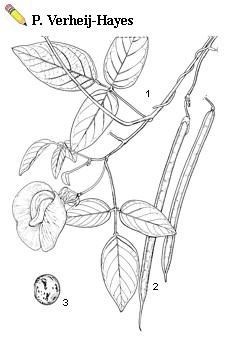 | Centrosema pubescens Benth. - 1, flowering branch; 2, fruits; 3, seed. |
Growth and Development
Centro is notoriously slow to establish and requires good conditions during the establishment period, but when grown in a pure sward it forms a dense, compact cover 35—45 cm deep, 4—8 months after sowing. It is fully established and vigorous by at least the 2nd year. In ungrazed mixtures with Panicum maximum Jacq. it forms an impenetrable vine canopy some 2 m high. In a mixture with calopo (Calopogonium mucunoides Desv.) and puero (Pueraria phaseoloides (Roxb.) Benth.), centro persists longest under the closing canopy of plantation crops. Up to 60% of the seed may be hard, requiring scarification before planting. In Australia, common centro flowers in April and October with main seed harvesting periods in June—July and November—December. Cultivar 'Belalto' flowers in June and has a main seed harvesting period in early August. Nodulation occurs with a range of rhizobia but optimal growth has been achieved with very few strains. Inoculation with an effective strain of Bradyrhizobium is, therefore, recommended. Estimates of N fixation range from 120—270 kg/ha per year.
Other Botanical Information
Two lines of centro are in commercial use: common centro and cultivar 'Belalto'. 'Belalto' is now identified as Centrosema schiedeanum (comb. ined., syn.: Clitoria schiedeana Schlecht.) rather than as Centrosema pubescens as was listed originally. It was selected as an improvement over common centro because of its superior cool season growth, greater tolerance of pests and diseases, and its stronger stoloniferous growth.
Ecology
In the humid tropics, the preferred legumes for fertile and infertile soils have traditionally been centro and stylo (Stylosanthes guianensis (Aublet) Swartz) respectively. However, when soil mineral deficiencies are corrected and seed is inoculated with an effective Bradyrhizobium, centro has been more productive than stylo on all land classes. The preferred annual rainfall for centro is 1500 mm or more but it has also proved to be more tolerant of lower rainfall than once considered, having persisted in pastures receiving an average annual rainfall of 800 mm. Centro tolerates waterlogged conditions when grazing is lenient and it will survive a 3—4 month dry season but is not adapted to prolonged drought. It is intolerant of low temperatures, growing poorly when temperatures fall below 15°C. It is one of the shade-tolerant legumes and can persist under 80% shade. Centro combines well with other species in mixed pastures or ground covers under plantation crops.
Propagation and planting
Centro is propagated by seed. Hand harvested seed has a high proportion of hard-seededness and mechanical scarification is desirable. Seeding rate is about 5 kg/ha. Full seed-bed preparation and careful crop planting procedures are generally recommended, especially since centro is somewhat slow to establish. However, centro has been successfully sod-seeded directly into a run-down grass pasture, following heavy grazing and low slashing of the residual grass.
Husbandry
Properly fertilized and carefully grazed grass/centro associations have been persistent, productive and competitive against weeds and timber regrowth. The tolerance of centro to certain herbicides has been determined, which can assist in weed control. In mixtures with grasses, notably Panicum maximum, centro tolerates rotational or continuous grazing, but is intolerant of grazing in pure stands. Under acidic soil conditions, centro is more responsive to Mo, Ca, K and P than puero which, in turn, is more responsive than stylo. Centro is more sensitive than stylo to soil P deficiency but is less sensitive to Cu and possibly S deficiencies.
Diseases and Pests
Centro has been relatively free of major diseases and pests. Some virus and bacterial diseases have been noted from time to time and there are seasonal infestations of Cercospora leaf-spot and red spider (Tetranychus sp.). In the humid tropics it is noticeable that the infestation of foliar blight (Rhizoctonia solani) may cause some dieback and that the attack of ladybird beetles may affect plant growth. The damage can be severe when centro is planted in a pure sward, especially during the wet season. However, none of these have warranted commercial control measures.
Harvesting
Harvesting is by grazing animals, when it can be selectively overgrazed unless care is taken, or it can be cut for stall feeding. Centro has persisted for decades as plantation cover or in well-managed grazed associations with grasses, but it has not been very stable in cut-and-carry systems. Centro is usually consumed fresh but it can be ensiled or dried for hay or pellets.
Yield
Pure stands of centro have produced DM yields of up to 12 t/ha per year. In mixed pastures, this is more likely to be about 3 t/ha per year. Standing DM yield of centro in grazed mixed pastures is unlikely to exceed 1 t/ha. Well managed grass/centro pastures have consistently supported stocking rates of 2.5 steers (375 kg liveweight) per ha in the Australian tropics and 4 steers (250 kg) in the Malaysian wet tropics, producing about 500 kg/ha of liveweight gain per year. Seed production can reach more than 200 kg/ha.
Genetic Resources
Seed of centro has been sold for many decades in South-East Asia and other humid tropical areas. Large germplasm collections are held by ATFGRC (CSIRO, Australia), CENARGEN/EMBRAPA (Brazil) and CIAT (Colombia).
Breeding
Plant breeding programmes have been undertaken by QDPI and CSIRO in Australia and CIAT in Colombia. However, the most promising lines are beginning to emerge from plant collections in South and Central America.
Prospects
Except for the humid tropics of Australia and a few areas of Malaysia and the Philippines, the potential of centro as a component of grazed pastures has been largely unrealized. Most pasture developments in South-East Asia have been on infertile soils which are not suitable for cropping. Similar developments in Australia have only been successful after careful studies of the nutritional status of the soil with respect to centro in particular. Very few studies of this type have been undertaken in South-East Asia. Centro is a recommended legume in the 'Three Strata Forage System' in Bali, Indonesia.
Literature
Clements, R.J., Williams, R.J., Grof, B. & Hacker, J.B., 1983. Centrosema. In: Burt, R.L., Rotar, P.P., Walker, J.L. & Silvey, M.W. (Editors): The role of Centrosema, Desmodium, and Stylosanthes in improving tropical pastures. Westview Press, Boulder, Colorado, United States. pp. 69-96.
Nitis, I.M., Lana, K., Suarna, M., Sukanten, W., Putra, S. & Arga, W., 1989. Three strata system for cattle feeds and feeding in dryland farming area in Bali. Final report to IRDC, Canada. 252 pp.
Schultze-Kraft, R. & Clements, R.J. (Editors), 1990. Centrosema: biology, agronomy and utilisation. CIAT, Cali, Colombia. 667 pp.
Skerman, P.J., Cameron, D.G. & Riveros, F., 1988. Tropical forage legumes. FAO, Rome. pp. 243-255.
Teitzel, J.K. & Burt, R.L., 1976. Centrosema pubescens in Australia. Tropical Grasslands 10: 5-14.
Author(s)
J.K. Teitzel & C.P. Chen
Correct Citation of this Article
Teitzel, J.K. & Chen, C.P., 1992. Centrosema pubescens Benth.. In: Mannetje, L.'t and Jones, R.M. (Editors): Plant Resources of South-East Asia No 4: Forages. PROSEA Foundation, Bogor, Indonesia. Database record: prota4u.org/prosea

All texts are licensed under a Creative Commons Attribution-Noncommercial-Share Alike 3.0 Netherlands License
This license does not include the illustrations (Maps,drawings,pictures); these remain all under copyright.