Record Number
1887
PROSEA Handbook Number
4: Forages
Taxon
Imperata cylindrica (L.) Raeuschel
Protologue
Nomencl. bot., ed. 3: 10 (1797).
Family
GRAMINEAE
Chromosome Numbers
2n = 20
Synonyms
Lagurus cylindricus L. (1759), Imperata arundinacea Cyr. (1792), Imperata cylindrica (L.) Raeuschel var. major (Nees) C.E. Hubbard (1940).
Vernacular Names
Blady grass (Australia), cogongrass, satintail (En). Paillotte (Fr). Indonesia: alang-alang, ilalang (Indonesian), kambengan (Javanese). Malaysia: lalang, alang-alang. Papua New Guinea: kunai. Philippines: kogon (Tagalog), gogon (Bikol), bulum (Ifugao). Burma: kyet-mei. Cambodia: sbö':w. Laos: hnha:z kh'a:. Thailand: ya-kha. Vietnam: co'tranh.
Origin and Geographic Distribution
A native of the Old World tropics that is widely distributed throughout the tropics and subtropics of South-East Asia, Africa, the Indian subcontinent and Australia. It occurs to a lesser extent in North, Central and South America. It also occurs in warm temperate areas and has been recorded at latitudes of 45° in New Zealand and Japan.
Uses
Imperata cylindrica, in an early stage of growth, is widely used as feed for ruminants, including cattle, buffaloes, goats and wild herbivores. It is traditionally used in the countryside as roofing material as it is readily available and durable. It has also been used to make paper. It is useful for mulching or controlling soil erosion, and the rhizomes are used medicinally in a decoction to purify the blood and as a diuretic. The rhizomes contain a fair amount of starch and a kind of beer can be made from them. It is regarded as a serious weed in cropping systems.
Properties
Imperata cylindrica is regarded as a low quality grass. Nitrogen concentrations may only remain above 1% for some 6 weeks where it grows rapidly, but can remain above this level for up to 20 weeks with slower growth at higher latitudes and altitudes. Very young growth may have digestibilities of 70%, falling to below 40% after 150 days. Where there is opportunity for selective grazing, other species are usually selected ahead of it.
Description
Aggressively rhizomatous, robust perennial with white, deeply buried (up to more than 1 m), branched, fleshy, scaly rhizome, forming loose to compact tufts of leaves. Culms erect, 0.1—1.2(—3 m) tall, 1—4(—8)-noded, unbranched, solid, usually hairy at the nodes. Leaf-sheath with ciliate margins, lower ones broad and leathery, overlapping, the upper ones finally splitting into thin fibres; ligule membraneous, truncate, up to 1 mm tall; leaf-blade linear-lanceolate, 10—180 cm x 5—25 mm, flat, erect, spreading or drooping, pilose at the base, when old with hard, serrate, cutting edges and a stout whitish midrib. Inflorescence a spiciform panicle, cylindrical, 6—30 cm x 2 cm, its branches ascending close to the main axis especially at anthesis; spikelets paired, bisexual, 3—6 mm long, 1-flowered, at the base with a dense whorl of silky white hairs up to 2.5 cm long; pedicels unequal, up to 1 mm long; glumes equal, 3—9-nerved; lower floret reduced to a hyaline lemma; stamens 2, anthers orange to purple; stigmas 2, purple. Caryopsis ellipsoid, ca. 1 mm long, brown.
Image
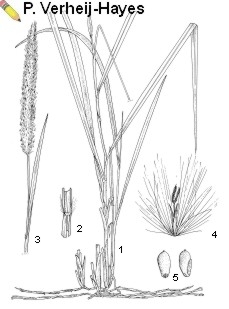 | Imperata cylindrica (L.) Raeuschel - 1, plant habit; 2, ligule; 3, inflorescence; 4, spikelet; 5, caryopsis in front and side view. |
Growth and Development
Imperata cylindrica is a prolific seed producer and the light seeds are readily dispersed by wind. There is no dormancy and seeds may give 95% germination within one week after harvest. The optimum temperature for growth is about 30°C with negligible growth at 20°C and 40°C. Some individual plants flower frequently, some never flower, and other are intermediate. The rhizomes are highly competitive and penetrate the roots of other plants, causing rot or death.
Other Botanical Information
Based on e.g. appearance of leaf-blades (rolled or flat), size of spikelets and hairiness of the node, several botanical varieties have been distinguished in the taxonomic literature. All varieties, however, intergrade so much that individual specimens are often unidentifiable. It seems best, therefore, to ignore the varietal classification, with the understanding that there are a number of imperfectly separable geographical variants. Cultivars have never been developed as research activities are much more directed towards the eradication of Imperata cylindrica than towards its cultivation!
Ecology
Imperata cylindrica is often found in areas receiving more than 1000 mm rainfall, but has been recorded in sites receiving from 500—5000 mm. It can withstand waterlogging but not continuous flooding. It grows at altitudes from sea-level up to 2000 m in several countries and has been recorded at 2700 m in Indonesia. It has been estimated that it covers some 500 million ha worldwide including 200 million ha in South-East Asia.
Whereas Imperata cylindrica may have originally been restricted to very low fertility and acid soils in the tropics, it has become widely spread through man's intervention, particularly following slashing and burning of forest lands. Its resistance to burning is associated with its vigorous underground rhizomes, but seedlings also establish after burning. It is found in a wide range of habitats including dry sand dunes of seashores and deserts, as well as swamps and river valleys. It grows in grassland, cultivated areas, and plantations. It quickly invades abandoned farmland and occurs on railway and highway embankments and in deforested areas. It is regarded as a light-loving plant and will not persist under heavy shade in plantations. Although it grows in a wide range of soil types with widely differing fertility levels, it grows most vigorously in wet soil of reasonable fertility. It has been reported to grow on soils with pH ranging form 4.0—7.5. It can even tolerate very hot, steamy and sulphurous conditions near an active volcanic fumarole or vent.
Whereas Imperata cylindrica may have originally been restricted to very low fertility and acid soils in the tropics, it has become widely spread through man's intervention, particularly following slashing and burning of forest lands. Its resistance to burning is associated with its vigorous underground rhizomes, but seedlings also establish after burning. It is found in a wide range of habitats including dry sand dunes of seashores and deserts, as well as swamps and river valleys. It grows in grassland, cultivated areas, and plantations. It quickly invades abandoned farmland and occurs on railway and highway embankments and in deforested areas. It is regarded as a light-loving plant and will not persist under heavy shade in plantations. Although it grows in a wide range of soil types with widely differing fertility levels, it grows most vigorously in wet soil of reasonable fertility. It has been reported to grow on soils with pH ranging form 4.0—7.5. It can even tolerate very hot, steamy and sulphurous conditions near an active volcanic fumarole or vent.
Propagation and planting
Imperata cylindrica is seldom propagated deliberately, but spreads by rhizomes and seed. If rhizomes are cut by cultivation, they can establish from pieces with as few as 2 nodes.
Husbandry
Imperata cylindrica is favoured by burning, which can lead to virtually monospecific swards. If it is to be used for thatching, swards are left ungrazed until after the mature growth is removed. It can be eliminated by heavy continuous grazing, where it may be replaced by inedible weeds; vigour will be reduced by close, frequent cutting and rhizomes can be destroyed by frequent intensive cultivation. If Imperata cylindrica is being regularly used for grazing, it has been suggested that it be rotationally grazed when 15—25 cm high.
Because of its aggressiveness and low quality, it is widely regarded as a weed and research has been carried out on improving its quality through introducing legumes or even replacing it with other grasses. However, it is not easy to maintain herbaceous legumes with Imperata cylindrica, though some promising results have been achieved with stylo (Stylosanthes guianensis (Aublet) Swartz) and with leucaena (Leucaena leucocephala (Lamk) de Wit).
Because of its aggressiveness and low quality, it is widely regarded as a weed and research has been carried out on improving its quality through introducing legumes or even replacing it with other grasses. However, it is not easy to maintain herbaceous legumes with Imperata cylindrica, though some promising results have been achieved with stylo (Stylosanthes guianensis (Aublet) Swartz) and with leucaena (Leucaena leucocephala (Lamk) de Wit).
Diseases and Pests
There are no records of major diseases or pests on Imperata cylindrica.
Harvesting
Imperata cylindrica is either grazed or cut for thatch when mature. It is little used as a species for cut-and-carry grazing systems.
Yield
Reported DM yields of Imperata cylindrica range from 2—11 t/ha per year. Weight gains of 0.25 kg/head per day have been recorded from Imperata cylindrica pastures in the Philippines and Papua New Guinea. In each case, gains from alternative, improved pastures were two or three times higher. Very low liveweight gains of 0.04 kg/head per day were recorded in northern Thailand.
Genetic Resources and Breeding
There are no known breeding programmes on this species.
Prospects
Although Imperata cylindrica is a low-quality forage, it is an important forage resource in South-East Asia and is often inadequately appreciated. Although there is potential for improving its productivity through growing associated with legumes, this will only take place very slowly. Care should be exercised that replacement of this species does not lead to invasion of inedible weeds and/or increased soil erosion.
Literature
Bor, N.L., 1960. The grasses of Burma, Ceylon, India and Pakistan. Pergamon Press, Oxford. pp. 169-171.
Falvey, J.L., 1981. Imperata cylindrica and animal production in South-east Asia: a review. Tropical Grasslands 15: 52-56.
Holm, L.G., Plucknett, D.L., Pancho, J.V. & Herberger, J.P., 1977. The world's worst weeds: distribution and biology. The East-West Center, University of Hawaii Press, Honolulu, Hawaii, United Sates. pp. 62-71.
Santiago, A., 1965. Studies on the autecology of I. cylindrica. Proceedings of the Ninth International Grassland Congress, São Paulo, Brazil. pp. 499-502.
Skerman, P.J. & Riveros, F., 1990. Tropical grasses. FAO, Rome. pp. 368-373.
Soerjani, M., 1970. Alang-alang, Imperata cylindrica (L.) Beauv., pattern of growth as related to its problem of control. BIOTROP Bulletin 1. Regional Centre for Tropical Biology, Bogor. 88 pp.
Falvey, J.L., 1981. Imperata cylindrica and animal production in South-east Asia: a review. Tropical Grasslands 15: 52-56.
Holm, L.G., Plucknett, D.L., Pancho, J.V. & Herberger, J.P., 1977. The world's worst weeds: distribution and biology. The East-West Center, University of Hawaii Press, Honolulu, Hawaii, United Sates. pp. 62-71.
Santiago, A., 1965. Studies on the autecology of I. cylindrica. Proceedings of the Ninth International Grassland Congress, São Paulo, Brazil. pp. 499-502.
Skerman, P.J. & Riveros, F., 1990. Tropical grasses. FAO, Rome. pp. 368-373.
Soerjani, M., 1970. Alang-alang, Imperata cylindrica (L.) Beauv., pattern of growth as related to its problem of control. BIOTROP Bulletin 1. Regional Centre for Tropical Biology, Bogor. 88 pp.
Author(s)
N.O. Aguilar
Correct Citation of this Article
Aguilar, N.O., 1992. Imperata cylindrica (L.) Raeuschel. In: Mannetje, L.'t and Jones, R.M. (Editors): Plant Resources of South-East Asia No 4: Forages. PROSEA Foundation, Bogor, Indonesia. Database record: prota4u.org/prosea

All texts are licensed under a Creative Commons Attribution-Noncommercial-Share Alike 3.0 Netherlands License
This license does not include the illustrations (Maps,drawings,pictures); these remain all under copyright.