Record Number
1942
PROSEA Handbook Number
6: Rattans
Taxon
Calamus exilis Griffith
Protologue
Palms of British India: 51 (1850).
Family
PALMAE
Chromosome Numbers
2n = unknown
Synonyms
Calamus ciliaris Blume sensu Ridley (1893), Calamus curtisii Ridley (1907), Calamus ciliaris Blume var. peninsularis Furt. (1956).
Vernacular Names
Indonesia: uwi pahe (Palembang), rotan gunung. Malaysia: rotan paku, rotan lilin.
Origin and Geographic Distribution
Calamus exilis is widespread in Peninsular Malaysia and Sumatra.
Uses
Both in Peninsular Malaysia and in Sumatra this rattan is mostly used locally in binding and weaving. The local people of Sungai Tutung, Kerinci, Sumatra have for years produced baskets using the split cane of this rattan. The same material can be used to produce handicrafts such as lamps and vases.
Production and International Trade
To date, Calamus exilis has been collected from the wild mostly for local consumption. Although it is known that this rattan is also sold, the actual amount traded internationally is not known.
Properties
Calamus exilis produces a good quality slender cane suitable for binding and weaving.
Botany
Slender solitary or clustering rattan. Stem climbing to 10 m or sometimes to 15 m high; stem without leaf-sheaths 4—8 mm in diameter, with sheaths 8—20 mm; internodes 15 cm or more. Leaf 45—90 cm long including the petiole; leaf-sheath dull grey-brown, variable in armature, always densely covered by minute scabrid spines, often no other spines present or two or more triangular spines present on one leaf-sheath, or leaf-sheath densely armed with flat triangular spines irregularly arranged or arranged in partial whorls; knee and whip (flagellum) present on the sheath; petiole up to 30 cm long, scabrid as the sheath; rachis to 60 cm long, with rusty hairs along the upper surface, armed with scattered spines on the lower surface; leaflets 22—40 pairs, very regularly arranged, linear lanceolate, up to 40 cm x 2 cm, the upper surface usually densely hairy. Inflorescence to 1.5 m long, with terminal whip, the male and female superficially similar, usually the female more robust, the male branching to 3 orders and the female to 2, the whole inflorescence scabrid as the sheath; bracts tightly tubular; first order branches 2—7, rather distant; flower-bearing branches slender, to 7 cm long in the female, shorter in the male; male flower greenish-yellow, 6 mm x 2 mm; female flower on a conspicuously stalked disk, 4 mm x 3 mm, each borne in a pair together with a sterile male flower. Mature fruit ovoid to oblong, 22 mm x 8 mm, with straw-coloured scales. Seed 12 mm x 3 mm, sinuous grooved, brain-like, covered with a thin green intensely bitter and fetid sarcotesta; endosperm homogenous, embryo lateral. Seedling-leaf pinnate, with rusty coloured hairs along rachis and about 10 leaflets on each side of the rachis, the uppermost leaflets much larger and broader than the lowermost.
No information on growth and development is available for this rattan. It is only known that Calamus exilis is a forest undergrowth species and in one trial at FRIM, Kepong, grew at a rate of 120 cm/year.
No information on growth and development is available for this rattan. It is only known that Calamus exilis is a forest undergrowth species and in one trial at FRIM, Kepong, grew at a rate of 120 cm/year.
Image
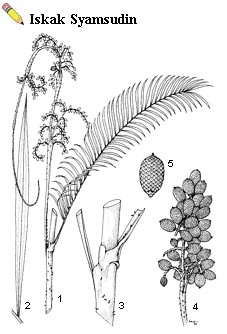 | Calamus exilis Griffith - 1, sheathed stem with leaf and inflorescence; 2, leaflet; 3, base of leaf and peduncle; 4, part of infructescence; 5, fruit |
Ecology
Calamus exilis is found in a wide variety of forest types. It has been found in peat-swamp forest, but mostly on ridges in hill and lower montane forests.
Agronomy
A plantation trial has been established in Sungai Tutung, Kerinci, Sumatra. Sucker shoots were used as planting material, and transplanted beneath perennial crops. It was reported that after two months survival was high.
Genetic Resources and Breeding
Besides the plantation trial at Kerinci, Sumatra, a few plants of Calamus exilis have been cultivated at the arboretum at FRIM, Kepong, Malaysia.
Prospects
This rattan may be cultivated for local use.
Literature
Dransfield, J., 1979. A manual of the rattans of the Malay Peninsula. Malayan Forest Records No 29. Forest Department, Kuala Lumpur. p. 176.
Siebert, S.F., 1989. The dilemma of a dwindling resource: Rattan in Kerinci, Sumatra. Principes 33(2): 79-87.
Siebert, S.F., 1989. The dilemma of a dwindling resource: Rattan in Kerinci, Sumatra. Principes 33(2): 79-87.
Author(s)
P. Kramadibrata
Correct Citation of this Article
Kramadibrata, P., 1993. Calamus exilis Griffith. In: Dransfield, J. and Manokaran, N. (Editors): Plant Resources of South-East Asia No 6: Rattans. PROSEA Foundation, Bogor, Indonesia. Database record: prota4u.org/prosea

All texts are licensed under a Creative Commons Attribution-Noncommercial-Share Alike 3.0 Netherlands License
This license does not include the illustrations (Maps,drawings,pictures); these remain all under copyright.