Record Number
1949
PROSEA Handbook Number
6: Rattans
Taxon
Calamus palustris Griffith
Protologue
Ann. Roy. Bot. Gard. Calcutta 11: 405 (1908).
Family
PALMAE
Chromosome Numbers
2n = unknown
Synonyms
Calamus dumetorum Ridley (1907).
Vernacular Names
Malaysia (Peninsular): rotan buku hitam, rotan teling (Kedah/Perlis), rotan sega beruang (Pahang), rotan pasir (Perak). Thailand: waai khring (Trang).
Origin and Geographic Distribution
Calamus palustris is widespread, occurring from Burma and southern China southwards to Peninsular Malaysia and the Andaman Islands.
Uses
Calamus palustris produces an excellent cane used in making the framework of furniture. Because of its great similarity in appearance and properties to Calamus manan Miq., the supreme cane of the furniture industry, it is traded as Calamus manan.
Properties
The beautiful glossy, yellowish cane of excellent appearance has morphological and strength properties that differ very little from those of Calamus manan, except the diameter is slightly smaller than the average diameter of the latter. Internode length ranges from 15—30 cm.
Description
Clustering rattan climbing to 30 m tall, flowering when quite short. Stem without leaf-sheaths 15—20 mm in diameter with internodes to 30 cm, with leaf-sheaths to 35 mm. Leaf cirrate, to 2.5 m long including the cirrus to 1 m; leaf-sheath bright green, armed with scattered brown yellow-based spines to 3 cm long, usually less, with much smaller spines scattered in between, reddish-brown indumentum abundant on young sheaths; knee conspicuous; ocrea to 3 mm long, dark brown, unarmed; petiole short, about 10—15 cm long, semicircular in cross-section, the upper flat surface armed with short erect spines; leaflets to about 21 on each side of the rachis, arranged in twos to fours, broad, spathulate, to about 35 cm x 4 cm, unarmed or very sparsely armed. Inflorescences to about 1 m long, usually less in female; male rachillae 2 cm long, up to 5 cm in female; bracts sparsely armed. Fruit globular, about 9 mm in diameter, weight 0.6 g, tipped with a beak 2 mm long, and covered in 12 vertical rows of straw-coloured scales with brown margins. Seed about 9 mm x 7 mm x 5 mm, deeply pitted, the pits penetrating the endosperm. Seedling-leaf bifid, midrib pale yellow.
Image
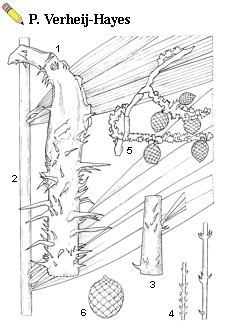 | Calamus palustris Griffith - 1, part of stem with leaf-sheath; 2, part of leaf; 3, base of leaflet; 4, two parts of the cirrus; 5, part of infructescence; 6, fruit |
Wood Anatomy
The peripheral zone consists of up to 10 rows of lignified parenchyma cells. The outer 3—4 cells are rectangular and appear more strongly lignified. The vascular bundles consist of 1 metaxylem vessel (approximate diameter 300—350 µm) and 2 phloem fields located laterally and containing 4—6 sieve tubes each. The surrounding fibre sheath is extensive and strongly lignified. Fibre with length 1.5 mm, diameter about 18 µm, wall thickness approximately 4 µm and lumen diameter about 10 µm. The ground tissue consists of large and generally thin-walled parenchyma cells of irregular outline, intercellular spaces large and numerous.
Growth and Development
Germination begins 6 weeks after sowing. At 31 months after planting under stands of Pinus caribaea Morelet, stem lengths ranged from 2—4 m, with one stem (3.5 m long) having produced a female inflorescence. Growth is better in young secondary forest or in old rubber plantations (5—15 stems per clump), where there is more light, than in regenerated forest (1—5 stems per clump). Each fruit bunch contains 500—1000 fruits.
Other Botanical Information
Calamus palustris resembles Calamus axillaris Becc., but in the latter the petiole is channelled on the upper surface, and is unarmed, as opposed to flat and densely armed. The inflorescences of the two species are also clearly distinct. Based on variation in armature and leaflet arrangement several varieties have been distinguished: var. malaccensis Becc. in northern Peninsular Malaysia, var. cochinchinensis Becc. in Indo-China, var. amplissima Becc. from cultivated material, and var. longistachys Pei & Chen from China. The separation of varieties is in need of reassessment. As the varieties themselves are so variable, there is probably little justification for recognizing them.
Ecology
Calamus palustris is found in various habitats such as regenerated forest and young secondary forest, and in old rubber plantations near villages, suggesting cultivation. It grows on lower slopes up to 900 m altitude.
Agronomy
Although Calamus palustris is a clump-forming species, and the sucker shoots could be used in propagation, seedlings raised from seeds are the best source of planting material. Nursery procedures and outplanting techniques are similar to those described for other species such as Calamus manan and Calamus subinermis Becc. Likely planting sites are secondary forest areas in the lowlands. The only plantings known are of a few plants under a stand of Pinus caribaea in Kedah. Clumps seen in old rubber plantations near villages have probably been planted.
Little maintenance is required, apart from initial weeding and where necessary, opening the canopy sufficiently to allow light to reach the seedlings. There is no information on diseases and pests of Calamus palustris in the wild or in the nursery.
It is not known at what age the cane can be harvested. The harvesting method is similar to that for other medium- to large-diameter canes. As for other medium- and large-diameter canes, the cut canes are washed and cleaned before being boiled in an mixture of diesel and coconut oil, diesel and kerosene or diesel and palm oil, for varying lengths of time. They are then rubbed with gunny sacking and stood upright to dry in the sun, after which they are bundled.
Genetic Resources and Breeding
No collection of genetic variability has been carried out so far and no breeding work has been initiated.
Prospects
Calamus palustris has the potential to be cultivated on a commercial scale because of its quality, which is comparable to that of Calamus manan, and of its clustering habit that allows for multiple harvests. It is a species that should be thoroughly researched.
Literature
Dransfield, J., 1979. A manual of the rattans of the Malay Peninsula. Malayan Forest Records No 29. Forest Department, Kuala Lumpur. pp. 140-143.
Nur Supardi, M.N., 1990. Langkawi's manau: Calamus palustris. Rattan Information Centre Bulletin 9(2): 1-3.
Weiner, G. & Liese, W., 1988. Anatomical differences of rattans from Peninsular Malaysia. Rattan Information Centre Bulletin 7(1/2): 2-6.
Nur Supardi, M.N., 1990. Langkawi's manau: Calamus palustris. Rattan Information Centre Bulletin 9(2): 1-3.
Weiner, G. & Liese, W., 1988. Anatomical differences of rattans from Peninsular Malaysia. Rattan Information Centre Bulletin 7(1/2): 2-6.
Author(s)
N. Manokaran
Correct Citation of this Article
Manokaran, N., 1993. Calamus palustris Griffith. In: Dransfield, J. and Manokaran, N. (Editors): Plant Resources of South-East Asia No 6: Rattans. PROSEA Foundation, Bogor, Indonesia. Database record: prota4u.org/prosea

All texts are licensed under a Creative Commons Attribution-Noncommercial-Share Alike 3.0 Netherlands License
This license does not include the illustrations (Maps,drawings,pictures); these remain all under copyright.