Record Number
1955
PROSEA Handbook Number
6: Rattans
Taxon
Calamus trachycoleus Beccari
Protologue
Ann. Roy. Bot. Gard. Calcutta 11 (Appendix): 108 (1913).
Family
PALMAE
Chromosome Numbers
2n = unknown
Vernacular Names
Indonesia: rotan irit (Kalimantan).
Origin and Geographic Distribution
Calamus trachycoleus is endemic to the Barito-Kapuas floodplains of South and Central Kalimantan in Indonesia between latitudes 2—3°S where it is widely planted by villagers along river banks. It is now also planted on a fairly large scale (4000—5000 ha) in the Malaysian state of Sabah, and to a smaller extent in the states of Sarawak and Pahang.
Uses
In commerce, Calamus trachycoleus is used mainly as skin peels for the weaving of chair seats and backs, and unsplit for furniture. The cores are also used for furniture and basket making. In recent years, because of the shortage of Calamus caesius Blume canes, it has been used extensively as a substitute for the production of rattan mats ('tatami' in Japanese, or known as 'lampit' locally). Villagers utilize it to make baskets and fish traps, as rope in raft building, and as cordage.
Production and International Trade
The 1984 consumption of Calamus trachycoleus in Indonesia was about 125 t (out of a total production of 150 000 t). Since more than 12 000 ha has been planted with Calamus trachycoleus around Dadahup in Central Kalimantan since 1850, production is expected to be much higher than published, as most Calamus trachycoleus harvested has been sold as Calamus caesius in order to fetch a higher price. Before Indonesia banned the export of round canes in 1986, most of the export of unprocessed canes was to Singapore where they were re-exported, mainly to Hong Kong and Taiwan. By 1988, finished products were exported directly to consumer countries, with Japan, Europe and the United States being the major buyers.
Properties
Diameter of canes varies from 4.5—13.5 mm, with most between 5—8 mm. This variation is due to increase in diameter of the cane with length. The siliceous layer gives the cane a glossy appearance and after fumigation with sulphur and sun drying, it is golden yellow in colour. The canes are lighter and more pliable than Calamus caesius. Because it is more pliable, the peels are preferred for weaving as they are easier to work with. Partly because of its smaller average diameter, between 7500—8000 pieces of 6 m long air-dried canes make a ton. Internodal lengths vary from 15—30 cm or more.
Description
Clustering, stoloniferous, dioecious rattan climbing to 60 m or more. Stolons 2—3 m long, 3—4 cm in diameter. Stems in diffuse, open colonies, medium-size, 4.5—13.5 mm without leaf-sheaths, to 20 mm in diameter with sheaths; internodes 15—30 cm or more long. Leaf cirrate, to 2.3 m long, including cirrus to 1 m and a short petiole 1.5—2.5 cm long; leaf-sheath to 95 cm long, exposed upper portion with scattered large spines, dark brown at the tip and green at the base, 10 mm long and 6 mm wide at the base and with numerous spicules 2 mm long in between; ocrea a low ridge 4 mm high; petiole semicircular to broadly triangular in cross-section, armed as the sheath on lower surface, unarmed on upper surface; leaflets to 15 pairs, irregularly arranged, lanceolate, largest to 33 cm x 3.7 cm with 3 main longitudinal veins on each side of the mid-vein, armed only along margin with 1.5 mm long brown spines. Male and female inflorescences superficially similar, to 170 cm long with 11—14 pairs of partial inflorescences, longest to 67 cm, branching to 3 orders in male and to 2 orders in the female; bracts tubular; male rachillae more crowded than in female, to 16 cm long with 6—12 pairs of distichous flowers; female rachillae to 10 pairs on most branches except apical ones. Fruit ovoid, 1 cm in diameter, with 9 or more vertical rows of scales. Seed 9 mm x 6 mm x 5 mm, shallowly grooved.
Image
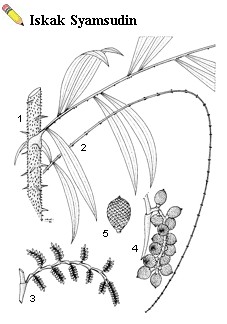 | Calamus trachycoleus Beccari - 1, part of stem with basal part of leaf; 2, upper part of leaf with cirrus; 3, part of inflorescence; 4, part of infructescence; 5, fruit |
Growth and Development
During germination a plug emerges, pushing aside the inner integument. This occurs from the second day after the seeds have been cleaned and up to 6 weeks; most of the seeds have germinated by the 3rd—4th week. The stem begins to elongate from the 5th—6th month followed by the production of short rhizomes and more aerial stems. This method of vegetative reproduction is the same as that for Calamus caesius; however, unlike Calamus caesius, long stolons are produced from year 2—3 onwards. When a stolon is 1—3 m long, it metamorphoses into an aerial stem. At the point of metamorphosis, two branches are produced, one from each adjacent node, which elongate to form new stolons. The stolons are thus very invasive and there is a potential for exponential increase in aerial stems, but the distal branch of the stolon usually develops more slowly and sometimes remains dormant. In Calamus caesius, competition for growing space is greater because of the short rhizomes, and rhizomes are forced to grow upwards or downwards, producing three or even four tiers of rhizomes. The severe competition causes many of the branches to remain dormant as bulbil-like shoots and expansion is thus nowhere as rapid as in Calamus trachycoleus. Production of stolons in Calamus trachycoleus, however, does not mean that the production of short rhizomes ceases. There is thus a denser central clump surrounded by diffuse canes from stolons. Inflorescences are produced by the 4th year. Not all canes flower at the same time. Flowering canes produce between 1—4 inflorescences. Fruits normally abort at first flowering. Between 1000—1500 fruits are borne per infructescence.
Ecology
Calamus trachycoleus grows best on raised alluvial soils of floodplains subject to seasonal flooding, e.g. river levées and foothills, but cannot withstand stagnant water. Seedlings, however, can survive being submerged under flood waters for over a month, provided the water is flowing (and thereby providing oxygen). The species grows most profusely on river banks because of abundant light. It does not occur in deep peat, and is generally not planted by villagers in such areas in Kalimantan. Calamus trachycoleus also does not occur in areas affected by salt or brackish water.
Propagation and planting
Propagation is from seed, but villagers along the Barito River also use wildlings and stolons for planting. In commercial nurseries fruits are lightly crushed to break up the seed-coat before being rubbed on quarter-inch wire mesh to remove the sarcotesta. The cleaned seeds are treated with a fungicide and sown without delay, either in trays or seed-beds. Seed-beds are usually filled with forest topsoil. The seeds are evenly spread over the topsoil and covered with 2 cm of sawdust. Seed-beds are shaded and well watered. Sawdust alone is used in germination trays. The seeds are similarly spread thinly and covered with 2 cm of sawdust. One month after sowing, when the shoots are 2—3 cm above the sawdust, the seedlings are potted into polybags 15 cm deep and about 15 cm in diameter, variously filled with topsoil or 75% topsoil mixed with 25% sand mixed with chicken dung or commercial fertilizers. The seedlings are provided with overhead shade and are watered twice a day. Villagers normally use palm fronds for shade, but netting providing 50—60% shade is more commonly used in commercial nurseries. The potted seedlings are periodically sprayed with fungicide and fertilized for continued and vigorous growth. At 8—9 months, when the seedlings are between 40—50 cm tall, they are planted in the field. Residual trees in logged-over riverine forest are used as support for the canes. Planting lanes 2—4 m wide and running east—west are cut and staked before planting. Various spacings of 2 m x 10 m, 8 m x 10 m to 20 m x 20 m are used. Unlike Calamus caesius which is clump-forming, very wide spacings can be used because Calamus trachycoleus soon spreads over the whole planting area. It has also been successfully planted under abandoned rubber holdings which have been thinned, leaving some trees for support. Where tapping of rubber is continued, Calamus trachycoleus spreads all over the plantation and hinders access and tapping. For this reason it is not suitable for planting under fruit trees.
Husbandry
After planting, the seedlings have to be weeded 2—3 times a year for the first 2—3 years. After the third year, when stolons have been produced, weeding is not possible because workers may cut the canes accidentally. Canopy manipulation is required to allow sufficient light to reach the seedlings for rapid growth. Along the Barito River, villagers systematically girdle other trees leaving behind Lagerstroemia sp. as support trees because these trees grow evenly in height to 10—15 m making harvesting of canes easy. These trees are also strong enough to support the weight of the climbing canes.
Diseases and Pests
Seedlings in the nursery are attacked by fungi belonging to the genera Curvularia, Colletotrichum, Phomopsis and Pestalotiopsis that cause leaf-spot diseases. Severely infected leaves dry up. Such diseases can be controlled by spraying the seedlings with a fungicide. Leaf blight caused by Colletotrichum gloeosporioides is more serious and may kill the seedlings in a few weeks. Control is by spraying with fungicide (e.g. triadimefon) at 10-day intervals. In the plantation, squirrels gnaw at the shoots and an unidentified weevil bores down the shoot, destroying the meristem. Other pests observed are elephants which pull out seedlings as they feed along the planting lanes, and wild boars that uproot seedlings when they forage for roots and worms. Elephants also pull down canes to eat the shoots, including the growing tips of stolons.
Harvesting
Older canes of the clumps are ready for harvesting 8 years after planting. The lower fronds have by this time turned brown and fallen off, leaving behind the dead leaf-sheaths. The canes are cut some 30 cm from the base and the dead leaf-sheaths removed by hitting the cane with the blade of a jungle knife. Green fronds and leaf-sheaths are stripped by either standing on the fronds and pulling the cane upwards or by pulling the cane between the fork of a branch or tree. Canes are pulled down in stages, usually by two men, as the leaf-sheaths are removed. If a cane cannot be completely pulled down because the upper portion is entangled in branches, it is cut as high up as possible. In Indonesia, entangled canes are cut with a knife attached to the end of a long pole. After the cane has been pulled down, it is cut into 6 m long pieces, and the apical 5—6 m discarded as it is immature and snaps easily after fumigation. A hundred pieces 6 m long are bent in the middle, tied into a bundle and carried to the nearest road for transportation to the processing centres. If the canes cannot be brought out the same day, they are placed over a log to drain off excess water.
Yield
Yield estimates from Kalimantan are 2 t dry canes per ha at year 8 followed thereafter by 1.5—2.2 t dry canes/ha per year. It is because of the high yield that villagers along the Barito River plant more Calamus trachycoleus than Calamus caesius, although the quality and price are higher in the latter species.
Handling After Harvest
In Central Kalimantan, canes are traditionally deglazed within 24 hours. Deglazing ('runti') is carried out for several reasons: to remove the silicified epidermis which will otherwise blunt the splitting tools and damage the machines, to effectively prevent the substitution of inferior kinds of canes, and to make the skins more pliable. The most common techniques used in deglazing are pulling the cane backward and forward through a hole made in a piece of bamboo tied to a tree ('runti gosok'), through a loop suspended between three bamboo poles 1 m above the ground or through a thick metal ring and rubbing briskly with a chain ('runti jala'), or by hitting the cane with a piece of wood or plaited rattan ('runti pelari'). Since 1987, harvesters have tended to leave the glaze on the canes, selling them as Calamus caesius for the manufacture of rattan carpets because of the increase in the number of factories making rattan mats ('tatami' mats) and the shortage of Calamus caesius canes for this purpose in Central Kalimantan.
Canes with a glaze are first washed in a river or stream and scrubbed with a metal brush or with sand to remove dirt and any dead leaf-sheaths remaining after harvesting. The canes are then stacked loosely in an airtight fumigation shed or over racks and covered with plastic tarpaulin and fumigated overnight with sulphur to turn the surface golden yellow as well as to destroy all borers and staining fungi. The amount of sulphur used for fumigation varies from 2—2.5 kg per half t of canes to 3—4 kg for 10 t. The canes are then removed from the fumigation shed and dried over racks in full sun for 5—7 days, during which time the moisture content is brought down to 5—10%. This is necessary because both fungal and insect attacks begin when moisture content is 20% or more. After drying, canes are graded according to diameter size and severity of fungal attack, with golden yellow canes as premium quality. Graded canes are tied into 50 kg bundles. Depending on the end-use, splitting, peeling and coring may be carried out. Low-grade canes are normally used for the manufacture of poor quality furniture for the domestic market.
Canes with a glaze are first washed in a river or stream and scrubbed with a metal brush or with sand to remove dirt and any dead leaf-sheaths remaining after harvesting. The canes are then stacked loosely in an airtight fumigation shed or over racks and covered with plastic tarpaulin and fumigated overnight with sulphur to turn the surface golden yellow as well as to destroy all borers and staining fungi. The amount of sulphur used for fumigation varies from 2—2.5 kg per half t of canes to 3—4 kg for 10 t. The canes are then removed from the fumigation shed and dried over racks in full sun for 5—7 days, during which time the moisture content is brought down to 5—10%. This is necessary because both fungal and insect attacks begin when moisture content is 20% or more. After drying, canes are graded according to diameter size and severity of fungal attack, with golden yellow canes as premium quality. Graded canes are tied into 50 kg bundles. Depending on the end-use, splitting, peeling and coring may be carried out. Low-grade canes are normally used for the manufacture of poor quality furniture for the domestic market.
Genetic Resources and Breeding
No breeding work has been carried out so far. There is, however, a substantial base population in plantations from which to work on, and selection of superior phenotypes is beginning.
Prospects
Prospects for cultivation of Calamus trachycoleus are very good, especially in areas of seasonal flooding where Calamus caesius and other agricultural crops will not survive. It is an ideal crop for smallholders, as demonstrated by villagers in Central and South Kalimantan. Because of its colonizing nature, it is an attractive crop for commercial cultivation as there is no need for replanting. The diameter of the cane is also ideal for splitting. With selection it may be possible to obtain plants producing high quality canes with long internodes, fetching the high price of Calamus caesius. An additional bonus in the planting in riverine forest is the minimum disturbance to the ecosystem.
Literature
Dransfield, J., 1977. Calamus caesius and Calamus trachycoleus compared. Gardens' Bulletin Singapore 30: 75-78.
Norani, A. & Maziah, Z., 1988. Diseases of Calamus spp. (Rattan). FRIM Technical Information No 4. 4 pp.
Shim, P.S., 1985. Notes on sites for rattan planting. Rattan Information Centre Bulletin 4(3): 1-2.
Shim, P.S., 1988. Outplanting techniques of Calamus trachycoleus. In: Dhanarajan, G. & Manokaran, N. (Editors): Proceedings of the colloquium on rattan propagation, 19-22 January 1987, Kota Kinabalu, Sabah, Malaysia. Rattan Information Centre Occasional Paper No 5: 29-31.
Shim, P.S., 1988. Why runti? Rattan Information Centre Bulletin 7(3/4): 8, 12.
Subyanto, 1986. Profil proyek industri barang jadi rotan untuk industri [Profile of an industrial project on manufactured rattan products]. Proceedings of Lokakarya Nasional Rotan, Jakarta. Departemen Kehutanan, Badan Penelitian Dan Pengembangan Kehutanan and IDRC. pp. 360-383.
Tardjo, S., 1986. Pengalaman pembudidayaan rotan dalam praktek [Experience with rattan cultivation]. Proceedings of Lokakarya Nasional Rotan, Jakarta. Departemen Kehutanan, Badan Penelitian Dan Pengembangan Kehutanan and IDRC. pp. 47-73.
Author(s)
P.S. Shim & C.F. Tan
Correct Citation of this Article
Shim, P.S. & Tan, C.F., 1993. Calamus trachycoleus Beccari. In: Dransfield, J. and Manokaran, N. (Editors): Plant Resources of South-East Asia No 6: Rattans. PROSEA Foundation, Bogor, Indonesia. Database record: prota4u.org/prosea

All texts are licensed under a Creative Commons Attribution-Noncommercial-Share Alike 3.0 Netherlands License
This license does not include the illustrations (Maps,drawings,pictures); these remain all under copyright.