Record Number
204
PROSEA Handbook Number
12(1): Medicinal and poisonous plants 1
Taxon
Curcuma xanthorrhiza Roxb.
This article should be read together with the article on the genus: Curcuma in the Handbook volume indicated above in this database.
This article should be read together with the article on the genus: Curcuma in the Handbook volume indicated above in this database.
Protologue
Fl. ind. (Carey ed.) 1: 25 (1820).
Vernacular Names
Indonesia: koneng gede (Sundanese), temu lawak (Javanese), temo labak (Madurese). Malaysia: temu lawas, temu raya (Peninsular). Thailand: wan chakmotluk (central). Vietnam: ngh[eej] v[af]ng, ngh[eej] r[eex] v[af]ng.
Distribution
Curcuma xanthorrhiza is native to Java, Bali and the Moluccas. It is commonly cultivated in Java, Peninsular Malaysia, the Philippines and Thailand, occasionally also in India.
Uses
Rhizomes are used to treat various abdominal complaints and liver disorders (jaundice, gallstones, promoting the flow of bile). A decoction of the rhizome is also used as a remedy for fever and constipation, and taken by women as a galactagogue and to lessen uterine inflammation after giving birth. Other applications are against bloody diarrhoea, dysentery, inflammation of the rectum, haemorrhoids, stomach disorders caused by cold, infected wounds, skin eruptions, acne vulgaris, eczema, smallpox and anorexia. In Indonesia, rhizomes enter as an important ingredient into many 'jamus'. They yield a starch, and a yellow dye. Young stems and rhizome parts are eaten as a vegetable either raw or cooked. The inflorescences are eaten cooked. In Java, a soft drink called 'bir temu lawak' is prepared by cooking dried pieces of rhizomes.
Observations
A herb with branched rhizome, outside dark yellow to reddish-brown, inside orange or orange-red; leaf sheaths up to 75 cm long, blades elliptical-oblong to oblong-lanceolate, 25-100 cm x 8-20 cm, green with a reddish-brown band along the midrib; inflorescence on a separate shoot, bracts pale green, coma bracts purple; corolla 4-6 cm long, pale red; labellum 2-2.5 cm x 1.5-2 cm, yellowish with a darker yellow median band, other staminodes longitudinally folded, yellowish-white, anther with long spurs. Curcuma xanthorrhiza is found in thickets and teak forest, mainly on moist, fertile, humus-rich soils, up to 750 m altitude.
Image
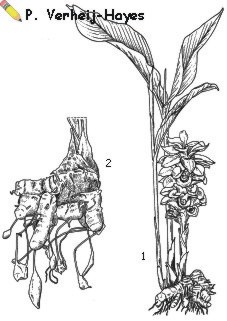 | Curcuma xanthorrhiza Roxb. — 1, habit flowering plant; 2, tuberous rhizome |
Selected Sources
[97] Backer, C.A. & Bakhuizen van den Brink Jr, R.C., 1963-1968. Flora of Java. 3 volumes. Noordhoff, Groningen, the Netherlands. Vol. 1 (1963) 647 pp., Vol. 2 (1965) 641 pp., Vol. 3 (1968) 761 pp.
[202] Burkill, I.H., 1966. A dictionary of the economic products of the Malay Peninsula. Revised reprint. 2 volumes. Ministry of Agriculture and Co-operatives, Kuala Lumpur, Malaysia. Vol. 1 (A-H) pp. 1-1240. Vol. 2 (I-Z) pp. 1241-2444.
[269] Claeson, P., Panthong, A., Tuchinda, P., Reutrakul, V., Kanjanapathi, D., Taylor, W.C. & Santisuk, T., 1993. Three non-phenolic diarylheptanoids with anti-inflammatory activity from Curcuma xanthorrhiza. Planta Medica 59(5): 451-454.
[270] Claeson, P., Pongprayoon, U., Sematong, T., Tuchinda, P., Reutrakul, V., Soonthorsaratune, P. & Taylor, W.C., 1996. Non-phenolic linear diarylheptanoids from Curcuma xanthorrhiza: a novel type of topical anti-inflammatory agents: structure-activity relationship. Planta Medica 62(3): 236-240.
[310] Dan Thi Mai et al., 1982. Cao long Curcuma xanthorrhiza (Zingiberaceae) lam ha cholesterol huyet thuc nghiem [Liquid balm of Curcuma xanthorrhiza (Zingiberaceae) can reduce blood cholesterol]. Tap chi Duoc hoc 2: 10-12. (in Vietnamese)
[314] Darwis SN, Madjo Indo, A.B.D. & Hasiyah, S., 1991. Tumbuhan obat famili Zingiberaceae [Medicinal plants of the Zingiberaceae]. Seri Pengembangan No. 17. Pusat Penelitian dan Pengembangan Tanaman Industri, Bogor, Indonesia. 103 pp.
[329] de Jong, A.W.K., 1948. Temoe lawak (Curcuma xanthorrhiza Roxb.). In: van Hall, C.J.J. & van de Koppel, C. (Editors): De landbouw in de Indische Archipel [Agriculture in the Indonesian Archipelago]. Vol. 2a. W. van Hoeve, 's-Gravenhage, the Netherlands. pp. 896-901.
[350] Dharma, A.P., 1981. Indonesische geneeskrachtige planten [Indonesian medicinal plants]. De Driehoek, Amsterdam, the Netherlands. 168 pp.
[414] Flach, M. & Rumawas, F. (Editors), 1996. Plant Resources of South-East Asia No 9. Plants yielding non-seed carbohydrates. Backhuys Publishers, Leiden, the Netherlands. 239 pp.
[580] Heyne, K., 1950. De nuttige planten van Indonesië [The useful plants of Indonesia]. 3rd Edition. 2 volumes. W. van Hoeve, 's-Gravenhage, the Netherlands/Bandung, Indonesia. 1660 + CCXLI pp.
[615] Holttum, R.E., 1950. The Zingiberaceae of the Malay Peninsula. Gardens' Bulletin, Singapore 13(1): 1-249.
[660] Itokawa, H., Hirayama, F., Funakoshi, K. & Takeya, K., 1992. Studies on the antitumor bisabolane sesquiterpenoids isolated from Curcuma xanthorrhiza. Chemical and Pharmaceutical Bulletin 33(8): 3488-3492.
[681] Jitoe, A. et al., 1992. Antioxidant activity of tropical ginger extracts and analysis of the contained curcuminoids. Journal of Agricultural and Food Chemistry 40(8): 1337-1340.
[776] Kosuge, T., 1985. Studies on antitumour activities and antitumour principles of Chinese herbs. Yakugaku Zasshi 105(8): 791-795. (in Japanese)
[866] Lin, S.C. et al., 1995. Protective and therapeutic effects of Curcuma xanthorrhiza on hepatotoxin-induced liver damage. American Journal of Chinese Medicine 23(3-4): 243-254.
[867] Lin, S.C., Teng, C.W., Lin, C.C., Lin, Y.H. & Supriyatna, S., 1996. Protective and therapeutic effect of the Indonesian medicinal herb Curcuma xanthorrhiza on 'BETA'-D-galactosamine-induced liver damage. Phytotherapy Research 10(2): 131-135.
[912] Masuda, T., Isobe, J., Jitoe, A. & Nakatani, N., 1992. Antioxidative curcuminoids from rhizomes of Curcuma xanthorrhiza. Phytochemistry 31(10): 3645-3647.
[1066] Ochse, J.J. & Bakhuizen van den Brink, R.C., 1980. Vegetables of the Dutch East Indies. 3rd English edition (translation of 'Indische groenten', 1931). Asher & Co., Amsterdam, the Netherlands. 1061 pp.
[1097] Ozaki, Y., 1990. Anti-inflammatory effect of Curcuma xanthorrhiza Roxb. and its active principles. Chemical and Pharmaceutical Bulletin 38(4): 1045-1048.
[1098] Ozaki, Y. & Liang, O.B., 1988. Cholagogic action of the essential oil obtained from Curcuma xanthorrhiza Roxb. Shoyakugaku Zasshi 42(4): 257-263. (in Japanese)
[1112] Pandii, C. et al., 1993. Insecticidal constituents from four species of the Zingiberaceae. Phytochemistry 34(2): 415-419.
[1211] Rehm, S. (Editor), 1989. Handbuch der Landwirtschaft und Ernahrung in den Entwicklungsländern. Band 4. Spezieller Pflanzenbau in den Tropen und Subtropen [Handbook of agriculture and nutrition in developing countries. Vol. 4. Special crop cultivation in the tropics and subtropics]. 2nd Edition. E. Ulmer, Stuttgart, Germany. 653 pp.
[1212] Rehm, S. & Espig, G., 1991. The cultivated plants of the tropics and subtropics. Cultivation, economic value, utilization. Technical Centre for Agriculture and Rural Co-operation (CTA), Ede, the Netherlands & Verlag Josef Margraf, Weikersheim, Germany. 552 pp.
[1380] Smitinand, T., 1980. Thai plant names. Royal Forest Department, Bangkok, Thailand. 379 pp.
[1496] Valeton, T., 1918. New notes on the Zingiberaceae of Java and the Malayan Archipelago. Bulletin du Jardin Botanique de Buitenzorg, Série II, 27: 1-167.
[1507] van Steenis, C.G.G.J., 1949. Plumbaginaceae. In: van Steenis, C.G.G.J. (General editor): Flora Malesiana. Series 1, Vol. 4. Noordhoff-Kolff N.V., Djakarta, Indonesia. pp. 107-112.
[1622] Yasni, S. et al., 1993. Effects of Curcuma xanthorrhiza Roxb. and curcuminoids on the level of serum and liver lipids serum apolipoprotein A-I and lipogenic enzymes in rats. Food and Chemical Toxicology 31(3): 213-218.
[1623] Yasni, S. et al., 1994. Identification of an active principle in essential oils and hexane-soluble fractions of Curcuma xanthorrhiza Roxb. showing triglyceride-lowering action in rats. Food and Chemical Toxicology 32(3): 273-278.
[1624] Yasni, S., Imaizumi, K. & Sugano, M., 1991. Effects of an Indonesian medicinal plant Curcuma xanthorrhiza Roxb. on the levels of serum glucose and triglyceride fatty acid desaturation and bile acid excretion in streptozotocin-induced diabetic rats. Agricultural and Biological Chemistry 55(12): 3005-3010.
Author(s)
Trimurti H. Wardini & Budi Prakoso
Correct Citation of this Article
Wardini, T.H. & Prakoso, B., 1999. Curcuma xanthorrhiza Roxb.. In: de Padua, L.S., Bunyapraphatsara, N. and Lemmens, R.H.M.J. (Editors): Plant Resources of South-East Asia No 12(1): Medicinal and poisonous plants 1. PROSEA Foundation, Bogor, Indonesia. Database record: prota4u.org/prosea

All texts are licensed under a Creative Commons Attribution-Noncommercial-Share Alike 3.0 Netherlands License
This license does not include the illustrations (Maps,drawings,pictures); these remain all under copyright.