Record Number
205
PROSEA Handbook Number
12(1): Medicinal and poisonous plants 1
Taxon
Curcuma zedoaria (Christm.) Roscoe
This article should be read together with the article on the genus: Curcuma in the Handbook volume indicated above in this database.
This article should be read together with the article on the genus: Curcuma in the Handbook volume indicated above in this database.
Protologue
Trans. Linn. Soc. London 8: 354 (1807).
Synonyms
Curcuma pallida Lour. (1790), Curcuma zerumbet Roxb. (1810).
Vernacular Names
Long zedoary, round zedoary, zedoary (En). Zédoaire (Fr). Indonesia: koneng tegal (Sundanese), temu putih (Malay, Jakarta). Malaysia: kunchur, temu kuning, temu lawak (Peninsular). Philippines: alimpuyas (Cebu Bisaya), barak (Tagalog), tamahilan (Bikol). Burma (Myanmar): thanuwen. Cambodia: prâtiël prèah 'ângkaôl. Laos: 'khmin2 khai. Thailand: khamin khun (northern), khamin oi (central). Vietnam: ngh[eej] den, nga tru[aaj]t, ng[ar]i t[is]m.
Distribution
Probably native to north-eastern India. Distributed through cultivation to South and South-East Asia and probably throughout Malesia, China and Taiwan from where it easily escapes. Occasionally it is cultivated elsewhere (e.g. in Madagascar).
Uses
Rhizomes are widely used as stimulant, stomachic, carminative, diuretic, anti-diarrhoeal, anti-emetic, anti-pyretic and depurative, the latter especially after childbirth, but also to clean and cure ulcers, wounds and other kinds of skin disorders. Rhizomes are also chewed against bad breath, and a decoction is drunk against stomach-ache, indigestion and colds. The major use of rhizomes is for starch. In Indonesia, the heart of young shoots is used as a vegetable, young rhizome parts are eaten raw and inflorescences cooked. The leaves are used for flavouring foods. In India, rhizomes are also used in perfumery.
Observations
A herb with branched rhizome, outside grey, inside pale yellowish to bright yellow; leaf sheaths 35-60 cm long, blades oblong to oblong-lanceolate, 25-75 cm x 7-20 cm, green with a purple band along the midrib; inflorescence on a separate shoot, bracts green or green with a purple margin, coma bracts purple or dark pink; corolla 3.5-4.5 cm long, yellowish-white; labellum 2-2.5 cm x 1.5-2 cm, yellowish-white with a darker yellow median band, other staminodes longitudinally folded, yellowish-white, anther with long spurs. Curcuma zedoaria is found in various shady, damp localities on various soils, but prefers well-drained sandy soils, up to 1000 m altitude.
Image
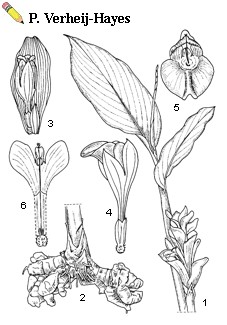 | Curcuma zedoaria (Christm.) Roscoe — 1, leafy and flowering stem; 2, tuberous rhizome; 3, bract with cincinnus; 4, flower in lateral view; 5, flower in front view; 6, stamen and lateral staminoides |
Selected Sources
[97] Backer, C.A. & Bakhuizen van den Brink Jr, R.C., 1963-1968. Flora of Java. 3 volumes. Noordhoff, Groningen, the Netherlands. Vol. 1 (1963) 647 pp., Vol. 2 (1965) 641 pp., Vol. 3 (1968) 761 pp.
[117] Bandara, B.M.R. et al., 1989. Antifungal activity of some medicinal plants of Sri Lanka. Journal of the National Science Council of Sri Lanka 17(1): 1-13.
[202] Burkill, I.H., 1966. A dictionary of the economic products of the Malay Peninsula. Revised reprint. 2 volumes. Ministry of Agriculture and Co-operatives, Kuala Lumpur, Malaysia. Vol. 1 (A-H) pp. 1-1240. Vol. 2 (I-Z) pp. 1241-2444.
[203] Burtt, B.L., 1977. Curcuma zedoaria. Gardens' Bulletin, Singapore 30: 59-62.
[287] Council of Scientific and Industrial Research, 1948-1976. The wealth of India: a dictionary of Indian raw materials & industrial products. 11 volumes. Publications and Information Directorate, New Delhi, India.
[314] Darwis SN, Madjo Indo, A.B.D. & Hasiyah, S., 1991. Tumbuhan obat famili Zingiberaceae [Medicinal plants of the Zingiberaceae]. Seri Pengembangan No. 17. Pusat Penelitian dan Pengembangan Tanaman Industri, Bogor, Indonesia. 103 pp.
[332] de Padua, L.S., Lugod, G.C. & Pancho, J.V., 1977-1983. Handbook on Philippine medicinal plants. 4 volumes. Documentation and Information Section, Office of the Director of Research, University of the Philippines at Los Baños, the Philippines.
[363] Doan Thi Nhu, Nguyen Thuong Thuc, Do Huy Bich & Vu Thuy Huyen (Editors), 1991. Les plants médicinales au Vietnam. Livre 1. Médicine traditionelle et pharmacopée [The medicinal plants of Vietnam. Volume 1. Traditional medicine and pharmacopoeia]. Agence de coopération Culturelle et Technique, Paris, France. 201 pp.
[414] Flach, M. & Rumawas, F. (Editors), 1996. Plant Resources of South-East Asia No 9. Plants yielding non-seed carbohydrates. Backhuys Publishers, Leiden, the Netherlands. 239 pp.
[455] Gagnepain, F. 1908. Zingibéracées [Zingiberaceae]. In: Gagnepain, F. (Editor): Flore générale de l'Indo-Chine [General flora of Indo-China]. Vol. 6. Masson & Cie, Paris, France. pp. 25-121.
[479] Ghazala Nasim, 1991. Vesicular arbuscular mycorrhizae in two Curcuma species (C. zedoaria and C. longa) of medicinal importance. Pakistan Journal of Forestry 41(4): 194-201.
[531] Gutierrez, H.G., 1980-1982. An illustrated manual of Philippine materia medica. 2 volumes. Natural Research Council of the Philippines, Tagig, Metro Manila, the Philippines. Vol. 1 (1980) pp. 1-234, Vol. 2 (1982) pp. 235-485.
[580] Heyne, K., 1950. De nuttige planten van Indonesië [The useful plants of Indonesia]. 3rd Edition. 2 volumes. W. van Hoeve, 's-Gravenhage, the Netherlands/Bandung, Indonesia. 1660 + CCXLI pp.
[615] Holttum, R.E., 1950. The Zingiberaceae of the Malay Peninsula. Gardens' Bulletin, Singapore 13(1): 1-249.
[639] Hwang, W.I., Cha, S. & Lee, S.Y., 1980. Extraction of anti cancer components from Korean medicinal plants and the determination of their cyto toxic activities on the cancer cells. Korean Biochemical Journal 13(1): 25-40.
[897] Mangaly, J. K. & Sabu, M., 1993. A taxonomic revision of the South Indian species of Curcuma Linn. (Zingiberaceae). Rheedea 3(2): 139-171.
[1035] Nguyen Van Duong, 1993. Medicinal plants of Vietnam, Cambodia and Laos. Mekong Printing, Santa Ana, California, United States. 528 pp.
[1066] Ochse, J.J. & Bakhuizen van den Brink, R.C., 1980. Vegetables of the Dutch East Indies. 3rd English edition (translation of 'Indische groenten', 1931). Asher & Co., Amsterdam, the Netherlands. 1061 pp.
[1112] Pandii, C. et al., 1993. Insecticidal constituents from four species of the Zingiberaceae. Phytochemistry 34(2): 415-419.
[1126] Perry, L.M., 1980. Medicinal plants of East and Southeast Asia. Attributed properties and uses. MIT Press, Cambridge, Massachusetts, United States & London, United Kingdom. 620 pp.
[1128] Pételot, A., 1952-1954. Les plantes médicinales du Cambodge, du Laos et du Vietnam [The medicinal plants of Cambodia, Laos and Vietnam]. 4 volumes. Centre National de Recherches Scientifiques et Techniques, Saigon, Vietnam.
[1178] Quisumbing, E., 1978. Medicinal plants of the Philippines. Katha Publishing Co., Quezon City, the Philippines. 1262 pp.
[1211] Rehm, S. (Editor), 1989. Handbuch der Landwirtschaft und Ernahrung in den Entwicklungsländern. Band 4. Spezieller Pflanzenbau in den Tropen und Subtropen [Handbook of agriculture and nutrition in developing countries. Vol. 4. Special crop cultivation in the tropics and subtropics]. 2nd Edition. E. Ulmer, Stuttgart, Germany. 653 pp.
[1212] Rehm, S. & Espig, G., 1991. The cultivated plants of the tropics and subtropics. Cultivation, economic value, utilization. Technical Centre for Agriculture and Rural Co-operation (CTA), Ede, the Netherlands & Verlag Josef Margraf, Weikersheim, Germany. 552 pp.
[1287] Saralamp, P., Temsiririrkkul, R., Chuakul, W., Riewpaiboon, A., Prathanturarug, S., Suthisisang, C. & Pongcharoensuk, P. (Editors), 1996. Medicinal plants in the Siri Ruckhachati Garden. 2nd Edition. Siambooks and Publications Co., Bangkok, Thailand. 263 pp.
[1380] Smitinand, T., 1980. Thai plant names. Royal Forest Department, Bangkok, Thailand. 379 pp.
[1496] Valeton, T., 1918. New notes on the Zingiberaceae of Java and the Malayan Archipelago. Bulletin du Jardin Botanique de Buitenzorg, Série II, 27: 1-167.
[1507] van Steenis, C.G.G.J., 1949. Plumbaginaceae. In: van Steenis, C.G.G.J. (General editor): Flora Malesiana. Series 1, Vol. 4. Noordhoff-Kolff N.V., Djakarta, Indonesia. pp. 107-112.
[1525] Vidal, J., 1962. Noms vernaculaires de plantes en usage au Laos [Vernacular names of plants used in Laos]. Ecole française d'Extrême-Orient, Paris, France. 197 pp.
Author(s)
Trimurti H. Wardini & Budi Prakoso
Correct Citation of this Article
Wardini, T.H. & Prakoso, B., 1999. Curcuma zedoaria (Christm.) Roscoe. In: de Padua, L.S., Bunyapraphatsara, N. and Lemmens, R.H.M.J. (Editors): Plant Resources of South-East Asia No 12(1): Medicinal and poisonous plants 1. PROSEA Foundation, Bogor, Indonesia. Database record: prota4u.org/prosea

All texts are licensed under a Creative Commons Attribution-Noncommercial-Share Alike 3.0 Netherlands License
This license does not include the illustrations (Maps,drawings,pictures); these remain all under copyright.