Record Number
2139
PROSEA Handbook Number
8: Vegetables
Taxon
Amaranthus L.
Protologue
Sp. pl.: 989 (1753); Gen. pl. ed. 5: 427 (1754).
Family
AMARANTHACEAE
Chromosome Numbers
2n = 34 (Amaranthus tricolor); 2n = 64 (Amaranthus dubius); 2n = 32 (Amaranthus cruentus)
Major Taxa and Synonyms
Major species and synonyms
— Amaranthus blitum L. cv. group Oleraceus, synonyms: Amaranthus lividus L. (1753), Amaranthus blitum L. var. oleraceus (L.) Hook.f. (1885);
— Amaranthus cruentus L., Syst. pl. ed. 10, 2: 1269 (1759), synonyms: Amaranthus paniculatus L. (1763), Amaranthus hybridus L. ssp. cruentus (L.) Thell. (1912);
— Amaranthus dubius C. Martius ex Thell., Fl. adv. Montpellier: 203 (1912);
— Amaranthus tricolor L., Sp. pl.: 989 (1753), synonyms: Amaranthus tristis L. (1753), Amaranthus mangostanus L. (1755), Amaranthus gangeticus L. (1759).
— Amaranthus blitum L. cv. group Oleraceus, synonyms: Amaranthus lividus L. (1753), Amaranthus blitum L. var. oleraceus (L.) Hook.f. (1885);
— Amaranthus cruentus L., Syst. pl. ed. 10, 2: 1269 (1759), synonyms: Amaranthus paniculatus L. (1763), Amaranthus hybridus L. ssp. cruentus (L.) Thell. (1912);
— Amaranthus dubius C. Martius ex Thell., Fl. adv. Montpellier: 203 (1912);
— Amaranthus tricolor L., Sp. pl.: 989 (1753), synonyms: Amaranthus tristis L. (1753), Amaranthus mangostanus L. (1755), Amaranthus gangeticus L. (1759).
Vernacular Names
Amaranth (En). Amarante (Fr). Indonesia and Malaysia: bayam. Papua New Guinea: aopa. Philippines: kulitis. Cambodia: phtii. Laos: hôm. Thailand: phakkhom-suan. Vietnam: rau d[eef]n.
Origin and Geographic Distribution
The genus is widely distributed. Typical vegetable amaranths (Amaranthus tricolor, Amaranthus dubius, Amaranthus blitum) originated from South-East Asia but have been carried to other regions by emigrants. Amaranthus cruentus is originally a cereal amaranth from South and Central America, currently grown as the main vegetable amaranth in Africa. By far the most important species in South-East Asia is Amaranthus tricolor, followed by Amaranthus dubius and Amaranthus cruentus.
Uses
The main use is as a leafy vegetable. It is very common in the whole of South-East Asia, more in lowland than in highland areas. With kangkong (Ipomoea aquatica Forssk.) it is the most popular leafy vegetable of Indonesia and Malaysia. It is an important vegetable in many tropical countries, for example in India, Bangladesh, Sri Lanka, Tanzania, Uganda, Nigeria, other West African countries and the Caribbean. Various amaranth species with light-coloured seeds, such as Amaranthus hypochondriacus L., Amaranthus cruentus and Amaranthus caudatus L., are traditionally grown as a minor cereal crop in Central America, South America, India and Nepal in mountain areas as well as at low altitudes. Thinnings of young seedlings from the cereal crop are frequently used as greens. Many wild Amaranthus species are used as pot herbs. Used as ornamentals are Amaranthus tricolor forms with red, yellow and green-coloured leaves or leaf sections, and Amaranthus caudatus and Amaranthus cruentus with large bright-red inflorescences. Amaranthus weeds are used for fodder (pigweed). Vegetable amaranths are recommended as a good food with medicinal properties for young children, lactating mothers and for patients with fever, haemorrhage, anaemia or kidney complaints. The wild Amaranthus spinosus L. is used as a depurative, against venereal diseases and as a dressing on boils.
Production and International Trade
Although considered a poor man's food, its economic value as a popular vegetable probably ranks among the ten highest in South-East Asia. Few exact economic data are available, since in most cases all leaf vegetables are recorded as one single group. Indonesian statistics in 1988 attributed 22 000 ha to amaranth grown for the city markets. Correct registration is hampered by the short growing period (3—6 weeks), scattered occurrence of small plots of cultivation, and the dispersed sales in small street markets. Amaranth is widely grown on a small scale in home gardens and open places in between field crops.
Properties
Amaranth leaves have a high content of essential micro- nutrients. They are an excellent source of ß-carotene with 4—8 mg per 100 g edible portion, vitamin C 60—120 mg, Fe 4—9 mg, and Ca 300—450 mg. They are rich in fibre and folic acid and their protein content (20—38% based on dry matter) includes methionine and other sulphur-containing amino-acids. The general dry matter content is high (12—16%). The leaves and stems have nitrate and oxalate levels similar to other green leaf vegetables such as spinach (Spinacia oleracea L.) and spinach beet (Beta vulgaris L.), but no adverse nutritional effects occur with a consumption of 100—200 g per day. The composition varies greatly with cultivar, soil fertility, water supply, and age at harvest. The higher the plant nutrition (N, P, K, etc.) the better the yield and the nutritional composition (especially iron, vitamin A and C). However, excessive N fertilization may result in an unacceptable high nitrate level. The weight of 1000 seeds varies from 200—850 mg.
Description
— Amaranthus. Erect annuals, strongly branching, up to 2.5 m tall, with a strongly branched taproot. Leaves alternate, long-petiolate, simple and entire. Flowers in axillary clusters, upper clusters often leafless and in panicled spikes, unisexual, solitary in the axil of a bract, with 2 bracteoles, 3—5 tepals and either free stamens, as many as tepals (male flowers), or ovate or oblong ovary with 2—3 (—4) stigmas (female flowers). Fruit a dry capsule, dehiscent or indehiscent. Seeds shiny black or brown.
— Amaranthus tricolor. Erect annual, up to 1.5 m tall. Leaves elliptical to lanceolate or broad-ovate, dark green, light green or red. Clusters of flowers axillary, often globose, with a reduced terminal spike, but occasionally the terminal spike is well developed. Tepals 3. Fruit dehiscent, with a circumscissile lid. Seeds black, relatively large; 1200—2900 seeds/g. Cultivated.
— Amaranthus dubius. Annual, sometimes biennial, up to 2 m tall, erect, strongly branching. Leaves ovate or rhomboid-ovate, shortly cuneate at base, dark green. Lower clusters of flowers axillary, upper clusters leafless and in lax panicled spikes. Tepals (3—) 5. Fruit dehiscent, with a circumscissile lid. Seeds black, very small; 3000—4800 seeds/g. Cultivated vegetable, sometimes escaped as weed.
— Amaranthus cruentus. Tall annual, up to 2.5 m. Leaves lanceolate, acute and often short-decurrent at base, greyish-green. Clusters of flowers in large axillary and terminal panicled spikes. Tepals 5. Fruit dehiscent, with a circumscissile lid. Seeds dark brown to black; 2500—3000 seeds/g. Seeds of grain types are light yellow. Cultivated as vegetable or grain.
— Amaranthus blitum cv. group Oleraceus. Small annual, up to 75 cm tall. Leaves (ob)ovate or rhomboid-(ob)ovate, shortly cuneate at base, green or more or less purple. Lower clusters of flowers axillary, upper clusters leafless and in axillary and terminal panicled spikes. Tepals 3 (—5). Fruit indehiscent or finally bursting irregularly. Seeds small, dark. Weed, sometimes cultivated. It is a popular cultivated vegetable in India.
— Amaranthus tricolor. Erect annual, up to 1.5 m tall. Leaves elliptical to lanceolate or broad-ovate, dark green, light green or red. Clusters of flowers axillary, often globose, with a reduced terminal spike, but occasionally the terminal spike is well developed. Tepals 3. Fruit dehiscent, with a circumscissile lid. Seeds black, relatively large; 1200—2900 seeds/g. Cultivated.
— Amaranthus dubius. Annual, sometimes biennial, up to 2 m tall, erect, strongly branching. Leaves ovate or rhomboid-ovate, shortly cuneate at base, dark green. Lower clusters of flowers axillary, upper clusters leafless and in lax panicled spikes. Tepals (3—) 5. Fruit dehiscent, with a circumscissile lid. Seeds black, very small; 3000—4800 seeds/g. Cultivated vegetable, sometimes escaped as weed.
— Amaranthus cruentus. Tall annual, up to 2.5 m. Leaves lanceolate, acute and often short-decurrent at base, greyish-green. Clusters of flowers in large axillary and terminal panicled spikes. Tepals 5. Fruit dehiscent, with a circumscissile lid. Seeds dark brown to black; 2500—3000 seeds/g. Seeds of grain types are light yellow. Cultivated as vegetable or grain.
— Amaranthus blitum cv. group Oleraceus. Small annual, up to 75 cm tall. Leaves (ob)ovate or rhomboid-(ob)ovate, shortly cuneate at base, green or more or less purple. Lower clusters of flowers axillary, upper clusters leafless and in axillary and terminal panicled spikes. Tepals 3 (—5). Fruit indehiscent or finally bursting irregularly. Seeds small, dark. Weed, sometimes cultivated. It is a popular cultivated vegetable in India.
Image
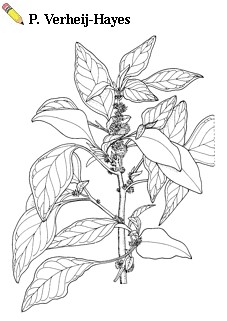 | Amaranthus tricolor L. — flowering and fruiting shoot |
Growth and Development
Emergence takes place 3—5 days after sowing and vegetative development is fast. Depending on cultivar, photoperiod and cultural practices, flowering may start 4—8 weeks after sowing, making the plant less suitable for consumption. There are at least four times as many female flowers as male flowers. Pollination is effected by wind but the abundant pollen production, especially in the higher flowers, causes a high rate of self-pollination. Outcrossing is 0—40%. In Amaranthus tricolor and Amaranthus cruentus, the seeds mature after 3—4 months and then the plant dies. Amaranthus dubius will continue its generative stage for a much longer period and when cut regularly, the plant may become shrubby and perennial, but even at its mature stage, the leaves are succulent enough for consumption. These plants can be found in Indonesia in home gardens.
Other Botanical Information
The taxonomy of the genus Amaranthus is still confused. Moreover, names such as Amaranthus hybridus L. are often erroneously used to describe vegetable amaranths. The commercially grown amaranth in South-East Asia is mostly Amaranthus tricolor. There are numerous landraces. Some cultivars are available from Indian, Taiwanese and other seed companies. Cultivars are distinguished by characteristics such as leaf form and colour, leaf/stem ratio, succulence, growing vigour, tolerance of fungal diseases, susceptibility to insect attack, drought resistance and photosensitivity. Amaranthus cruentus is the most resistant to adverse climate and soil conditions.
Two different types of plants of Amaranthus blitum are distinguishable. Comparatively small and ascending plants are found as a weed. Large, erect plants are cultivated and are referred to as Amaranthus blitum cv. group Oleraceus.
Besides these cultivated types, several wild species are occasionally collected as pot herbs, i.e. Amaranthus viridis L. (synonym Amaranthus gracilis Desf.), Amaranthus spinosus, Amaranthus retroflexus L., and A. hybridus. In South America, India and Nepal, the young plants of the grain type Amaranthus hypochondriacus are used as a vegetable.
Two different types of plants of Amaranthus blitum are distinguishable. Comparatively small and ascending plants are found as a weed. Large, erect plants are cultivated and are referred to as Amaranthus blitum cv. group Oleraceus.
Besides these cultivated types, several wild species are occasionally collected as pot herbs, i.e. Amaranthus viridis L. (synonym Amaranthus gracilis Desf.), Amaranthus spinosus, Amaranthus retroflexus L., and A. hybridus. In South America, India and Nepal, the young plants of the grain type Amaranthus hypochondriacus are used as a vegetable.
Ecology
Like maize and sugar cane, the genus Amaranthus is characterized by the C4-cycle photosynthetic pathway, which means a high photosynthesis at high temperature and radiation. Vegetable amaranths grow well at day temperatures above 25°C and night temperatures not lower than 15°C. In Indonesia, the temperature is too low above 800 m for Amaranthus tricolor, causing growth retardation. However, Amaranthus cruentus and Amaranthus dubius are found up to 2000 m. Shade is disadvantageous except in cases of drought stress. Amaranths are quantitative short-day plants, which is an advantage in the subtropics where the generative stage is retarded during summer. Because of rapid growth, water consumption is high. A crop normally uses about 6 mm/day. Amaranths like fertile, well-drained soils with a loose structure. The mineral uptake is very high.
Propagation and planting
Amaranth is a vegetable for small labour- intensive farms of rarely more than 0.25 ha. The most common practice is sowing directly in rows with 10—20 cm between the rows, or broadcasting, with a seed rate of 2—5 g/m2 (20—50 kg/ha). If transplanted, the seed requirement is only 2 kg/ha. Plant densities of 400 plants/m2 for harvesting by uprooting or once-over cutting, and of 100 plants/m2 for repeated clippings are considered as maximum. Higher densities result in self-thinning without giving higher yield. Amaranth is normally grown commercially as a sole crop on beds. It is also found in intercropping systems with food crops, in particular in Africa.
Husbandry
Because of the strong growth of amaranth, weeds are not very troublesome, except nut grass (Cyperus rotundus L.). Usually no weeding is necessary. If rainfall is not sufficient, irrigation by sprinkling should be done before the plants reach their wilting point. Watering every day with 8 mm (8 l/m2) is generally sufficient. With a normal yield of 25 t/ha in 8 weeks, about 125 kg N, 25 kg P, 250 kg K, 75 kg Ca and 40 kg Mg may be taken up per ha. Larger quantities of N and K are easily absorbed as luxury uptake if these elements are abundant. Amaranth responds to high rates of organic fertilizer. In some places it is grown on large quantities (up to 50 t/ha) of almost fresh town refuse, which fulfils its need for minerals. On poor soils, the application of 400 kg/ha of NPK (10—10—20) in addition to 25 t of organic manure is recommended. A split application is recommended during the rainy season. Nitrate-N is better than ammonium-N. It seems that amaranth does not need to be rotated with other crops since no serious soilborne disease has been observed. Many growers cultivate amaranth continuously on the same beds.
Diseases and Pests
Damping-off caused by Pythium may be serious in seed-beds. It is controlled by good drainage and over-dense sowing should be avoided. Fungicides like dithiocarbamates have some effect. White rust caused by Albugo candida is reported as a minor problem. Wet rot caused by Choanephora cucurbitarum is the main disease on Amaranthus cruentus, but Amaranthus tricolor and Amaranthus dubius are not very susceptible to this fungus.
Insects are a serious problem for amaranth growers. Caterpillars (Spodoptera litura, Heliothis armigera, Hymenia recurvalis) and grass hoppers are the most harmful. Many other insects such as borers, aphids, leafminers, stinkbugs, mole crickets and spint mites also attack amaranth. The more primitive traditional method of spreading wood ash to dispel insects has been replaced by spraying regularly, up to twice a week, with insecticides. In order to avoid harmful residues, the use of less toxic chemicals is strongly recommended (for example, bromophos, carbaryl, pyrethroids). Thuricide is effective against caterpillars.
Insects are a serious problem for amaranth growers. Caterpillars (Spodoptera litura, Heliothis armigera, Hymenia recurvalis) and grass hoppers are the most harmful. Many other insects such as borers, aphids, leafminers, stinkbugs, mole crickets and spint mites also attack amaranth. The more primitive traditional method of spreading wood ash to dispel insects has been replaced by spraying regularly, up to twice a week, with insecticides. In order to avoid harmful residues, the use of less toxic chemicals is strongly recommended (for example, bromophos, carbaryl, pyrethroids). Thuricide is effective against caterpillars.
Harvesting
The whole crop is harvested 3—4 weeks after sowing by uprooting all at once or by cutting at ground level. Another method is harvesting by repeated cuttings every 2—3 weeks (ratooning). In this case, the best planting method, at least for Amaranthus dubius, is rather wide spacing of about 20 cm x 20 cm and cutting at a height which leaves behind at least 2 leaves and buds for regrowth. The height of the first cut is normally 10—15 cm. Low cutting retards bolting. Up to 10 cuts may be obtained at weekly or two-weekly intervals.
Yield
Yield averages 1—2 kg/m2 (edible portion). Continuous cropping of amaranth may yield at least 12 kg/m2 per year. In Amaranthus tricolor and Amaranthus dubius, growth is less vigorous and yields are lower than in Amaranthus cruentus. The optimal harvest period is reached when the total leaf area is 7 times the ground area (LAI = 7). But the yield is often lower because the crop is harvested at a very young stage for a more tender product.
Handling After Harvest
Amaranth wilts rapidly. In markets and shops, it is sprinkled with water to keep a fresh appearance. If uprooted, the vegetable can be kept fresh for some days by putting it in a basin with the roots in the water. It is sold in bunches per unit of money or by weight.
Genetic Resources
Collections of amaranths are kept at the Rodale Organic Gardening and Farming Research Center (OGFRC) at Kutztown, Pennsylvania (United States); South-East Asian accessions are kept at the Asian Vegetable Research and Development Center (AVRDC) at Tainan (Taiwan), and Indian collections at the National Bureau of Plant Genetic Resources (NBPGR), New Delhi (India). Indonesian cultivars are available from the Lembang Horticultural Research Institute (LEHRI).
Breeding
In some countries (Indonesia, Taiwan, India, Benin) selections have been made from local landraces. Popular cultivars are 'Klaroen' (Amaranthus dubius), which originates from Surinam (South America), and 'Fotete' (Amaranthus cruentus), a productive cultivar from Benin (West Africa). Well-known cultivars of Amaranthus tricolor are 'Katwa Data', 'Lal Sag' and 'Co.2' and 'Co.3' from India. The 'Co.' cultivars come from Tamil Nadu University in Coimbatore (India), where researchers work on intervarietal hybridization and polyploidy. 'Co.2' is a cultivar for pulling, 'Co.3' for clipping. Both have a high leaf/stem ratio of more than 2. In Taiwan, seed companies sell 'White Leaf', and in Indonesia cultivar 'Giti Hijau' has been selected from Taiwanese material.
Prospects
Amaranth is recognized as an easy-to-grow and very productive crop. It is probably the highest-yielding leaf vegetable of the tropics. Its excellent nutritional value makes it an important vegetable for human nutrition, both in rural areas for home consumption and as a cheap green vegetable in city markets. Research should focus on optimization of cultural practices (effective pest control with fewer residues, plant nutrition).
Literature
Grubben, G.J.H., 1976. The cultivation of amaranth as a tropical leaf vegetable. Communication 67. Royal Tropical Institute, Amsterdam, the Netherlands. 207 pp.
Grubben, G.J.H. & van Sloten, D.H., 1981. Genetic resources of amaranths: a global plan of action. International Board for Plant Genetic Resources (IBPGR), Rome, Italy. 57 pp. (including a provisional key to some edible species of the family Amaranthaceae, by Laurie B. Feine-Dudley).
Kauffman, C.S., & Gilbert, L., 1981. Vegetable amaranth summary. Rodale Press, Emmaus, Pennsylvania, United States. 30 pp.
National Research Council, 1984. Amaranth, modern prospects for an ancient crop. National Academy Press, Washington, DC., United States. 80 pp.
Proceedings of the Second Amaranth Conference, 1980. Rodale Press, Emmaus, Pennsylvania, United States. 184 pp.
Senft, J.P., Kauffman, C.S. & Bailey, N.N., 1981. The genus Amaranthus: a comprehensive bibliography. Rodale Press, Emmaus, Pennsylvania, United States. 217 pp.
Shanmugavelu, K.G. & Kader Mohideen, M., 1989. Accomplishments in amaranth research at the College of Horticulture, Tamil Nadu Agricultural University. Amaranth Newsletter 3: 5-7.
Grubben, G.J.H. & van Sloten, D.H., 1981. Genetic resources of amaranths: a global plan of action. International Board for Plant Genetic Resources (IBPGR), Rome, Italy. 57 pp. (including a provisional key to some edible species of the family Amaranthaceae, by Laurie B. Feine-Dudley).
Kauffman, C.S., & Gilbert, L., 1981. Vegetable amaranth summary. Rodale Press, Emmaus, Pennsylvania, United States. 30 pp.
National Research Council, 1984. Amaranth, modern prospects for an ancient crop. National Academy Press, Washington, DC., United States. 80 pp.
Proceedings of the Second Amaranth Conference, 1980. Rodale Press, Emmaus, Pennsylvania, United States. 184 pp.
Senft, J.P., Kauffman, C.S. & Bailey, N.N., 1981. The genus Amaranthus: a comprehensive bibliography. Rodale Press, Emmaus, Pennsylvania, United States. 217 pp.
Shanmugavelu, K.G. & Kader Mohideen, M., 1989. Accomplishments in amaranth research at the College of Horticulture, Tamil Nadu Agricultural University. Amaranth Newsletter 3: 5-7.
Author(s)
G.J.H. Grubben
Correct Citation of this Article
Grubben, G.J.H., 1993. Amaranthus L.. In: Siemonsma, J.S and Piluek, K (Editors): Plant Resources of South-East Asia No 8: Vegetables. PROSEA Foundation, Bogor, Indonesia. Database record: prota4u.org/prosea

All texts are licensed under a Creative Commons Attribution-Noncommercial-Share Alike 3.0 Netherlands License
This license does not include the illustrations (Maps,drawings,pictures); these remain all under copyright.