Record Number
2197
PROSEA Handbook Number
8: Vegetables
Taxon
Saccharum edule Hasskarl
Protologue
Flora 25, Beibl. 2: 3 (1842).
Family
GRAMINEAE
Chromosome Numbers
2n = 60—122, most common are 2n = 70 and 80
Vernacular Names
Indonesia: trubus, tebu telur. Papua New Guinea: pit, pitpit.
Origin and Geographic Distribution
The origin of Saccharum edule is unknown; it only occurs in cultivation. It has very probably been derived from the wild Saccharum robustum Brandes & Jeswiet ex Grassl, which is also considered as one of the possible ancestors of sugar cane (Saccharum officinarum L.). Saccharum edule is cultivated from Borneo and Java through Melanesia to the New Hebrides.
Uses
Saccharum edule is cultivated for its edible inflorescences. The inflorescences are abnormal in the sense that they remain enclosed within the leaf-sheaths, forming a compact mass about the size of a banana. This mass is relished as a vegetable, either raw, cooked, steamed or roasted. In Papua New Guinea it is an important seasonal food in some areas.
Production and International Trade
No production figures are available. Saccharum edule is produced and consumed locally and traded in local markets only. In Indonesia it is offered for sale in bunches of 10. It is very common in New Guinea and the Moluccas; worldwide it is most important in western Melanesia.
Properties
Well-prepared Saccharum edule is very tasty. Per 100 g fresh edible portion it contains: water 89 g, protein 3.8—4.1 g, no fat, carbohydrates 6.9—7.6 g, fibre 0.7 g, Ca 10 mg, Fe 0.4—21 mg, vitamin C 21 mg. The energy value is 143—160 kJ/100 g.
Botany
Robust perennial herb, tillering or spreading by stolons or rhizomes. Culms cylindrical, large, 1.5—3(—10) m tall, 2—3 cm in diameter, widest at the growth rings just above nodes and root bands; pith hard, with little or no sugar. Leaves in upper part of culm, sheathed; leaf-sheath softly hirsute; leaf-blade oblong, 1—2 m x 2.5—7 cm, on both sides with rather long hairs. Inflorescence abortive, remaining enclosed in sheath of uppermost leaf, consisting of a dense mass of underdeveloped floral primordia, 10—20 cm long.
Saccharum edule is exclusively propagated by cuttings or by division of clumps. The cuttings soon tiller and form clumps which continuously increase in size by forming lateral shoots which curve downwards and root in the soil. About 5 months after planting, harvesting of inflorescence masses can start. The economic lifetime of each clump is about 2—3 years.
The identity of Saccharum edule is often debated. Probably it does not deserve species status, but the abortive inflorescences obscure characters that would facilitate its identification. In the literature it has been considered as an unusual form of sugar cane (Saccharum officinarum L. var. edule (Hasskarl) Backer), as a derivative of Saccharum robustum because it resembles it in vegetative habit and has the same distribution (cultivation) area, and it has been thought of as a hybrid between Saccharum robustum and Miscanthus floridulus (Labill.) Warburg. If Saccharum robustum and Saccharum edule are conspecific, the name Saccharum edule has priority. Being a purely cultivated taxon, it could also be named Saccharum L. cv. group Edule, thereby disregarding its complex origin.
Various clones differing in morphology (stem colour, leaf form, position of the inflorescence), chromosome number and isoenzyme content are known to exist. They can best be classified and described as cultivars. At least 10 different clones are known in Papua New Guinea.
Image
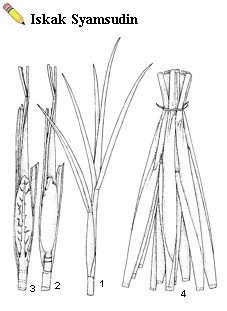 | Saccharum edule Hasskarl - 1, leafy shoot; 2, shoot with young inflorescence [leaf removed]; 3, shoot with young inflorescence [longitudinal section]; 4, marketed product |
Ecology
Not much is known about the ecological preferences of Saccharum edule. Saccharum robustum occurs in the hot humid tropics of Melanesia, mostly at low elevations, forming cane brakes along river banks, occasionally in montane valleys up to 2300 m altitude.
Agronomy
Saccharum edule is propagated by cuttings or by parts of the clump. Cuttings or shoots 0.5—1 m long are planted 2—3 together in mixed crop gardens. They take 6—9 months to develop fully. If not harvested, the inflorescence does not develop further but rots within the leaf-sheath. Too old inflorescences become inedible. It is recommended to renew the plant clumps every 2—3 years.
Prospects
Being a nutritious and delicious vegetable, rich in protein, Saccharum edule deserves more attention. Extensive germplasm collection is recommended. Further research on cultivation techniques and ecological requirements might reveal that it is an interesting vegetable species for the hot humid tropics, worth being introduced to other areas too.
Literature
Backer, C.A. & Bakhuizen van den Brink Jr, R.C., 1968. Flora of Java. Vol. 3. Wolters-Noordhoff, Groningen, the Netherlands. pp. 584-585.
Barrau, J., 1962. Les plantes alimentaires de l'Océanie, origines, distibution et usages [The edible plants of Oceania, origins, distribution and uses]. University of Aix-Marseille, Faculty of Sciences, Thesis No 71. pp. 157-158.
Ochse, J.J. & Bakhuizen van den Brink, R.C., 1980. Vegetables of the Dutch East Indies. 3rd English edition (translation of 'Indische Groenten', 1931). Asher & Co., Amsterdam, the Netherlands. pp. 337-338.
Powell, J.M., 1976. Ethnobotany. In: Paijmans, K. (Editor): New Guinea vegetation. Elsevier Scientific Publishers, Amsterdam, the Netherlands. pp. 106-134.
Whalen, M.D., 1991. Taxonomy of Saccharum (Poaceae). Baileya 23(3): 109-125.
Author(s)
P.C.M. Jansen
Correct Citation of this Article
Jansen, P.C.M., 1993. Saccharum edule Hasskarl. In: Siemonsma, J.S and Piluek, K (Editors): Plant Resources of South-East Asia No 8: Vegetables. PROSEA Foundation, Bogor, Indonesia. Database record: prota4u.org/prosea

All texts are licensed under a Creative Commons Attribution-Noncommercial-Share Alike 3.0 Netherlands License
This license does not include the illustrations (Maps,drawings,pictures); these remain all under copyright.