Record Number
2339
PROSEA Handbook Number
12(3): Medicinal and poisonous plants 3
Taxon
Aeginetia indica L.
Protologue
Sp. pl. 2: 632 (1753).
Family
OROBANCHACEAE
Chromosome Numbers
n = 15
Synonyms
Aeginetia pedunculata auct. non (Roxb.) Wallich.
Vernacular Names
Indonesia: rajatawa (Javanese). Philippines: dapong-tubo (Tagalog), suako-ti-uak (Iloko), lapo (Ibanag). Thailand: so-suai (Karen, Mae Hong Son), dok din daeng (Trat), paak cha khe (north-eastern). Vietnam: l[eej] du[uw][ow]ng, tai d[aas]t.
Origin and Geographic Distribution
Aeginetia indica occurs throughout tropical and subtropical Asia, from India and Sri Lanka to China and Japan, and throughout South-East Asia, but its distribution is poorly known. In Malesia, it is recorded from Java and the Philippines; possibly also in Peninsular Malaysia and New Guinea.
Uses
In the Philippines an infusion of Aeginetia indica is used internally against diabetes, and a decoction to treat fluid accumulations due to acute nephritis. In Vietnam and Thailand, Aeginetia indica is also applied to treat diabetes, and in Taiwan against hepatitis and other liver diseases.
Properties
Aeginetic acid, the monoterpenoid lactone aeginetolide, 3 polyene compounds and b-sitosterol were identified in an ethanolic extract of the whole plant, and the glycosides hydroxy-b-ionone glucoside, aeginetoside and the iridoid isoaucubin were identified in an n-butanol extract.
The extract from seeds induced potent antitumour immunity against fibrosarcomas in mice. It was demonstrated that the extract contained polysaccharides and proteins. The polysaccharides induced B cell mitogenic and thymocyte co-stimulatory effects in vitro, whereas the proteins mediated antitumour activity in vivo. In-vitro activities of the extract on the induction of cytokine production and lymphocyte proliferation have been recorded; these might contribute to the in-vivo antitumour effect. Antihepatotoxic activity has also been recorded for Aeginetia indica.
The extract from seeds induced potent antitumour immunity against fibrosarcomas in mice. It was demonstrated that the extract contained polysaccharides and proteins. The polysaccharides induced B cell mitogenic and thymocyte co-stimulatory effects in vitro, whereas the proteins mediated antitumour activity in vivo. In-vitro activities of the extract on the induction of cytokine production and lymphocyte proliferation have been recorded; these might contribute to the in-vivo antitumour effect. Antihepatotoxic activity has also been recorded for Aeginetia indica.
Botany
A slightly fleshy parasitic herb up to 40 cm tall, somewhat reddish; stem subterranean or scarcely emergent above the ground, with few scale-like leaves. Flowers on long pedicels up to 30 cm long from the axils of scales, bisexual, zygomorphic; calyx spathe-like, split in front nearly to the base, 2—3 cm long; corolla gamopetalous, 3—5 cm long, with elongate, curved tube, limb obscurely 2-lipped having 5 subequal lobes, pinkish-purple; stamens 4, inserted on the corolla tube, included; ovary superior, 1-celled, style slender with large peltate stigma. Fruit an ovoid to globose capsule, many-seeded. Seeds very small, brownish.
The seeds germinate slowly and show distinct dormancy.
Aeginetia is a small genus of approximately 6—10 species and is distributed in tropical and subtropical Asia, from India and Sri Lanka to Japan and New Guinea. Aeginetia indica has probably often been confused with Aeginetia pedunculata (Roxb.) Wallich, which usually has shorter pedicels and larger whitish or yellowish flowers with purplish or bluish corolla lobes.
The seeds germinate slowly and show distinct dormancy.
Aeginetia is a small genus of approximately 6—10 species and is distributed in tropical and subtropical Asia, from India and Sri Lanka to Japan and New Guinea. Aeginetia indica has probably often been confused with Aeginetia pedunculata (Roxb.) Wallich, which usually has shorter pedicels and larger whitish or yellowish flowers with purplish or bluish corolla lobes.
Image
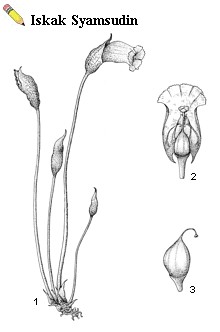 | Aeginetia indica L. - 1, habit of flowering plant; 2, flower with calyx removed and opened corolla; 3, fruit |
Ecology
Aeginetia indica is parasitic on the roots of grasses, and occurs mainly in grassland, but sometimes also in forest. Imperata and rice (Oryza sativa L.) are common hosts in Java, Miscanthus in Taiwan and Japan. However, several other hosts have been mentioned, e.g. millet (Panicum miliaceum L.), maize (Zea mays L.), but also Carex, Luzula, Zingiber and Canna spp. Aeginetia indica can be a destructive parasite in rice, and sometimes in other crops as well.
Genetic Resources
Aeginetia indica has an extremely large area of distribution and occurs in anthropogenic habitats. It is not threatened by genetic erosion.
Prospects
The antitumour activity of Aeginetia indica found in tests with mice warrants more research concerning the active compounds and to establish the value in human cancer treatment. The findings show that proteins are present that may be useful immunotherapeutic agents for patients with malignant diseases. The reported activity against diabetes should also be investigated. A thorough taxonomic revision of Aeginetia is needed.
Literature
[129]Chai, J.G. et al., 1992. An extract of seeds from Aeginetia indica L., a parasitic plant, induces potent antigen-specific antitumor immunity in Meth a-bearing BALB/c mice. Cancer Immunology and Immunotherapy 35(3): 181—185.
[130]Chai, J.G. et al., 1994. Seed extract of Aeginetia indica L. induces cytokine production and lymphocyte proliferation in vitro. Immunopharmacology 27(1): 13—21.
[131]Chai, J.G. et al., 1995. Dissociation between the mitogenic effect and antitumor activity of seed extract from Aeginetia indica L. Immunopharmacology 30(3): 209—215.
[231]Endo, T., Taguchi, H., Sasaki, H. & Yosioka, I., 1979. Constituents of Aeginetia indica var. gracilis Nakai. Structures of three glycosides isolated from the whole plant. Chemical & Pharmaceutical Bulletin 27(11): 2807—2814.
[694]Ohe, G. et al., 2001. Th1-cytokine induction and anti-tumor effect of 55 kDa protein isolated from Aeginetia indica L., a parasitic plant. Cancer Immunology, Immunotherapy 50(5): 251—259.
[697]Okamoto, M. et al., 2000. Purification and characterization of cytokine- inducing protein of seed extract from Aeginetia indica L., a parasitic plant. Immunopharmacology 49(3): 377—389.
[760]Quisumbing, E., 1978. Medicinal plants of the Philippines. Katha Publishing Co., Quezon City, the Philippines. 1262 pp.
[130]Chai, J.G. et al., 1994. Seed extract of Aeginetia indica L. induces cytokine production and lymphocyte proliferation in vitro. Immunopharmacology 27(1): 13—21.
[131]Chai, J.G. et al., 1995. Dissociation between the mitogenic effect and antitumor activity of seed extract from Aeginetia indica L. Immunopharmacology 30(3): 209—215.
[231]Endo, T., Taguchi, H., Sasaki, H. & Yosioka, I., 1979. Constituents of Aeginetia indica var. gracilis Nakai. Structures of three glycosides isolated from the whole plant. Chemical & Pharmaceutical Bulletin 27(11): 2807—2814.
[694]Ohe, G. et al., 2001. Th1-cytokine induction and anti-tumor effect of 55 kDa protein isolated from Aeginetia indica L., a parasitic plant. Cancer Immunology, Immunotherapy 50(5): 251—259.
[697]Okamoto, M. et al., 2000. Purification and characterization of cytokine- inducing protein of seed extract from Aeginetia indica L., a parasitic plant. Immunopharmacology 49(3): 377—389.
[760]Quisumbing, E., 1978. Medicinal plants of the Philippines. Katha Publishing Co., Quezon City, the Philippines. 1262 pp.
Other Selected Sources
[62]Backer, C.A. & Bakhuizen van den Brink Jr, R.C., 1964—1968. Flora of Java. 3 volumes. Noordhoff, Groningen, the Netherlands. Vol. 1 (1964) 647 pp., Vol. 2 (1965) 641 pp., Vol. 3 (1968) 761 pp.
[121]Burkill, I.H., 1966. A dictionary of the economic products of the Malay Peninsula. Revised reprint. 2 volumes. Ministry of Agriculture and Co- operatives, Kuala Lumpur, Malaysia. Vol. 1 (A—H) pp. 1—1240, Vol. 2 (I— Z) pp. 1241—2444.
[182]Council of Scientific and Industrial Research, 1985. The wealth of India: a dictionary of Indian raw materials & industrial products. Revised Edition. Vol. 1. Publications and Information Directorate, New Delhi, India. 513 pp.
[334]Heyne, K., 1950. De nuttige planten van Indonesië [The useful plants of Indonesia]. 3rd Edition. 2 volumes. W. van Hoeve, 's-Gravenhage, the Netherlands/Bandung, Indonesia. 1660 + CCXLI pp.
[544]Li, H.-L. et al. (Editors), 1975—1979. Flora of Taiwan. Angiospermae. 6 volumes. Epoch Publishing Co., Taipei, Taiwan, Republic of China.
[121]Burkill, I.H., 1966. A dictionary of the economic products of the Malay Peninsula. Revised reprint. 2 volumes. Ministry of Agriculture and Co- operatives, Kuala Lumpur, Malaysia. Vol. 1 (A—H) pp. 1—1240, Vol. 2 (I— Z) pp. 1241—2444.
[182]Council of Scientific and Industrial Research, 1985. The wealth of India: a dictionary of Indian raw materials & industrial products. Revised Edition. Vol. 1. Publications and Information Directorate, New Delhi, India. 513 pp.
[334]Heyne, K., 1950. De nuttige planten van Indonesië [The useful plants of Indonesia]. 3rd Edition. 2 volumes. W. van Hoeve, 's-Gravenhage, the Netherlands/Bandung, Indonesia. 1660 + CCXLI pp.
[544]Li, H.-L. et al. (Editors), 1975—1979. Flora of Taiwan. Angiospermae. 6 volumes. Epoch Publishing Co., Taipei, Taiwan, Republic of China.
Author(s)
R.H.M.J. Lemmens
Correct Citation of this Article
Lemmens, R.H.M.J., 2003. Aeginetia indica L.. In: Lemmens, R.H.M.J. and Bunyapraphatsara, N. (Editors): Plant Resources of South-East Asia No 12(3): Medicinal and poisonous plants 3. PROSEA Foundation, Bogor, Indonesia. Database record: prota4u.org/prosea

All texts are licensed under a Creative Commons Attribution-Noncommercial-Share Alike 3.0 Netherlands License
This license does not include the illustrations (Maps,drawings,pictures); these remain all under copyright.