Record Number
235
PROSEA Handbook Number
12(1): Medicinal and poisonous plants 1
Taxon
Desmodium styracifolium (Osbeck) Merr.
This article should be read together with the article on the genus: Desmodium in the Handbook volume indicated above in this database.
This article should be read together with the article on the genus: Desmodium in the Handbook volume indicated above in this database.
Protologue
Amer. Journ. Bot. 3: 580 (1916).
Synonyms
Hedysarum styracifolium Osbeck (1757), Desmodium capitatum Burm.f. (1825), Desmodium retroflexum (L.) DC. (1825).
Vernacular Names
Indonesia: katepan, melikan (Javanese), susuukan (Sundanese). Malaysia: korat nasi. Cambodia: voë vè:t (general), smau srâlâb pôpôôk, srâka: niëk (Battambang). Laos: kéng no:yz ngwà liaz, pâdông fai. Thailand: ruk ku ning taa no, phee suea nam (Lampang). Vietnam: d[oof]ng ti[eef]n (l[oo]ng), kim ti[eef]n th[ar]o, v[ar]y r[oof]ng.
Distribution
From India and Sri Lanka eastward to China, and southward to Malesia and Micronesia. Commonly found throughout the Malesian region, but no records from New Guinea.
Uses
In Malaysia, Desmodium styracifolium is used against colic, together with the central part of maize cobs. In Vietnam, the whole plant is considered diuretic, and applied against gall bladder and kidney stones and oedema. In southern China, it is also used to treat gall bladder and kidney stones. Desmodium styracifolium is reported to be a good green manure, which covers the soil fast and produces numerous roots, nodules and seeds.
Observations
A much branched, erect shrub or prostrate to ascending subshrub, 60-200 cm tall, young stems hairy; leaves 1- or 3-foliolate, stipules narrowly triangular, 8-11 mm long, terminal leaflet broadly elliptical or broadly obovate to orbicular, (1-)2-4.5(-5.5) cm x (1-)2-4.5(-5) cm, larger than the lateral ones, thick chartaceous to subcoriaceous, upper surface glabrous, lower surface densely hairy, lateral veins 8-10, not extending to the margin; inflorescence terminal and axillary, short racemose, 1-3(-5) cm long, very densely flowered; flowers in pairs, calyx 4-lobed, densely hairy, corolla purple or violet and fragrant, androecium diadelphous; pod narrowly oblong, compressed, (12-)15-20 mm x 2.5-3 mm, plicate-retroflexed when young, later straight, (4-)5-6-jointed, article quadrate or transversely broadly oblong, densely covered with hairs; seed reniform, depressed obovate or transversely elliptical, 1.3-1.8 mm x 2-2.2 mm. Desmodium styracifolium is found in rather open habitats, in full sunlight as well as in shade. It grows on periodically wet and dry terrain, as well as in grasslands and abandoned rice fields from sea-level up to 600 m altitude.
Image
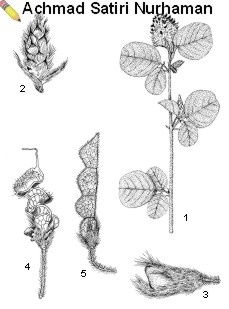 | Desmodium styracifolium (Osbeck) Merr. — 1, flowering stem; 2, young inflorescence; 3, flowerbud; 4, young pod; 5, mature pod |
Selected Sources
[50] Allen, O.N. & Allen, E.K., 1981. The Leguminosae. A source book of characteristics, uses and nodulation. MacMillan Publishers, London, United Kingdom. 812 pp.
[97] Backer, C.A. & Bakhuizen van den Brink Jr, R.C., 1963-1968. Flora of Java. 3 volumes. Noordhoff, Groningen, the Netherlands. Vol. 1 (1963) 647 pp., Vol. 2 (1965) 641 pp., Vol. 3 (1968) 761 pp.
[202] Burkill, I.H., 1966. A dictionary of the economic products of the Malay Peninsula. Revised reprint. 2 volumes. Ministry of Agriculture and Co-operatives, Kuala Lumpur, Malaysia. Vol. 1 (A-H) pp. 1-1240. Vol. 2 (I-Z) pp. 1241-2444.
[389] Dy Phon, P., Ohashi, H. & Vidal, J.E., 1994. Légumineuses - Desmodiées [Leguminosae (Fabaceae) Papilionoideae - Desmodieae]. In: Lescot, M., Vidal, J.E. & Vidal, Y. (Editors): Flore du Cambodge, du Laos et du Viêtnam [Flora of Cambodia, Laos and Vietnam]. Vol. 27. Muséum National d'Histoire Naturelle, Paris, France. 154 pp.
[580] Heyne, K., 1950. De nuttige planten van Indonesië [The useful plants of Indonesia]. 3rd Edition. 2 volumes. W. van Hoeve, 's-Gravenhage, the Netherlands/Bandung, Indonesia. 1660 + CCXLI pp.
[591] Hirayama, H., Wang, Z., Nishi, K., Ogawa, A., Ishimatu, T., Ueda, S., Kubo, T. & Nohara, T., 1993. Effect of Desmodium styracifolium triterpenoid on calcium oxalate renal stones. British Journal of Urology 71(2): 143-147.
[593] Ho, C.S., Wong, Y.H. & Chiu, K.W., 1989. The hypotensive action of Desmodium styracifolium and Clematis chinensis. American Journal of Chinese Medicine 17(3-4): 189-202.
[752] Knaap-van Meeuwen, M.S., 1962. Preliminary revisions of some genera of Malaysian Papilionaceae V. A census of the genus Desmodium. Reinwardtia 6(3): 239-276.
[1035] Nguyen Van Duong, 1993. Medicinal plants of Vietnam, Cambodia and Laos. Mekong Printing, Santa Ana, California, United States. 528 pp.
[1069] Ohashi, H., 1973. The Asiatic species of Desmodium and its allied genera (Leguminosae). Ginkgoana No 1. Academia Scientific Books, Tokyo, Japan. 318 pp.
[1120] Pedley, L. & Rudd, V.E., 1996. Fabaceae (Leguminosae) subfamily Faboideae (Papilionoideae) tribe Desmodieae. In: Dassanayake, M.D. & Clayton, W. D. (Editors): A revised handbook to the flora of Ceylon. Vol. 10. A.A. Balkema, Rotterdam, the Netherlands. pp. 149-198.
[1393] Sprent, J.I. & McKey, D. (Editors), 1994. Advances in legume systematics. Part 5. The nitrogen factor. The Royal Botanic Gardens, Kew, United Kingdom. pp. 241.
[1476] Tran Dinh Ly, 1993. 1900 Loai cay co ich o Viet nam [1900 useful plant species in Vietnam]. Hanoi, Vietnam. 544 pp.
[1602] Xu, S.B., Chung, J.Y., Hsien, S.Y. & Sun, Y.S., 1980. Cardio-cerebrovascular effect of total flavonoids from Desmodium styracifolium (Osbeck) Merr. Chung Tsao Yao 11: 265-267.
[97] Backer, C.A. & Bakhuizen van den Brink Jr, R.C., 1963-1968. Flora of Java. 3 volumes. Noordhoff, Groningen, the Netherlands. Vol. 1 (1963) 647 pp., Vol. 2 (1965) 641 pp., Vol. 3 (1968) 761 pp.
[202] Burkill, I.H., 1966. A dictionary of the economic products of the Malay Peninsula. Revised reprint. 2 volumes. Ministry of Agriculture and Co-operatives, Kuala Lumpur, Malaysia. Vol. 1 (A-H) pp. 1-1240. Vol. 2 (I-Z) pp. 1241-2444.
[389] Dy Phon, P., Ohashi, H. & Vidal, J.E., 1994. Légumineuses - Desmodiées [Leguminosae (Fabaceae) Papilionoideae - Desmodieae]. In: Lescot, M., Vidal, J.E. & Vidal, Y. (Editors): Flore du Cambodge, du Laos et du Viêtnam [Flora of Cambodia, Laos and Vietnam]. Vol. 27. Muséum National d'Histoire Naturelle, Paris, France. 154 pp.
[580] Heyne, K., 1950. De nuttige planten van Indonesië [The useful plants of Indonesia]. 3rd Edition. 2 volumes. W. van Hoeve, 's-Gravenhage, the Netherlands/Bandung, Indonesia. 1660 + CCXLI pp.
[591] Hirayama, H., Wang, Z., Nishi, K., Ogawa, A., Ishimatu, T., Ueda, S., Kubo, T. & Nohara, T., 1993. Effect of Desmodium styracifolium triterpenoid on calcium oxalate renal stones. British Journal of Urology 71(2): 143-147.
[593] Ho, C.S., Wong, Y.H. & Chiu, K.W., 1989. The hypotensive action of Desmodium styracifolium and Clematis chinensis. American Journal of Chinese Medicine 17(3-4): 189-202.
[752] Knaap-van Meeuwen, M.S., 1962. Preliminary revisions of some genera of Malaysian Papilionaceae V. A census of the genus Desmodium. Reinwardtia 6(3): 239-276.
[1035] Nguyen Van Duong, 1993. Medicinal plants of Vietnam, Cambodia and Laos. Mekong Printing, Santa Ana, California, United States. 528 pp.
[1069] Ohashi, H., 1973. The Asiatic species of Desmodium and its allied genera (Leguminosae). Ginkgoana No 1. Academia Scientific Books, Tokyo, Japan. 318 pp.
[1120] Pedley, L. & Rudd, V.E., 1996. Fabaceae (Leguminosae) subfamily Faboideae (Papilionoideae) tribe Desmodieae. In: Dassanayake, M.D. & Clayton, W. D. (Editors): A revised handbook to the flora of Ceylon. Vol. 10. A.A. Balkema, Rotterdam, the Netherlands. pp. 149-198.
[1393] Sprent, J.I. & McKey, D. (Editors), 1994. Advances in legume systematics. Part 5. The nitrogen factor. The Royal Botanic Gardens, Kew, United Kingdom. pp. 241.
[1476] Tran Dinh Ly, 1993. 1900 Loai cay co ich o Viet nam [1900 useful plant species in Vietnam]. Hanoi, Vietnam. 544 pp.
[1602] Xu, S.B., Chung, J.Y., Hsien, S.Y. & Sun, Y.S., 1980. Cardio-cerebrovascular effect of total flavonoids from Desmodium styracifolium (Osbeck) Merr. Chung Tsao Yao 11: 265-267.
Author(s)
N. Setyowati-Indarto & M. Brink
Correct Citation of this Article
Setyowati-Indarto, N. & Brink, M., 1999. Desmodium styracifolium (Osbeck) Merr.. In: de Padua, L.S., Bunyapraphatsara, N. and Lemmens, R.H.M.J. (Editors): Plant Resources of South-East Asia No 12(1): Medicinal and poisonous plants 1. PROSEA Foundation, Bogor, Indonesia. Database record: prota4u.org/prosea

All texts are licensed under a Creative Commons Attribution-Noncommercial-Share Alike 3.0 Netherlands License
This license does not include the illustrations (Maps,drawings,pictures); these remain all under copyright.