Record Number
2487
PROSEA Handbook Number
12(3): Medicinal and poisonous plants 3
Taxon
Cocculus orbiculatus (L.) DC.
This article should be read together with the article on the genus: Cocculus in the Handbook volume indicated above in this database.
This article should be read together with the article on the genus: Cocculus in the Handbook volume indicated above in this database.
Protologue
Syst. nat. 1: 523 (1817).
Synonyms
Cocculus trilobus (Thunberg) DC. (1817), Cocculus sarmentosus (Lour.) Diels (1910).
Vernacular Names
Vietnam: d[aa]y xanh, d[aa]y m[ooj]t, m[ooj]c ph[of]ng ky.
Distribution
Nepal, India, China, Taiwan, Japan, Hawaii, Indo-China, Thailand, Peninsular Malaysia, Singapore, north-eastern Sumatra, western and central Java, and the Philippines; also in Réunion and Mauritius, but there possibly introduced.
Uses
In Vietnam, the stem is used as a diuretic to treat oedema. The roots are considered febrifuge and used to treat epilepsy. In traditional medicine in China, the stems and leaves are applied against flatulence, stomach-ache and oedema. In Thailand, the leaves are used to produce a jelly.
Observations
A slender herbaceous or slightly woody climber, with stem up to 1.5 mm in diameter; leaves broadly elliptical to narrowly elliptical or ovate, 3—10 cm x 1—5.5 cm, base 3(—5)-veined with veins usually not running parallel to margins and becoming indistinct at or below the middle of the leaf; flowers whitish, female ones with 6 carpels; drupe rotund in outline, 4—5 mm in diameter, dark blue. In South-East Asia, Cocculus orbiculatus often occurs near the sea-shore, but sometimes also inland on limestone terraces.
Image
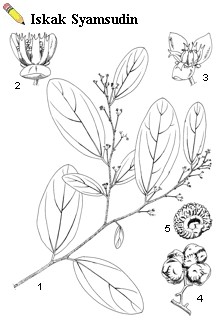 | Cocculus orbiculatus (L.) DC. - 1, branch of male flowering plant; 2, male flower; 3, female flower; 4, infructescence; 5, endocarp |
Selected Sources
[247]Flora Malesiana (various editors), 1950—. Foundation Flora Malesiana. Rijksherbarium/Hortus Botanicus, Leiden, the Netherlands.
[249]Flora of Thailand (various editors), 1970—. The Forest Herbarium, Royal Forest Department, Bangkok, Thailand.
[402]Itokawa, H., Nishimura, K., Hitotsuyanagi, Y. & Takeya, K., 1995. Isosinococuline, a novel antitumor morphinane alkaloid from Cocculus trilobus. Bioorganic and Medicinal Chemistry Letters 5(8): 821—822.
[403]Itokawa, H. et al., 1987. An antitumor morphinane alkaloid, sinococuline, from Cocculus trilobus. Chemical and Pharmaceutical Bulletin 35(4): 1660—1662.
[671]Nguyen Van Duong, 1993. Medicinal plants of Vietnam, Cambodia and Laos. Mekong Printing, Santa Ana, California, United States. 528 pp.
[981]Watanabe, K., Miyakado, M., Iwai, T., Izumi, K. & Yanagi, K., 1988. Isolation of aristolochic acid and aristolic acid from Cocculus triolobus DC. as potent seed germination inhibitors. Agricultural and Biological Chemistry 52(4): 1079—1082.
[249]Flora of Thailand (various editors), 1970—. The Forest Herbarium, Royal Forest Department, Bangkok, Thailand.
[402]Itokawa, H., Nishimura, K., Hitotsuyanagi, Y. & Takeya, K., 1995. Isosinococuline, a novel antitumor morphinane alkaloid from Cocculus trilobus. Bioorganic and Medicinal Chemistry Letters 5(8): 821—822.
[403]Itokawa, H. et al., 1987. An antitumor morphinane alkaloid, sinococuline, from Cocculus trilobus. Chemical and Pharmaceutical Bulletin 35(4): 1660—1662.
[671]Nguyen Van Duong, 1993. Medicinal plants of Vietnam, Cambodia and Laos. Mekong Printing, Santa Ana, California, United States. 528 pp.
[981]Watanabe, K., Miyakado, M., Iwai, T., Izumi, K. & Yanagi, K., 1988. Isolation of aristolochic acid and aristolic acid from Cocculus triolobus DC. as potent seed germination inhibitors. Agricultural and Biological Chemistry 52(4): 1079—1082.
Author(s)
Francisca Murti Setyowati
Correct Citation of this Article
Setyowati, F.M., 2003. Cocculus orbiculatus (L.) DC.. In: Lemmens, R.H.M.J. and Bunyapraphatsara, N. (Editors): Plant Resources of South-East Asia No 12(3): Medicinal and poisonous plants 3. PROSEA Foundation, Bogor, Indonesia. Database record: prota4u.org/prosea

All texts are licensed under a Creative Commons Attribution-Noncommercial-Share Alike 3.0 Netherlands License
This license does not include the illustrations (Maps,drawings,pictures); these remain all under copyright.