Record Number
2500
PROSEA Handbook Number
12(3): Medicinal and poisonous plants 3
Taxon
Crassocephalum crepidioides (Benth.) S. Moore
Protologue
Journ. Bot. 50: 211 (1912).
Family
COMPOSITAE
Chromosome Numbers
2n = 40
Synonyms
Gynura crepidioides Benth. (1849).
Vernacular Names
Papua New Guinea: thick head (Pidgin), marago beja (Kaluli, Southern Highlands), yogobikabika (Bwaidoga, Goodenough Island, Milne Bay). Thailand: phakphet chaang (Mae Hong Son), yaa kho on (Chiang Mai), phakhaan (Loei). Vietnam: rau t[aaf]u bay.
Origin and Geographic Distribution
Crassocephalum crepidioides originates from Africa and Madagascar, but is now naturalized throughout tropical and subtropical Asia, Australia, the New Hebrides, Fiji, Tonga and Samoa. It was found near Medan (northern Sumatra) in 1926, was introduced in Java, and subsequently spread throughout Indonesia. It is now found throughout South-East Asia.
Uses
In Papua New Guinea Crassocephalum crepidioides leaves are used externally to treat sores and irritation of the penis. The leaves are considered mildly stomachic in Africa, and are applied to treat indigestion, colic and flatulence. In Africa the leaves are also used as an analgesic to treat headache and epilepsy, whereas powdered leaves are administered as a snuff to stop nosebleeds and smoked to treat sleeping sickness.
Young plants are used as a vegetable in Vietnam and Japan, and in Africa the mucilaginous leaves are eaten in soups and sauces, and with groundnuts. The plants are readily eaten by livestock, and they are considered a useful green fodder for poultry. Crassocephalum crepidioides has been used successfully as a trap plant to collect adult corm weevils in banana plantations.
Some other Crassocephalum species are used in traditional medicine in Africa, e.g. Crassocephalum rubens (Juss. ex Jacq.) S. Moore internally as a stomachic and to treat liver complaints and colds, and externally to treat burns, sore eyes, earache and breast cancer, and Crassocephalum vitellinum (Benth.) S. Moore to treat infected eyes, gonorrhoea and suppurations, and as a galactagogue.
Young plants are used as a vegetable in Vietnam and Japan, and in Africa the mucilaginous leaves are eaten in soups and sauces, and with groundnuts. The plants are readily eaten by livestock, and they are considered a useful green fodder for poultry. Crassocephalum crepidioides has been used successfully as a trap plant to collect adult corm weevils in banana plantations.
Some other Crassocephalum species are used in traditional medicine in Africa, e.g. Crassocephalum rubens (Juss. ex Jacq.) S. Moore internally as a stomachic and to treat liver complaints and colds, and externally to treat burns, sore eyes, earache and breast cancer, and Crassocephalum vitellinum (Benth.) S. Moore to treat infected eyes, gonorrhoea and suppurations, and as a galactagogue.
Properties
Crassocephalum crepidioides extracts showed moderate antimutagenic activity in Salmonella typhimurium TA98 and TA100. The roots have been reported to contain tannin. The pyrrolizidine alkaloids jacobine and jacoline were isolated from the aerial parts of Japanese Crassocephalum crepidioides; jacobine proved to be hepatotoxic.
Botany
An erect, sparingly branched annual herb up to 100 cm tall; stem rather stout, soft, ribbed, branches pubescent. Leaves arranged spirally, elliptical, oblong or obovate-elliptical in outline, 8—18 cm x 2—5.5 cm, pinnately lobed or pinnatifid, irregularly serrate, base tapered and often long-decurrent into the petiole, upper leaves sessile; stipules absent. Inflorescence a head arranged in terminal, rather small corymbs, cylindrical, 13—16 mm x 5—6 mm, nodding during anthesis, afterwards erect, many-flowered; inner involucral bracts 1—2-seriate, initially coherent, lanceolate, 8—12 mm long, pellucid-marginate, outer involucral bracts linear, unequal, 1—4 mm long; hypanthium flat, epaleate. Flowers bisexual, equal; corolla tubular, 9—11 mm long, yellow with reddish-brown top, tube long and slender, limb short, 5-fid; anthers 5, united, purplish; ovary inferior, 1-celled, style bifid, arms long, having apical appendages. Fruit a cylindrical-linear, ribbed achene c. 2 mm long, crowned by numerous white, minutely toothed, caducous pappus hairs 9—12 mm long. Seedling with epigeal germination; hypocotyl long, up to 2 cm long; cotyledons broad-ovate, glabrous, shortly petiolate.
The fruits with the long pappus are dispersed by wind over long distances. In Indonesia Crassocephalum crepidioides is often confused with Erechtites valerianifolia (Wolf) DC.
The fruits with the long pappus are dispersed by wind over long distances. In Indonesia Crassocephalum crepidioides is often confused with Erechtites valerianifolia (Wolf) DC.
Image
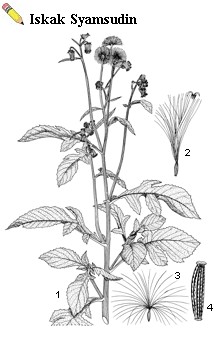 | Crassocephalum crepidioides (Benth.) S. Moore - 1, upper part of flowering and fruiting plant; 2, flower; 3, fruit with pappus; 4, fruit without pappus |
Ecology
Crassocephalum crepidioides occurs as a weed on arable land, riversides, roadsides, tea, coffee, cinchona, sweet potato, taro and citrus plantations, and in upland rice fields, particularly in wetter localities, at 200—2500 m altitude. It may also be a dominant pioneer species in shifting cultivation sites that have been recently burned.
Silviculture and Management
Crassocephalum crepidioides is usually a weed of minor importance that can be easily eradicated. However, in young tea plantations it may become a serious weed. Paraquat is often used to control Crassocephalum crepidioides as a weed, but resistance to this herbicide has developed in several South-East Asian countries.
Under experimental conditions, seeds stored under dry conditions still germinated after 20 months, but after 22 months of dry storage they began to lose their viability.
Under experimental conditions, seeds stored under dry conditions still germinated after 20 months, but after 22 months of dry storage they began to lose their viability.
Genetic Resources
Crassocephalum crepidioides is certainly not endangered. On the contrary, it has recently become a widespread weed of the Old World tropics, and it is still extending its area of distribution.
Prospects
The fact that Crassocephalum species are used in traditional medicine in different parts of the world, often for comparable complaints such as stomach troubles, justifies more research. Research on the safe use as a vegetable is desirable since pyrrolizidine alkaloids, which are hepatotoxic or even carcinogenic, are present.
Literature
[52]Asada, Y., Shiraishi, M., Takeuchi, T., Osawa, Y. & Furuya, T., 1985. Pyrrolizidine alkaloids from Crassocephalum crepidioides. Planta Medica 1985: 539—540.
[347]Holdsworth, D.K., 1977. Medicinal plants of Papua New Guinea. Technical Paper No 175. South Pacific Commission, Noumea, New Caledonia. 123 pp.
[347]Holdsworth, D.K., 1977. Medicinal plants of Papua New Guinea. Technical Paper No 175. South Pacific Commission, Noumea, New Caledonia. 123 pp.
Other Selected Sources
[120]Burkill, H.M., 1985—2000. The useful plants of West tropical Africa. 2nd Edition. 5 volumes. Royal Botanic Gardens, Kew, United Kingdom. Vol. 1 (1985), Families A—D, 960 pp.; Vol. 2 (1994), Families E—I, 636 pp.; Vol. 3 (1995), Families J—L, 857 pp.; Vol. 4 (1997), Families M—R, 969 pp; Vol. 5 (2000), Families S—Z, 686 pp.
[879]Soerjani, M., Kostermans, A.J.G.H. & Tjitrosoepomo, G. (Editors), 1987. Weeds of rice in Indonesia. Balai Pustaka, Jakarta, Indonesia. 716 pp.
[1033]Yen, G.C., Chen, H.Y. & Peng, H.H., 2001. Evaluation of the cytotoxicity, mutagenicity and antimutagenicity of emerging edible plants. Food and Chemical Toxicology 39(11): 1045—1053.
[879]Soerjani, M., Kostermans, A.J.G.H. & Tjitrosoepomo, G. (Editors), 1987. Weeds of rice in Indonesia. Balai Pustaka, Jakarta, Indonesia. 716 pp.
[1033]Yen, G.C., Chen, H.Y. & Peng, H.H., 2001. Evaluation of the cytotoxicity, mutagenicity and antimutagenicity of emerging edible plants. Food and Chemical Toxicology 39(11): 1045—1053.
Author(s)
R.H.M.J. Lemmens
Correct Citation of this Article
Lemmens, R.H.M.J., 2003. Crassocephalum crepidioides (Benth.) S. Moore. In: Lemmens, R.H.M.J. and Bunyapraphatsara, N. (Editors): Plant Resources of South-East Asia No 12(3): Medicinal and poisonous plants 3. PROSEA Foundation, Bogor, Indonesia. Database record: prota4u.org/prosea

All texts are licensed under a Creative Commons Attribution-Noncommercial-Share Alike 3.0 Netherlands License
This license does not include the illustrations (Maps,drawings,pictures); these remain all under copyright.