Record Number
2553
PROSEA Handbook Number
12(3): Medicinal and poisonous plants 3
Taxon
Dischidia major (Vahl) Merr.
This article should be read together with the article on the genus: Dischidia in the Handbook volume indicated above in this database.
This article should be read together with the article on the genus: Dischidia in the Handbook volume indicated above in this database.
Protologue
Interpr. Herb. amboin.: 437 (1917).
Synonyms
Dischidia rafflesiana Wallich (1831).
Vernacular Names
Malaysia: akar kul, akar banok, akar bani (Peninsular). Thailand: chuk rohini (central), kluai mai (northern), thao phung pla (eastern, Ranong). Vietnam: song ly to, d[aa]y m[or] qu[aj].
Distribution
Eastern India, Burma (Myanmar), Indo-China, Thailand, Peninsular Malaysia, Sumatra, Java, Borneo, the Philippines, Timor, Sulawesi, New Guinea and north-eastern Australia.
Uses
In Peninsular Malaysia the roots are added to betel quid to cure cough. A decoction of whole plants is used to treat peptic ulcers in Thailand, whereas the leaves are used in a mixture with Hoya kerrii Craib leaves and Vanilla aphylla Blume stems to treat liver dysfunction. The roots are used to treat fever. In the Philippines the leaves of a Dischidia species, possibly Dischidia major, are applied externally, crushed with salt, to treat goitre.
Observations
An epiphytic, climbing herb with glabrescent stem; leaves of 2 types: flat-orbicular, 2—3 cm in diameter, and pitcher-form ones 6—12 cm long, appressed to the host surface; inflorescence with 0.5—5 cm long peduncle, simple or bifid; corolla 8—10 mm long, yellow-green, lobes inside with short white hairs. Dischidia major is locally common in sunny and slightly shaded localities in open forest up to 1000 m altitude, also in secondary forest and mangrove forest, and on roadside trees, often hanging down in long garlands.
Image
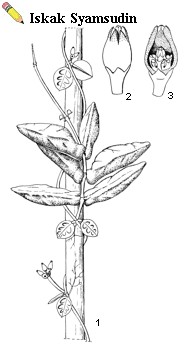 | Dischidia major (Vahl) Merr. - 1, habit of flowering plant; 2, flower; 3, flower with opened corolla |
Selected Sources
[121]Burkill, I.H., 1966. A dictionary of the economic products of the Malay Peninsula. Revised reprint. 2 volumes. Ministry of Agriculture and Co- operatives, Kuala Lumpur, Malaysia. Vol. 1 (A—H) pp. 1—1240, Vol. 2 (I— Z) pp. 1241—2444.
[169]Chuakul, W. & Chaikaew, C., 1998. Medicinal plants in Ubon Ratchathani Province (3). Thai Journal of Phytopharmacy 5(2): 28—56.
[173]Chuakul, W., Saralamp, P., Paonil, W., Temsiririrkkul, R. & Clayton, T. (Editors), 1997. Medicinal plants in Thailand. Vol. II. Department of Pharmaceutical Botany, Faculty of Pharmacy, Mahidol University, Bangkok, Thailand. 248 pp.
[760]Quisumbing, E., 1978. Medicinal plants of the Philippines. Katha Publishing Co., Quezon City, the Philippines. 1262 pp.
[793]Rintz, R.E., 1980. The Peninsular Malayan species of Dischidia (Asclepiadaceae). Blumea 26(1): 81—126.
[934]Treseder, K.K., Davidson, D.W. & Ehleringer, J.R., 1995. Absorption of ant-provided carbon dioxide and nitrogen by a tropical epiphyte. Nature 375(6527): 137—139.
[169]Chuakul, W. & Chaikaew, C., 1998. Medicinal plants in Ubon Ratchathani Province (3). Thai Journal of Phytopharmacy 5(2): 28—56.
[173]Chuakul, W., Saralamp, P., Paonil, W., Temsiririrkkul, R. & Clayton, T. (Editors), 1997. Medicinal plants in Thailand. Vol. II. Department of Pharmaceutical Botany, Faculty of Pharmacy, Mahidol University, Bangkok, Thailand. 248 pp.
[760]Quisumbing, E., 1978. Medicinal plants of the Philippines. Katha Publishing Co., Quezon City, the Philippines. 1262 pp.
[793]Rintz, R.E., 1980. The Peninsular Malayan species of Dischidia (Asclepiadaceae). Blumea 26(1): 81—126.
[934]Treseder, K.K., Davidson, D.W. & Ehleringer, J.R., 1995. Absorption of ant-provided carbon dioxide and nitrogen by a tropical epiphyte. Nature 375(6527): 137—139.
Author(s)
Wongsatit Chuakul, Noppamas Soonthornchareonnon & Orawan Ruangsomboon
Correct Citation of this Article
Chuakul, W., Soonthornchareonnon, N. & Ruangsomboon, O., 2003. Dischidia major (Vahl) Merr.. In: Lemmens, R.H.M.J. and Bunyapraphatsara, N. (Editors): Plant Resources of South-East Asia No 12(3): Medicinal and poisonous plants 3. PROSEA Foundation, Bogor, Indonesia. Database record: prota4u.org/prosea

All texts are licensed under a Creative Commons Attribution-Noncommercial-Share Alike 3.0 Netherlands License
This license does not include the illustrations (Maps,drawings,pictures); these remain all under copyright.