Record Number
263
PROSEA Handbook Number
12(1): Medicinal and poisonous plants 1
Taxon
Eurycoma longifolia Jack
This article should be read together with the article on the genus: Eurycoma in the Handbook volume indicated above in this database.
This article should be read together with the article on the genus: Eurycoma in the Handbook volume indicated above in this database.
Protologue
Mal. Misc. 2: 45 (1822).
Distribution
Southern Burma (Myanmar), Indo-China (Cambodia, Laos and Vietnam), Thailand, Peninsular Malaysia, Sumatra, Borneo and the Philippines (subsp. eglandulosa (Merr.) Nooteboom only).
Uses
A decoction of the root is a well-known febrifuge. A poultice of the pounded root is used on wounds, ulcers and sores. The bitter constituents of the roots will in a large enough dose provoke vomiting and are employed as such. In Brunei, a decoction of the root is drunk to relieve gastric pains, reduce high blood pressure and fever. The bark is used as a blood coagulant in complications during childbirth. Also in Brunei, the leaves are reportedly eaten raw to relieve stomach-ache. Furthermore, the roots are locally popular as an aphrodisiac.
Observations
A spindly unbranched androdioecious tree or shrub up to 10 m tall, or with a few upright branches, each crowned by an umbrella-like rosette of leaves; leaves up to 100 cm long, leaflets lanceolate to obovate-lanceolate, 5-20 cm x 1.5-6 cm; petals lanceolate to ovate or obovate-oblong, 4.5-5.5 mm x 2-3 mm, puberulous on both surfaces, styles rather long with a peltate 5(-6)-lobed stigma, elevated about 1 mm above the carpels; fruit 10-17(-20) mm x 5-12 mm. Eurycoma longifolia is common in the understorey of primary and secondary forest on a wide range of soils and is locally abundant.
Image
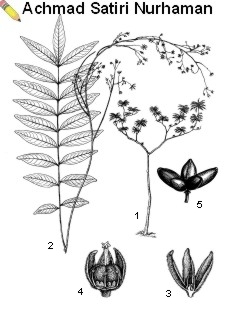 | Eurycoma longifolia Jack — 1, tree habit; 2, detached leaf and inflorescence; 3, male flower in section; 4, female flower with 2 petals removed; 5, fruit |
Selected Sources
[68] Ang, H.H., Chan, K.L. & Mak, J.W., 1995. Effect of 7-day daily replacement of culture medium containing Eurycoma longifolia Jack constituents on the Malaysian Plasmodium falciparum isolates. Journal of Ethnopharmacology 49: 171-175.
[69] Ang, H.H. & Sim, M.K., 1998a. Eurycoma longifolia Jack and orientation activies in sexually experienced male rats. Biological and Pharmaceutical Bulletin 21(2): 153-155.
[70] Ang, H.H. & Sim. M.K., 1998b. Eurycoma longifolia increases sexual motivation in sexually naive rats. Archives of Pharmaceutical Research 21(6): 779-781.
[202] Burkill, I.H., 1966. A dictionary of the economic products of the Malay Peninsula. Revised reprint. 2 volumes. Ministry of Agriculture and Co-operatives, Kuala Lumpur, Malaysia. Vol. 1 (A-H) pp. 1-1240. Vol. 2 (I-Z) pp. 1241-2444.
[228] Chan, K.L., O'neill, M.J., Phillipson, J.D. & Warhurst, D.W., 1986. Plants as sources of antimalarial drugs: Eurycoma longifolia. Planta Medica 52: 105-107.
[284] Corner, E.J.H., 1988. Wayside trees of Malaya. 3rd Edition. 2 volumes. The Malayan Nature Society, Kuala Lumpur, Malaysia. 774 pp.
[350] Dharma, A.P., 1981. Indonesische geneeskrachtige planten [Indonesian medicinal plants]. De Driehoek, Amsterdam, the Netherlands. 168 pp.
[822] Latiff, A., 1991. Plant resources for natural products: an ethnobotanical perspective. In: Shaari, K., Kadir, A.A. & Ali, A.R.H. (Editors): Medicinal products from tropical rain forests. Proceedings of the conference, Forest Research Institute Malaysia, May 13-15, 1991. Forest Research Institute Malaysia, Kepong, Selangor, Malaysia. pp. 1-12.
[829] Leaman, D.J., Yusuf, R. & Sangat-Roemantyo, H., 1991. Kenyah Dayak forest medicines. Prospects for development and implications for conservation. Report for the World Wide Fund for Nature, Indonesia Programme. 34 pp. + appendices.
[1035] Nguyen Van Duong, 1993. Medicinal plants of Vietnam, Cambodia and Laos. Mekong Printing, Santa Ana, California, United States. 528 pp.
[1052] Nooteboom, H.P., 1972. Simaroubaceae. In: van Steenis C.G.G.J. (General editor): Flora Malesiana. Series 1, Vol. 6. Wolters-Noordhoff, Groningen, the Netherlands. pp. 193-226.
[1126] Perry, L.M., 1980. Medicinal plants of East and Southeast Asia. Attributed properties and uses. MIT Press, Cambridge, Massachusetts, United States & London, United Kingdom. 620 pp.
[1287] Saralamp, P., Temsiririrkkul, R., Chuakul, W., Riewpaiboon, A., Prathanturarug, S., Suthisisang, C. & Pongcharoensuk, P. (Editors), 1996. Medicinal plants in the Siri Ruckhachati Garden. 2nd Edition. Siambooks and Publications Co., Bangkok, Thailand. 263 pp.
[1383] Soepadmo, E., Wong, K.M. & Saw, L.G. (Editors), 1995-. Tree flora of Sabah and Sarawak. Sabah Forestry Department, Forest Research Institute Malaysia and Sarawak Forestry Department, Kepong, Malaysia.
[1509] van Valkenburg, J.L.C.H., 1997. Non-timber forest products of East Kalimantan - potentials for sustainable forest use. (Tropenbos Series 16). The Tropenbos Foundation, Wageningen, the Netherlands. 202 pp.
Author(s)
Tahan Uji
Correct Citation of this Article
Uji, T., 1999. Eurycoma longifolia Jack. In: de Padua, L.S., Bunyapraphatsara, N. and Lemmens, R.H.M.J. (Editors): Plant Resources of South-East Asia No 12(1): Medicinal and poisonous plants 1. PROSEA Foundation, Bogor, Indonesia. Database record: prota4u.org/prosea

All texts are licensed under a Creative Commons Attribution-Noncommercial-Share Alike 3.0 Netherlands License
This license does not include the illustrations (Maps,drawings,pictures); these remain all under copyright.