Record Number
2808
PROSEA Handbook Number
12(3): Medicinal and poisonous plants 3
Taxon
Osbeckia chinensis L.
Protologue
Sp. pl. 1: 345 (1753).
Family
MELASTOMATACEAE
Chromosome Numbers
n = 10
Vernacular Names
Philippines: payong-payong, saang-parang (Tagalog), korontillo (Panay Bisaya). Thailand: yaa phlong khon (Chumphon), aa noi (Chiang Mai), en aa noi (Ubon Ratchathani). Vietnam: mua t[es]p.
Origin and Geographic Distribution
Osbeckia chinensis is widely distributed, from Indo-China, southern China, Taiwan and southern Japan, through Thailand and the whole of Malesia, to northern Australia.
Uses
In Papua New Guinea the whole plant of Osbeckia chinensis is used externally to treat toothache. In Vietnam whole plants are used to treat dysentery, tuberculosis of the lungs and haemorrhages.
A decoction of dried leaves of Osbeckia crinita Benth. ex Triana is applied in northern Vietnam as a gargle to treat toothache. In Sri Lanka Osbeckia aspera (L.) Blume and Osbeckia octandra (L.) DC. are both used in traditional medicine to treat liver diseases.
A decoction of dried leaves of Osbeckia crinita Benth. ex Triana is applied in northern Vietnam as a gargle to treat toothache. In Sri Lanka Osbeckia aspera (L.) Blume and Osbeckia octandra (L.) DC. are both used in traditional medicine to treat liver diseases.
Properties
Antioxidant activity has been recorded for Osbeckia chinensis, possibly due to the presence of kaempferol, quercetin, their 3-glucosides, quercetin-3-glucoglucoside, tannins and osbeckia acid. Other chemical constituents isolated from Osbeckia chinensis are 2-furoic acid, succinic acid, ursolic acid and daucosterol.
In a screening assay based on protection of human-liver derived HepG2 cells against toxic damage by bromobenzene and 2,6-diMeNAPQI, a crude extract of Osbeckia aspera from Sri Lanka significantly improved viability of the cells. A leaf extract of Osbeckia aspera also showed some antioxidant activity. It can markedly decrease carbon tetrachloride-mediated reduction in aniline hydroxylase and p-aminopyrine N-demethylase activity and inhibit peroxidative damage to the cell membrane. Antioxidant compounds in Osbeckia aspera may be an important mechanism responsible for the in-vivo hepatoprotective activity of this plant. An aqueous leaf extract of Osbeckia aspera also showed inhibitory effect on lymphocyte proliferation stimulated by phytohaemagglutinin and tuberculin purified protein derivative. The combined hepatoprotective and immunosuppressive effects of the extract are more likely to be beneficial in acute hepatitis rather than chronic hepatitis viral infection.
A leaf extract of Osbeckia octandra, also from Sri Lanka, markedly decreased carbon tetrachloride-mediated alterations in the liver histopathology as well as the serum enzyme levels in rats. Post-treatment with the extract also resulted in a fast recovery of the liver. An aqueous extract of Osbeckia octandra significantly lowered the fasting blood glucose level and markedly improved glucose tolerance in Sprague Dawley rats. Maximum hypoglycaemic activity was observed after 3 hours and was comparable to that of tolbutamide.
In a screening assay based on protection of human-liver derived HepG2 cells against toxic damage by bromobenzene and 2,6-diMeNAPQI, a crude extract of Osbeckia aspera from Sri Lanka significantly improved viability of the cells. A leaf extract of Osbeckia aspera also showed some antioxidant activity. It can markedly decrease carbon tetrachloride-mediated reduction in aniline hydroxylase and p-aminopyrine N-demethylase activity and inhibit peroxidative damage to the cell membrane. Antioxidant compounds in Osbeckia aspera may be an important mechanism responsible for the in-vivo hepatoprotective activity of this plant. An aqueous leaf extract of Osbeckia aspera also showed inhibitory effect on lymphocyte proliferation stimulated by phytohaemagglutinin and tuberculin purified protein derivative. The combined hepatoprotective and immunosuppressive effects of the extract are more likely to be beneficial in acute hepatitis rather than chronic hepatitis viral infection.
A leaf extract of Osbeckia octandra, also from Sri Lanka, markedly decreased carbon tetrachloride-mediated alterations in the liver histopathology as well as the serum enzyme levels in rats. Post-treatment with the extract also resulted in a fast recovery of the liver. An aqueous extract of Osbeckia octandra significantly lowered the fasting blood glucose level and markedly improved glucose tolerance in Sprague Dawley rats. Maximum hypoglycaemic activity was observed after 3 hours and was comparable to that of tolbutamide.
Botany
An erect herb or subshrub, up to 70 cm tall, with 4-angled branches. Leaves opposite, simple and entire, oblong-lanceolate, 1—6 cm x 0.5—2 cm, rounded at base, acute at apex, 3—5-veined from the base, very shortly petioled; stipules absent. Inflorescence a terminal cyme, (1—)5—10-flowered, with involucre of leaves at base. Flowers bisexual, 4-merous, sessile; hypanthium (calyx tube) campanulate, c. 5 mm long, with pectinate scales and tufts of hairs, calyx lobes 6—8 mm long; petals free, 1—1.5 cm long, red-purple; stamens 8, subequal; ovary inferior, adnate to hypanthium, setose at apex, 4—5-celled, style filiform, curved. Fruit a subglobular capsule 3—7 mm in diameter, included in the hypanthium, apically 4—5-valved, many-seeded. Seeds shell-shaped.
Osbeckia chinensis can be found flowering and fruiting throughout the year.
Osbeckia comprises about 50 species and occurs in Africa, tropical and subtropical Asia and northern Australia.
Osbeckia chinensis can be found flowering and fruiting throughout the year.
Osbeckia comprises about 50 species and occurs in Africa, tropical and subtropical Asia and northern Australia.
Image
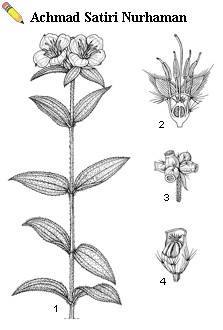 | Osbeckia chinensis L. - 1, flowering stem; 2, flower in longitudinal section; 3, fruits; 4, fruit with hypanthium partly removed |
Ecology
Osbeckia chinensis can be found in grassland and roadsides, occasionally in thickets and open forest, up to 2000 m altitude.
Genetic Resources
Osbeckia chinensis is widespread and occurs in open anthropogenic habitats. There is no reason to consider it liable to genetic erosion.
Prospects
Tests of leaf extracts of Osbeckia aspera and Osbeckia octandra from Sri Lanka showed hepatoprotective abilities, thus justifying their use in traditional medicine for the treatment of liver dysfunction. No pharmacological research has yet been done on Osbeckia chinensis, but its use in traditional medicine in regions as far apart as Vietnam and Papua New Guinea, and the positive results of tests of the Sri Lankan Osbeckia species are encouraging.
Literature
[62]Backer, C.A. & Bakhuizen van den Brink Jr, R.C., 1964—1968. Flora of Java. 3 volumes. Noordhoff, Groningen, the Netherlands. Vol. 1 (1964) 647 pp., Vol. 2 (1965) 641 pp., Vol. 3 (1968) 761 pp.
[248]Flora of Australia, 1981—. Australian Government Publishing Service, Canberra, Australia.
[331]Hegnauer, R., 1962—1997. Chemotaxonomie der Pflanzen [Chemotaxonomy of plants]. 11 volumes. Birkhäuser Verlag, Basel, Switzerland.
[347]Holdsworth, D.K., 1977. Medicinal plants of Papua New Guinea. Technical Paper No 175. South Pacific Commission, Noumea, New Caledonia. 123 pp.
[817]Saralamp, P., Chuakul, W., Temsiririrkkul, R. & Clayton, T. (Editors), 1996. Medicinal plants in Thailand. Vol. I. Department of Pharmaceutical Botany, Faculty of Pharmacy, Mahidol University, Bangkok, Thailand. 219 pp.
[1050]Zeng, X., Fang, Z. & Ma, J., 1991. Chemical constituents of Osbeckia chinensis L. China Journal of Chinese Materia Medica 16(2): 99—101 (in Chinese).
[248]Flora of Australia, 1981—. Australian Government Publishing Service, Canberra, Australia.
[331]Hegnauer, R., 1962—1997. Chemotaxonomie der Pflanzen [Chemotaxonomy of plants]. 11 volumes. Birkhäuser Verlag, Basel, Switzerland.
[347]Holdsworth, D.K., 1977. Medicinal plants of Papua New Guinea. Technical Paper No 175. South Pacific Commission, Noumea, New Caledonia. 123 pp.
[817]Saralamp, P., Chuakul, W., Temsiririrkkul, R. & Clayton, T. (Editors), 1996. Medicinal plants in Thailand. Vol. I. Department of Pharmaceutical Botany, Faculty of Pharmacy, Mahidol University, Bangkok, Thailand. 219 pp.
[1050]Zeng, X., Fang, Z. & Ma, J., 1991. Chemical constituents of Osbeckia chinensis L. China Journal of Chinese Materia Medica 16(2): 99—101 (in Chinese).
Other Selected Sources
[242]Fernando, M.R., Thabrew, M.I. & Karunanayake, E.H., 1990. Hypoglycemic activity of some medicinal plants in Sri Lanka. General Pharmacology 21(5): 779—782.
[417]Jayatilaka, K.A.P.W. & Thabrew, M.I., 2000. Protection by Osbeckia aspera against carbon tetrachloride-mediated alterations in microsomal drug metabolizing enzyme activity. Journal of Pharmacy and Pharmacology 52(4): 461—465.
[418]Jayatilaka, K.A.P.W., Thabrew, M.I., Pathirana, C., de Silva, D.G. & Perera, D.J., 1989. An evaluation of the potency of Osbeckia octandra and Melothria maderaspatana as antihepatotoxic agents. Planta Medica 55(2): 137—139.
[671]Nguyen Van Duong, 1993. Medicinal plants of Vietnam, Cambodia and Laos. Mekong Printing, Santa Ana, California, United States. 528 pp.
[674]Nicholl, D.S. et al., 2001. In vitro studies on the immunomodulatory effects of extracts of Osbeckia aspera. Journal of Ethnopharmacology 78(1): 39—44.
[924]Thabrew, M.I., Hughes, R.D. & McFarlane, I.G., 1997. Screening of hepatoprotective plant components using a HepG2 cell cytotoxicity assay. Journal of Pharmacy and Pharmacology 49(11): 1132—1135.
[925]Thabrew, M.L., Joice, P.D.T.M. & Rajatissa, W., 1987. A comparative study of the efficacy of Pavetta indica and Osbeckia octandra in the treatment of liver dysfunction. Planta Medica 53(3): 239—241.
[417]Jayatilaka, K.A.P.W. & Thabrew, M.I., 2000. Protection by Osbeckia aspera against carbon tetrachloride-mediated alterations in microsomal drug metabolizing enzyme activity. Journal of Pharmacy and Pharmacology 52(4): 461—465.
[418]Jayatilaka, K.A.P.W., Thabrew, M.I., Pathirana, C., de Silva, D.G. & Perera, D.J., 1989. An evaluation of the potency of Osbeckia octandra and Melothria maderaspatana as antihepatotoxic agents. Planta Medica 55(2): 137—139.
[671]Nguyen Van Duong, 1993. Medicinal plants of Vietnam, Cambodia and Laos. Mekong Printing, Santa Ana, California, United States. 528 pp.
[674]Nicholl, D.S. et al., 2001. In vitro studies on the immunomodulatory effects of extracts of Osbeckia aspera. Journal of Ethnopharmacology 78(1): 39—44.
[924]Thabrew, M.I., Hughes, R.D. & McFarlane, I.G., 1997. Screening of hepatoprotective plant components using a HepG2 cell cytotoxicity assay. Journal of Pharmacy and Pharmacology 49(11): 1132—1135.
[925]Thabrew, M.L., Joice, P.D.T.M. & Rajatissa, W., 1987. A comparative study of the efficacy of Pavetta indica and Osbeckia octandra in the treatment of liver dysfunction. Planta Medica 53(3): 239—241.
Author(s)
R.H.M.J. Lemmens
Correct Citation of this Article
Lemmens, R.H.M.J., 2003. Osbeckia chinensis L.. In: Lemmens, R.H.M.J. and Bunyapraphatsara, N. (Editors): Plant Resources of South-East Asia No 12(3): Medicinal and poisonous plants 3. PROSEA Foundation, Bogor, Indonesia. Database record: prota4u.org/prosea

All texts are licensed under a Creative Commons Attribution-Noncommercial-Share Alike 3.0 Netherlands License
This license does not include the illustrations (Maps,drawings,pictures); these remain all under copyright.