Record Number
2821
PROSEA Handbook Number
12(3): Medicinal and poisonous plants 3
Taxon
Picrasma javanica Blume
Protologue
Bijdr. fl. Ned. Ind.: 248 (1825).
Family
SIMAROUBACEAE
Chromosome Numbers
2n = unknown
Synonyms
Picrasma nepalensis A.W. Bennett (1844), Picrasma philippinensis Elmer (1913).
Vernacular Names
Indonesia: ki pahit (Sundanese), tuba ulet (Palembang, Sumatra), pati laler (Javanese). Malaysia: balimbing (Sabah), kayu pahit (Sarawak). Thailand: kom khom (northern), dam, yee nam bai lek (peninsular). Vietnam: kh[oor] di[eej]p.
Origin and Geographic Distribution
Picrasma javanica occurs from north-eastern India throughout South-East Asia to the Solomon Islands.
Uses
In Burma (Myanmar), Thailand and Java, the bark of Picrasma javanica is used as a febrifuge, as a substitute for quinine. The leaves are applied to treat festering sores. Another more temperate Asiatic species, Picrasma quassioides (D. Don) A.W. Bennett, is widely used in Chinese folk medicine. The fruit is stomachic, and a decoction of stem or bark is taken as a treatment for colic, stomach-ache, and as a febrifuge. The decoction is also applied as a vermifuge for cattle and as an insecticide. The wood of Picrasma excelsa Planchon (from Jamaica) is used as a substitute for Quassia amara L. wood.
Properties
All plant parts of Picrasma javanica are exceedingly bitter. The bitterness can be ascribed to the presence of quassinoids, sometimes also known as simaroubolides. Dozens of individual compounds, often classified as picrasidines, picrajavanins, javanicinocides or javanicins, have been recorded. The principal basic skeleton of these decanotriterpenes (C20) is that of picrasan-16-one. In addition, the quassinoids differ in the positions of double bonds, hydroxy-, epoxy-, oxo- and/or ester-groups (often with acetic- or C5-acids, e.g. hydroxybutyric, isovalerenic). Examples are quassin (= nigakilactone D), isoquassin (picrasmin), neoquassin and quassinol. Other components isolated belong to 2 categories of indole alkaloids: the ß-carbolides (e.g. 1-vinyl-4,8-dimethoxy-ß-carbolin) and the canthin-6-ones (e.g. 2-methoxycanthin-6-one). Chloroform and ethanol extracts of Picrasma javanica bark showed in-vitro antimalarial activity.
In a screening experiment using the disk diffusion method, extracts of leaves, seeds, stems and roots of Picrasma javanica, collected in Papua New Guinea, showed antimicrobial activity. Light petroleum, dichloromethane, ethyl acetate and butanol fractions of the various methanol extracts showed a broad spectrum antibacterial activity but no antifungal activity.
In a screening experiment using the disk diffusion method, extracts of leaves, seeds, stems and roots of Picrasma javanica, collected in Papua New Guinea, showed antimicrobial activity. Light petroleum, dichloromethane, ethyl acetate and butanol fractions of the various methanol extracts showed a broad spectrum antibacterial activity but no antifungal activity.
Botany
A monoecious or dioecious tree up to 25 m tall; bole fluted, up to 35 cm in diameter. Leaves arranged spirally, imparipinnate; petiole 2—6 cm long; stipules early caducous, foliaceous; leaflets opposite or subopposite, 4—20 cm x 1—10 cm, base cuneate, apex blunt-acuminate, entire. Inflorescence axillary, compound-cymose, unisexual, up to 20 cm long, bracteolate, long-peduncled. Flowers functionally unisexual, 4-merous, white to yellow or green, female ones usually twice as large as male; sepals triangular to ovate, c. 1 mm; petals ovate-oblong or oblong, in male flowers 2—5 mm x 1—2 mm, in female flowers 3—7 mm x 3—5 mm, accrescent; stamens up to 5 mm long in male flowers; disk 4-lobed, hairy; ovaries superior, up to 4, free, in male flowers absent, styles up to 4, united. Fruit consisting of 1—4, hardly fleshy drupelets; drupelet ovoid to depressed-globose, 9—10 mm x 7—12 mm, green to red or blue, exocarp thin, fleshy, wrinkled when dry, endocarp hard.
Picrasma comprises about 8 species, 6 in Central and South America, and 2 in Asia.
Picrasma comprises about 8 species, 6 in Central and South America, and 2 in Asia.
Image
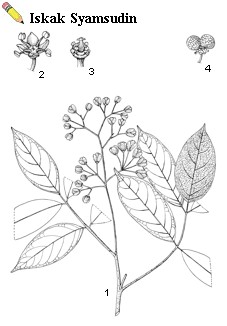 | Picrasma javanica Blume - 1, flowering twig; 2, male flower; 3, female flower, sepals and petals removed; 4, fruit |
Ecology
Picrasma javanica occurs scattered in rain forest from sea-level up to 1500 m altitude.
Genetic Resources
Although widespread throughout South-East Asia, Picrasma javanica is always rather scarce.
Prospects
Little is known with respect to the pharmacology of Picrasma javanica, as compared with other South-East Asian Simaroubaceae (e.g. Ailanthus, Brucea, Eurycoma, Quassia). In general quassinoids and canthin-6-ones, as found in numerous Simaroubaceae, display various interesting pharmacological effects, which make them of potential use in the development of templates for new drugs, e.g. to treat malaria. Because of the growing resistance of malaria parasites to the well-known, and even newer, antimalarials currently in use, there is a continuous need to develop new compounds to control this important infectious disease. The quassinoids and the canthin-6-one alkaloids might also have good potential for the development of a cytostatic drug to treat various cancers. Therefore, Picrasma javanica merits scientific attention to explore its pharmacological potency.
Literature
[44]Arbain, D., Byrne, L.T., Sargent, M.V., Skelton, B.W. & White, A.H., 1990. The alkaloids of Picrasma javanica, further studies. Australian Journal of Chemistry 43(2): 433—438.
[247]Flora Malesiana (various editors), 1950—. Foundation Flora Malesiana. Rijksherbarium/Hortus Botanicus, Leiden, the Netherlands.
[463]Khan, M.R., Kihara, M. & Omoloso, A.D., 2001. Antibacterial activity of Picrasma javanica. Fitoterapia 72(4): 406—408.
[497]Koike, K., Yokoh, M., Furukawa, M., Ishii, S. & Ohmoto, T., 1995. Picrasane quassinoids from Picrasma javanica. Phytochemistry 40(1): 233—238.
[731]Perry, L.M., 1980. Medicinal plants of East and Southeast Asia. Attributed properties and uses. MIT Press, Cambridge, Massachusetts, United States & London, United Kingdom. 620 pp.
[247]Flora Malesiana (various editors), 1950—. Foundation Flora Malesiana. Rijksherbarium/Hortus Botanicus, Leiden, the Netherlands.
[463]Khan, M.R., Kihara, M. & Omoloso, A.D., 2001. Antibacterial activity of Picrasma javanica. Fitoterapia 72(4): 406—408.
[497]Koike, K., Yokoh, M., Furukawa, M., Ishii, S. & Ohmoto, T., 1995. Picrasane quassinoids from Picrasma javanica. Phytochemistry 40(1): 233—238.
[731]Perry, L.M., 1980. Medicinal plants of East and Southeast Asia. Attributed properties and uses. MIT Press, Cambridge, Massachusetts, United States & London, United Kingdom. 620 pp.
Other Selected Sources
[121]Burkill, I.H., 1966. A dictionary of the economic products of the Malay Peninsula. Revised reprint. 2 volumes. Ministry of Agriculture and Co- operatives, Kuala Lumpur, Malaysia. Vol. 1 (A—H) pp. 1—1240, Vol. 2 (I— Z) pp. 1241—2444.
[334]Heyne, K., 1950. De nuttige planten van Indonesië [The useful plants of Indonesia]. 3rd Edition. 2 volumes. W. van Hoeve, 's-Gravenhage, the Netherlands/Bandung, Indonesia. 1660 + CCXLI pp.
[496]Koike, K., Ishii, K., Mitsunaga, K. & Ohmoto, T., 1991. New quassinoids from Picrasma javanica. Structures of javanicins U, V, W, X and Y. Chemical and Pharmaceutical Bulletin 39(8): 2021—2023.
[877]Soepadmo, E. et al. (Editors), 1995—. Tree flora of Sabah and Sarawak. Sabah Forestry Department, Forest Research Institute Malaysia and Sarawak Forestry Department, Kepong, Malaysia.
[334]Heyne, K., 1950. De nuttige planten van Indonesië [The useful plants of Indonesia]. 3rd Edition. 2 volumes. W. van Hoeve, 's-Gravenhage, the Netherlands/Bandung, Indonesia. 1660 + CCXLI pp.
[496]Koike, K., Ishii, K., Mitsunaga, K. & Ohmoto, T., 1991. New quassinoids from Picrasma javanica. Structures of javanicins U, V, W, X and Y. Chemical and Pharmaceutical Bulletin 39(8): 2021—2023.
[877]Soepadmo, E. et al. (Editors), 1995—. Tree flora of Sabah and Sarawak. Sabah Forestry Department, Forest Research Institute Malaysia and Sarawak Forestry Department, Kepong, Malaysia.
Author(s)
Syamsul Hidayat
Correct Citation of this Article
Hidayat, S., 2003. Picrasma javanica Blume. In: Lemmens, R.H.M.J. and Bunyapraphatsara, N. (Editors): Plant Resources of South-East Asia No 12(3): Medicinal and poisonous plants 3. PROSEA Foundation, Bogor, Indonesia. Database record: prota4u.org/prosea

All texts are licensed under a Creative Commons Attribution-Noncommercial-Share Alike 3.0 Netherlands License
This license does not include the illustrations (Maps,drawings,pictures); these remain all under copyright.