Record Number
2830
PROSEA Handbook Number
12(3): Medicinal and poisonous plants 3
Taxon
Prismatomeris tetrandra (Roxb.) K. Schumann
Protologue
Engl. & Prantl, Nat. Pflanzenfam. 4: 138 (1891).
Family
RUBIACEAE
Chromosome Numbers
2n = unknown
Synonyms
Prismatomeris malayana Ridley (1920), Prismatomeris albidiflora auct. non Thwaites.
Vernacular Names
Indonesia: mentulang (Bangka). Malaysia: sepedeh, mundess, susun kelapa hutan (Peninsular). Philippines: hagpo (Ibanag). Cambodia: romdenh men, romdenh meas. Thailand: kraduk kai (peninsular), to kraduk (Loei), son pa (Nakhon Ratchasima). Vietnam: mu[oof]i, l[aw]ng trang.
Origin and Geographic Distribution
Prismatomeris tetrandra occurs in north-eastern India, Sri Lanka, Bangladesh, Burma (Myanmar), southern Laos, Vietnam, southern China, Thailand, Peninsular Malaysia, Singapore, Anambas Islands (Indonesia) and the Philippines (Luzon).
Uses
In Peninsular Malaysia leaves of Prismatomeris tetrandra have been applied as a poultice to fresh wounds. In Thailand the roots or stem, mixed with Hyptis suaveolens (L.) Poit. and Barleria strigosa Willd. roots and whole plants of Elephantopus scaber L., are used in a decoction to treat bloody vomiting, whereas the roots macerated in water are used in cases of snakebite. In Indo-China a decoction of the roots has been used to treat bronchitis in a mixture with coconut and henna (Lawsonia inermis L.). The wood is considered tonic and depurative in a herbal tea drunk after childbirth. Root-shavings have been recorded as one of the ingredients of a complex dart poison in Malaysia.
In Thailand powdered roots or stems of Prismatomeris fragrans Geddes, which occurs in Indo-China, Thailand and the Andaman Islands, are used internally as a tonic. The roots of Prismatomeris sessiliflora Pitard, which is restricted to Indo-China and Thailand, are crushed in water and applied to snakebites.
In Thailand powdered roots or stems of Prismatomeris fragrans Geddes, which occurs in Indo-China, Thailand and the Andaman Islands, are used internally as a tonic. The roots of Prismatomeris sessiliflora Pitard, which is restricted to Indo-China and Thailand, are crushed in water and applied to snakebites.
Properties
The anthraquinones rubiadin and rubiadin-1-methyl ether have been isolated from methanol extracts of Prismatomeris tetrandra and Prismatomeris sessiliflora roots. These exhibited weak antimalarial activity against Plasmodium falciparum.
Botany
A shrub or small tree up to 7 m tall; young branches with 2 prominent longitudinal ridges. Leaves decussately opposite on vertical branches, distichously opposite on horizontal branches, simple and entire, elliptical or narrowly elliptical to ovate or narrowly ovate, 3—23 cm x 1—8 cm, base truncate, apex acute to acuminate, papery to leathery, pinnately veined; petiole 2—25 mm long; stipules interpetiolar, narrowly triangular, up to 7.5 mm long, caducous or persistent. Inflorescence a terminal or axillary cyme, up to 20-flowered. Flowers bisexual, (4—)5(—6)-merous, heterodistylous, strongly scented; pedicel up to 3.5 cm long; calyx tubular, up to 2.5 mm long, usually denticulate; corolla hypocrateriform, tube up to 3 cm long, lobes up to 2.5 cm long, spreading, white; stamens inserted above the middle of the corolla tube; disk annular; ovary inferior, 2-celled, style filiform, stigma 2-lobed. Fruit a subglobose drupe 7—11 mm in diameter, blackish-purple to blackish-blue, 1-seeded. Seed almost spherical, up to 9 mm in diameter, with dark reddish-brown testa; endosperm corneous.
The seeds may be dispersed by birds such as fruit-pigeons, and perhaps also by small mammals like rodents and monkeys.
Prismatomeris comprises 15 species and is distributed in the same region as indicated for Prismatomeris tetrandra, plus Sumatra, western Java, Borneo and the Philippines. It is classified in the tribe Morindeae, together with e.g. Morinda and Rennellia; it seems closely related to the latter genus. However, some authors place it in a separate tribe Prismatomerideae.
Prismatomeris tetrandra forms a very variable complex, particularly varying in corolla and fruit size. Two subspecies are distinguished: subsp. tetrandra and subsp. malayana (Ridley) J.T. Johansson. The first subspecies occurs from north-eastern India, Bangladesh and northern Burma (Myanmar) to northern Vietnam, southern China, Thailand and Luzon (the Philippines), the second one from Sri Lanka (extinct?) and southern Burma (Myanmar) to southern Indo-China, Thailand, Peninsular Malaysia, Singapore and Anambas Island.
The seeds may be dispersed by birds such as fruit-pigeons, and perhaps also by small mammals like rodents and monkeys.
Prismatomeris comprises 15 species and is distributed in the same region as indicated for Prismatomeris tetrandra, plus Sumatra, western Java, Borneo and the Philippines. It is classified in the tribe Morindeae, together with e.g. Morinda and Rennellia; it seems closely related to the latter genus. However, some authors place it in a separate tribe Prismatomerideae.
Prismatomeris tetrandra forms a very variable complex, particularly varying in corolla and fruit size. Two subspecies are distinguished: subsp. tetrandra and subsp. malayana (Ridley) J.T. Johansson. The first subspecies occurs from north-eastern India, Bangladesh and northern Burma (Myanmar) to northern Vietnam, southern China, Thailand and Luzon (the Philippines), the second one from Sri Lanka (extinct?) and southern Burma (Myanmar) to southern Indo-China, Thailand, Peninsular Malaysia, Singapore and Anambas Island.
Image
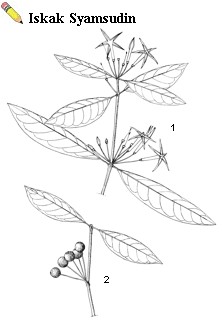 | Prismatomeris tetrandra (Roxb.) K. Schumann - 1, flowering branch; 2, fruiting branch |
Ecology
Subsp. tetrandra occurs mainly in highland regions up to 1800 m altitude, and has been collected in primary and secondary, damp and dry, evergreen and deciduous forests, and occasionally in savanna woodland. Subsp. malayana occurs mainly in the lowland, up to 500 m altitude, but sometimes in montane forest up to 1700 m altitude, in humid evergreen forest as well as dry forest, scrub vegetation, on dunes, also on shale and limestone.
Genetic Resources
Prismatomeris tetrandra is widely distributed in a wide range of habitats and thus not endangered.
Prospects
Although several medicinal applications have been indicated for Prismatomeris tetrandra, there is little information available on its phytochemistry and pharmacological properties. Until now, its prospects as a medicinal plant of importance are not promising.
Literature
[121]Burkill, I.H., 1966. A dictionary of the economic products of the Malay Peninsula. Revised reprint. 2 volumes. Ministry of Agriculture and Co- operatives, Kuala Lumpur, Malaysia. Vol. 1 (A—H) pp. 1—1240, Vol. 2 (I— Z) pp. 1241—2444.
[434]Johansson, J.T., 1987. Revision of the genus Prismatomeris Thw. (Rubiaceae, Morindeae). Opera Botanica 94. 62 pp.
[549]Likhitwitayawuid, K., Dej-adisai, S., Jongbunprasert, V. & Krungkrai, J., 1999. Antimalarials from Stephania venosa, Prismatomeris sessiliflora, Diospyros montana and Murraya siamensis. Planta Medica 65(8): 754—756.
[434]Johansson, J.T., 1987. Revision of the genus Prismatomeris Thw. (Rubiaceae, Morindeae). Opera Botanica 94. 62 pp.
[549]Likhitwitayawuid, K., Dej-adisai, S., Jongbunprasert, V. & Krungkrai, J., 1999. Antimalarials from Stephania venosa, Prismatomeris sessiliflora, Diospyros montana and Murraya siamensis. Planta Medica 65(8): 754—756.
Other Selected Sources
[168]Chuakul, W., 2000. Medicinal plants in North-eastern Thailand. Amarin Printing and Publishing Public Co. Ltd., Bangkok, Thailand (in Thai).
[174]Chuakul, W. & Soonthornchareonnon, N., 1997. Medicinal plants in Ubon Ratchathani Province (1). Thai Journal of Phytopharmacy 4(2): 29—61.
[732]Pételot, A., 1952—1954. Les plantes médicinales du Cambodge, du Laos et du Vietnam [The medicinal plants of Cambodia, Laos and Vietnam]. 4 volumes. Centre National de Recherches Scientifiques et Techniques, Saigon, Vietnam.
[174]Chuakul, W. & Soonthornchareonnon, N., 1997. Medicinal plants in Ubon Ratchathani Province (1). Thai Journal of Phytopharmacy 4(2): 29—61.
[732]Pételot, A., 1952—1954. Les plantes médicinales du Cambodge, du Laos et du Vietnam [The medicinal plants of Cambodia, Laos and Vietnam]. 4 volumes. Centre National de Recherches Scientifiques et Techniques, Saigon, Vietnam.
Author(s)
Wongsatit Chuakul, Noppamas Soonthornchareonnon & Orawan Ruangsomboon
Correct Citation of this Article
Chuakul, W., Soonthornchareonnon, N. & Ruangsomboon, O., 2003. Prismatomeris tetrandra (Roxb.) K. Schumann. In: Lemmens, R.H.M.J. and Bunyapraphatsara, N. (Editors): Plant Resources of South-East Asia No 12(3): Medicinal and poisonous plants 3. PROSEA Foundation, Bogor, Indonesia. Database record: prota4u.org/prosea

All texts are licensed under a Creative Commons Attribution-Noncommercial-Share Alike 3.0 Netherlands License
This license does not include the illustrations (Maps,drawings,pictures); these remain all under copyright.