Record Number
2862
PROSEA Handbook Number
12(3): Medicinal and poisonous plants 3
Taxon
Ruellia tuberosa L.
Protologue
Sp. pl. 2: 635 (1753).
Family
ACANTHACEAE
Chromosome Numbers
2n = 32, 34
Vernacular Names
Thailand: toi ting (Bangkok). Vietnam: q[ur]a n[oor], tanh t[as]ch.
Origin and Geographic Distribution
Ruellia tuberosa originates from tropical America, but is naturalized in South-East Asia (Thailand, Peninsular Malaysia, Java) and elsewhere in the tropics (India, Sri Lanka, Africa), as an escape from cultivation as an ornamental.
Uses
Although Ruellia tuberosa is apparently only rarely used medicinally in South-East Asia, it has numerous applications in traditional medicine in tropical America, most commonly the roots, which are emetic and purgative. A decoction of dried and powdered roots is used as a diuretic, often in cases of gonorrhoea and syphilis, to treat kidney troubles and diabetes, as a febrifuge, and to treat colds. A decoction of whole plants is applied externally to sores and wounds and internally to treat pulmonary catarrh, asthma, influenza and colds. The leaves are used to treat toothache, and a leaf decoction against fever, chronic bronchitis and leucorrhoea. In Thailand, seeds and leaves are applied as a poultice to ulcers and abscesses.
Ruellia tuberosa is grown as an ornamental for its attractive flowers.
Ruellia tuberosa is grown as an ornamental for its attractive flowers.
Properties
An aqueous extract of Ruellia tuberosa stems of Cuban origin showed antineoplastic activity on Neurospora crassa (83.5% inhibition).
In-vitro bactericidal effects against plant pathogenic bacteria have been demonstrated for Ruellia tuberosa infusions. Ruellia tuberosa root extracts containing 2,6-dimethoxyquinone, acacetin and a C16-quinone had protective and curative effects against fusarial wilt of safflower (Carthamus tinctorius L.). Triterpenes (lupeol) and phytosterols (sitosterol, stigmasterol and campesterol) have been isolated from the roots. Flavone glucuronides such as apigenin-7-b-D-glucuronide were isolated from the leaves and flowers.
In-vitro bactericidal effects against plant pathogenic bacteria have been demonstrated for Ruellia tuberosa infusions. Ruellia tuberosa root extracts containing 2,6-dimethoxyquinone, acacetin and a C16-quinone had protective and curative effects against fusarial wilt of safflower (Carthamus tinctorius L.). Triterpenes (lupeol) and phytosterols (sitosterol, stigmasterol and campesterol) have been isolated from the roots. Flavone glucuronides such as apigenin-7-b-D-glucuronide were isolated from the leaves and flowers.
Botany
An erect perennial herb up to 90 cm tall, with elongately tuberous roots and subquadrangular stem thickened above the nodes. Leaves opposite, simple and entire, oblong to oblong-obovate, 6—18 cm x 3—9 cm, decurrent at base, obtuse to rounded at apex, sparingly hairy or glabrous, with cystoliths; petiole up to 1.5 cm long, connected by transverse ridges; stipules absent. Inflorescence an axillary cyme, rather lax, 1—15-flowered; bracts narrow, up to 9 mm long; peduncle up to 2.5 cm long. Flowers bisexual, 5-merous; pedicel up to 2.5 cm long; calyx 2—3 cm long, partite with narrow, finally reflexed segments; corolla 5—6 cm long, infundibular with narrow base, unequally to subequally lobed with rounded lobes up to 2.5 cm long, irregularly sinuate-dentate, bright violet to pale blue, sometimes white; stamens 4, inserted at base of corolla tube, didynamous; ovary superior, 2-celled, style subulate with 2 unequal stigmatic lobes. Fruit a fusiform capsule 2—3 cm long, many-seeded. Seeds orbicular, compressed, ringed with hygroscopic hairs.
The flowers are ephemerous, but plants may flower throughout the year. Cleistogamous flowers only about 2.5 mm long are commonly present, often producing fruits.
Numerous species have been described in Ruellia, resulting in a large and variable genus. Several attempts have been made to split it up into segregate genera which form more natural groups, one of these resulting in a small genus concept of Ruellia consisting of only 2—5 species. However, there is still disagreement among taxonomists about the generic concept within the group of Acanthaceae to which Ruellia belongs. Some medicinal species in South-East Asia formerly included in Ruellia are described in this publication in the genera Dipteracanthus, Hemigraphis and Pararuellia.
Image
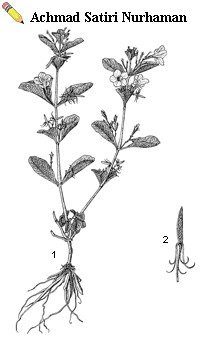 | Ruellia tuberosa L. - 1, plant habit; 2, fruit |
Ecology
Ruellia tuberosa occurs along roadsides and in waste places, in Java up to 150 m altitude, and is locally common.
Silviculture and Management
In cultivation Ruellia tuberosa is propagated by seed, suckers and cuttings. It is planted in garden borders, and is especially suited for slightly shaded, humid localities.
Genetic Resources
Ruellia tuberosa is widely spread through cultivation and naturalization, and does not seem liable to genetic erosion. Its area of distribution still seems to be expanding.
Prospects
Although, as an introduced species, Ruellia tuberosa is little known in the Malesian region, it deserves attention as a medicinal plant given its reputation in the American tropics.
Literature
[62]Backer, C.A. & Bakhuizen van den Brink Jr, R.C., 1964—1968. Flora of Java. 3 volumes. Noordhoff, Groningen, the Netherlands. Vol. 1 (1964) 647 pp., Vol. 2 (1965) 641 pp., Vol. 3 (1968) 761 pp.
[273]Ghosal, S., Banerjee, S., Chattopadhyay, B.K., Srivastava, R.S. & Chakrabarti, D.K., 1978. Toxic substances produced by Fusarium VII. Control of fusarial wilt of safflower by root exudates and extractives of Ruellia tuberosa. Experientia 34(8): 1057—1058.
[575]Long, R.W., 1976. Biosystematics of Ruellia tuberosa L. (Acanthaceae). American Journal of Botany 63(7): 951—959.
[646]Morton, J.F., 1981. Atlas of medicinal plants of Middle America. Bahamas to Yucatan. Charles C. Thomas, Springfield, Illinois, United States. 1420 pp.
Other Selected Sources
[120]Burkill, H.M., 1985—2000. The useful plants of West tropical Africa. 2nd Edition. 5 volumes. Royal Botanic Gardens, Kew, United Kingdom. Vol. 1 (1985), Families A—D, 960 pp.; Vol. 2 (1994), Families E—I, 636 pp.; Vol. 3 (1995), Families J—L, 857 pp.; Vol. 4 (1997), Families M—R, 969 pp; Vol. 5 (2000), Families S—Z, 686 pp.
[121]Burkill, I.H., 1966. A dictionary of the economic products of the Malay Peninsula. Revised reprint. 2 volumes. Ministry of Agriculture and Co- operatives, Kuala Lumpur, Malaysia. Vol. 1 (A—H) pp. 1—1240, Vol. 2 (I— Z) pp. 1241—2444.
[972]Wagner, H. et al., 1971. Synthese von Glucuroniden der Flavonoid-Reihe. 3. Isolierung von Apigenin-7-ß-D-glucuronid aus Ruellia tuberosa L. und seine Synthese [Synthesis of glucuronides in the flavonoid series. 3. Isolation of apigenin-7-ß-D-glucuronide from Ruellia tuberosa L. and its synthesis]. Chemische Berichte 104(9): 2681—2687.
Author(s)
Yun Astuti Nugroho
Correct Citation of this Article
Nugroho, Y.A., 2003. Ruellia tuberosa L.. In: Lemmens, R.H.M.J. and Bunyapraphatsara, N. (Editors): Plant Resources of South-East Asia No 12(3): Medicinal and poisonous plants 3. PROSEA Foundation, Bogor, Indonesia. Database record: prota4u.org/prosea

All texts are licensed under a Creative Commons Attribution-Noncommercial-Share Alike 3.0 Netherlands License
This license does not include the illustrations (Maps,drawings,pictures); these remain all under copyright.