Record Number
2869
PROSEA Handbook Number
12(3): Medicinal and poisonous plants 3
Taxon
Sapindus saponaria L.
This article should be read together with the article on the genus: Sapindus in the Handbook volume indicated above in this database.
This article should be read together with the article on the genus: Sapindus in the Handbook volume indicated above in this database.
Protologue
Sp. pl. 1: 367 (1753).
Synonyms
Sapindus mukorossi Gaertner (1788), Sapindus vitiensis A. Gray (1854), Sapindus microcarpus Jardin (1857).
Vernacular Names
Soap-berry tree, soap-nut (En). Philippines: tikastikas (Tagalog), kasibeng (Ibanag, Iloko), malapalitpit (Pampango). Vietnam: b[oof] h[of]n, v[oo] ho[aj]n t[uwr].
Distribution
Originating from tropical and subtropical America, widely cultivated and naturalized in the tropics and subtropics, in Asia from India to China and Japan; in Malesia confined to the Philippines, the Lesser Sunda Islands and Papua New Guinea (Central Province).
Uses
Roots, bark, leaves, but especially fruits are used as a substitute for soap. The fruits are applied as a fish poison and as a leech repellent. In the Philippines the bark is used for washing the hair, and crushed leaves for removing stains from the skin. In Vietnam a decoction of macerated bark is applied to kill head and body lice. The fruits are employed as a skin wash to remove tan and freckles. The kernel is recommended for bad breath, gum boils and tooth decay. A seed decoction taken internally acts as an expectorant. In Taiwan the flowers are a recommended medication for conjunctivitis and various eye diseases. In South and Central America the fruits are commonly used in traditional medicine, mainly in external applications to treat arthritis, rheumatism, gout, tumours and leprous swellings. Fibre from the inner bark may be used for ropes.
Observations
A tree up to 25 m tall, bole up to 55 cm in diameter; leaves 1—5-jugate, up to 40 cm long, glabrous, petiole terete to 3-angular, 1.5—5.5 cm long, rachis variably marginated or winged, leaflets (sub-)opposite, elliptical to lanceolate, mostly slightly oblique and falcate, 6—16 cm x 3—6 cm, base cuneate, apex emarginate or obtuse to acute; inflorescence up to 25 cm long, densely tomentose; flowers regular, cream, sepals concave, mostly with a broad petaloid margin, ciliolate and with some appressed hairs near the base, petals 5, oblong-ovate to ovate, 1.5—2.5 mm x 1—1.2 mm, scale represented by a hairy ridge or 2 auricles, disk annular, pistil c. 2 mm long; drupe subglobular, 0.8—1.2 cm in diameter, not carinate. In Malesia three geographically disjunct races can be discerned. Sapindus saponaria is found in more or less open, mostly secondary forest up to 500 m altitude.
Image
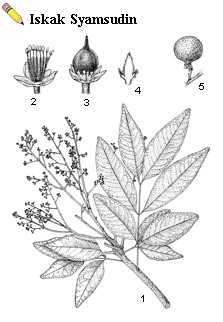 | Sapindus saponaria L. - 1, flowering branch; 2, male flower; 3, female flower; 4, petal; 5, fruit |
Selected Sources
[117]Brown, W.H., 1951—1957. Useful plants of the Philippines. Reprint of the 1941—1943 edition. 3 volumes. Technical Bulletin 10. Department of Agriculture and Natural Resources. Bureau of Printing, Manila, the Philippines. Vol. 1 (1951) 590 pp., Vol. 2 (1954) 513 pp., Vol. 3 (1957) 507 pp.
[247]Flora Malesiana (various editors), 1950—. Foundation Flora Malesiana. Rijksherbarium/Hortus Botanicus, Leiden, the Netherlands.
[646]Morton, J.F., 1981. Atlas of medicinal plants of Middle America. Bahamas to Yucatan. Charles C. Thomas, Springfield, Illinois, United States. 1420 pp.
[671]Nguyen Van Duong, 1993. Medicinal plants of Vietnam, Cambodia and Laos. Mekong Printing, Santa Ana, California, United States. 528 pp.
[732]Pételot, A., 1952—1954. Les plantes médicinales du Cambodge, du Laos et du Vietnam [The medicinal plants of Cambodia, Laos and Vietnam]. 4 volumes. Centre National de Recherches Scientifiques et Techniques, Saigon, Vietnam.
[783]Ribeiro, A. et al., 1995. Molluscicidal saponins from the pericarp of Sapindus saponaria. International Journal of Pharmacognosy 33(3): 177—180.
[926]Thalib, A., Widiawati, Y., Hamid, H., Suherman, D. & Sabrani, M., 1996. The effects of saponin from Sapindus rarak fruit on rumen microbes and performance of sheep. Jurnal Ilmu Ternak dan Veteriner 2(1): 17—21 (in Indonesian).
[247]Flora Malesiana (various editors), 1950—. Foundation Flora Malesiana. Rijksherbarium/Hortus Botanicus, Leiden, the Netherlands.
[646]Morton, J.F., 1981. Atlas of medicinal plants of Middle America. Bahamas to Yucatan. Charles C. Thomas, Springfield, Illinois, United States. 1420 pp.
[671]Nguyen Van Duong, 1993. Medicinal plants of Vietnam, Cambodia and Laos. Mekong Printing, Santa Ana, California, United States. 528 pp.
[732]Pételot, A., 1952—1954. Les plantes médicinales du Cambodge, du Laos et du Vietnam [The medicinal plants of Cambodia, Laos and Vietnam]. 4 volumes. Centre National de Recherches Scientifiques et Techniques, Saigon, Vietnam.
[783]Ribeiro, A. et al., 1995. Molluscicidal saponins from the pericarp of Sapindus saponaria. International Journal of Pharmacognosy 33(3): 177—180.
[926]Thalib, A., Widiawati, Y., Hamid, H., Suherman, D. & Sabrani, M., 1996. The effects of saponin from Sapindus rarak fruit on rumen microbes and performance of sheep. Jurnal Ilmu Ternak dan Veteriner 2(1): 17—21 (in Indonesian).
Author(s)
Lucie Widowati
Correct Citation of this Article
Widowati, L., 2003. Sapindus saponaria L.. In: Lemmens, R.H.M.J. and Bunyapraphatsara, N. (Editors): Plant Resources of South-East Asia No 12(3): Medicinal and poisonous plants 3. PROSEA Foundation, Bogor, Indonesia. Database record: prota4u.org/prosea

All texts are licensed under a Creative Commons Attribution-Noncommercial-Share Alike 3.0 Netherlands License
This license does not include the illustrations (Maps,drawings,pictures); these remain all under copyright.