Record Number
29
PROSEA Handbook Number
5(2): Timber trees; Minor commercial timbers
Taxon
Castanospermum A. Cunn. ex Hook.
Protologue
Bot. Misc. 1: 241 (1830).
Family
LEGUMINOSAE
Chromosome Numbers
x = unknown; Castanospermum australe: 2n = 26
Trade Groups
Trade groups Black bean: medium-weight to moderately heavy hardwood, a single species, Castanospermum australe A. Cunn. & C. Fraser ex Hook., Bot. Misc. 1: 241, t. 51 (1830), synonym: Castanospermum cunninghamii J. Wood (1903).
Vernacular Names
Black bean, Moreton Bay chestnut (En).
Origin and Geographic Distribution
Castanospermum has only a single species which is native in north-eastern Australia, New Caledonia and Vanuatu. It was probably introduced into New Britain during the earliest days of European settlement. Nowadays, it is extensively planted in a few other tropical countries, e.g. in Sri Lanka. In Papua New Guinea, it is cultivated near Port Moresby and at Lae. Fossil remains of Castanospermum date back to the Eocene (44-50 million years ago) in New South Wales (Australia).
Uses
Black bean timber is highly valued and is used for furniture, cabinets and high-quality fittings. The wood is suitable for the manufacture of luxury articles such as fancy veneer, inlay work and fancy woodwork. Furthermore, it has been used for moulding, boat building, vehicle bodies, musical instruments, interior trim, carvings, toys and novelties, and turnery. Some specific applications are gun stocks and electrical equipment, the latter due to its high electrical resistance.
The tree is widely cultivated (but not commonly) as an ornamental and shade tree. The leaves are used for fodder, but may be toxic to livestock. The fruit is sometimes eaten roasted or made into a coarse flour. The seeds may be toxic, but small amounts do not seem to have any severe effects on livestock and humans. Chemical components of the seed may show some potential in the treatment of AIDS.
The tree is widely cultivated (but not commonly) as an ornamental and shade tree. The leaves are used for fodder, but may be toxic to livestock. The fruit is sometimes eaten roasted or made into a coarse flour. The seeds may be toxic, but small amounts do not seem to have any severe effects on livestock and humans. Chemical components of the seed may show some potential in the treatment of AIDS.
Production and International Trade
Black bean is exported from Papua New Guinea to Japan and fetches high prices but only very limited amounts are available. The export of black bean logs from Papua New Guinea has been banned since 1991.
Properties
Black bean is a medium-weight to fairly heavy hardwood. The heartwood is deep brown to blackish-brown, sharply differentiated from the yellowish-white sapwood. Yellow streaks of tissue (parenchyma) contrast with the dark heartwood; the wood has a prominent figure and is decorative. The density is (575-)750-815(-1000) kg/m³ at 15% moisture content. The grain is usually straight but sometimes slightly interlocked, texture rather coarse. Black bean is valued for its mechanical properties and durability but the dimensional stability in use is poor.
At 12% moisture content, the modulus of rupture is 80-103 N/mm², modulus of elasticity 9200-13 500 N/mm², compression parallel to grain 57 N/mm², compression perpendicular to grain 8.5 N/mm², shear 12.5-15.5 N/mm², cleavage 40-71.5 N/mm (direction unknown), Janka side hardness 6895 N and Janka end hardness 8230 N. See also the table on wood properties.
The rates of shrinkage are usually moderate to high, but occasionally very low figures have been reported: from green to 15% moisture content 0.9-5.8% radial and 1.6-10.3% tangential, from green to 12% moisture content 1.8-8.1% radial and 5.8-12.1% tangential, and from green to oven dry 3.0-9.3% radial and 5.1-14.9% tangential. The moisture content of green wood is high: 115-126%. Black bean seasons very slowly, often with serious distortion. It requires careful drying because it is very prone to collapse and tends to check internally if dried quickly in large cross-section. Thin strips, close spacing of strips and possible baffling of the stack can help to slow down drying and reduce the tendency to check. Kiln drying should also be done slowly. Air drying before kiln drying is recommended.
The working properties are generally satisfactory but may be affected by alternating soft and hard patches. The wood moderately blunts cutting edges. The logs have a reputation for having brittle heart, leading to low recovery figures in milling. Wood dust may cause nasal irritation. The wood can be nailed satisfactorily. It is easy to glue, but occasionally gluing is problematic because of the slightly greasy nature of the wood. The wood stains and polishes well. The bending are moderate. Tests on the suitability for the production of veneer, plywood and fibreboard showed moderate results; black bean is not suitable for making particle board and cement board or for pulp production.
Black bean heartwood is durable. It is moderately to highly resistant to termite and other insect attacks. The sapwood is liable to attack by powder-post beetles. The heartwood is extremely resistant to preservative treatment, the sapwood is permeable. The retention by the pressure treating method is 27 kg/m³ for heartwood and 440 kg/m³ for sapwood.
The wood contains 72.5% holocellulose, 40% ¢-cellulose, 26.5-27.5% lignin, 15.5% pentosan and 0.2-0.3% ash. The solubility is 9.1-12.4% in alcohol-benzene, 7.3-11.8% in cold water, 9.0-12.2% in hot water and 22.2-27.3% in a 1% NaOH solution. Black bean wood is not suitable for the production of charcoal. The frothing test is positive; the wood fluoresces in ultraviolet light.
The seeds of black bean yield castanospermine and 1-deoxynojirimycin which may show some potential in the treatment of AIDS. The unpleasant purgative effects and indigestibility of the fresh seeds have been attributed to their high saponin content of about 7%. The astringency is reduced by soaking and roasting.
At 12% moisture content, the modulus of rupture is 80-103 N/mm², modulus of elasticity 9200-13 500 N/mm², compression parallel to grain 57 N/mm², compression perpendicular to grain 8.5 N/mm², shear 12.5-15.5 N/mm², cleavage 40-71.5 N/mm (direction unknown), Janka side hardness 6895 N and Janka end hardness 8230 N. See also the table on wood properties.
The rates of shrinkage are usually moderate to high, but occasionally very low figures have been reported: from green to 15% moisture content 0.9-5.8% radial and 1.6-10.3% tangential, from green to 12% moisture content 1.8-8.1% radial and 5.8-12.1% tangential, and from green to oven dry 3.0-9.3% radial and 5.1-14.9% tangential. The moisture content of green wood is high: 115-126%. Black bean seasons very slowly, often with serious distortion. It requires careful drying because it is very prone to collapse and tends to check internally if dried quickly in large cross-section. Thin strips, close spacing of strips and possible baffling of the stack can help to slow down drying and reduce the tendency to check. Kiln drying should also be done slowly. Air drying before kiln drying is recommended.
The working properties are generally satisfactory but may be affected by alternating soft and hard patches. The wood moderately blunts cutting edges. The logs have a reputation for having brittle heart, leading to low recovery figures in milling. Wood dust may cause nasal irritation. The wood can be nailed satisfactorily. It is easy to glue, but occasionally gluing is problematic because of the slightly greasy nature of the wood. The wood stains and polishes well. The bending are moderate. Tests on the suitability for the production of veneer, plywood and fibreboard showed moderate results; black bean is not suitable for making particle board and cement board or for pulp production.
Black bean heartwood is durable. It is moderately to highly resistant to termite and other insect attacks. The sapwood is liable to attack by powder-post beetles. The heartwood is extremely resistant to preservative treatment, the sapwood is permeable. The retention by the pressure treating method is 27 kg/m³ for heartwood and 440 kg/m³ for sapwood.
The wood contains 72.5% holocellulose, 40% ¢-cellulose, 26.5-27.5% lignin, 15.5% pentosan and 0.2-0.3% ash. The solubility is 9.1-12.4% in alcohol-benzene, 7.3-11.8% in cold water, 9.0-12.2% in hot water and 22.2-27.3% in a 1% NaOH solution. Black bean wood is not suitable for the production of charcoal. The frothing test is positive; the wood fluoresces in ultraviolet light.
The seeds of black bean yield castanospermine and 1-deoxynojirimycin which may show some potential in the treatment of AIDS. The unpleasant purgative effects and indigestibility of the fresh seeds have been attributed to their high saponin content of about 7%. The astringency is reduced by soaking and roasting.
Description
A medium-sized to fairly large tree up to 40 m tall; bole unbranched for up to 20 m, up to 135 cm in diameter, buttresses absent; bark surface with fine vertical and horizontal cracks, grey-white or grey-brown, outer bark 0.5-1 cm thick, inner bark rather hard and brittle, pale brown or pale red-brown, sometimes partially yellow; crown compact. Leaves alternate, imparipinnate, with opposite or alternate leaflets; stipules absent; leaflets 7-19, elliptical-oblong to oblong, 6-16 cm x 2.5-5.5 cm, acuminate, glabrous, dark green and shining, stipels absent. Inflorescence terminal or axillary, usually on older branches, rather large; racemes 4-25 cm long. Flowers on 2.3-3 cm long pedicel, without bracteoles; calyx thick, with 5 broad short lobes, yellow; corolla papilionaceous, fleshy, 3-4 cm long, yellow becoming orange-red; wings and keel shorter than standard, lacking the usual auricle at base; stamens 10, free, with linear versatile anthers; ovary superior, stipitate, 1-locular, with 6-7 ovules, style long, glabrous, with a small terminal stigma. Fruit a large, woody pod, 2-valved, oblong, 18-25 cm x 4-6 cm, acute, with spongy tissue, dark brown. Seeds 2-5, depressed oblong-ovoid, 4 cm x 3.5 cm x 2.2 cm, dark brown, with a soft seed-coat, without albumen.
Image
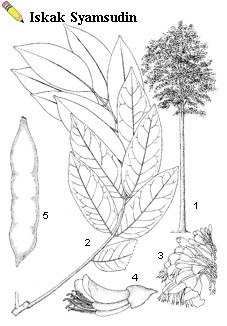 | Castanospermum australe A. Cunn. & C. Fraser ex Hook. – 1, tree habit; 2, leaf; 3, inflorescence; 4, flower; 5, pod. |
Wood Anatomy
- Macroscopic characters: Heartwood pale brown to dark chocolate-brown with irregular black streaks, clearly demarcated from the white to yellowish sapwood. Grain usually straight, occasionally interlocked. Texture coarse and even; wood with prominent streaky figure due to abundant parenchyma and dark streaks, sometimes greasy to the feel. Growth rings not evident; vessels large and distinct to the naked eye, evenly distributed, mostly white, sometimes yellow or rarely pink chalky deposits present; parenchyma abundant, aliform tending to confluent, occasionally irregular bands of parenchyma present; rays small, barely visible to the naked eye as individual rays, inconspicuous on radial surface; ripple marks present, variable (20- 30/mm).
- Microscopic characters: Growth rings inconspicuous. Vessels diffuse, 2-6/mm², solitary and in radial multiples of (2-)3-6(-9), round to mostly oval, average maximum tangential diameter 170-270 µm; perforations simple; intervessel pits alternate, vestured, mostly rounded to polygonal, sometimes loosely arranged, (6-)7-9 µm in diameter; vessel-ray pits similar to intervessel pits but half-bordered, apertures rounded; helical thickenings absent; tyloses absent. Fibres 1.1-1.2 mm long, non-septate, moderately thin-walled to moderately thick-walled, with minutely bordered to simple pits mainly confined to the radial walls. Parenchyma abundant, paratracheal, aliform to confluent, occasionally in confluent bands, in 2-4-celled strands, with a tendency to storied arrangement. Rays 9-10/mm, 1-2(-3)-seriate, 0.3-0.7 mm (5-25 cells) high, heterocellular with 1-2 marginal rows of square or upright cells (Kribs type heterogeneous II), uniseriate rays often made up of upright cells. Prismatic crystals in chambered parenchyma strands, usually at margins, some in diffuse strands. Silica absent.
Heartwood from plantation-grown black bean tends to be considerably paler than from naturally growing trees in Australia. Black bean wood may show similarity to wood of Albizia procera (Roxb.) Benth. and Intsia spp. However, it can be differentiated by consistently lacking pink tints, lack of lustre and its tendency to have storied rays.
- Microscopic characters: Growth rings inconspicuous. Vessels diffuse, 2-6/mm², solitary and in radial multiples of (2-)3-6(-9), round to mostly oval, average maximum tangential diameter 170-270 µm; perforations simple; intervessel pits alternate, vestured, mostly rounded to polygonal, sometimes loosely arranged, (6-)7-9 µm in diameter; vessel-ray pits similar to intervessel pits but half-bordered, apertures rounded; helical thickenings absent; tyloses absent. Fibres 1.1-1.2 mm long, non-septate, moderately thin-walled to moderately thick-walled, with minutely bordered to simple pits mainly confined to the radial walls. Parenchyma abundant, paratracheal, aliform to confluent, occasionally in confluent bands, in 2-4-celled strands, with a tendency to storied arrangement. Rays 9-10/mm, 1-2(-3)-seriate, 0.3-0.7 mm (5-25 cells) high, heterocellular with 1-2 marginal rows of square or upright cells (Kribs type heterogeneous II), uniseriate rays often made up of upright cells. Prismatic crystals in chambered parenchyma strands, usually at margins, some in diffuse strands. Silica absent.
Heartwood from plantation-grown black bean tends to be considerably paler than from naturally growing trees in Australia. Black bean wood may show similarity to wood of Albizia procera (Roxb.) Benth. and Intsia spp. However, it can be differentiated by consistently lacking pink tints, lack of lustre and its tendency to have storied rays.
Growth and Development
Seed germinates below-ground and seedlings may still be alive and vital even after 2 years of burial. The seeds float and are dispersed by streams or the sea.
Other Botanical Information
Castanospermum belongs to the tribe Sophoreae and is most closely related to Angylocalyx (tropical Africa) and Xanthocercis (Madagascar and southern Africa). Castanospermine has also been found in seeds of Alexa spp., suggesting a close relationship with black bean.
Ecology
Black bean occurs in primary coastal rain forest and along beaches; it is classified as a primary species. In its natural area of distribution the mean annual rainfall is 1000-1500 mm. It thrives on wet soils of moderate fertility, and is not tolerant of a long dry season.
Propagation and planting
The seeds are large, weighing about 30 g. They are viable for a short period but can be stored longer in air-tight containers at 3-5 °C. No pretreatment is needed to initiate germination. Seeds germinate from within the pod. When buried, viability remains 100% for 6 weeks, then drops to 40% after 6 months and to 0% after one year. However, germinated seeds which are buried in the ground may be dormant but viable for a long time.
Silviculture and Management
As black bean coppices well, replanting after harvesting may not be necessary.
Harvesting
Logs often have brittle heart.
Yield
The 13 m long unbranched bole of a 34 m tall tree had a volume of 11.7 m³.
Genetic Resources
Black bean has been cut for its valuable timber throughout its natural area of distribution, and stands may have been seriously depleted. However, black bean has been planted in many areas outside its natural area of distribution.
Prospects
As black bean timber fetches high prices there may be scope for increased cultivation in South-East Asia. However, research is needed on its silvicultural aspects before extension of its cultivation can be considered.
Literature
Allen, O.N. & Allen, E.K., 1981. The Leguminosae. A source book of characteristics, uses and nodulation. Macmillan Publishers, London and Basingstoke, and the University of Wisconsin Press, Madison. pp. 149-150.
All Nippon Checkers Corporation, 1989. Illustrated commercial foreign woods in Japan. Tokyo. p. 77.
Davidson, B.R. & Davidson, H.F., 1993. Legumes, the Australian experience: the botany, ecology, and agriculture of indigenous and immigrant legumes. Research studies in botany and related applied fields No 12. Research Study Press, Somerset. 471 pp.
Hopkins, M.S. & Graham, A.W., 1987. The viability of seeds of rainforest species after experimental soil burials under tropical wet lowland forest in north-eastern Australia. Australian Journal of Ecology 12: 97-108.
Keating, W.G. & Bolza, E., 1982. Characteristics, properties and uses of timbers. Vol. 1: South-east Asia, Northern Australia and the Pacific. Division of Chemical Technology, Commonwealth Scientific and Industrial Research Organization. Inkata Press, Melbourne, Sydney, London. p. 75.
Kingston, R.S.T. & Risdon, C.J.E., 1961. Shrinkage and density of Australian and other South-west Pacific woods. Division of Forest Products Technological Paper No 13. Commonwealth Scientific and Industrial Research Organization, Melbourne. p. 13.
Sunkara, P.S., Bowlin, T.L., Liu, P.S. & Sjoerdsma, A., 1987. Antiretroviral activity of castanospermine and deoxynojirimycin, specific inhibitors of glycoprotein processing. Biochemical and Biophysical Research Communications 148: 206-210.
Verdcourt, B., 1979. A manual of New Guinea legumes. Botany Bulletin No 11. Office of Forests, Division of Botany, Lae. pp. 283-284.
Working Group on lesser-known tropical timber, 1984. Studies on the end-use development of lesser-known tropical timber (III). Properties and utilization of five lesser-known species grown in Kapuluk District, Papua New Guinea. Research Reports of the Forest Research Institute, Seoul No 31: 86-105.
Working Group on utilization of tropical woods, 1978. Properties of some Papua New Guinea woods relating with manufacturing processes VI-IX. Bulletin of the Forestry and Forest Products Research Institute, Ushiku, Ibaraki No 299: 23-187.
All Nippon Checkers Corporation, 1989. Illustrated commercial foreign woods in Japan. Tokyo. p. 77.
Davidson, B.R. & Davidson, H.F., 1993. Legumes, the Australian experience: the botany, ecology, and agriculture of indigenous and immigrant legumes. Research studies in botany and related applied fields No 12. Research Study Press, Somerset. 471 pp.
Hopkins, M.S. & Graham, A.W., 1987. The viability of seeds of rainforest species after experimental soil burials under tropical wet lowland forest in north-eastern Australia. Australian Journal of Ecology 12: 97-108.
Keating, W.G. & Bolza, E., 1982. Characteristics, properties and uses of timbers. Vol. 1: South-east Asia, Northern Australia and the Pacific. Division of Chemical Technology, Commonwealth Scientific and Industrial Research Organization. Inkata Press, Melbourne, Sydney, London. p. 75.
Kingston, R.S.T. & Risdon, C.J.E., 1961. Shrinkage and density of Australian and other South-west Pacific woods. Division of Forest Products Technological Paper No 13. Commonwealth Scientific and Industrial Research Organization, Melbourne. p. 13.
Sunkara, P.S., Bowlin, T.L., Liu, P.S. & Sjoerdsma, A., 1987. Antiretroviral activity of castanospermine and deoxynojirimycin, specific inhibitors of glycoprotein processing. Biochemical and Biophysical Research Communications 148: 206-210.
Verdcourt, B., 1979. A manual of New Guinea legumes. Botany Bulletin No 11. Office of Forests, Division of Botany, Lae. pp. 283-284.
Working Group on lesser-known tropical timber, 1984. Studies on the end-use development of lesser-known tropical timber (III). Properties and utilization of five lesser-known species grown in Kapuluk District, Papua New Guinea. Research Reports of the Forest Research Institute, Seoul No 31: 86-105.
Working Group on utilization of tropical woods, 1978. Properties of some Papua New Guinea woods relating with manufacturing processes VI-IX. Bulletin of the Forestry and Forest Products Research Institute, Ushiku, Ibaraki No 299: 23-187.
Other Selected Sources
Cremer, K.W. (Editor), 1990. Trees for rural Australia. Inkata Press, Melbourne, Sydney. 455 pp.
Stirton, C.H. (Editor), 1987. Advances in legume systematics. Part 3. Royal Botanic Gardens, Kew. 466 pp.
Walters, G.A., 1972. Coppicing to convert small cull trees to growing stock. USDA Forest Service Research Note No PSW-272. Pacific Southwest Forest and Range Experiment Station, Berkeley. 4 pp.
William, E., 1958. Timbers of New South Wales - black bean, Castanospermum australe A. Cunn. Technical Notes 11(1-2). Forestry Commission New South Wales. pp. 2-6.
Yakovlev, G.P., Demchenko, N.A. & Zubkova, I.K., 1969. Some principles of the classification of the order Leguminales Jones in connection with the phylogeny of the tribe Sophorae sensu Hutch. Bulletin of the Moscow Society of Naturalists, Biological series 74: 106-118.
Stirton, C.H. (Editor), 1987. Advances in legume systematics. Part 3. Royal Botanic Gardens, Kew. 466 pp.
Walters, G.A., 1972. Coppicing to convert small cull trees to growing stock. USDA Forest Service Research Note No PSW-272. Pacific Southwest Forest and Range Experiment Station, Berkeley. 4 pp.
William, E., 1958. Timbers of New South Wales - black bean, Castanospermum australe A. Cunn. Technical Notes 11(1-2). Forestry Commission New South Wales. pp. 2-6.
Yakovlev, G.P., Demchenko, N.A. & Zubkova, I.K., 1969. Some principles of the classification of the order Leguminales Jones in connection with the phylogeny of the tribe Sophorae sensu Hutch. Bulletin of the Moscow Society of Naturalists, Biological series 74: 106-118.
Author(s)
E. Boer (general part), M.S.M. Sosef (general part), S.I. Wiselius (properties), J. Ilic (wood anatomy)
Correct Citation of this Article
Boer, E., Sosef, M.S.M., Wiselius, S.I. & Ilic, J., 1995. Castanospermum A. Cunn. ex Hook.. In: Lemmens, R.H.M.J., Soerianegara, I. and Wong, W.C. (Editors): Plant Resources of South-East Asia No 5(2): Timber trees; Minor commercial timbers. PROSEA Foundation, Bogor, Indonesia. Database record: prota4u.org/prosea

All texts are licensed under a Creative Commons Attribution-Noncommercial-Share Alike 3.0 Netherlands License
This license does not include the illustrations (Maps,drawings,pictures); these remain all under copyright.