Record Number
2975
PROSEA Handbook Number
12(3): Medicinal and poisonous plants 3
Taxon
Ammannia baccifera L.
Protologue
Sp. pl. 1: 120 (1753).
Family
LYTHRACEAE
Chromosome Numbers
n = 12
Vernacular Names
Blistering ammannia (En). Philippines: bias-pugo (Tagalog), apoy-apoyan (Pangasinan, Tagalog), parapit-angit (Pampangan). Thailand: kaeo raknaa (Ratchaburi), mafai nok khum (Bangkok), yaa raknaa (northern). Vietnam: m[uf]I ch[os].
Origin and Geographic Distribution
Ammannia baccifera has a very large distribution comprising Africa, Afghanistan, Pakistan, India, Sri Lanka, Indo-China, China, Thailand, throughout Malesia (except Borneo, as far as is known) and Australia; recently introduced into the Caribbean (Guadeloupe, Jamaica).
Uses
In the Philippines, Ammannia baccifera is used in place of cantharides as a blistering plaster. In Pakistan and India, bruised fresh leaves are used for raising blisters against rheumatic pains and fever. Ammannia auriculata Willd. is used for similar purposes. The leaves or the ash of Ammannia baccifera, mixed with oil, are applied externally to cure herpetic eruptions and other skin diseases, and as remedy for ringworm and parasitic skin affections. An infusion made from entire plants is claimed to have aphrodisiac activity.
Properties
Ammannia baccifera is intensely acrid. Food contaminated with the leaf extract may produce severe burning pain in the abdomen. Betulinic acid, daucosterol, ellagic acid, n-hentricontane, lupeol, quercetin and triacontane-1,30-diol have been found in chemical studies.
Tests with rats showed anti-urolithic activity for an ethanolic extract of Ammannia baccifera. A dose of 2 g/kg/day of the extract was effective in reducing the formation of urinary stones as well as in dissolving pre-formed ones. An aqueous ethanol extract showed hypotensive activity in dogs and mice. Extracts showed antibacterial activity against several plant pathogenic and human pathogenic bacteria; extracts obtained from stems, leaves and inflorescences were more effective than those from roots and seeds.
A compound with strong piscicidal activity, a-naphthoquinone, was isolated from Ammannia baccifera. Leaves are used to reduce sexual libido in animals.
Botany
An erect, annual or short-lived perennial herb up to 100 cm tall, glabrous, much-branched. Leaves decussately opposite, lanceolate to oblanceolate, 1—5(—7) cm x 0.5—1(—1.5) cm, usually attenuate at base, acute to subobtuse at apex, entire, glabrous, subsessile; stipules absent. Inflorescence an axillary, dense, more or less sessile cyme. Flowers sessile or subsessile, 4(—5)-merous, with 2 small bracteoles at base; hypanthium persistent in fruit; sepals inserted on the hypanthium, persistent in fruit; petals absent; stamens inserted on the hypanthium, equal in length; ovary superior, style absent or very short, stigma capitate. Fruit a globose capsule, 1—1.5(—2) mm in diameter, slightly exceeding the hypanthium, irregularly circumscissile, many-seeded. Seeds obovoid, concave-convex, up to 0.5 mm long.
Seeds may remain viable for many years. They float in water due to their convex-concave shape and by a large aerenchymatous float on the concave side. Under conditions of high humidity, light intensity and temperature, germination may start within one week, with the majority of seeds germinating in two weeks.
Ammannia consists of about 25 species and is cosmopolitan, with the greatest diversity in Africa (16 species). It is often difficult to identify specimens: they appear to be intermediate between the accepted species. A possible reason for this may be that the plants are predominantly autogamous, but with at least a low level of outcrossing. Apparently they sometimes hybridize. Ammannia is related to Rotala and Nesaea, which differ in the fruits having dense transverse striations and opening with 2—5 septicidal valves in Rotala and dehiscing first by a small apical operculum and then irregularly in Nesaea. Ammannia baccifera is a variable species.
Image
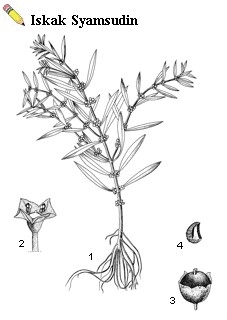 | Ammannia baccifera L. - 1, plant habit; 2, flower; 3, fruit; 4, seed |
Ecology
Ammannia baccifera occurs in wet locations, very often as a weed in rice fields in the lowland, up to 1200 m altitude. Like other Ammannia species, it can be a problematic weed in rice fields.
Silviculture and Management
Maximum alkaloid synthesis was found in plants at the fruiting stage, under moderate light intensity and with a photoperiod of 16 hours. The application of NPK-fertilizer enhanced the alkaloid content. For controlling Ammannia baccifera as a weed of rice, 1 kg/ha of oxadiazon has been applied successfully in India, and in Taiwan bensulfuron-methyl showed good results at 0.5 kg/ha. High rates of 2,4-D are recommended in Indonesia. The chrysomelid beetle Altica cyanea was found feeding on Ammannia baccifera in rice fields in India, defoliating the plants completely, but no damage to the rice crop was observed. Apparently the beetle may be a biological control agent.
Genetic Resources
Efforts are being directed towards eradication of Ammannia baccifera as a noxious weed of rice, and not towards protection.
Prospects
Some interesting properties of Ammannia baccifera deserve more attention, particularly the antibacterial activity, the anti-urolithic activity, and the reputed effectiveness against skin diseases.
Literature
[289]Graham, S.A., 1985. A revision of Ammannia (Lythraceae) in the western hemisphere. Journal of the Arnold Arboretum 66(4): 395—420.
[470]Kher, A., 1978. Antibacterial activity in Ammannia baccifera. Bulletin of the Botanical Society, University of Saugar 25: 1—3.
[752]Prasad, K.V., Bharathi, K. & Srinivasan, K.K., 1994. Evaluation of Ammannia baccifera Linn. for antiurolithic activity in albino rats. Indian Journal of Experimental Biology 32(5): 311—313.
[760]Quisumbing, E., 1978. Medicinal plants of the Philippines. Katha Publishing Co., Quezon City, the Philippines. 1262 pp.
[879]Soerjani, M., Kostermans, A.J.G.H. & Tjitrosoepomo, G. (Editors), 1987. Weeds of rice in Indonesia. Balai Pustaka, Jakarta, Indonesia. 716 pp.
Other Selected Sources
[121]Burkill, I.H., 1966. A dictionary of the economic products of the Malay Peninsula. Revised reprint. 2 volumes. Ministry of Agriculture and Co- operatives, Kuala Lumpur, Malaysia. Vol. 1 (A—H) pp. 1—1240, Vol. 2 (I— Z) pp. 1241—2444.
[394]Immelman, K.L., 1991. Synopsis of the genera Nesaea and Ammannia (Lythraceae) in southern Africa. Bothalia 21(1): 35—49.
[593]Mall, S.L. & Singh, V.P., 1976. Effect of light intensity duration and fertilizers on variability of alkaloid production in Ammannia baccifera. Journal of the Indian Botanical Society 55(1): 71—74.
[666]Nasir, E. & Ali, S.I. (Editors), 1970—1988. Flora of West Pakistan. No 1—188. Department of Botany, University of Karachi and National Herbarium, Pakistan Agricultural Research Council, Islamabad, Pakistan.
Author(s)
R.H.M.J. Lemmens
Correct Citation of this Article
Lemmens, R.H.M.J., 2003. Ammannia baccifera L.. In: Lemmens, R.H.M.J. and Bunyapraphatsara, N. (Editors): Plant Resources of South-East Asia No 12(3): Medicinal and poisonous plants 3. PROSEA Foundation, Bogor, Indonesia. Database record: prota4u.org/prosea

All texts are licensed under a Creative Commons Attribution-Noncommercial-Share Alike 3.0 Netherlands License
This license does not include the illustrations (Maps,drawings,pictures); these remain all under copyright.