Record Number
2979
PROSEA Handbook Number
12(3): Medicinal and poisonous plants 3
Taxon
Tiliacora triandra (Colebr.) Diels
Protologue
Engl., Pflanzenr., Heft 46 (IV 94): 62 (1910).
Family
MENISPERMACEAE
Chromosome Numbers
2n = unknown
Synonyms
Cocculus triandrus Colebr. (1822), Limacia triandra (Colebr.) Hook.f. & Thomson (1855).
Vernacular Names
Malaysia: akar kunyit-kunyit, berkunyit, akar kusin (Peninsular). Thailand: choi nang (northern), thao wan khieo (central), yat nang (peninsular). Vietnam: xanh tam.
Origin and Geographic Distribution
Tiliacora triandra occurs in India (Assam), southern Burma (Myanmar), Indo-China, Thailand and Peninsular Malaysia.
Uses
In Thailand aerial parts of Tiliacora triandra are widely used as an antipyretic. In Cambodia the leafy shoots enter into a prescription for the treatment of dysentery. They are also used as a flavouring in cooking in Thailand. In Indo-China the flexible stems are used for rough cordage, thatching and basketry.
Tiliacora acuminata (Lamk) Hook.f. & Thomson, an Indian-Burmese species, appreciated for its ornamental foliage and fragrant flowers and mentioned as a remedy for snakebites, is cultivated in the botanical garden in Bogor, Indonesia.
Tiliacora acuminata (Lamk) Hook.f. & Thomson, an Indian-Burmese species, appreciated for its ornamental foliage and fragrant flowers and mentioned as a remedy for snakebites, is cultivated in the botanical garden in Bogor, Indonesia.
Properties
More than 15 alkaloids have been identified from Tiliacora triandra including the bisbenzylisoquinolines tiliacorinine, nortiliacorinine and tiliacorine. These alkaloids act as cardiac and respiratory poisons when injected into frogs. A crude ethanol extract of Tiliacora triandra leaves showed strong antifeedant activity against the green leafhopper Nephotettix virescens. A methanol extract of roots exhibited antimalarial activity in vitro.
An ethanol extract of Tiliacora acuminata showed strong antibacterial activity. Tiliacorinine isolated from a crude extract showed promising antifungal activity against Alternaria tenuissima, a causal agent of leaf blight in pigeon pea (Cajanus cajan (L.) Millsp.).
An ethanol extract of Tiliacora acuminata showed strong antibacterial activity. Tiliacorinine isolated from a crude extract showed promising antifungal activity against Alternaria tenuissima, a causal agent of leaf blight in pigeon pea (Cajanus cajan (L.) Millsp.).
Botany
A dioecious liana with puberulous to glabrous and striate stems. Leaves alternate, simple and entire, elliptical, lanceolate or sometimes subovate, 6.5—11(—17) cm x 2—4(—8.5) cm, base cuneate to rounded, apex usually acuminate, with 3—5 basal veins and 2—6 pairs of lateral veins; petiole 0.5—2 cm long; stipules absent. Inflorescence an axillary or cauliflorous pseudo-raceme, up to 2—8(—17) cm long, composed of 1—few-flowered peduncled cymes. Flowers unisexual, yellowish; sepals 6—12, the outermost smallest, innermost up to 2 mm long; male flowers with 3 or 6 petals c. 1 mm long and 3 stamens; female flowers with 6 petals c. 1 mm long and 8—9 carpels inserted on a gynophore. Fruit consisting of several drupes borne on a branched carpophore; drupes obovoid, 7—10 mm x 6—7 mm, red, glabrous, endocarp transversely and irregularly ridged.
In Indo-China Tiliacora triandra can be found flowering and fruiting throughout the year, but in Thailand from December—July only. As in other Menispermaceae, the pollinators are probably small insects, which are undoubtedly attracted by the scent of the flowers.
Tiliacora consists of 19 species in Africa, 2 in tropical Asia and 1 in Australia.
In Indo-China Tiliacora triandra can be found flowering and fruiting throughout the year, but in Thailand from December—July only. As in other Menispermaceae, the pollinators are probably small insects, which are undoubtedly attracted by the scent of the flowers.
Tiliacora consists of 19 species in Africa, 2 in tropical Asia and 1 in Australia.
Image
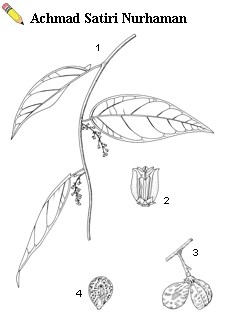 | Tiliacora triandra (Colebr.) Diels - 1, flowering branch of male plant; 2, male flower with front inner sepal removed; 3, fruit; 4, endocarp |
Ecology
Tiliacora triandra occurs in forest and scrub vegetation up to 1300 m altitude. It is found on rocky or clayey soils, and also on limestone hills.
Genetic Resources
Although relatively widespread and locally common in old forest clearings in Thailand, T. triandra is largely confined to lowland forest. Therefore, it may be liable to genetic erosion.
Prospects
Little is known about the pharmacological activities of Tiliacora in comparison with other Menispermaceae. Since many bisbenzylisoquinoline alkaloids show interesting activities, further research on Tiliacora triandra is desirable to judge its full potential as a medicinal plant, also for the Malesian region.
Literature
[121]Burkill, I.H., 1966. A dictionary of the economic products of the Malay Peninsula. Revised reprint. 2 volumes. Ministry of Agriculture and Co- operatives, Kuala Lumpur, Malaysia. Vol. 1 (A—H) pp. 1—1240, Vol. 2 (I— Z) pp. 1241—2444.
[247]Flora Malesiana (various editors), 1950—. Foundation Flora Malesiana. Rijksherbarium/Hortus Botanicus, Leiden, the Netherlands.
[514]Kumar, T.K., Ranjini, C.E. & Sasidharan, V.K., 1997. Antibacterial and antifungal activity of secondary metabolites from some medicinal and other common plant species. Journal of Life Science 2: 14—19.
[712]Pachaly, P. & Khosravian, H., 1988. Neue Bisbenzylisochinolin-Alkaloide aus Tiliacora triandra [New bisbenzylisoquinoline alkaloids from Tiliacora triandra]. Planta Medica 54(5): 433—437.
[713]Pachaly, P. & Khosravian, H., 1988. Tilitriandrin, ein neues Bisbenzylisochinolin-Alkaloid aus Tiliacora triandra [Tilitriandrin, a new bisbenzylisoquinoline alkaloid from Tiliacora triandra]. Planta Medica 54(6): 516—519.
[723]Pavanand, K., Webster, H.K., Yongoanitachit, K. & Dechatiwongse, T., 1989. Antimalarial activity of Tiliacora triandra against Plasmodium falciparum in vitro. Phytotherapy Research 3(5): 215—217.
[864]Singh, K.P., Pandey, V.B., Tripathi, Y.C. & Singh, U.P., 1991. Tiliacorinine, a new systemic fungicide effective against Alternaria blight of pigeon pea (Cajanus cajan). Zeitschrift für Pflanzenkrankheiten und Pflanzenschutz 98(2): 213—219.
[247]Flora Malesiana (various editors), 1950—. Foundation Flora Malesiana. Rijksherbarium/Hortus Botanicus, Leiden, the Netherlands.
[514]Kumar, T.K., Ranjini, C.E. & Sasidharan, V.K., 1997. Antibacterial and antifungal activity of secondary metabolites from some medicinal and other common plant species. Journal of Life Science 2: 14—19.
[712]Pachaly, P. & Khosravian, H., 1988. Neue Bisbenzylisochinolin-Alkaloide aus Tiliacora triandra [New bisbenzylisoquinoline alkaloids from Tiliacora triandra]. Planta Medica 54(5): 433—437.
[713]Pachaly, P. & Khosravian, H., 1988. Tilitriandrin, ein neues Bisbenzylisochinolin-Alkaloid aus Tiliacora triandra [Tilitriandrin, a new bisbenzylisoquinoline alkaloid from Tiliacora triandra]. Planta Medica 54(6): 516—519.
[723]Pavanand, K., Webster, H.K., Yongoanitachit, K. & Dechatiwongse, T., 1989. Antimalarial activity of Tiliacora triandra against Plasmodium falciparum in vitro. Phytotherapy Research 3(5): 215—217.
[864]Singh, K.P., Pandey, V.B., Tripathi, Y.C. & Singh, U.P., 1991. Tiliacorinine, a new systemic fungicide effective against Alternaria blight of pigeon pea (Cajanus cajan). Zeitschrift für Pflanzenkrankheiten und Pflanzenschutz 98(2): 213—219.
Other Selected Sources
[181]Council of Scientific and Industrial Research, 1948—1976. The wealth of India: a dictionary of Indian raw materials & industrial products. 11 volumes. Publications and Information Directorate, New Delhi, India.
[249]Flora of Thailand (various editors), 1970—. The Forest Herbarium, Royal Forest Department, Bangkok, Thailand.
[253]Forman, L.L., 1975. The tribe Triclisieae Diels in Asia, the Pacific and Australia. The Menispermaceae of Malesia and adjacent areas: VIII. Kew Bulletin 30(1): 77—100.
[249]Flora of Thailand (various editors), 1970—. The Forest Herbarium, Royal Forest Department, Bangkok, Thailand.
[253]Forman, L.L., 1975. The tribe Triclisieae Diels in Asia, the Pacific and Australia. The Menispermaceae of Malesia and adjacent areas: VIII. Kew Bulletin 30(1): 77—100.
Author(s)
Wongsatit Chuakul, Noppamas Soonthornchareonnon & Orawan Ruangsomboon
Correct Citation of this Article
Chuakul, W., Soonthornchareonnon, N. & Ruangsomboon, O., 2003. Tiliacora triandra (Colebr.) Diels. In: Lemmens, R.H.M.J. and Bunyapraphatsara, N. (Editors): Plant Resources of South-East Asia No 12(3): Medicinal and poisonous plants 3. PROSEA Foundation, Bogor, Indonesia. Database record: prota4u.org/prosea

All texts are licensed under a Creative Commons Attribution-Noncommercial-Share Alike 3.0 Netherlands License
This license does not include the illustrations (Maps,drawings,pictures); these remain all under copyright.