Record Number
3
PROSEA Handbook Number
1: Pulses
Taxon
Vigna umbellata (Thunb.) Ohwi & Ohashi
Protologue
Japanese Journal of Botany 44: 31 (1969).
Family
LEGUMINOSAE
Chromosome Numbers
2n = 22
Synonyms
Phaseolus calcaratus Roxb. (1832), Vigna calcarata (Roxb.) Kurz (1876), Azukia umbellata (Thunb.) Ohwi (1953).
Vernacular Names
Rice bean (En). Haricot riz (Fr). Indonesia: kacang uci. Malaysia: kacang sepalit. The Philippines: anipai, kapilan, pagsei. Burma: pé-yin. Cambodia: sândaèk ângkât miëhs, sândaèk riech mieh. Laos: thwâx la:ng tê:k, thwàx sadê:t pa:x, thwàx phi. Thailand: thua daeng, thua pae, ma pae. Vietnam: dâu gao.
Origin and Geographic Distribution
Rice bean is a native of South and South-East Asia. It is most widely cultivated in China, Korea, Japan, India, Burma, Indonesia, Malaysia, Fiji, the Philippines and Mauritius, and to a limited extent in the tropical parts of all continents.
Uses
Rice beans are usually boiled and eaten with rice or instead of rice. The young pods, leaves and sprouts are used as vegetable. The whole plant is used as fodder, as a cover crop, as green manure and as living hedge. In Perak (Malaysia), the leaves are used with rice flour in a poultice applied to the abdomen for stomach ache.
Production and International Trade
Rice bean rarely enters international trade but is extensively grown for food in Asia and the Pacific islands. In 1975, Japan imported 12 000 t, 7000 t from Thailand, 3000 t from China and 2000 t from Burma.
Properties
Per 100 g edible portion of dry seeds contain: water 13.3 g, protein 20.9 g, fat 0.9 g, carbohydrates 64.9 g, fibre 4.8 g, ash 4.2 g. The energy content averages 1373 kJ/100 g. Seed weight varies between 8 and 12 g/100 seeds.
Description
Annual vining herb with erect, suberect or flexuose stem, 30-75 cm tall, usually clothed with fine, deciduous, deflexed hairs; vines grooved, 1-3 m long. Leaves trifoliolate, stipules lanceolate, petioles 5-10 cm long; leaflets broadly ovate to ovate-lanceolate, 5-10 cm x 2.5-6 cm, membranous, subglabrous, usually entire, sometimes trilobed. Inflorescences erect axillary racemes, 5-10 cm long, with 5-20 flowers, peduncles up to 20 cm long; flowers bright yellow, 2-3 together, diameter up to 2 cm, with large bracteoles. Pods long and slender, partly falcate, 6-13 cm x 0.5 cm, glabrous, with 10-16 seeds, which are oblong to strongly elongate, subtrapezoidal, 5-10 mm x 2-5 mm, smooth, dark red, green, yellow, brown, black, speckled or mottled.
Image
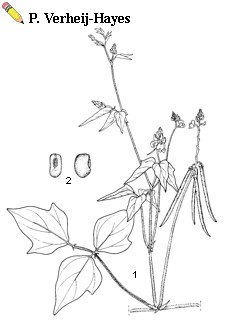 | Vigna umbellata (Thunb.) Ohwi & Ohashi - 1, flowering and fruiting branch; 2, seeds |
Growth and Development
Germination is hypogeal. Seedlings grow vigorously and establish themselves early. The plants can smother weeds. The crop matures in 60-150 days. In the Philippines, time to flowering averages 64 days, to maturity 92 days; in India, early-maturing types behave likewise; late types ripen in 130-150 days. Flowers are self-fertile but cross-pollination occurs as well. All pods mature almost simultaneously.
Other Botanical Information
Two botanical varieties are distinguished: var. umbellata, the cultivated forms, and var. gracilis (Prain) Marechal, Mascherpa & Stainier, the original wild forms with slender branchlets, narrow leaflets and long peduncles. Many cultivars exist.
Ecology
Rice bean is suited to humid tropical lowlands but some cultivars are adapted to subtropical or subtemperate conditions. It grows best at average temperatures of 18-30 °C and prefers a rainfall of 1000-1500 mm/year. The crop can be grown in the tropics up to an altitude of 2000 m. Rice bean is a quantitative short-day plant. The threshold is less than 12 hours. In West Bengal, the maximum and minimum temperatures for flower initiation are 25-26 °C and 10-12 °C, respectively. Rice bean grows best on fertile loams. It tolerates high temperatures and moderate drought, but is frost-susceptible.
Propagation and planting
Propagation is by seed. Rice bean is usually broadcast, after two or three ploughings. It can also be sown in rows 90 cm apart. In India, the seed rate is 40-50 kg/ha if grown for seed or 60-70 kg/ha if grown as a catch crop for fodder. In Burma, average seed rate is 21 kg/ha. In north-eastern India, it is grown under shifting cultivation with maize and millet. Its forage quality is improved when grown in mixture with the annual grass Pennisetum pedicellatum Trin.
Husbandry
The crop receives little care. In India, superphosphate at 50-60 kg/ha is recommended. In Burma, rice bean is usually grown in rotation with rice.
Diseases and Pests
Rice bean is fairly pest-free. Powdery mildew, rust and cucumber mosaic virus can attack the crop in the Philippines. Nematode problems are reduced by flooding and so rotation with rice is recommended.
Harvesting
The viny habit and the shattering of pods make rice bean difficult to harvest. Harvesting in the morning when the pods are moist reduces the losses. If grown for fodder, rice bean should be harvested when the pods are half-developed, since the leaves drop easily when the plant reaches maturity.
Yield
Average seed yield is 200-300 kg/ha, though in West Bengal, with good crop management, yields up to 2240 kg/ha have been obtained. Yield averages 420-840 kg/ha in Burma and 500-800 kg/ha in Papua New Guinea. Forage yield is 2200-3500 kg/ha.
Handling After Harvest
The seeds are dried in the sun and threshed by hand. Usually the seeds are not affected by storage insects.
Genetic Resources and Breeding
Germplasm collections are available in India and Taiwan (AVRDC), but more collections are needed. The breeding of quick- maturing day-neutral high-yielding and non-shattering erect cultivars that are nematode-resistant are the most urgent research needs. Moreover, all agronomical aspects need investigation, e.g. time of sowing, plant density and fertilizer requirements.
Prospects
Development is handicapped by low average yields and by pods shattering easily, making economic harvesting difficult. Its tolerance of high temperatures and humidities, its adaptation to heavy soils, its quick growth, its resistance to pests and diseases, and its nutritious seeds make rice bean a valuable crop that deserves testing throughout the tropics. There has been increasing interest in India in the development of rice bean as a fodder crop and now as a grain crop, and also in West Africa, where it is less susceptible to pests and diseases than many other grain legumes.
Literature
Arora, R.K., Chandel, K.P.S., Joshi, B.S. & Pant, K.C., 1980. Rice bean: tribal pulse of eastern India. Economic Botany 34 (3): 260-263.
Chandel, K.P.S., Arora, R.K. & Pant, K.C., 1988. Rice bean - a potential grain legume. NBPGR, New Delhi, India. Scientific Monograph No 12. 60 pp.
Kay, D.E., 1979. Food legumes. Tropical Products Institute, London. Crop and Product Digest No 3. p. 348-354.
Mukherjee, A.K. & Roquib, M.A., 1980. Herbage and grain yield potentiality of rice bean (Vigna umbellata (Thunb.) Ohwi & Ohashi) - a review. Forage Research 6: 165-170.
Chandel, K.P.S., Arora, R.K. & Pant, K.C., 1988. Rice bean - a potential grain legume. NBPGR, New Delhi, India. Scientific Monograph No 12. 60 pp.
Kay, D.E., 1979. Food legumes. Tropical Products Institute, London. Crop and Product Digest No 3. p. 348-354.
Mukherjee, A.K. & Roquib, M.A., 1980. Herbage and grain yield potentiality of rice bean (Vigna umbellata (Thunb.) Ohwi & Ohashi) - a review. Forage Research 6: 165-170.
Author(s)
C.C.C.M. van Oers
Correct Citation of this Article
Van Oers, C.C.C.M., 1989. Vigna umbellata (Thunb.) Ohwi & Ohashi. In: van der Maesen, L.J.G. & Somaatmadja, S. (Editors): Plant Resources of South-East Asia No 1: Pulses. PROSEA Foundation, Bogor, Indonesia. Database record: prota4u.org/prosea

All texts are licensed under a Creative Commons Attribution-Noncommercial-Share Alike 3.0 Netherlands License
This license does not include the illustrations (Maps,drawings,pictures); these remain all under copyright.