Record Number
3016
PROSEA Handbook Number
11: Auxiliary plants
Taxon
Homonoia riparia Lour.
Protologue
Flora Cochinch.: 637 (1790).
Family
EUPHORBIACEAE
Chromosome Numbers
2n = 42 (44)
Synonyms
Adelia neriifolia Heyne ex Roth (1821), Lumanaja fluviatilis Blanco (1837), Ricinus salicinus Hassk. (1844).
Vernacular Names
Water-willow (En). Indonesia: sobah (Javanese), jurai (Sundanese), sangkir (West Sumatra). Malaysia: kelereh, mempenai, kayu suarah. Philippines: agukuk, agoyoi, managos (Tagalog). Burma (Myanmar): momakha. Cambodia: réi tük. Laos: kh'aiz fa:d. Thailand: khrai-nam, khrai-hin (peninsular), khrai (central, northern). Vietnam: ru ri, ri ri, cay ru ri nuoc.
Origin and Geographic Distribution
Homonoia riparia is widely distributed in Asia from India through Indo-China and southern China to Taiwan and from Peninsular Malaysia, throughout Indonesia and the Philippines to Papua New Guinea.
Uses
Because of its long and extended root system Homonoia riparia is planted along rivers and streams to stabilize and protect the banks. Stems and branches provide firewood. In southern China the bark is used as rope. Leaves are eaten as a vegetable in the Philippines and can be used for fodder as well. In Sabah the root is used to make handles.
Homonoia riparia provides a number of popular local medicines. In Laos, a decoction of the leaves is used against itches. In Cambodia, the stems and leaves are applied as a purgative, whereas an infusion of the wood is used against malaria and scabies. In Java, leaves were used to blacken teeth and to fix loose ones. The pounded leaves and sometimes fruits are applied as a poultice against skin diseases in Malaysia, Thailand and Cambodia. A decoction of the leaves and fruits is similarly effective. Young shoots and leaves are a component of a hair oil in Cambodia.
Homonoia riparia provides a number of popular local medicines. In Laos, a decoction of the leaves is used against itches. In Cambodia, the stems and leaves are applied as a purgative, whereas an infusion of the wood is used against malaria and scabies. In Java, leaves were used to blacken teeth and to fix loose ones. The pounded leaves and sometimes fruits are applied as a poultice against skin diseases in Malaysia, Thailand and Cambodia. A decoction of the leaves and fruits is similarly effective. Young shoots and leaves are a component of a hair oil in Cambodia.
Properties
Seeds contain a fatty oil. Most parts of the plant have a high tannin content. The bark contains cyanogenic glycosides. The grey-brown wood is moderately hard and close-grained.
Botany
A gregarious shrub or small, crooked and twisted tree, 1—4 m tall, up to 10 cm in stem diameter, forming a woody, deep and extensive root system. Branches smooth to slightly grooved. Leaves alternate, simple; stipules keel-like, enlarged at base, 5—6 mm long, caducous; petiole 5—15 mm long, pubescent; blade narrowly lanceolate to oblong, 4—20 cm x 1—2.5 cm, obtuse or rounded at base, acuminate, obtuse or mucronate at apex, bright green, penninerved, thin, chartaceous, upper surface shiny, glabrous, lower surface pubescent, closely glabrescent and minutely lepidote, margin entire or dentate. Male inflorescence an axillary, densely-flowered spike, 5 cm long or more, pubescent; peduncle grooved; bracts triangular, acuminate; flowers solitary, axillary, with two lateral, sterile bracteoles; sepals 3, minute, mucronate; stamens numerous, united in fascicles or bundles which at base are connate into a common trunk, unilocular. Female inflorescence an elongated, pauciflorous spike, to 7 cm long; flowers sessile, axillary, bracteate; sepals 5, ovate, 1.5—2 mm long, acuminate, imbricate, abaxially puberulous; ovary globose, trilocular, 2 mm in diameter; style tripartite, 5 mm long, strongly papillate, basally united over a short distance. Fruit a globose capsule, 4 mm in diameter, puberulent, tricoccous. Seed ovoid, 2 mm long, crustaceous.
In seasonal climatic conditions Homonoia riparia is deciduous. In Vietnam it flowers from April to June and fruits from August to October. In West Java flowering and fruiting is from June to November, in Central Java it flowers from June to October and fruits from September to April. Most plants are unisexual, but sometimes male and female flowers can be found on the same plant.
In seasonal climatic conditions Homonoia riparia is deciduous. In Vietnam it flowers from April to June and fruits from August to October. In West Java flowering and fruiting is from June to November, in Central Java it flowers from June to October and fruits from September to April. Most plants are unisexual, but sometimes male and female flowers can be found on the same plant.
Image
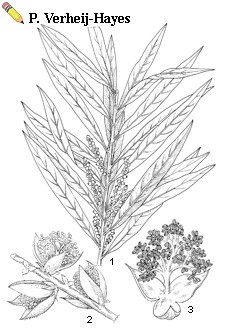 | Homonoia riparia Lour. - 1, fruiting branch; 2, part of male inflorescence; 3, male flower |
Ecology
Homonoia riparia is restricted to river banks, lake shores and rocky stream beds, from 50—500 m altitude. In its natural habitat it is regularly flooded, at least annually. Its extended root system protects it against uprooting during floods; even floods that completely submerge the shrub during the rainy season for up to 9 months per year can be withstood (such plants are called 'rheophytes').
It is found under ever-wet and seasonal climatic conditions, preferring exposed sunny sites on stream banks and in stream beds in not too deep or too swift streams. As to the stream bed soil, Homonoia riparia seems to have no preferences; it occurs on sand, granite, shale, andesite, and other volcanic-derived material, but also on calcareous soil.
It is found under ever-wet and seasonal climatic conditions, preferring exposed sunny sites on stream banks and in stream beds in not too deep or too swift streams. As to the stream bed soil, Homonoia riparia seems to have no preferences; it occurs on sand, granite, shale, andesite, and other volcanic-derived material, but also on calcareous soil.
Agronomy
Since Homonoia riparia is only occasionally planted on river banks hardly any information on its cultivation is known to exist. It can be propagated by seed and by cuttings.
Genetic Resources and Breeding
It is unlikely that any germplasm collections of Homonoia riparia are being maintained.
Prospects
Homonoia riparia is a good source of firewood because the woody roots, stems and branches are hard and have a high energy value. Its strong and extended root system and strong, branched stem make it a useful plant to protect river banks. Its strong bark is worth testing for fibre.
Literature
Airy Shaw, H.K., 1982. The Euphorbiaceae of Central Malesia (Celebes, Moluccas, Lesser Sunda Islands). Kew Bulletin 37: 25.
Gagnepain, F., 1925. Homonoia. In: Lecomte, H. & Gagnepain, F. (Editors): Flore générale de l'Indochine [General flora of Indo-China]. Vol. 5. Masson, Paris, France. pp. 330-333.
Loc, Phan Ke, 1973. List of tannin containing plants in North Vietnam. Bio-Geographical Journal (Hanoi) 11: 1-44.
Pételot, A., 1954. Les plantes médicinales du Cambodge, du Laos et du Vietnam [The medicinal plants of Cambodia, Laos and Vietnam]. Vol. 3. Archives des recherches agronomiques et pastorales du Vietnam No 22. Centre National de Recherches Scientifiques et Techniques, Saigon, Vietnam. pp. 85-86.
van Steenis, C.G.G.J., 1981. Rheophytes of the world. An account of the flood-resistant flowering plants and ferns and the theory of autonomous evolution. Sijthoff & Noordhoff, Alphen aan den Rijn, the Netherlands. 407 pp., particularly pp. 241-247.
Author(s)
Nguyen Nghia Thin
Correct Citation of this Article
Thin, N.N., 1997. Homonoia riparia Lour.. In: Faridah Hanum, I & van der Maesen, L.J.G. (Editors): Plant Resources of South-East Asia No 11: Auxiliary plants. PROSEA Foundation, Bogor, Indonesia. Database record: prota4u.org/prosea

All texts are licensed under a Creative Commons Attribution-Noncommercial-Share Alike 3.0 Netherlands License
This license does not include the illustrations (Maps,drawings,pictures); these remain all under copyright.