Record Number
3031
PROSEA Handbook Number
11: Auxiliary plants
Taxon
Mimosa diplotricha C. Wright ex Sauvalle
Protologue
Anal. Acad. Cienc. Med. Fis. & Nat. Habana 5: 405 (1869).
Family
LEGUMINOSAE - MIMOSOIDEAE
Chromosome Numbers
2n = 24
Synonyms
Mimosa invisa Martius (1837), non Martius ex Colla (1834).
Vernacular Names
Giant sensitive plant (En). Giant false sensitive plant (Am). Indonesia: simeduri-dura (Malay), jukut borang (Sundanese). Malaysia: duri semalu. Philippines: makahiang lalake (Tagalog). Cambodia: bânla: sâ-'öt. Laos: hnha:z khè:wz ngu:. Thailand: maiyarap-thao. Vietnam: c[aa]y trinh n[uwx] m[os]c.
Origin and Geographic Distribution
Mimosa diplotricha is native to tropical and subtropical America from north-eastern Argentina and south-eastern Brazil to south-western Mexico and the Greater Antilles; its distribution is now pantropical. It was probably accidentally introduced into South-East Asia in the 19th Century. In the early 20th Century it was taken into cultivation in Java and Sumatra and from there to other countries in South-East Asia. A true-breeding, spineless form was discovered in Java in 1942 and soon taken into cultivation; this form spread to most countries of South and South-East Asia and to a lesser extent to Africa.
Uses
The typical, spiny form of Mimosa diplotricha used to be cultivated as a green manure, fallow crop and cover crop. However, it is now considered a noxious weed because it aggressively colonizes open spaces, produces large amounts of easily distributed seed and may pose a fire hazard. Because of its spines, it is especially notorious in hand-harvested sugar cane. The spineless form is still cultivated. It is an excellent soil improver, cover crop and soil binder against erosion in humid areas, but is somewhat less effective in smothering weeds than the spiny form.
Until 1940, Mimosa diplotricha had been used as a fallow crop in wrapper tobacco cultivation in Deli, Sumatra, because it significantly reduced the incidence of Granville wilt or slime disease caused by Pseudomonas solanacearum. As it was difficult to eradicate the fallow crop later and it slightly reduced the quality of the tobacco leaves, this use has been discontinued.
In the Philippines the Italian honeybee, Apis mellifera, collects large amounts of pollen of Mimosa diplotricha and Mimosa pudica L. during the distinct 'Mimosa pollen season' (October—March). At this time over 80% of the pollen collected originates from Mimosa species.
Until 1940, Mimosa diplotricha had been used as a fallow crop in wrapper tobacco cultivation in Deli, Sumatra, because it significantly reduced the incidence of Granville wilt or slime disease caused by Pseudomonas solanacearum. As it was difficult to eradicate the fallow crop later and it slightly reduced the quality of the tobacco leaves, this use has been discontinued.
In the Philippines the Italian honeybee, Apis mellifera, collects large amounts of pollen of Mimosa diplotricha and Mimosa pudica L. during the distinct 'Mimosa pollen season' (October—March). At this time over 80% of the pollen collected originates from Mimosa species.
Properties
Information on the properties of Mimosa diplotricha is scanty. Mature spiny plants discourage animals from grazing them, although buffaloes are said to eat young shoots. Pigs are reported to be poisoned by ingesting large amounts, probably of the spineless form.
The weight of 1000 seeds is about 6 g.
The weight of 1000 seeds is about 6 g.
Description
A straggling or scrambling, short-lived perennial woody shrub or semi-woody herb, with branches to over 5 m long, rooting at the base and with a strong, elaborate rooting system. Stem 4—5-angular, prostrate or ascending, up to 1—2 m tall, slightly purplish to brown, hirsute, on the angles with strong, recurved, sharp, yellow spines 3—4 mm long. Leaves bipinnate, with 3—10 pairs of evenly distributed, opposite pinnae; petiole 2—7 cm long, thickened at the base; rachis 6—11 cm long, thickened at the base; petiole and rachis furrowed, hirsute, armed with 4 rows of recurved prickles; stipels transformed into prickles at the bases of the pinnae; pinnae 1—4.5 cm long, hirsute, with recurved prickles abaxially; leaflets opposite, in 11—30 pairs per pinna, oblong, acute, (2—)3.5—5(—7) mm x 1—2 mm, sensitive to the touch or movement, with scattered hairs on both surfaces. Inflorescence a glomerule (globose head), mostly (1—)2(—3) together in the axil of a young leaf; peduncle 0.5—2 cm long, densely and subpatently villous with recurved spines; bracts spathulate, with ciliate tips, 0.4—1 mm long; flower bisexual, subsessile, actinomorphic, 4-merous; calyx campanulate, small, up to 0.4 mm long; corolla narrowly funnel-shaped, 1—2.8 mm long, whitish, finely puberulous or glabrous, with 4 ovate, 1 mm long lobes that are greenish with purplish margin; stamens 8, filaments free, pale purplish-pink, 8—16 mm long, strongly exserted; pistil with puberulous ovary, style purplish-red and as long as the stamens. Pod borne in umbelliform clusters, sessile, flattened oblongoid, slightly curved, 1—3.5 cm x 4—5 mm, acuminate at apex, 3—8-seeded, sharply bristly, at maturity breaking into free-falling, 1-seeded articles, sutures persistent. Seed flattened rhomboid or ovoid, 2—5 mm in diameter, glossy yellowish-brown.
Image
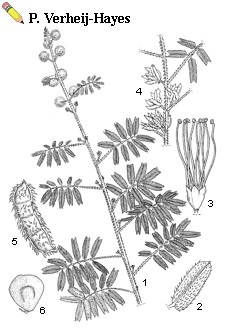 | Mimosa diplotricha C. Wright ex Sauvalle - 1, flowering branch; 2, leaflet; 3, flower; 4, fruiting branch; 5, pod; 6, seed |
Growth and Development
Mimosa diplotricha has a robust growth and scrambles over other plants forming spreading, tangled masses or thickets of undergrowth up to 2 m tall, eventually forming pure stands. The duration of growth is 1.5—2 years, at the end of which time the plant dies. With fast-growing Rhizobium similar to the form infecting Leucaena leucocephala (Lamk) de Wit it forms root nodules and fixes atmospheric nitrogen. In Indonesia, Malaysia and the Philippines it flowers and fruits throughout the year.
Other Botanical Information
Mimosa diplotricha has long been known as Mimosa invisa Martius, and the latter has long been thought to be identical with Mimosa invisa Martius ex Colla which, however, is a different species from South America with larger leaves (4—21 pairs of pinnae, 17—50 pairs of leaflets), with spiciform inflorescences and larger fruits (up to 14.5 cm long). Mimosa diplotricha has been subdivided into 3 varieties:
— var. diplotricha: spiny; fruits 1—2.5(—3.2) cm long, containing 2—8 seeds; distributed all over tropical America and pantropically as a weed;
— var. odibilis Barneby: spiny; fruits 4—7 cm long, containing 12—16 seeds; only known from Mexico;
— var. inermis (Adelb.) Veldkamp (synonym: Mimosa invisa Martius var. inermis Adelb.): spineless, for the rest like var. diplotricha; the spineless form originated in Indonesia, where it gradually replaced the spiny forms as soil cover in plantations; spineless forms have also been discovered in other tropical areas, but unlike the Javanese form, most of them do not breed true.
— var. diplotricha: spiny; fruits 1—2.5(—3.2) cm long, containing 2—8 seeds; distributed all over tropical America and pantropically as a weed;
— var. odibilis Barneby: spiny; fruits 4—7 cm long, containing 12—16 seeds; only known from Mexico;
— var. inermis (Adelb.) Veldkamp (synonym: Mimosa invisa Martius var. inermis Adelb.): spineless, for the rest like var. diplotricha; the spineless form originated in Indonesia, where it gradually replaced the spiny forms as soil cover in plantations; spineless forms have also been discovered in other tropical areas, but unlike the Javanese form, most of them do not breed true.
Ecology
Mimosa diplotricha is an aggressive colonizer on light and heavy, moist, often poor soils, in sunny to lightly shaded locations, along drains, water courses and roadsides, in ravines, in annual and perennial crops and in secondary forest. In drier areas it is restricted to depressions and other damp sites. The plant may die during prolonged dry spells. It occurs at various altitudes, from 0—2000 m above sea level. Although it prefers light, permeable soils, it can also be grown on heavy clay soils.
Propagation and planting
Mimosa diplotricha is propagated by seed. Seed kept in 98°C hot water for 1.5 minutes or in 98% sulphuric acid for 20—30 minutes showed a high percentage of germination. Dry heat has also given a high germination rate. Seed is sown in rows about 5 m apart at a rate of 6—8 kg/ha.
Pods of the spiny forms have spiny surfaces and are easily distributed by animals and farm machinery. The seed may germinate immediately or remain dormant in the soil for a long period. Seed collected about 50 days after flowering gives the highest direct germination rate.
Pods of the spiny forms have spiny surfaces and are easily distributed by animals and farm machinery. The seed may germinate immediately or remain dormant in the soil for a long period. Seed collected about 50 days after flowering gives the highest direct germination rate.
Husbandry
As a cover crop in tree plantations the spineless forms will last for 1.5—2 years (under favourable conditions 4 years) and then gradually die. It is cheaper to establish, covers the soil more quickly and can be better established on poorer soils than most other leguminous cover crops. The spiny forms are most effective in suppressing Imperata cylindrica (L.) Raeuschel but do not kill it and the grass may recover after Mimosa diplotricha is phased out. The spineless form is less effective in smothering weeds. In rubber estates in Indonesia and Malaysia Mimosa diplotricha was prevented from climbing trees and its growth was checked by pulling its branches back and beating them down with bamboo sticks. Rubber trees in Sri Lanka and coconut palms in India grew better with a cover crop of Mimosa diplotricha than with a natural cover, but in coffee plantations in Cameroon its use is not recommended because of the risk of fire in exceptionally dry periods. In replanting experiments in tea conducted in Tocklay (India), a soil cover of Mimosa diplotricha for 2 years followed by subsoiling resulted in much faster establishment and better growth of tea plants than direct planting or planting of tea after subsoiling alone. In tests in Thailand maize yields gradually increased in a rotation with leguminous green manure crops and moderate fertilizer applications, while fertilizer alone could not maintain yields. Mimosa diplotricha and Lablab purpureus (L.) Sweet gave the best results. Mimosa diplotricha is a host of crickets and grasshoppers that feed on coconut palm and oil palm. The main disadvantage of Mimosa diplotricha var. inermis, however, is that it may cross with spiny forms and thus contribute to the spread of the latter. In Cameroon a cover crop of var. inermis was kept free of spiny forms by roguing them twice per year during weeding rounds. As a weed, Mimosa diplotricha is effectively controlled by cultivation and hand weeding when plants are still young. It can be controlled by foliar spraying with a wide range of herbicides. The experimental use of larvae of the cerambycid insect Milothris irrorata as biological control against Mimosa pigra L. gave promising results. The larvae tested also attacked Mimosa diplotricha. The larvae attack by boring the stems, while the adults girdle some of the shoots causing them to dry out.
Diseases and Pests
Few diseases and pests have been reported, but Mimosa diplotricha is sensitive to Meloidogyne nematodes.
Genetic Resources and Breeding
No substantial germplasm collections or breeding programmes are known to exist.
Prospects
Although its ease of establishment and effectiveness against Imperata cylindrica are very favourable attributes, the difficulty of controlling its spread and regrowth and the risk of getting spiny forms through crossing with wild plants have limited the use of Mimosa diplotricha var. inermis as a cover crop and green manure. It will probably continue to be used on a minor scale only, because good alternatives, such as Pueraria phaseoloides (Roxb.) Benth., have been selected.
Literature
1
Barneby, R.C., 1991. Sensitivae censitae. A description of the genus Mimosa Linnaeus (Mimosaceae) in the New World. Memoirs of the New York Botanical Garden 65: 200—203.
2
Bouharmont, P., 1979. L'utilisation des plantes de couverture et du paillage dans la culture du caféier Arabica au Cameroun [The utilization of cover crops and mulching in the cultivation of arabica coffee in Cameroon]. Café, Cacao, Thé 23: 75—102.
3
Holmes, I.G., Plucknett, D.L., Pancho, J.V. & Herberger, J.P., 1977. The world's worst weeds, distribution and biology. East-West Center, University Press of Hawaii, Honolulu, United States. pp. 328—331.
4
Ishizawa, S., 1972. Root nodule bacteria of tropical legumes. JARQ (Japanese Agricultural Research Quarterly) 6(4): 199—211.
5
Nielsen, I.C., 1992. Mimosaceae (Leguminosae — Mimosoideae). In: de Wilde, W.J.J.O., Nooteboom, H.P. & Kalkman, C. (Editors): Flora Malesiana, Series 1, Vol. 11. Foundation Flora Malesiana, Leiden, the Netherlands. pp. 184—185.
6
Payawal, P.C., Tilde, A.C. & Manimtin, A.L., 1986. Year round pollen sources of Italian honeybee (Apis mellifera L.) in Los Baños area. The Philippine Agriculturist 69(2): 217—225.
7
Sukthumrong, A., Chotechaungmanirat, S., Chancharoensook, J. & Veerasan, V., 1987. The effect of green manure-chemical fertilizer combinations on soil fertility and yield of corn. Extension Bulletin No 246. Asian and Pacific Council, Food & Fertilizer Technology Center, Taipei, Taiwan. 10 pp.
8
Sukunnarah, N. & Doungsa-ard, C., 1985. Biological studies on the thorny sensitive plant, Mimosa invisa Mart. Journal of Agricultural Research and Extension (Thailand) 2(4): 189—194.
9
Suryatna, E.S. & McIntosh, J.L., 1982. Weed control in shifting cultivation and permanent agriculture. Biotrop Special Publication No 15: 63—73.
10
Yogaratram, N., Sulaiman, H., Karunaratna, A.D.M. & Peiris, K.S.A.C., 1977. Management of covers under Hevea in Sri Lanka. Journal of the Rubber Research Institute of Sri Lanka (RRISL) 54(1): 291—298.
Literature
1
Barneby, R.C., 1991. Sensitivae censitae. A description of the genus Mimosa Linnaeus (Mimosaceae) in the New World. Memoirs of the New York Botanical Garden 65: 200—203.
2
Bouharmont, P., 1979. L'utilisation des plantes de couverture et du paillage dans la culture du caféier Arabica au Cameroun [The utilization of cover crops and mulching in the cultivation of arabica coffee in Cameroon]. Café, Cacao, Thé 23: 75—102.
3
Holmes, I.G., Plucknett, D.L., Pancho, J.V. & Herberger, J.P., 1977. The world's worst weeds, distribution and biology. East-West Center, University Press of Hawaii, Honolulu, United States. pp. 328—331.
4
Ishizawa, S., 1972. Root nodule bacteria of tropical legumes. JARQ (Japanese Agricultural Research Quarterly) 6(4): 199—211.
5
Nielsen, I.C., 1992. Mimosaceae (Leguminosae — Mimosoideae). In: de Wilde, W.J.J.O., Nooteboom, H.P. & Kalkman, C. (Editors): Flora Malesiana, Series 1, Vol. 11. Foundation Flora Malesiana, Leiden, the Netherlands. pp. 184—185.
6
Payawal, P.C., Tilde, A.C. & Manimtin, A.L., 1986. Year round pollen sources of Italian honeybee (Apis mellifera L.) in Los Baños area. The Philippine Agriculturist 69(2): 217—225.
7
Sukthumrong, A., Chotechaungmanirat, S., Chancharoensook, J. & Veerasan, V., 1987. The effect of green manure-chemical fertilizer combinations on soil fertility and yield of corn. Extension Bulletin No 246. Asian and Pacific Council, Food & Fertilizer Technology Center, Taipei, Taiwan. 10 pp.
8
Sukunnarah, N. & Doungsa-ard, C., 1985. Biological studies on the thorny sensitive plant, Mimosa invisa Mart. Journal of Agricultural Research and Extension (Thailand) 2(4): 189—194.
9
Suryatna, E.S. & McIntosh, J.L., 1982. Weed control in shifting cultivation and permanent agriculture. Biotrop Special Publication No 15: 63—73.
10
Yogaratram, N., Sulaiman, H., Karunaratna, A.D.M. & Peiris, K.S.A.C., 1977. Management of covers under Hevea in Sri Lanka. Journal of the Rubber Research Institute of Sri Lanka (RRISL) 54(1): 291—298.
Author(s)
C. Doungsa-ard & C.S. Tawan
Correct Citation of this Article
Doungsa-ard, C. & Tawan, C.S., 1997. Mimosa diplotricha C. Wright ex Sauvalle. In: Faridah Hanum, I & van der Maesen, L.J.G. (Editors): Plant Resources of South-East Asia No 11: Auxiliary plants. PROSEA Foundation, Bogor, Indonesia. Database record: prota4u.org/prosea

All texts are licensed under a Creative Commons Attribution-Noncommercial-Share Alike 3.0 Netherlands License
This license does not include the illustrations (Maps,drawings,pictures); these remain all under copyright.