Record Number
31
PROSEA Handbook Number
5(3): Timber trees; Lesser-known timbers
Taxon
Cassia L.
Protologue
Sp. pl. 1: 376 (1753); Gen. pl., ed. 5: 178 (1754).
Family
LEGUMINOSAE
Chromosome Numbers
x = 12, 14; Cassia javanica: n = 12, 2n = 28
Vernacular Names
Johar (trade name). Indonesia: bobondelan (Sundanese), boking-boking (Sumatra), trengguli (Javanese). Malaysia: bebusok, busok-busok (Peninsular). Philippines: pink shower (En), antsoan (Bikol). Cambodia: bô prùk'. Laos: khoun loy². Thailand: chaiyaphruk, kalapaphruk (central), kalaphruk (northern). Vietnam: b[uf] c[aj]p.
Origin and Geographic Distribution
Cassia in the narrow sense comprises about 30 species with a pantropical distribution. Only a few species occur naturally in tropical Asia, and only 3 in Malesia. Cassia javanica L. is the only species with some importance as a timber tree. It occurs in India, Burma (Myanmar), Indo-China, southern China, Thailand and throughout Malesia. It has been planted for so long that the natural area of distribution is difficult to reconstruct. It is also planted as an ornamental in Central and South America. Cassia grandis L. f. and Cassia fistula L. have been introduced into the Malesian area for ornamental purposes.
Uses
The wood of a few Cassia species, particularly Cassia javanica, is used for general construction, furniture and cabinet making.
Cassia is a well-known ornamental or roadside tree; several species are planted for this purpose. Some of the introduced ornamental species grow to medium-sized trees and may provide larger sizes of timber when cut. Some species are valued medicinal plants (e.g. Cassia fistula). Cassia javanica is also extensively used as an ornamental and roadside tree, particularly forms of subsp. agnes (de Wit) K. Larsen with larger flowers. The bark has been used for tanning leather, but the amount of tannin is comparatively low. The pods and seeds are used in local medicine; they are purgative.
Cassia is a well-known ornamental or roadside tree; several species are planted for this purpose. Some of the introduced ornamental species grow to medium-sized trees and may provide larger sizes of timber when cut. Some species are valued medicinal plants (e.g. Cassia fistula). Cassia javanica is also extensively used as an ornamental and roadside tree, particularly forms of subsp. agnes (de Wit) K. Larsen with larger flowers. The bark has been used for tanning leather, but the amount of tannin is comparatively low. The pods and seeds are used in local medicine; they are purgative.
Production and International Trade
Cassia timber is not traded in large amounts on the international market, but the heartwood in particular is exported in small volumes and is locally in demand as it is decorative and durable.
Properties
Cassia javanica yields a lightweight to heavy hardwood with a density of 400-875 kg/m³ at 15% moisture content. Heartwood pale yellow when fresh, turning red or pale orange-brown with age, demarcated sharply or not sharply from the 2-5 cm wide white sapwood; grain interlocked; texture moderately fine; taste bitter. Growth rings not always distinct, the boundaries indicated by a fine line of parenchyma forming a more or less distinct, but interrupted ring; vessels medium-sized to moderately large, solitary and in radial pairs, reddish gummy deposits in many vessels; parenchyma abundant, apotracheal diffuse, and paratracheal vasicentric, aliform to confluent, the latter connecting 2-4 vessels; rays very fine, not visible to the naked eye; ripple marks occasionally locally just discernable.
Shrinkage of the wood is low; it seasons well with little or no degrade. The wood is hard and strong. It works well and finishes well. The sapwood is very perishable, the heartwood moderately durable when exposed to the weather or in contact with the ground, and very durable for interior work. The sapwood is susceptible to Lyctus.
See also the tables on microscopic wood anatomy and wood properties.
Shrinkage of the wood is low; it seasons well with little or no degrade. The wood is hard and strong. It works well and finishes well. The sapwood is very perishable, the heartwood moderately durable when exposed to the weather or in contact with the ground, and very durable for interior work. The sapwood is susceptible to Lyctus.
See also the tables on microscopic wood anatomy and wood properties.
Botany
A semi-deciduous, small to medium-sized, sometimes fairly large tree up to 25(-40) m tall; bole often curved, up to 60 cm in diameter, small buttresses sometimes present, trunk of young trees and branches either smooth or spiny; bark surface smooth, sometimes shallowly longitudinally fissured, greyish to pale brown or red-brown, sometimes blackish mottled, inner bark yellow to orange. Leaves alternate, distichous, paripinnate with up to 17(-20) pairs of leaflets; stipules 2-lobed, caducous. Flowers in an axillary or terminal, many-flowered, subsessile, distinctly bracteate raceme, 5-merous; calyx deeply divided, lobes firm, imbricate, reflexed; petals widely spreading, whitish to reddish or buff; stamens 10, irregularly accrescent toward the abaxial side of the flower, longest ones S-shaped; ovary superior, linear and curved, stigma terminal or subterminal. Fruit a woody, pendulous, short stiped, linear pod with septa between the numerous seeds, indehiscent, dark brown to black. Seed brown, smooth and glossy, lying transverse in the pod. Seedling with epigeal germination; cotyledons emergent, semi-fleshy; first few leaves arranged spirally.
Cassia javanica trees show Troll's architectural model, with sympodial growth and all axes plagiotropic, the architecture being built by their continual superposition. In East Java Cassia javanica flowers in October-December and fruits in the dry season. It has been observed flowering and fruiting in a mast fruiting year in Peninsular Malaysia.
Until the beginning of the 1980s, Cassia was considered to be a very large genus of over 500 species, but then the genus was split into 3 genera: Cassia sensu stricto, Senna and Chamaecrista. Cassia s.s. includes far fewer species than the latter two genera that have approximately 270 and 250 species, respectively. Cassia javanica is very polymorphic and several subspecies are distinguished. Cassia agnes (de Wit) Brenan, Cassia bartonii F.M. Bailey, Cassia nodosa Buch.-Ham. ex Roxb. and Cassia renigera Wallich ex Benth. are all reduced to one of these subspecies.
Cassia javanica trees show Troll's architectural model, with sympodial growth and all axes plagiotropic, the architecture being built by their continual superposition. In East Java Cassia javanica flowers in October-December and fruits in the dry season. It has been observed flowering and fruiting in a mast fruiting year in Peninsular Malaysia.
Until the beginning of the 1980s, Cassia was considered to be a very large genus of over 500 species, but then the genus was split into 3 genera: Cassia sensu stricto, Senna and Chamaecrista. Cassia s.s. includes far fewer species than the latter two genera that have approximately 270 and 250 species, respectively. Cassia javanica is very polymorphic and several subspecies are distinguished. Cassia agnes (de Wit) Brenan, Cassia bartonii F.M. Bailey, Cassia nodosa Buch.-Ham. ex Roxb. and Cassia renigera Wallich ex Benth. are all reduced to one of these subspecies.
Image
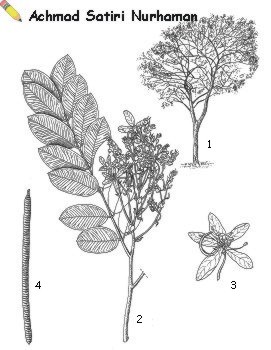 | Cassia javanica L. – 1, tree habit; 2, flowering twig; 3, flower; 4, pod. |
Ecology
Cassia javanica is usually found in more open sites in the forest, up to 400 m altitude, but can also occur in closed evergreen primary forest. It is often naturalized in secondary forest close to locations where it has been planted. In Java it has been reported from fertile volcanic loams, and from marshy, sandy and limestone soils.
Silviculture and Management
Cassia javanica can be propagated by seed or by vegetative means. There are 5700-8400 dry seeds/kg. Pods can easily be collected from the ground and have to be opened with a chopping knife. Seed storage is variable: fresh seed can be stored for only 3 weeks in airtight containers, but storing dry seeds for over one year is also reported. Seeds start to germinate after 7 days and 80% of the seedlings appear within in 14-30 days. The germination rate is about 70%; 50% of the seed sown yields good plants. Other records, however, show a germination rate of 20-65% in 5 days to well over one year. For India, where late and prolonged germination is a problem, it is reported that mechanical scarification may be used to overcome seed dormancy. The planting of large cuttings of Cassia javanica in the Philippines was unsuccessful as only 10% of the cuttings survived. Air layering failed altogether. Cassia javanica is not resistant to fire.
Genetic Resources and Breeding
Cassia javanica is rather common in several areas and, moreover, is extensively planted. It is not endangered or liable to genetic erosion.
Prospects
Cassia javanica seems worth trying as a timber plantation tree. It is considered to grow comparatively fast and may provide timber of fair quality. In addition it is an attractive tree, offering the potential of combining its uses as an ornamental and timber tree.
Literature
Backer, C.A. & Bakhuizen van den Brink Jr., R.C., 1963-1968. Flora of Java. 3 volumes. Wolters-Noordhoff, Groningen.
Burger, D., 1972. Seedlings of some tropical trees and shrubs mainly of South East Asia. Pudoc, Wageningen. 399 pp.
Burkill, I.H., 1966. A dictionary of the economic products of the Malay Peninsula. 2nd edition. Ministry of Agriculture and Co-operatives, Kuala Lumpur. Vol. 1 (A-H) pp. 1-1240. Vol. 2 (I-Z) pp. 1241-2444.
Chanphaka, U., 1958. A preliminary study on the marcottage of five species of tall flowering trees and three species of fruit trees with the use of plastic cloth, moss and soil. Philippine Journal of Forestry 14(1-4): 77-96.
Cockburn, P.F., 1976-1980. Trees of Sabah. 2 volumes. Sabah Forest Records No 10. Forest Department Sabah, Sandakan.
Corner, E.J.H., 1988. Wayside trees of Malaya. 3rd edition. 2 volumes. The Malayan Nature Society, Kuala Lumpur. 774 pp.
de Guzman, E.D., Umali, R.M. & Sotalbo, E.D., 1986. Guide to the Philippine flora and fauna. Vol. 3: Dipterocarps, non-dipterocarps. Natural Resources Management Centre, Ministry of Natural Resources, Quezon City & University of the Philippines, Los Baños. xx + 414 pp.
de Wit, H.C.D., 1956. A revision of the genus Cassia (Caesalp.) as occurring in Malaysia. Webbia 11: 197-292.
den Berger, L.G. & Endert, F.H., 1925. Belangrijke houtsoorten van Nederlandsch-Indië, deel I [Important timbers of the Dutch East Indies, part I]. Mededeelingen No 11. Proefstation voor het Boschwezen, Buitenzorg. 136 pp.
Desch, H.E., 1941-1954. Manual of Malayan timbers. Malayan Forest Records No 15. 2 volumes. Malaya Publishing House Ltd., Singapore. 762 pp.
Flore du Cambodge, du Laos et du Viêtnam (various editors), 1960-. Muséum National d'Histoire Naturelle, Paris.
Hallé, F., Oldeman, R.A.A. & Tomlinson, P.B., 1978. Tropical trees and forests - an architectural analysis. Springer Verlag, Berlin, Heidelberg, New York. 441 pp.
Hardjowasono, M.S., 1942. Gewicht en volume van verschillende vruchten zaadsoorten [Weight and volume of various fruits and seeds]. Korte Mededeelingen No 20. Bosbouwproefstation, Buitenzorg. 172 pp.
Heyne, K., 1927. De nuttige planten van Nederlands-Indië [The useful plants of the Dutch East Indies]. 2nd edition. 3 volumes. Departement van Landbouw, Nijverheid en Handel in Nederlandsch-Indië. 1953 pp. (3rd edition, 1950. van Hoeve, 's-Gravenhage/Bandung. 1660 pp.).
Irwin, H.S. & Barneby, R.C., 1982. The American Cassiinae. A synoptical revision of Leguminosae tribe Cassieae subtribe Cassiinae in the New World. Memoirs of the New York Botanical Garden 35 (2 parts). 918 pp.
Jacalne, D.V. & Galinato, P.F., 1958. A study on the propagation of Cananga odorata Lamarck, Phaeanthus ebracteolatus Merrill, Intsia bijuga (Colebrooke) O. Kuntze, Cassia javanica Linnaeus and Toona calantas Merrill and Rolfe by cuttings. Philippine Journal of Forestry 14(1-4): 97-110.
Meniado, J.A. et al., 1975-1981. Wood identification handbook for Philippine timbers. 2 volumes. Government Printing Office, Manila. 370 pp. & 186 pp.
Ng, F.S.P., 1991-1992. Manual of forest fruits, seeds and seedlings. 2 volumes. Malayan Forest Record No 34. Forest Research Institute Malaysia, Kepong. 997 pp.
Ng, F.S.P. & Mat Asri Ngah Sanah, 1991. Germination and seedling records. Research Pamphlet No 108. Forest Research Institute Malaysia, Kepong. 191 pp.
Oey Djoen Seng, 1951. De soortelijke gewichten van Indonesische houtsoorten en hun betekenis voor de praktijk [Specific gravity of Indonesian woods and its significance for practical use]. Rapport No 46. Bosbouwproefstation, Bogor. 183 pp.
Reyes, L.J., 1938. Philippine woods. Technical Bulletin No 7. Commonwealth of the Philippines, Department of Agriculture and Commerce. Bureau of Printing, Manila. 536 pp. + 88 plates.
Rocafort, J.E., Floresca, A.R. & Siopongco, J.O., 1971. Fourth progress report on the specific gravity of Philippine woods. Philippine Architecture, Engineering & Construction Report 18(5): 17-27.
Sjape'ie, I., 1954. Gewicht en volume van verschillende vrucht- en zaadsoorten [Weight and volume of various fruits and seeds]. Korte mededeling 20A. Bosbouwproefstation, Bogor. 10 pp.
Verdcout, B., 1979. A manual of New Guinea legumes. Botany Bulletin No 11. Office of Forests. Division of Botany, Lae. 645 pp.
Weidelt, H.J. (Editor), 1976. Manual of reforestation and erosion control for the Philippines. Schriftenreihe No 22. Deutsche Gesellschaft für Technische Zusammenarbeit (GTZ) GmbH, Eschborn. 569 pp.
Whitmore, T.C. & Ng, F.S.P. (Editors), 1972-1989. Tree flora of Malaya. A manual for foresters. 4 volumes. Malayan Forest Records No 26. Longman Malaysia Sdn. Berhad, Kuala Lumpur & Petaling Jaya.
Willan, R.L., 1985. A guide to forest seed handling with special reference to the tropics. FAO Forestry Paper 20/2. FAO, Rome. 379 pp.
Wong, T.M., 1982. A dictionary of Malaysian timbers. Malayan Forest Records No 30. Forest Research Institute Malaysia, Kepong. 259 pp.
Burger, D., 1972. Seedlings of some tropical trees and shrubs mainly of South East Asia. Pudoc, Wageningen. 399 pp.
Burkill, I.H., 1966. A dictionary of the economic products of the Malay Peninsula. 2nd edition. Ministry of Agriculture and Co-operatives, Kuala Lumpur. Vol. 1 (A-H) pp. 1-1240. Vol. 2 (I-Z) pp. 1241-2444.
Chanphaka, U., 1958. A preliminary study on the marcottage of five species of tall flowering trees and three species of fruit trees with the use of plastic cloth, moss and soil. Philippine Journal of Forestry 14(1-4): 77-96.
Cockburn, P.F., 1976-1980. Trees of Sabah. 2 volumes. Sabah Forest Records No 10. Forest Department Sabah, Sandakan.
Corner, E.J.H., 1988. Wayside trees of Malaya. 3rd edition. 2 volumes. The Malayan Nature Society, Kuala Lumpur. 774 pp.
de Guzman, E.D., Umali, R.M. & Sotalbo, E.D., 1986. Guide to the Philippine flora and fauna. Vol. 3: Dipterocarps, non-dipterocarps. Natural Resources Management Centre, Ministry of Natural Resources, Quezon City & University of the Philippines, Los Baños. xx + 414 pp.
de Wit, H.C.D., 1956. A revision of the genus Cassia (Caesalp.) as occurring in Malaysia. Webbia 11: 197-292.
den Berger, L.G. & Endert, F.H., 1925. Belangrijke houtsoorten van Nederlandsch-Indië, deel I [Important timbers of the Dutch East Indies, part I]. Mededeelingen No 11. Proefstation voor het Boschwezen, Buitenzorg. 136 pp.
Desch, H.E., 1941-1954. Manual of Malayan timbers. Malayan Forest Records No 15. 2 volumes. Malaya Publishing House Ltd., Singapore. 762 pp.
Flore du Cambodge, du Laos et du Viêtnam (various editors), 1960-. Muséum National d'Histoire Naturelle, Paris.
Hallé, F., Oldeman, R.A.A. & Tomlinson, P.B., 1978. Tropical trees and forests - an architectural analysis. Springer Verlag, Berlin, Heidelberg, New York. 441 pp.
Hardjowasono, M.S., 1942. Gewicht en volume van verschillende vruchten zaadsoorten [Weight and volume of various fruits and seeds]. Korte Mededeelingen No 20. Bosbouwproefstation, Buitenzorg. 172 pp.
Heyne, K., 1927. De nuttige planten van Nederlands-Indië [The useful plants of the Dutch East Indies]. 2nd edition. 3 volumes. Departement van Landbouw, Nijverheid en Handel in Nederlandsch-Indië. 1953 pp. (3rd edition, 1950. van Hoeve, 's-Gravenhage/Bandung. 1660 pp.).
Irwin, H.S. & Barneby, R.C., 1982. The American Cassiinae. A synoptical revision of Leguminosae tribe Cassieae subtribe Cassiinae in the New World. Memoirs of the New York Botanical Garden 35 (2 parts). 918 pp.
Jacalne, D.V. & Galinato, P.F., 1958. A study on the propagation of Cananga odorata Lamarck, Phaeanthus ebracteolatus Merrill, Intsia bijuga (Colebrooke) O. Kuntze, Cassia javanica Linnaeus and Toona calantas Merrill and Rolfe by cuttings. Philippine Journal of Forestry 14(1-4): 97-110.
Meniado, J.A. et al., 1975-1981. Wood identification handbook for Philippine timbers. 2 volumes. Government Printing Office, Manila. 370 pp. & 186 pp.
Ng, F.S.P., 1991-1992. Manual of forest fruits, seeds and seedlings. 2 volumes. Malayan Forest Record No 34. Forest Research Institute Malaysia, Kepong. 997 pp.
Ng, F.S.P. & Mat Asri Ngah Sanah, 1991. Germination and seedling records. Research Pamphlet No 108. Forest Research Institute Malaysia, Kepong. 191 pp.
Oey Djoen Seng, 1951. De soortelijke gewichten van Indonesische houtsoorten en hun betekenis voor de praktijk [Specific gravity of Indonesian woods and its significance for practical use]. Rapport No 46. Bosbouwproefstation, Bogor. 183 pp.
Reyes, L.J., 1938. Philippine woods. Technical Bulletin No 7. Commonwealth of the Philippines, Department of Agriculture and Commerce. Bureau of Printing, Manila. 536 pp. + 88 plates.
Rocafort, J.E., Floresca, A.R. & Siopongco, J.O., 1971. Fourth progress report on the specific gravity of Philippine woods. Philippine Architecture, Engineering & Construction Report 18(5): 17-27.
Sjape'ie, I., 1954. Gewicht en volume van verschillende vrucht- en zaadsoorten [Weight and volume of various fruits and seeds]. Korte mededeling 20A. Bosbouwproefstation, Bogor. 10 pp.
Verdcout, B., 1979. A manual of New Guinea legumes. Botany Bulletin No 11. Office of Forests. Division of Botany, Lae. 645 pp.
Weidelt, H.J. (Editor), 1976. Manual of reforestation and erosion control for the Philippines. Schriftenreihe No 22. Deutsche Gesellschaft für Technische Zusammenarbeit (GTZ) GmbH, Eschborn. 569 pp.
Whitmore, T.C. & Ng, F.S.P. (Editors), 1972-1989. Tree flora of Malaya. A manual for foresters. 4 volumes. Malayan Forest Records No 26. Longman Malaysia Sdn. Berhad, Kuala Lumpur & Petaling Jaya.
Willan, R.L., 1985. A guide to forest seed handling with special reference to the tropics. FAO Forestry Paper 20/2. FAO, Rome. 379 pp.
Wong, T.M., 1982. A dictionary of Malaysian timbers. Malayan Forest Records No 30. Forest Research Institute Malaysia, Kepong. 259 pp.
Author(s)
B. Ibnu Utomo W.
Correct Citation of this Article
Ibnu Utomo, B.W., 1998. Cassia L.. In: Sosef, M.S.M., Hong, L.T. and Prawirohatmodjo, S. (Editors): Plant Resources of South-East Asia No 5(3): Timber trees; Lesser-known timbers. PROSEA Foundation, Bogor, Indonesia. Database record: prota4u.org/prosea

All texts are licensed under a Creative Commons Attribution-Noncommercial-Share Alike 3.0 Netherlands License
This license does not include the illustrations (Maps,drawings,pictures); these remain all under copyright.