Record Number
3166
PROSEA Handbook Number
15(2): Cryptogams: Ferns and fern allies
Taxon
Asplenium L.
Protologue
Sp. pl.: 1078 (1753); Gen. pl., ed. 5: 485 (1754).
Family
ASPLENIACEAE
Chromosome Numbers
x = 36; ploidy level of species varies from diploid to 16-ploid
Major Taxa and Synonyms
Major species and synonyms
— Asplenium nidus L., Sp. pl.: 1079 (1753), synonyms: Neottopteris nidus (L.) J. Smith (1842), Thamnopteris nidus (L.) Presl (1849), Asplenium musifolium J. Smith ex Mett. (1859).
— Asplenium nidus L., Sp. pl.: 1079 (1753), synonyms: Neottopteris nidus (L.) J. Smith (1842), Thamnopteris nidus (L.) Presl (1849), Asplenium musifolium J. Smith ex Mett. (1859).
Vernacular Names
General: spleenwort (En). Doradille (Fr).
— Asplenium nidus. Bird's nest fern (En). Indonesia: pakis sarang burung (Indonesian), lokot (Kalimantan), kadaka (Sundanese). Malaysia: daun semun, paku langsuyar, paku pandan. Singapore: rumah langsuyar (Malay). Philippines: pugad-lauin, pakpak-lauin (Tagalog), dapong babae. Thailand : kaprok hang sing, kaprok hua long (south-eastern), katae tai hin (north-eastern). Vietnam: rang be, t[oor] chim.
— Asplenium nidus. Bird's nest fern (En). Indonesia: pakis sarang burung (Indonesian), lokot (Kalimantan), kadaka (Sundanese). Malaysia: daun semun, paku langsuyar, paku pandan. Singapore: rumah langsuyar (Malay). Philippines: pugad-lauin, pakpak-lauin (Tagalog), dapong babae. Thailand : kaprok hang sing, kaprok hua long (south-eastern), katae tai hin (north-eastern). Vietnam: rang be, t[oor] chim.
Origin and Geographic Distribution
There are more than 700 known species of Asplenium and the total number is increasing steadily. They are distributed all over the world but the majority are found in the tropics and warm temperate regions (about 30% in the neotropics, 22% in Africa, 33% in Asia, 10% in the Pacific and Australia, 5% in Europe). In South-East Asia 40—50 species occur (e.g. about 25 in Java, 25 in Peninsular Malaysia, 35 in Borneo, 40 in the Philippines, 40 in Indo-China and 35 in Thailand). Asplenium nidus occurs throughout the Old World tropics, from East Africa through India, Sri Lanka, throughout South-East Asia to Taiwan, Australia, Tahiti and Hawaii.
Uses
Many Asplenium ferns are used mainly as ornamentals. Particularly well known are the bird's nest ferns:
— Asplenium antiquum Makino in Okinawa and Ryukyu Islands;
— Asplenium australasicum (J. Smith) Hook. in Australia and New Zealand;
— Asplenium nidus pantropically and
— Asplenium phyllitidis D. Don in South-East Asia.
Many more species are used or have potential as ornamentals, e.g.:
— Asplenium bulbiferum Forst. f., mother fern, a viviparous fern of Australia and New Zealand with finely dissected leaves;
— Asplenium ceterach L. (synonym: Ceterach officinarum Willd.), the rust-back fern of the northern and western Mediterranean;
— Asplenium longissimum Blume from Indo-China to western Malesia;
— Asplenium macrophyllum Swartz from East Africa to Polynesia, including South-East Asia;
— Asplenium marinum L., known as sea spleenwort in Europe;
— Asplenium scolopendrium L. (synonym: Phyllitis scolopendrium (L.) Newman) known as hart's-tongue fern in Europe and the United States and of which numerous cultivars exist;
— Asplenium trichomanes L., the maidenhair spleenwort, a temperate-climate species with numerous cultivars;
— Asplenium viviparum C.B. Presl from Mauritius.
In the Philippines, Asplenium nidus, in addition to being an important ornamental, is also used for orchid potting.
Many Asplenium species are also used medicinally. The Latin name 'asplenium' and the English vernacular 'spleenwort' refer to their supposed curative properties for spleen complaints. In Malaysia Asplenium nidus is traditionally used to improve hair growth by frequent washing of the hair with a decoction of a mixture of ground leaves and coconut milk; Sakai women take a decoction or infusion of the plant in northern Pahang to ease labour pain and in northern Perak against fever. In Malaysia Asplenium nidus is also believed to be the home of the ghosts of women who died during childbirth ('langsuyar'). In the Philippines Asplenium nidus is thought to have depurative and sedative properties. In Vanuatu young Asplenium nidus leaves are used as a contraceptive; two young, still curled leaves (croziers) are eaten in the morning just after menstruation. To reverse sterility, 300 ml juice of leaves of Hemigraphis reptans (G. Forst.) T. Anderson ex Hemsley (Acanthaceae) should be drunk for 2 days. Modern herbalists recommend Asplenium scolopendrium as a diuretic and expectorant, and to treat obstructions of the liver and spleen. Several other medicinal species are Asplenium adiantum-nigrum L., Asplenium ceterach L., Asplenium falcatum Lamk, Asplenium macrophyllum Swartz, Asplenium polyodon Forst.f. and Asplenium trichomanes L. (anthelmintic, emetic, diuretic, laxative and to treat ophthalmia, jaundice and diseases of the spleen). In India Asplenium trichomanes is smoked to get rid of head cold whereas Asplenium ruta-muraria L. is used to cure rickets. Asplenium monanthes L. is reported as a diaphoretic in Peru and Colombia. In North Africa and India (Madras), the rhizome of Asplenium falcatum is used to treat prolonged malaria and in Venezuela Asplenium auritum Swartz and other aspleniums are used to alleviate fevers. Asplenium serratum L. is used in Colombia to treat liver problems. Several species are used in Chinese medicine: Asplenium adiantoides L., Asplenium incisum Thunb., Asplenium nidus, Asplenium sampsoni Hance, Asplenium scolopendrium, and Asplenium yoshinagae Makino.
The young curled leaves (croziers) of Asplenium nidus and several other Asplenium species are eaten as a vegetable (e.g. Asplenium affine Swartz in Papua New Guinea). In the inland areas of New Guinea Asplenium acrobryum Christ is used as a source of salt and is known as the 'New Guinea salt fern'. In certain hill regions of Uttar Pradesh (India), Asplenium polypodioides, known as 'lingura' or 'kothira', is eaten as a rainy season vegetable. Asplenium leaves are chewed in Peru as a substitute for coca. The midrib of Asplenium nidus was used in Hawaii to decorate woven mats.
Production and International Trade
Most Asplenium ferns are only locally used. The cultivated ornamental species probably account worldwide for a considerable amount of production and trade, but statistics are not available.
Properties
In-vitro tests of Asplenium nidus extracts at concentrations of 2.5 mg/ml demonstrated oxytoxic activity on isolated rat uterus. In the Philippines histochemical tests showed the presence of alkaloids, tannin and oxalic acid in the leaves of Asplenium nidus. In older literature Asplenium nidus is mentioned as a source of salt in inland areas of Papua New Guinea. Later investigations made it clear that the source is not Asplenium nidus but a closely related group of other ferns, collectively named the Asplenium acrobryum complex. There seems to be no obvious chemical reason why only this complex is used in preference to Asplenium nidus, as the salt productions are comparable, consisting mainly of potassium, calcium and chloride.
Description
Terrestrial, climbing or epiphytic ferns; rhizome creeping or erect, scales usually small, clathrate, dark. Leaves simple, pinnate or more finely dissected, mostly less then 1 m long; petiole often shiny black, grooved above, with 2 vascular strands at the base which unite upwards into a single 4-armed strand; lamina usually with grooved rachis and free veins. Sori usually rather long, along and on one side of the veins, protected by a narrow indusium, opening normally towards the midrib of the leaflet; sometimes double sori or sori of irregular orientation occur. Spores are bilateral with perispore.
— Asplenium nidus. Rhizome short, stout, erect or ascending, epiphytic, bearing a rosette of leaves at the apex (forming the nest) and below the leaves usually with a large mass of roots which bear copious, persistent, brown root hairs; apex of rhizome clothed with thin clathrate scales up to 2 cm x 3 mm, margins amply ciliate, black to purple-brown. Leaves simple, coriaceous; petiole up to 5 cm long, pale yellow to black; lamina narrowly elliptical, 1—1.5 m x 6—30 cm, gradually narrowed towards both ends, margin entire, grass-green; midrib strongly raised above, flat below, dark brown in old leaves, veins prominent and close, once (sometimes twice) forked near the midrib and then running parallel to unite again near the margin to form submarginal veins about 0.5 mm inside the margin. Sori elongate along veins in the upper half of the lamina underside, extending as close (about 1 mm apart), parallel, brown lines from near the midrib up to halfway (sometimes more) the margin; indusium about 0.5 mm wide, reflexed at maturity; sporangium small, stalked, annulus with 20—28 thickened cells. Spores with irregular, thickened wing, translucent light brown when fresh, turning darker brown.
— Asplenium nidus. Rhizome short, stout, erect or ascending, epiphytic, bearing a rosette of leaves at the apex (forming the nest) and below the leaves usually with a large mass of roots which bear copious, persistent, brown root hairs; apex of rhizome clothed with thin clathrate scales up to 2 cm x 3 mm, margins amply ciliate, black to purple-brown. Leaves simple, coriaceous; petiole up to 5 cm long, pale yellow to black; lamina narrowly elliptical, 1—1.5 m x 6—30 cm, gradually narrowed towards both ends, margin entire, grass-green; midrib strongly raised above, flat below, dark brown in old leaves, veins prominent and close, once (sometimes twice) forked near the midrib and then running parallel to unite again near the margin to form submarginal veins about 0.5 mm inside the margin. Sori elongate along veins in the upper half of the lamina underside, extending as close (about 1 mm apart), parallel, brown lines from near the midrib up to halfway (sometimes more) the margin; indusium about 0.5 mm wide, reflexed at maturity; sporangium small, stalked, annulus with 20—28 thickened cells. Spores with irregular, thickened wing, translucent light brown when fresh, turning darker brown.
Image
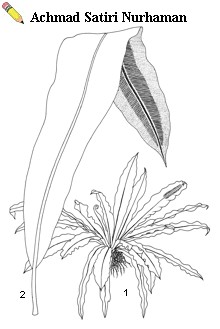 | Asplenium nidus L. - 1, habit plant; 2, leaf, with sori at underside upper part |
Growth and Development
Asplenium spores germinate in shaded and moist soils, on rocks or on tree trunks. The prothallus is of the common cordate or elongate-cordate type, sometimes naked, sometimes bearing papillae or hairs. The nest-shaped rosette of leaves of Asplenium nidus catches and firmly retains dead leaves; this dead material starts rotting and forms a most effective sponge together with the roots, capable of holding much water after rains. The sponge thus provides water and food for the development of the fern.
Other Botanical Information
Although several subclassifications of Asplenium exist, they are all highly artificial and often based on superficial resemblances. Asplenium is still extremely poorly known and thus recognition of natural infrageneric groups such as subgenera, sections or groups is not easily possible. Asplenium is thought to be closely related to Athyriaceae, Blechnaceae or Thelypteridaceae, but the similarities are few and may be due to convergence. Confusion of Asplenium with Diplazium and Athyrium is common but these genera are not thought to be closely related. Holttum classified Asplenium in the family Dennstaedtiaceae, subfamily Asplenioideae, and he believed that the original Asplenium has tripinnate leaves from which species with simple leaves evolved. Although Asplenium nidus is a common species, it has often been neglected by collectors and its variability is little known. Asplenium nidus plants with very wide leaf blades, up to 30 cm, have sometimes been considered a separate species (Asplenium musifolium J. Smith ex Mett.) or a variety (var. musifolia (J. Smith ex Mett.) Bedd.), but are considered here as falling within the species variability. On the other hand evidence exists that Asplenium nidus consists of a number of morphologically indistinguishable cryptospecies which do not intercross and have different allozyme patterns and habitat preferences. In addition to Asplenium acrobryum Christ, also Leptochilus macrophyllus (Blume) Noot. (synonym: Colysis macrophylla (Blume) C. Presl, Polypodiaceae, widely distributed in South-East Asia) is used as a source of salt in New Guinea.
Ecology
Asplenium has adapted to a wide range of habitats. In the tropics it is often epiphytic or epipetric and particularly abundant in cloud forest of medium elevation. In temperate zones Asplenium ferns often grow epipetrically on acid or alkaline soils, but for example Asplenium scolopendrium favours terrestrial sites in woodlands. In Malesia Asplenium nidus is by far the commonest and the only epiphytic Asplenium growing in open locations in the lowlands. Asplenium tenerum Forst., also with a nest habit but with pinnate leaves, is the commonest lowland forest species, growing as an epiphyte near the ground and on rocks; on the mountains Asplenium robustum Blume is the commonest epiphytic species. The epiphyte Asplenium nidus with its enormous spongy mass of roots, affords shelter for many other ferns and epiphytes. Fallen leaves are caught in its capacious nest and each successive crop of leaves hold the accumulating mass securely between their bases, which the roots of the fern also penetrate. In this way gigantic masses of roots and humus are developed over a long period of years, continuing until their weight breaks the branch or the tree itself. These 'hanging soils' provide a habitat for a rich meiofauna and a specific mycoflora. Also harems of the larger dog-faced fruit bat (Cynopterus horsfieldi) seek shelter to roost between the marcescent leaves. The aptness of the name of Asplenium nidus (bird's nest fern) appears on Madagascar, where the critically endangered, endemic Madagascar serpent-eagles (Eutriochis astur) build their nests in the fern. Only few species of Asplenium are frost resistant, e.g. cultivars of Asplenium scolopendrium and Asplenium trichomanes tolerate temperatures as low as —30°C.
Propagation and planting
Asplenium normally propagates by spores. Many species, however, produce side crowns which can be separated. Separation of new plants is easiest in species with a creeping rhizome. Although Asplenium nidus grows naturally as an epiphyte, it can thrive terrestrially. In addition to spore propagation, Asplenium nidus can also be propagated through in-vitro culture of rhizome segments and through planting out dissected leaf-bases (up to 13 per leaf) in vermiculite, each with a small portion of the rhizome attached. Micropropagation through tissue culture of both the gametophyte and the sporophyte has been successful as well. A good potting material for Asplenium consists of equal parts of rich soil and leaf mould or peat.
Husbandry
Asplenium nidus grown in pots does not positively react to N and P applications, but K doses of up to 160 mg/pot increased plant growth and reduced the number of necrotic leaves. Plants should be kept in a very lightly shaded position.
Diseases and Pests
In potted Asplenium nidus for ornamental use, a leaf spot and blight caused by Pseudomonas gladioli and Pseudomonas asplenii are serious diseases . The impatiens necrotic spot virus causes ring spots and necrotic lesions. Because of its rather fleshy foliage, damage caused by slugs can also be serious. In the rainy season Asplenium scolopendrium suffers from a troublesome rust disease caused by Melesina scolopendrii.
Genetic Resources and Breeding
Germplasm collections of Asplenium species occurring in Peninsular Malaysia are available at the Fernarium of the Universiti Kebangsaan Malaysia in Bangi. Breeding in Asplenium is directed towards new ornamental cultivars.
Prospects
The ornamental value of most Asplenium species warrants more research on propagation, cultivation requirements and marketing possibilities. Cultivation of these ferns may reduce the collection of plants from the wild. It is recommended that germplasm be collected from all Asplenium species. The traditional medicinal value of several Asplenium ferns seems interesting and deserves more pharmacological research.
Literature
Bourdy, G., François, C., Andary, C. & Boucard, M., 1996. Maternity and medicinal plants in Vanuatu 2. Pharmacological screening of five selected species. Journal of Ethnopharmacology 52: 139-143.
Croft, J.R. & Leach, D.N., 1985. New Guinea salt fern (Asplenium acrobryum complex): identity, distribution, and chemical composition of its salt. Economic Botany 39: 139-149.
Fernandez, H., Bertrand, A. & Sanchez-Tames, R., 1997. Plantlet regeneration in Asplenium nidus L. and Pteris ensiformis L. by homogenization of BA treated rhizomes. Scientia Horticulturae 68: 243-247.
Holttum, R.E., 1966. A revised flora of Malaya. 2nd Edition. Vol. 2. Ferns of Malaya. Government Printing Office, Singapore. pp. 413-443.
Kramer, K.U. & Viane, R., 1990. Aspleniaceae. In: Kramer, K.U. & Green, P.S. (Volume editors), 1990. Pteridophytes and gymnosperms. In: Kubitzki, K. (Series editor): The families and genera of vascular plants. Vol. 1. Springer-Verlag, Berlin, Germany. pp. 52-57.
Tagawa, M. & Iwatsuki, K., 1985. Aspleniaceae. In: Tagawa, M. & Iwatsuki, K. (Volume editors), 1979-1989. Pteridophytes. In: Smitinand, T., Larsen, K. (Series editors): Flora of Thailand. Vol. 3. Forest Herbarium, Royal Forest Department, Bangkok, Thailand. pp. 261-291.
Yatabe, Y., Masuyama, S., Darnaedi, D. & Murakami, N., 2001. Molecular systematics of the Asplenium nidus complex from Mt. Halimun National Park, Indonesia: evidence for reproductive isolation among three sympatric rbcL sequence types. American Journal of Botany 88: 1517-1522.
Zamora, P.M. & Co, L., 1986. Guide to Philippine flora and fauna. Vol. 2. Economic ferns, endemic ferns, gymnosperms. Natural Resources Management Center, Ministry of Natural Resources and University of the Philippines, Goodwill Bookstore, Manila, The Philippines. pp. 47-50.
Author(s)
G. Rusea
Correct Citation of this Article
Rusea, G., 2003. Asplenium L.. In: de Winter, W.P. and Amoroso, V.B. (Editors): Plant Resources of South-East Asia No 15(2): Cryptogams: Ferns and fern allies. PROSEA Foundation, Bogor, Indonesia. Database record: prota4u.org/prosea

All texts are licensed under a Creative Commons Attribution-Noncommercial-Share Alike 3.0 Netherlands License
This license does not include the illustrations (Maps,drawings,pictures); these remain all under copyright.