Record Number
3177
PROSEA Handbook Number
15(2): Cryptogams: Ferns and fern allies
Taxon
Diplazium Swartz
Protologue
J. Bot. (Schrad.) 1800 (2): 4, 61 (1801).
Family
DRYOPTERIDACEAE
Chromosome Numbers
x = 41, occasionally 40; polyploidy is frequent
Major Taxa and Synonyms
Major species and synonyms
— Diplazium esculentum (Retz.) Swartz, J. Bot. (Schrad.) 1801 (2): 312 (1803), synonyms: Hemionitis esculenta Retz. (1791), Asplenium esculentum (Retz.) C. Presl (1825), Athyrium esculentum (Retz.) Copel. (1908).
— Diplazium polypodioides Blume, Enum. pl. Javae: 194 (1828), synonyms: Diplazium asperum Blume (1828), Athyrium asperum (Blume) Milde (1870), Athyrium blumei (Bergsma.) Copel. (1908).
— Diplazium proliferum (Lamk) Thouars, Fl. Tristan da Cunha: 35 (1804), synonyms: Callipteris prolifera (Lamk) Bory (1804), Diplazium accedens Blume (1828), Athyrium accedens (Blume) Milde (1870).
Vernacular Names
— Diplazium esculentum. Edible fern (En). Indonesia: paku sayur (Indonesian), paku beunyeur (Sundanese), pakis wilis (Balinese). Malaysia: paku tanjong, paku benar, kuò kuô ch'ai ch'uèh (Chinese). Philippines: pako (general), tagabas (Tagalog). Thailand: phak kuut (general), hasdam (peninsular), kuut khue (northern).
— Diplazium polypodioides. Indonesia: paku beunteur (Sundanese). Thailand: kuut yoi (Chiang Mai).
— Diplazium proliferum. Indonesia: paku buwah, paku careham (Sundanese), pakis angkrik (Javanese).
— Diplazium polypodioides. Indonesia: paku beunteur (Sundanese). Thailand: kuut yoi (Chiang Mai).
— Diplazium proliferum. Indonesia: paku buwah, paku careham (Sundanese), pakis angkrik (Javanese).
Origin and Geographic Distribution
Diplazium comprises about 400 species and is distributed all over the tropical and subtropical rain forests of the world. The three major species mentioned here are native throughout South-East Asia. Diplazium esculentum also occurs from central China and southern Japan throughout humid tropical Asia and in Polynesia and is widely cultivated in gardens; as a garden escape it may occur outside its natural range (e.g. in Florida, United States). Diplazium polypodioides is found from the Himalayas and Sri Lanka to Taiwan, throughout South-East Asia, but not as far as Australia. Diplazium proliferum occurs throughout the tropics of the Old World.
Uses
The tender uncurling leaves of Diplazium are eaten boiled or steamed as a leafy vegetable or raw as a salad with various dressings. It is an appreciated vegetable, being slimy and sweetish after cooking. Occasionally it is used as an ingredient in more complicated dishes. Diplazium esculentum is the most palatable and most popular vegetable fern in South-East Asia and the most important fern used as human food in the world. Some restaurants offer it as delicacy when available. A decoction of Diplazium esculentum is used by women as a tonic after childbirth and is said to be good to cure expectoration of blood and ordinary coughs. An extract of mature leaves is applied externally against fever and the leaves are rubbed on the body to get rid of the unpleasant smell of sweat. The pulverized rhizome, soaked in water, is taken against diarrhoea and dysentery. The wiry roots (which look like horse hairs) are sold in the Philippines as a growing base for orchids and are worn in the hair by the Sundanese in Indonesia (known as 'kumpai cai') to stimulate hair growth. Diplazium esculentum and Diplazium proliferum are also attractive ornamentals in gardens and are widely cultivated for this purpose. The bulbils of Diplazium proliferum, often present in considerable numbers in the axils of leaflets, are also eaten raw or cooked.
Production and International Trade
Diplazium esculentum is commonly offered for sale on local markets, where demand seems to exceed supply. All Diplazium ferns are collected from the wild or grown in gardens for home use. No international trade exists and there is no commercial cultivation.
Properties
Per 100 g edible portion, fresh Diplazium esculentum contains: water 90 g, protein 3.1 g, fat 0.3 g, carbohydrates 3.9 g, fibre 1.2 g, ash 1.3 g, P 115 mg, Ca 22 mg, Fe 1.2 mg. The data show that it is a reasonable source of Ca, an excellent source of P and a good source of Fe. In Malaysia average ascorbic acid content in fresh young leaves sold as vegetable is 29 mg per 100 g. Diplazium esculentum contains the flavonoids procyanidin, quercetin-3-rutinoside, kaempferol-3-rutinoside, quercetin-3-glucoside and eriodictyol 5-O-methyl ether 7-ß-D-xylosylgalactoside. It also contains syringic acid (a major component of phenolic acids) and protocathechuic acid. Diplazium polypodioides contains kaempferol-3-rutinoside and quercetin-3-glucoside. An ethanol extract of Diplazium esculentum showed antimicrobial activity with minimum inhibitory concentration in the range 100—800 µg/ml and minimum lethal concentration values in the range 400—800 µg/ml. Extracts, particularly of the rhizome, also have fungicidal activity e.g. against spore germination of Alternaria brassicicola and Aspergillus niger.
Description
Medium to large, terrestrial or epilithic ferns. Rhizomes creeping to erect, scaly at apex, the scales not clathrate. Leaves not articulate with the rhizome, rachis grooved, U-shaped in transverse section, glabrous; laminas simple to 4-pinnate, linear to deltoid, glabrous or pubescent, the veins free or partly anastomosing. Sori oblong to linear, attached to sides of veins, partly or wholly double, back-to-back; indusia membranous, facing outward, almost always linear.
— Diplazium esculentum. A terrestrial, palustrial fern, up to 2.5 m tall. Rhizome erect, up to 100 cm tall above ground level, lower parts often hidden by dark stringy roots, upper part covered with brown scales; scales 10 mm x 1.2 mm, margins denticulate, apex long acuminate, dark brown with black margins. Leaves clustered at apex of the rhizome; petiole 50—70 cm long, black, paler distally, glabrescent but with brown scales at the base; lamina ovate to lanceolate, 0.5—1.5 m x 0.5—1 m, bipinnate with shallowly lobed pinnules, dark green, thin, papyraceous, abaxially glabrous; pinnae ovate, rather suddenly narrowed towards the apex, up to 50 cm x 25 cm, base truncate, apex acute; pinnules linear-lanceolate, the largest ones 10—15 cm x 2—4 cm, the base subsessile, truncate or broadly cuneate, more or less auricled on both sides, margins incised to one fourth length towards the costa, apex gradually narrowed; veins pinnate within each crenation, with 8—10 pairs of lateral veins, the lowest 2—3 of which join with the veins of the next crenation, to form an extra vein running towards the margin, but not originating from the midrib. Sori elongated, occupying almost the whole length of the ultimate veins, with a narrow scarious indusium along one side of each group or running through the middle. Spores monolete, reniform, rugulate.
— Diplazium polypodioides. Differing from Diplazium esculentum mainly in the following characteristics: leaves up to 3 m tall; petiole and rachis rough or spiny; lamina more finely dissected, with smaller segments, in which the veins of neighbouring groups are not connected.
— Diplazium proliferum. Differing from Diplazium esculentum mainly in the following characteristics: leaf blade only dissected once, segments up to 45 cm x 7.5 cm, often with small bulbils (or young plants) in the axils of the midrib and segments.
Image
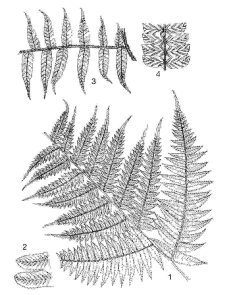 | Diplazium polypodioides Blume - 1, apical part of the leaf blade; 2, fertile pinnule segments Diplazium esculentum (Retz.) Swartz - 3, pinna; 4, fertile pinnule segments |
Other Botanical Information
Diplazium is now placed in the subfamily Athyrioideae of the Dryopteridaceae. Very often this subfamily is treated as an independent family, the Woodsiaceae. With a still narrower family concept, the onocleid genera are excluded and placed into the Onocleaceae, and then Diplazium forms with the remaining genera the Athyriaceae. Diplazium (synonyms: Callipteris Bory, Rhachidosorus Ching, Triblemma (J. Smith) Ching) is a difficult and incompletely known genus, which partly accounts for the over 400 described species. The combination Diplazium asperum which is given here as synonym to Diplazium polypodioides is still often used and might be the correct name. It is not sure whether the specimens found in India and Sri Lanka apply to the same species. In Papua New Guinea Diplazium cordifolium Blume (occurring all over South-East Asia) is particularly mentioned as being used as vegetable.
Diplazium subsinuatum (Wall. ex Hook. & Grev.) Tagawa, occurring from India, throughout continental South-East Asia to China, Taiwan, Japan and south to the Philippines and Borneo, is used in Chinese medicine, usually prepared as a tea from dried material, as a diuretic and anti-inflammatory agent. It is said to clear heat, cool the blood, stop bleeding, promote urination and open the urinary pathways, as well as to eliminate or reduce food stagnation and congestion. It is used to treat coughing with phlegm and blood from tuberculosis, red, swollen, or painful eyes, low back pain, diphtheria, vomiting with blood, rheumatoid arthritis in the hands where the muscles have atrophied and the joints have nodular swellings, causing the hands to have a curved, claw-like appearance. All parts of Diplazium subsinuatum contain hopane-triterpene gycosides which are named diplaziosides and hopane glycosides with acetylated sugars.
Diplazium subsinuatum (Wall. ex Hook. & Grev.) Tagawa, occurring from India, throughout continental South-East Asia to China, Taiwan, Japan and south to the Philippines and Borneo, is used in Chinese medicine, usually prepared as a tea from dried material, as a diuretic and anti-inflammatory agent. It is said to clear heat, cool the blood, stop bleeding, promote urination and open the urinary pathways, as well as to eliminate or reduce food stagnation and congestion. It is used to treat coughing with phlegm and blood from tuberculosis, red, swollen, or painful eyes, low back pain, diphtheria, vomiting with blood, rheumatoid arthritis in the hands where the muscles have atrophied and the joints have nodular swellings, causing the hands to have a curved, claw-like appearance. All parts of Diplazium subsinuatum contain hopane-triterpene gycosides which are named diplaziosides and hopane glycosides with acetylated sugars.
Ecology
Diplazium ferns grow terrestrially in forests and thickets, occasionally as epilithics, in the warmer parts of the world, only sparingly and locally extending into temperate areas. Diplazium esculentum occurs in open, wet, swampy locations, often along watercourses and rivers, usually with some shading, but never in shady forest, in lowland and hill forests up to 1100 m altitude. It forms clonal colonies by vegetative reproduction from root buds. Diplazium polypodioides is found in similar environments but also in drier and less shady locations, e.g. as a weed in plantations and along roads. It occurs from sea-level up to 1200 m, but is usually found above 600 m altitude. Diplazium proliferum grows in moist forest, along brooks and riversides, up to 1200 m altitude.
Propagation and planting
Diplazium ferns grow easily from spores. Vegetative propagation is possible by runners and rhizome parts with buds in Diplazium esculentum and by bulbils in Diplazium proliferum. Diplazium esculentum absolutely needs wet conditions and shade in dry periods during planting.
Husbandry
If Diplazium ferns are grown in gardens, the soil should preferably be poor and wet. Provided wet and shady conditions are maintained, no more care is necessary. In a trial in Sarawak (Malaysia), yield of shaded Diplazium esculentum increased linearly with increasing applications of NPK.
Harvesting
When grown from spores, 2—3-year-old Diplazium plants can be harvested. When grown from runners, harvesting might start after 6 months.
Yield
In a trial in Sarawak (Malaysia) in 1995—1996 yield of a NPK fertilized Diplazium esculentum vegetable was not profitable at the prevailing market prices.
Handling After Harvest
In parts of India, where fresh Diplazium esculentum leaves ('lungru') are available only for a short period of the year, young leaves are dried and stored. Leaves dried in the shade retain better quality after rehydration for use as a vegetable compared to leaves dried artificially.
Genetic Resources and Breeding
The major Diplazium species mentioned are common and seem unthreatened. Germplasm collections and breeding programmes are not known to exist.
Prospects
In Malaysia, Indonesia, the Philippines and Papua New Guinea, Diplazium ferns are considered the most important ferns for human consumption. They show potential as 'functional food' in view of the significant therapeutic and nutritive benefits. Further research is needed to domesticate these species. A perennial species, a continuous vegetable supply is therefore ensured throughout the year, once the plants are established.
Literature
Copeland, E.B., 1942. Edible ferns. American Fern Journal 32(4): 121-126.
Gupta, R., Kalia, M. & Dhaliwal, Y.S., 1999. Effect of drying/dehydration on quality of rehydrated lungru (Diplazium esculentum). Himachal Journal of Agricultural Research 25: 76-80.
Hovenkamp, P.H., 1989. Diplazium Swartz. In: Westphal, E. & Jansen, P.C.M. (Editors): Plant resources of South-East Asia. A selection. Pudoc, Wageningen, The Netherlands. pp.114-116.
Johns, R.J., 1991. Diplazium proliferum. Woodsiaceae. Kew Magazine 8: 128-133.
Mackeen, M.M., Ali, M.M., El-Sharkawy, S.H., Manap, M.Y., Salleh, K.M., Lajis, N.H. & Kawazu, K., 1997. Antimicrobial and cytotoxic properties of some Malaysian traditional vegetables (ulam). International Journal of Pharmacognosy 35: 174-178.
Mehra, P.N. & Bir, S.S., 1960. Cytological observations on the Himalayan species of Athyrium and comments on the evolutionary status of the genus. American Fern Journal 50(4): 276- 295.
Mertz, O., 1999. Cultivation potential of two edible ferns, Diplazium esculentum and Stenochlaena palustris. Tropical Agriculture 76: 10-16.
Ochse, J.J. & Bakhuizen van den Brink, R.C., 1980. Vegetables of the Dutch East Indies. 3rd English edition (translation of 'Indische groenten', 1931). Asher & Co., Amsterdam, The Netherlands. pp. 598-603.
Umi Kalsom, Y., Grayer-Barkmeijer, R.J. & Harborne, J.B., 1994. A comparison of the flavonoids in Athyriaceae and Aspleniaceae. Biochemical Systematics and Ecology 22: 587-594.
Zamora, P.M. & Co, L., 1986. Guide to Philippine flora and fauna. Natural Resources Management Center, Ministry of Natural Resources and University of the Philippines. Vol. 2. pp. 54-56.
Author(s)
P.H. Hovenkamp & Y. Umi Kalsom
Correct Citation of this Article
Hovenkamp, P.H. & Umi Kalsom, Y., 2003. Diplazium Swartz. In: de Winter, W.P. and Amoroso, V.B. (Editors): Plant Resources of South-East Asia No 15(2): Cryptogams: Ferns and fern allies. PROSEA Foundation, Bogor, Indonesia. Database record: prota4u.org/prosea

All texts are licensed under a Creative Commons Attribution-Noncommercial-Share Alike 3.0 Netherlands License
This license does not include the illustrations (Maps,drawings,pictures); these remain all under copyright.