Record Number
3207
PROSEA Handbook Number
15(2): Cryptogams: Ferns and fern allies
Taxon
Schizaea dichotoma (L.) J.E. Smith
Protologue
Mem. Acad. Roy. Sci. (Turin) 5: 422, t. 9 (1793).
Family
SCHIZAEACEAE
Chromosome Numbers
2n = 144 (New Zealand)
Synonyms
Acrostichum dichotomum L. (1753), Schizaea biroi Richter (1911), Schizaea copelandica Richter (1911).
Vernacular Names
Branched comb fern, fan fern (En). Indonesia: paku cakar ayam (Bangka), rumput bulu merak (Belitung), silaju (Sumatra western coast). Malaysia: paku tombak, paku jarum (Malay), pirangas (Murut). Papua New Guinea: umiar, biak. Thailand: tan klom, mimsa rima (peninsular), ya hang ma ba (south-eastern).
Origin and Geographic Distribution
Schizaea dichotoma is found from Sri Lanka and southern India throughout South-East Asia to Australia, New Zealand and Tahiti.
Uses
In Indonesia (Belitung) the root of Schizaea dichotoma is applied as a medicine for cough and other throat troubles and as a tonic for women after childbirth. In Malaysia a decoction of the roots is used to treat cough and, in a mixture with other herbs, to treat kidney problems and impotency.
Production and International Trade
Schizaea dichotoma is not cultivated commercially and only locally used.
Properties
Little is known about the properties of Schizaea dichotoma. Two phytoecdysteroids have been isolated from the leaves, namely schizaeasterones A (20R,22R,24R)-3-ß,11-ß,14-'ALFA',20,22-pentahydroxy-24-methyl-5-ß-cholest-7-en-6-one) and schizaeasterones B, (20R,22R,24xi,25xi)-3-ß,11-a,14-a,20,22,26-hexahydroxy-24-ethyl-5-ß-cholest-7-en-6-one).
Description
A small terrestrial fern, with repeatedly forked leaves whose lobes end in sorophores. Rhizomes short creeping, up to 6 cm long, covered with coarse, lustrous, brown hairs 2—3 mm long. Leaves dichotomously branched; petiole (10—)15—30(—50) cm long, narrowly alate towards the top; lamina flabellate, 2—8 times dichotomously branched, the lower branches narrowly alate like the petiole, the upper ones gradually changing into more flattened surfaces by wider wings and less prominent costa; ultimate lobes 1—1.5 mm wide; fertile segments (sorophores) in small groups of about 5—10 pinnately arranged pairs at the apices of the branches, folded together, the lowest 3—4 mm long. Sporangia in two rows on each lobe, mixed with long brown hairs, opening by a crown of annulus cells on their top. Spores smooth to minutely granular.
Image
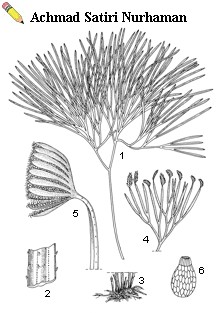 | Schizaea dichotoma (L.) J.E. Smith - 1, leaf; 2, part of lower surface of leaf; 3, rhizome; 4, fertile segments on ultimate leaf divisions; 5, sorophores; 6, sporangium |
Growth and Development
Schizaea species have subterranean gametophytes with a modified filamentous or pseudo-axial organization. The archegonia and antheridia are borne on short branches. Some cells are associated with an endophytic fungus. The time between embryo emergence from the archegonium and the first leaf production is quite long. It could be that the sporeling lives for several years as an entirely underground saprophyte before the first leaf emerges.
Other Botanical Information
Schizaea J.E. Smith comprises about 30 species, distributed mainly pantropically and in temperate regions of the southern hemisphere. In Malesia 7 species occur. Some populations of Schizaea dichotoma consist predominantly of smaller plants, where sporogenous leaves may be as small as 3.5 cm. Such specimens have been named Schizaea copelandica and Schizaea biroi by Richter. There is, however, no sharp distinction between these forms and typical Schizaea dichotoma.
Ecology
Like most Schizaea species, Schizaea dichotoma is almost exclusively found on drier sandy soils in lowland areas up to 1000 m altitude above sea-level, in lightly shaded localities, in forest, scrubland and coastal heathland. It is also commonly found in rubber plantations.
Propagation and planting
Little is known about the propagation of Schizaea dichotoma. As it has a creeping rhizome, cutting the rhizome for propagation might be possible. It requires cool, shady and rather dry soils.
Genetic Resources and Breeding
No germplasm collections or breeding programmes of Schizaea dichotoma are known to exist. It has a wide distribution and though it is rather uncommon, it does not seem to be endangered.
Prospects
Schizaea dichotoma was traditionally only used locally as a herb and not extensively in Indonesia and Malaysia. More research on its chemical content and properties is desirable to evaluate its medicinal potential.
Literature
Bidin, A.A., 1987. Paku-pakis ubatan di semenanjung Malaysia [Medicinal ferns of Peninsular Malaysia]. Dewan Bahasa dan Pustaka, Kementerian Pendidikan Malaysia, Kuala Lumpur, Malaysia.
Bierhorst, D.W., 1969. Leaf development in Schizaea and Actinostachys. American Journal of Botany 56(8): 860-870.
Bierhorst, D.W., 1983. On embryogeny of Schizaea dichotoma. American Journal of Botany 70(7): 1057-1062.
Fuchino, H., Nakamura, H., Hakamatsuka, T., Tanaka, N. & Cambie, R., 1997. Two new phytoecdysteroids from the fern Schizaea dichotoma. Natural Medicines 51(5): 491-492.
Holttum, R.E., 1959. Schizaeaceae. In: van Steenis, C.G.G.J. & Holttum, R.E. (General editors): Flora Malesiana, Series 2. Pteridophyta (Ferns & fern allies). Vol. 1, part 1. Martinus Nijhoff / Dr W. Junk Publishers, The Hague, The Netherlands. pp. 37-44.
Holttum, R.E., 1966. A revised flora of Malaya. 2nd Edition. Vol. 2. Ferns of Malaya. Government Printing Office, Singapore. pp. 50-51.
Bierhorst, D.W., 1969. Leaf development in Schizaea and Actinostachys. American Journal of Botany 56(8): 860-870.
Bierhorst, D.W., 1983. On embryogeny of Schizaea dichotoma. American Journal of Botany 70(7): 1057-1062.
Fuchino, H., Nakamura, H., Hakamatsuka, T., Tanaka, N. & Cambie, R., 1997. Two new phytoecdysteroids from the fern Schizaea dichotoma. Natural Medicines 51(5): 491-492.
Holttum, R.E., 1959. Schizaeaceae. In: van Steenis, C.G.G.J. & Holttum, R.E. (General editors): Flora Malesiana, Series 2. Pteridophyta (Ferns & fern allies). Vol. 1, part 1. Martinus Nijhoff / Dr W. Junk Publishers, The Hague, The Netherlands. pp. 37-44.
Holttum, R.E., 1966. A revised flora of Malaya. 2nd Edition. Vol. 2. Ferns of Malaya. Government Printing Office, Singapore. pp. 50-51.
Author(s)
Cheksum Supiah Tawan & W. Somprasong
Correct Citation of this Article
Tawan, C.S. & Somprasong, W., 2003. Schizaea dichotoma (L.) J.E. Smith. In: de Winter, W.P. and Amoroso, V.B. (Editors): Plant Resources of South-East Asia No 15(2): Cryptogams: Ferns and fern allies. PROSEA Foundation, Bogor, Indonesia. Database record: prota4u.org/prosea

All texts are licensed under a Creative Commons Attribution-Noncommercial-Share Alike 3.0 Netherlands License
This license does not include the illustrations (Maps,drawings,pictures); these remain all under copyright.