Record Number
3208
PROSEA Handbook Number
15(2): Cryptogams: Ferns and fern allies
Taxon
Selaginella Pal. Beauv.
Protologue
Mag. Encycl. Paris 9(5): 478 (1804).
Family
SELAGINELLACEAE
Chromosome Numbers
x = 7, 8, 9, 10 (in South-East Asian species counted so far); 11, 12 (also recorded from elsewhere); Selaginella doederleinii: 2n = 16, 18; Selaginella tamariscina: 2n = 20
Major Taxa and Synonyms
Major species and synonyms
— Selaginella doederleinii Hieron., Hedwigia 43(1): 41—42 (1904).
— Selaginella plana (Desv.) Hieron., in Engl. & Prantl, Nat. Pfl. 1 (4): 703, number 363 (1902).
— Selaginella tamariscina (Pal. Beauv.) Spring, Bull. Acad. Brux. 10: 136, number 9 (1843).
— Selaginella doederleinii Hieron., Hedwigia 43(1): 41—42 (1904).
— Selaginella plana (Desv.) Hieron., in Engl. & Prantl, Nat. Pfl. 1 (4): 703, number 363 (1902).
— Selaginella tamariscina (Pal. Beauv.) Spring, Bull. Acad. Brux. 10: 136, number 9 (1843).
Vernacular Names
General: selaginella, moss fern, spikemoss (En, Am, Aus).
— Selaginella doederleinii. Greater selaginella (En). Herba selaginellae doederleinii (Latin). Shi shang bai (Chinese).
— Selaginella plana. Indonesia: tapak doro (Javanese), paku rane biru (Sudanese), rutu rutu (Moluccas). Malaysia: sondotnulogo (Murut, Sabah).
— Selaginella tamariscina. Chinese resurrection plant (En). Juan bai, chüan pai, huan hun ts'ao (Chinese). Philippines: pakong-tulog, pakongcipres (Tagalog), pakaunkung (Iloko). Thailand: dok hin (northern). Vietnam: mong lung rong, cay chan vit, thach bachi.
Note: For many Selaginella species vernacular and botanical names have become very confused.
— Selaginella doederleinii. Greater selaginella (En). Herba selaginellae doederleinii (Latin). Shi shang bai (Chinese).
— Selaginella plana. Indonesia: tapak doro (Javanese), paku rane biru (Sudanese), rutu rutu (Moluccas). Malaysia: sondotnulogo (Murut, Sabah).
— Selaginella tamariscina. Chinese resurrection plant (En). Juan bai, chüan pai, huan hun ts'ao (Chinese). Philippines: pakong-tulog, pakongcipres (Tagalog), pakaunkung (Iloko). Thailand: dok hin (northern). Vietnam: mong lung rong, cay chan vit, thach bachi.
Note: For many Selaginella species vernacular and botanical names have become very confused.
Origin and Geographic Distribution
Selaginella as a genus (comprising more than 400 species) has an almost worldwide distribution. The subgenera (see under Other botanical information) however, have more limited ranges. The subgenus Selaginella is found throughout
the northern hemisphere; subgenus Ericetorum has a southern range in Australia, Tasmania and South-Africa; subgenus Tetragonostachys has species in the Americas, Africa, and from Sri Lanka, northern India and north-eastern China to Japan and Kamchatka (Russia); subgenera Stachygynandrum and Heterostachys are pantropical. Selaginella doederleinii is a northern species found from India, China and Japan to Malaysia. Selaginella plana is found in Indonesia (Sumatra, Java, Lesser Sunda Islands, Moluccas) and is also commonly cultivated. Selaginella tamariscina occurs from Thailand to China and Korea, in the Philippines and Indonesia (Lombok, Java, Sulawesi).
the northern hemisphere; subgenus Ericetorum has a southern range in Australia, Tasmania and South-Africa; subgenus Tetragonostachys has species in the Americas, Africa, and from Sri Lanka, northern India and north-eastern China to Japan and Kamchatka (Russia); subgenera Stachygynandrum and Heterostachys are pantropical. Selaginella doederleinii is a northern species found from India, China and Japan to Malaysia. Selaginella plana is found in Indonesia (Sumatra, Java, Lesser Sunda Islands, Moluccas) and is also commonly cultivated. Selaginella tamariscina occurs from Thailand to China and Korea, in the Philippines and Indonesia (Lombok, Java, Sulawesi).
Uses
In general, Selaginella species are used as food, medicinally, for handicrafts and as ornamentals. Selaginella doederleinii is applied in Chinese traditional medicine as a bactericide in the treatment of cardiovascular diseases and of smaller body cancers in nose, throat, lung and liver. It is said to be helpful in the treatment of malignant hydatidiform moles and accelerates cancer remissions when used with chemotherapy and radiation (e.g. applied in lung cancer, nasopharyngeal carcinoma, chorionic epithelioma and tumour of the digestive tract). As a broad spectrum medicine it has many applications. It is applied to cure fever, promote blood circulation and remove blood stasis, for jaundice of dampness-heat type and abdominal mass, for acute and chronic hepatitis, cirrhosis, cholecystitis, diarrhoea, dysentery and leucorrhagia of dampness-heat type, cough of lung-heat type, sore throat, silicosis, for haematemesis, haemafecia, haemoptysis, epistaxis and externally to stop bleeding after trauma and after separation of the umbilical cord. Selaginella plana is used to staunch blood from cuts by applying finely chewed branches as a plaster below a bandage and left until bleeding has stopped and the wound healed. It has also been used as a blood-cleanser and as stomach medicine. In Sabah, the Murut people use Selaginella plana against fever by bathing in a decoction. In New Guinea, cooked young shoots of Selaginella tamariscina are consumed. In Vietnam the whole plant of Selaginella tamariscina has been used to treat jaundice, hepatitis, burns and as an infusion for respiratory diseases and haemorrhoids. In Malaysia and the Philippines it is applied against cough, prolapse of the rectum, haemoptysis, gastro-intestinal haemorrhage, haematosuria, excessive menstrual flow and gravel. The whole plant is boiled to a concentrated decoction and drunk. Used as a styptic, the wound is powdered or dressed with the granulated herb. In combination with Thuja L., the ground herbs are drunk in an infusion with warm water against blood in the faeces due to a boil in the anal region (so the patient cannot sit) or for extra-menstrual bleeding of the uterus. In traditional Chinese medicine Selaginella tamariscina is used in therapy of advanced cancer. The whole plant is astringent and haemostatic. A decoction is applied in the treatment of traumatic bleeding, haemoptysis in pulmonary disease, gastro-intestinal bleeding, metrorrhagia, haematuria, persistence of post-partum lochial discharge, rectal prolapse and leucorrhoea. In combination with acupuncture, it forms part of the treatment of diabetes. In Germany a beauty tea is prepared from a mixture of plants including Selaginella tamariscina against fragile and brittle finger nails.
Production and International Trade
Although Selaginella is quite important in traditional Chinese medicine both in and outside China, production and trade statistics are not available. It is known that Selaginella tamariscina is exported from China to Peninsular Malaysia and Germany but no statistics are available.
Properties
Mice inoculated with granuloma-180 and injected with Selaginella doederleinii showed 40—50% tumour inhibition. Mice with hepatic cancer lived significantly longer than the control group. From the ethanolic extract of Selaginella doederleinii 11 phenolic compounds have been isolated: 5 lignans: (—)-lirioresinol A, lirioresinol B, (+)-wikstromol, (—)-nortracheloside and matairesinol; 2 phenylpropanones: 3-hydroxy-1(3-methoxy-4-hydroxyphenyl)-propan-1-one, 3-hydroxy-1-(3,5-dimethoxy-4-hydroxyphenyl)-propan-1-one, and 4 biflavonoids: amentoflavone, 7,7''-di-O-methylamentoflavone, 7,4',7'',4'''-tetra-O-methylamentoflavone and heveaflavone. The cytotoxic activity of the lignans against L929 murine cells accounts for the use of the plant in traditional Chinese medicine as an anticancer agent. However, after taking Selaginella doederleinii as an alternative anticancer treatment, severe bone marrow suppression has been observed. Extracts of Selaginella tamariscina inhibited human mesangial cell proliferation activated by interleukin-1ß and interleukin-6; they also showed significant tumoricidal effects against cultured human leukaemia cells, whereas these fractions did not affect normal human lymphocytes. The extracts possess a strong antioxidant property. In experiments with diabetes induced by alloxan in rats, the Selaginella tamariscina-complex injection given intraperitoneally (25g/kg) for 12 days lowered the levels of blood sugar and serum lipid peroxide, as well as increasing the concentration of serum insulin. Histologic observation revealed the repair of the structure of pancreatic inlet B cells injured by alloxan. It is claimed to promote the adrenocortical function in mice, the metabolism and reticulo-endothelial function but there are no scientific references.
Amentoflavone, a biflavonoid, showed cytotoxic activity and significantly suppressed the growth of Raji and Calu-1 tumour cell lines. It is found in a number of species, including Selaginella doederleinii and Selaginella tamariscina. It was shown to have an inhibitory effect on the group II phospholipase A2 activity and to inhibit cyclo-oxygenase from guinea-pig epidermis without affecting lipoxygenase, to inhibit phospholipase C 'GAMA'-1 activity and the formation of total inositol phosphates (IPt). It showed also potent antiviral activity against respiratory syncytial virus with an IC50 of 5.5 µg/ml and potent anti-inflammatory activity. It shows inhibitory activity against influenza A and B viruses. However, amentoflavone did not show significant inhibitory activity against rat adjuvant-induced arthritis, a chronic inflammatory model. In addition, amentoflavone was found to possess potent analgesic activity. Robustaflavone, a biflavonoid found in Selaginella denticulata (L.) Spring, Selaginella lepidophylla (Hook. & Grev.) Spring and Selaginella willdenowii (Desv. ex Poir.) Baker, is a potent in-vitro inhibitor of the hepatitis B virus, a strong inhibitor of HIV-1 and influenza A and B viruses, and a moderate inhibitor of HSV-1 and -2. Its usage and purification is patented in the United States as an inhibitor of viral activity.
The composition of the mixture from which a German beauty tea is prepared (powdered mixture 15 minutes in 0.25 l boiling water) is: 30 g Achillea clavennae L., 30 g Anthemis nobilis L., 20 g leaves of Fragaria sp., 30 g leaves of Rubus fruticosus L., 20 g leaves of Rubus idaeus L., 30 g Selaginella tamariscina and 20 g Urtica sp.
Amentoflavone, a biflavonoid, showed cytotoxic activity and significantly suppressed the growth of Raji and Calu-1 tumour cell lines. It is found in a number of species, including Selaginella doederleinii and Selaginella tamariscina. It was shown to have an inhibitory effect on the group II phospholipase A2 activity and to inhibit cyclo-oxygenase from guinea-pig epidermis without affecting lipoxygenase, to inhibit phospholipase C 'GAMA'-1 activity and the formation of total inositol phosphates (IPt). It showed also potent antiviral activity against respiratory syncytial virus with an IC50 of 5.5 µg/ml and potent anti-inflammatory activity. It shows inhibitory activity against influenza A and B viruses. However, amentoflavone did not show significant inhibitory activity against rat adjuvant-induced arthritis, a chronic inflammatory model. In addition, amentoflavone was found to possess potent analgesic activity. Robustaflavone, a biflavonoid found in Selaginella denticulata (L.) Spring, Selaginella lepidophylla (Hook. & Grev.) Spring and Selaginella willdenowii (Desv. ex Poir.) Baker, is a potent in-vitro inhibitor of the hepatitis B virus, a strong inhibitor of HIV-1 and influenza A and B viruses, and a moderate inhibitor of HSV-1 and -2. Its usage and purification is patented in the United States as an inhibitor of viral activity.
The composition of the mixture from which a German beauty tea is prepared (powdered mixture 15 minutes in 0.25 l boiling water) is: 30 g Achillea clavennae L., 30 g Anthemis nobilis L., 20 g leaves of Fragaria sp., 30 g leaves of Rubus fruticosus L., 20 g leaves of Rubus idaeus L., 30 g Selaginella tamariscina and 20 g Urtica sp.
Description
Herbaceous, creeping, erect or sprawling plants with a characteristic branching pattern. Main stems either far-creeping, often much-branched and of indefinite growth or short-creeping and then becoming erect, often with a distinct unbranched region below and with variously arranged leaf-like flattened branch systems (pseudo-leaves) of finite growth above; further growth arising only from basal branches; sometimes exhibiting a scrambling or climbing habit, from 10 cm up to 6 m long; naked dichotomously branching rhizophores ('roots') emerge from stem branch axes. Leaves simple, ligulate, very small, usually much less than 10 mm long, with a midrib but no lateral veins, arranged in four ranks (in all South-East Asian species) with two lateral rows of larger leaves spreading from the branch and two rows of smaller median leaves dorsally appressed along the branch axis; an axillary leaf present at every branching point. Strobili usually terminal on ultimate branches, compact, or occasionally more spread out along secondary branches; sporophylls leaf-like in four ranks, uniform or dimorphic; sporangia on the adaxial surface in the axils of the sporophylls; sporangium stalked, of two kinds: megasporangia assuming a shape determined by the megaspores; microsporangia globose or somewhat wider than long, thin-walled with areas of thickened cells which aid dehiscence.
— Selaginella doederleinii. Main stem erect from a decumbent base, 8—10 cm x 12—35 cm, with long rhizophores, alternately branched. Leaves dimorphic; lateral leaves oblong, unequilateral, spreading, the margins ciliate adaxially, subentire abaxially; median leaves ovate, equilateral, imbricate, aristate. Strobili terminal and lateral on the lateral branches, 5—12 mm long; sporophylls monomorphic, ovate, carinate, the margins ciliate, the apex aristate.
— Selaginella plana. Main stem procumbent, ascending from a more or less trailing base, or erect, up to 60(—120) cm long, the basal part unbranched to 45 cm, woody, the distal part pinnately compound. Pinnae ovate, pinnate (up to 3-pinnate), the branches rather irregular. Leaves dimorphic, entire, distant, erect and appressed to stem; lateral leaves oblong-linear, conspicuous free auricle at base of outer side, margin entire; median leaves lanceolate, conspicuous free auricle at base of outer side, apex acuminate, margin entire. Strobili tetragonous, up to 2.3 cm long; sporophylls monomorphic, lanceolate, apex acuminate, margin broadly pellucid and denticulate.
— Selaginella tamariscina. Flat, circular rosettes of branches on a pseudo-trunk. Main stem densely tufted, short and stout, with many equal sized branches, the basal part covered with roots. Lateral and median leaves only slightly different, in four rows, ovate, inequilateral, basally narrowed, marginate, ciliate, cuspidate, abaxially pale, the upper side dark green. Strobili terminal, tetragonous, those with microspores long, with megaspores very short; sporophylls monomorphic, ovate, ciliate, the apex acuminate.
— Selaginella doederleinii. Main stem erect from a decumbent base, 8—10 cm x 12—35 cm, with long rhizophores, alternately branched. Leaves dimorphic; lateral leaves oblong, unequilateral, spreading, the margins ciliate adaxially, subentire abaxially; median leaves ovate, equilateral, imbricate, aristate. Strobili terminal and lateral on the lateral branches, 5—12 mm long; sporophylls monomorphic, ovate, carinate, the margins ciliate, the apex aristate.
— Selaginella plana. Main stem procumbent, ascending from a more or less trailing base, or erect, up to 60(—120) cm long, the basal part unbranched to 45 cm, woody, the distal part pinnately compound. Pinnae ovate, pinnate (up to 3-pinnate), the branches rather irregular. Leaves dimorphic, entire, distant, erect and appressed to stem; lateral leaves oblong-linear, conspicuous free auricle at base of outer side, margin entire; median leaves lanceolate, conspicuous free auricle at base of outer side, apex acuminate, margin entire. Strobili tetragonous, up to 2.3 cm long; sporophylls monomorphic, lanceolate, apex acuminate, margin broadly pellucid and denticulate.
— Selaginella tamariscina. Flat, circular rosettes of branches on a pseudo-trunk. Main stem densely tufted, short and stout, with many equal sized branches, the basal part covered with roots. Lateral and median leaves only slightly different, in four rows, ovate, inequilateral, basally narrowed, marginate, ciliate, cuspidate, abaxially pale, the upper side dark green. Strobili terminal, tetragonous, those with microspores long, with megaspores very short; sporophylls monomorphic, ovate, ciliate, the apex acuminate.
Image
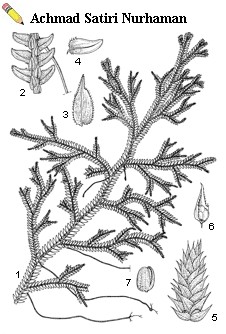 | Selaginella doederleinii Hieron. - 1, habit; 2, part of stem with leaves and rhizophore; 3, median branch leaf; 4, lateral branch leaf; 5, strobilus; 6, megasporophyll; 7, microsporangium |
Growth and Development
Gametophytes of Selaginella develop endosporously and the gametophyte is well developed by the time the spores are shed; those of the microspores develop antheridia that produce 100 biflagellate antherozoids, those of the megaspores develop archegonia containing egg cells. A film of moisture is necessary for fertilization to take place. The embryology is endoscopic, the embryo emerges from the upper surface of the gametophyte and the young plant grows quickly into the adult form.
Other Botanical Information
Selaginella is subdivided into five subgenera which are well distinct:
— Selaginella. 2 species. Leaves monomorphic, spirally arranged.
— Ericetorum. 3 species. Leaves monomorphic, spirally arranged.
— Tetragonostachys. About 50 species. Leaves monomorphic, spirally arranged. Strobili with the sporophylls in four rows so that the spikes are square in transverse section.
— Stachygynandrum. About 600 species, including some of the South-East Asian ones. Primary stems erect, only rooting at the base, or semi-prostrate, rooting in the axils of the dichotomies; branches often compound and often forming a pseudopinnate leaf-like growth form in one plane; they are flattened with larger lateral leaves. Strobili in cross-section square or terete, never flattened, often many on the branch-tips maturing simultaneously; sporophylls in four rows, monomorphic. Analysis of the DNA-sequence of the chloroplast rbcL-gene has revealed that Stachygynandrum is polyphyletic.
— Heterostachys. About 60 species, including some of the South-East Asian ones. Primary stems creeping and copiously branched, or secondary branches erect and shrubby. Branches flattened with larger lateral leaves. Strobili flattened with dimorphic sporophylls. Analysis of the DNA-sequence of the chloroplast rbcL-gene has revealed that Heterostachys is polyphyletic.
Many of the several hundreds of species superficially resemble each other and must be distinguished by a number of microscopic characters in combination. A dozen other species have been or are used in South-East Asia. Although their properties are not interchangeable, it requires specialist knowledge to identify Selaginella to the species level. Some other species used are:
— Selaginella caudata (Desv.) Spring. Vernacular names: Indonesia: tapak doro, cakar ayam (Javanese), paku rane (Sundanese). Malaysia: paku merak. Selaginella caudata is similar to Selaginella usteri Hieron. in general habit, leaves with entire margins and terete strobili. Differences: Stem becoming scandent, up to 3 m long. 3—5 pinnate. All leaves lack conspicuous free auricles; median leaves ovate, apex acute; axillary leaves obovate, apex obtuse. Sporophylls lanceolate, apex acute, margin without conspicuous pellucid border and entire. Occurring in the Moluccas and in New Guinea. Young leaves of Selaginella caudata are eaten as a vegetable in Java but also as a depurative or stomachic. Selaginella caudata is also used as a poultice for vertigo and to staunch blood from cuts by applying finely chewed branches as a plaster under a bandage and left until bleeding has stopped and the wound healed. Whole plant material of Selaginella caudata contains 0.05% alkaloids (on dry weight basis).
— Selaginella intermedia (Blume) Spring. Synonyms: Selaginella atroviridis (Wall.) Spring, Selaginella ascendens Alderw. (excl. var. ciliaris Spring), Selaginella plumea Spring. Vernacular names: Malaysia: jambol merak, ekor merak, daun ekor merak. Main stem scrambling or suberect, up to 30 cm or more long, rooting in the lower half, up to 14 mm broad including leaves. Leaves dimorphous; lateral leaves of main stem spreading, usually crowded, up to 3-pinnate; branching irregular, pinnae outline deltate to linear; lateral leaves oblong lanceolate, one false vein on either side of main vein, upper margin denticulate; median leaves lanceolate, outer side auriculate, apex aristate with arista about half the lamina length, margins denticulate; axillary leaves ovate, apex acute, margins denticulate. Strobilus terete. Sporophylls uniform, lanceolate, apex acute, margins denticulate with a conspicuous white border. An eastern species, not known from the Moluccas and New Guinea. Selaginella intermedia is given in decoction for stomach ache and is applied as a poultice over the whole body for asthma. Pounded with Cleome viscosa L. or Achyranthes aspera L. it has been applied as a poultice for rheumatism and pounded with Cardiospermum halicacabum L. for buboes in the groin. Selaginella intermedia is cultivated around Bogor (West Java) and used to make small pots and sold in the form of plates.
— Selaginella opaca Warb. Main stem creeping, up to 30 cm or more long, rooting at intervals, up to 6 mm broad including leaves. Leaves dimorphic throughout; lateral leaves of main stem spreading, usually crowded, up to 3-pinnate; branches distant, pinnae outline ovate to linear; lateral leaves oblong-lanceolate, shortly ciliate on upper margin; median leaves ovate, apex abruptly aristate, arista usually more than half lamina length, margins shortly ciliate; axillary leaves ovate, apex acute, margins shortly ciliate. Strobilus flattened. Sporophylls slightly dimorphic, ovate-lanceolate, margins shortly ciliate. Selaginella opaca is widespread, but not known from Borneo or continental Asia. Young leaves of Selaginella opaca are eaten boiled in the Chimbu and Jimi areas of Papua New Guinea.
— Selaginella ornata (Hook. & Grev.) Spring. Synonyms: Selaginella fimbriata Spring, Selaginella ornata sensu Alston, p.p. Vernacular names: Indonesia: lumut, pakis lumut (Javanese), rane biru. Selaginella ornata is similar in general habit to Selaginella intermedia. Differences: Main stem up to 8 mm broad including leaves. Pinnae outline linear to ovate; lateral leaves oblong-linear, no false veins, upper margin dentate at base; median leaves apex acute to shortly aristate; axillary leaves deltate, apex rounded-acute, margins dentate. Strobilus flattened. Sporophylls dimorphic, ovate-lanceolate, shortly aristate-acute, dentate. Selaginella ornata is widespread throughout South-East Asia, but is not known from the Moluccas or New Guinea. Young leaves of Selaginella ornata are eaten as a vegetable in Java but also as a depurative or stomachic. Selaginella ornata is also used as ornamental ground cover.
— Selaginella padangensis Hieron. Vernacular names: Malaysia: paku merak, pagau (Dusun Rungus, northern Borneo). Selaginella padangensis is similar to Selaginella caudata in general habit but leaves lacking conspicuous free auricles and with entire margins, and terete strobili. Differences: median leaves lanceolate, apex acute. Sporophylls deltate. Selaginella padangensis occurs in Indonesia (Sumatra, Kalimantan) and Malaysia. Selaginella padangensis is used as a poultice for the treatment of vertigo and as a medicine for toothache. Dried leaves of Selaginella padangensis are smoked like tobacco in northern Borneo.
— Selaginella stipulata (Blume) Spring. Synonyms: Selaginella permutata Hieron., Selaginella illustris Ridley, Selaginella polystachya and Selaginella permutata sensu Alston. Vernacular names: Malaysia: ekor merak, paku batu. Selaginella stipulata is very similar to Selaginella wallichii in general habit and appearance. Differences: Leaves of main stem larger than those of branches and very conspicuous on upper part of main stem; median leaves lanceolate, aristate; axillary leaves ovate, apex obtuse. Strobili sometimes in pairs. Sporophylls uniform, ovate-lanceolate, apex acute to acuminate, margin entire. Selaginella stipulata occurs in Indonesia (Sumatra) and Peninsular Malaysia. Selaginella stipulata is used in decoction as protective medicine after childbirth.
— Selaginella usteri Hieron. Similar to Selaginella plana in general habit, auriculate leaves with entire margins and terete strobili. Differences: stem up to 1m long; branches regular, linear-lanceolate in outline; median leaves lanceolate, apex acute; axillary leaves lanceolate, apex acute. Sporophylls lanceolate, apex acuminate, margin narrowly pellucid and minutely denticulate. Selaginella usteri occurs in the Philippines. Baskets decorated with Selaginella usteri (and probably other species) are exported from the Philippines. Plants grow wild but often also as ground cover in plantations.
— Selaginella wallichii (Hook. & Grev.) Spring. Vernacular names: Malaysia: paku merak, paku beranas. Singapore: paku berenas. Selaginella wallichii is similar to Selaginella caudata in general habit, leaves lacking conspicuous free auricles and with entire margins and terete strobili. Differences: Main stem erect, up to 1 m long, 2-pinnate, branches regular, pinnae linear-lanceolate in outline. Median leaves lanceolate, outer base very rounded, apex acuminate; axillary leaves lanceolate, base somewhat auriculate, apex acute. Sporophylls lanceolate, margin very narrowly pellucid, apex long acute. Selaginella caudata occurs in Thailand, Peninsular Malaysia and Indonesia (Sumatra). In decoction Selaginella wallichii is used as a protective medicine after childbirth.
— Selaginella willdenowii (Desv.) Baker. Vernacular names: Indonesia: rane halus (Sundanese), lingonai (Minangkabau), sikili batu (Sumatra west coast). Malaysia: paku merak, paku selemah, paku tanjong. Singapore: paku salumah, paku lumut, paku tanjong. Thailand: rang kai (peninsular). Selaginella willdenowii is similar to Selaginella plana in general habit, auriculate leaves with entire margins and terete strobili. Differences: The stem becomes scrambling, reaching several m in length. The leaves are iridescent blue-green. Branches regular, deltate in outline; median leaves lanceolate, apex acute; axillary leaves oblong, apex obtuse. Sporophylls ovate, apex acute. Selaginella willdenowii occurs in Indo-China, Peninsular Malaysia and Indonesia (Sumatra, Java). Young leaves of Selaginella willdenowii are eaten as a vegetable in Java but are also used as a depurative or stomachic. Selaginella willdenowii is used in decoction as a protective medicine after childbirth and as an ingredient of tonics. It is also used to treat skin diseases such as itches and ringworm by pounding the plant finely with Alyxia reinwardtii Blume and Foeniculum vulgare Miller ('adas pulasari') and made into an ointment. Sometimes a little incense derived from gum benzoin, resin of Stryrax spp. (kemenyan) is also included in the mixture. In Peninsular Malaysia Selaginella willdenowii has also been given internally as an infusion in cold water with Bridelia tomentosa Blume, Dicranopteris linearis (Burm.f.) Underw., Merremia vitifolia (Burm.f.) H. Hallier and Pericampylus glaucus (Lamk) Merrill to treat fever, and the ashes have been used in a liniment for backache. Similar uses have been reported from the Andaman and Nicobar Islands. Bioactive constituents of Selaginella willdenowii include the biflavones, 4,7'-di-O-methylamentoflavone, isocryptomerin and 7'-O-methylrobustaflavone, which are significantly cytotoxic against a panel of human cancer cell lines. Non-cytotoxic constituents of Selaginella willdenowii proved to be bilobetin, robustaflavone and the dihydrobiflavone 2',3'-dihydroisocryptomerin.
In other parts of the world numerous Selaginella species are used medicinally, e.g.:
— Selaginella asperula Spring is applied on wounds in Colombia.
— Selaginella exaltata (Kuntze) Spring is used by the Cuna Indians in Colombia for spleen diseases and stomach aches by taking daily a portion of the cooked rhizome for a prolonged period.
— Selaginella fissidentoides (Hook. & Grev.) Spring is applied in Madagascar against cough.
— Selaginella lepidophylla (Hook. & Grev.) Spring is used in Mexico as a decoction or infusion to treat kidney stones, gastric ulcers, infections of the stomach, cough, intestinal parasites, diarrhoea, rheumatism, cystitis of the liver, to facilitate the parting and expulsion of the placenta, to purify the blood, to alleviate painful dyspepsia and aching waist or back. The popularity of the plant has resulted in legislation to regulate collection from the wild.
— Selaginella pallescens (Presl) Spring is sold in Venezuela and used in decoction, as an emmenagogue and diuretic. In Colombia it is used similarly to Selaginella articulata (Kunze) Spring, to treat snake bites. Extracts of Selaginella pallescens, used by the Otomi Indians of Queretaro (Mexico) for the treatment of gastro-intestinal disorders, produce a concentration-dependent inhibition of spontaneous ileum contractions.
— Selaginella. 2 species. Leaves monomorphic, spirally arranged.
— Ericetorum. 3 species. Leaves monomorphic, spirally arranged.
— Tetragonostachys. About 50 species. Leaves monomorphic, spirally arranged. Strobili with the sporophylls in four rows so that the spikes are square in transverse section.
— Stachygynandrum. About 600 species, including some of the South-East Asian ones. Primary stems erect, only rooting at the base, or semi-prostrate, rooting in the axils of the dichotomies; branches often compound and often forming a pseudopinnate leaf-like growth form in one plane; they are flattened with larger lateral leaves. Strobili in cross-section square or terete, never flattened, often many on the branch-tips maturing simultaneously; sporophylls in four rows, monomorphic. Analysis of the DNA-sequence of the chloroplast rbcL-gene has revealed that Stachygynandrum is polyphyletic.
— Heterostachys. About 60 species, including some of the South-East Asian ones. Primary stems creeping and copiously branched, or secondary branches erect and shrubby. Branches flattened with larger lateral leaves. Strobili flattened with dimorphic sporophylls. Analysis of the DNA-sequence of the chloroplast rbcL-gene has revealed that Heterostachys is polyphyletic.
Many of the several hundreds of species superficially resemble each other and must be distinguished by a number of microscopic characters in combination. A dozen other species have been or are used in South-East Asia. Although their properties are not interchangeable, it requires specialist knowledge to identify Selaginella to the species level. Some other species used are:
— Selaginella caudata (Desv.) Spring. Vernacular names: Indonesia: tapak doro, cakar ayam (Javanese), paku rane (Sundanese). Malaysia: paku merak. Selaginella caudata is similar to Selaginella usteri Hieron. in general habit, leaves with entire margins and terete strobili. Differences: Stem becoming scandent, up to 3 m long. 3—5 pinnate. All leaves lack conspicuous free auricles; median leaves ovate, apex acute; axillary leaves obovate, apex obtuse. Sporophylls lanceolate, apex acute, margin without conspicuous pellucid border and entire. Occurring in the Moluccas and in New Guinea. Young leaves of Selaginella caudata are eaten as a vegetable in Java but also as a depurative or stomachic. Selaginella caudata is also used as a poultice for vertigo and to staunch blood from cuts by applying finely chewed branches as a plaster under a bandage and left until bleeding has stopped and the wound healed. Whole plant material of Selaginella caudata contains 0.05% alkaloids (on dry weight basis).
— Selaginella intermedia (Blume) Spring. Synonyms: Selaginella atroviridis (Wall.) Spring, Selaginella ascendens Alderw. (excl. var. ciliaris Spring), Selaginella plumea Spring. Vernacular names: Malaysia: jambol merak, ekor merak, daun ekor merak. Main stem scrambling or suberect, up to 30 cm or more long, rooting in the lower half, up to 14 mm broad including leaves. Leaves dimorphous; lateral leaves of main stem spreading, usually crowded, up to 3-pinnate; branching irregular, pinnae outline deltate to linear; lateral leaves oblong lanceolate, one false vein on either side of main vein, upper margin denticulate; median leaves lanceolate, outer side auriculate, apex aristate with arista about half the lamina length, margins denticulate; axillary leaves ovate, apex acute, margins denticulate. Strobilus terete. Sporophylls uniform, lanceolate, apex acute, margins denticulate with a conspicuous white border. An eastern species, not known from the Moluccas and New Guinea. Selaginella intermedia is given in decoction for stomach ache and is applied as a poultice over the whole body for asthma. Pounded with Cleome viscosa L. or Achyranthes aspera L. it has been applied as a poultice for rheumatism and pounded with Cardiospermum halicacabum L. for buboes in the groin. Selaginella intermedia is cultivated around Bogor (West Java) and used to make small pots and sold in the form of plates.
— Selaginella opaca Warb. Main stem creeping, up to 30 cm or more long, rooting at intervals, up to 6 mm broad including leaves. Leaves dimorphic throughout; lateral leaves of main stem spreading, usually crowded, up to 3-pinnate; branches distant, pinnae outline ovate to linear; lateral leaves oblong-lanceolate, shortly ciliate on upper margin; median leaves ovate, apex abruptly aristate, arista usually more than half lamina length, margins shortly ciliate; axillary leaves ovate, apex acute, margins shortly ciliate. Strobilus flattened. Sporophylls slightly dimorphic, ovate-lanceolate, margins shortly ciliate. Selaginella opaca is widespread, but not known from Borneo or continental Asia. Young leaves of Selaginella opaca are eaten boiled in the Chimbu and Jimi areas of Papua New Guinea.
— Selaginella ornata (Hook. & Grev.) Spring. Synonyms: Selaginella fimbriata Spring, Selaginella ornata sensu Alston, p.p. Vernacular names: Indonesia: lumut, pakis lumut (Javanese), rane biru. Selaginella ornata is similar in general habit to Selaginella intermedia. Differences: Main stem up to 8 mm broad including leaves. Pinnae outline linear to ovate; lateral leaves oblong-linear, no false veins, upper margin dentate at base; median leaves apex acute to shortly aristate; axillary leaves deltate, apex rounded-acute, margins dentate. Strobilus flattened. Sporophylls dimorphic, ovate-lanceolate, shortly aristate-acute, dentate. Selaginella ornata is widespread throughout South-East Asia, but is not known from the Moluccas or New Guinea. Young leaves of Selaginella ornata are eaten as a vegetable in Java but also as a depurative or stomachic. Selaginella ornata is also used as ornamental ground cover.
— Selaginella padangensis Hieron. Vernacular names: Malaysia: paku merak, pagau (Dusun Rungus, northern Borneo). Selaginella padangensis is similar to Selaginella caudata in general habit but leaves lacking conspicuous free auricles and with entire margins, and terete strobili. Differences: median leaves lanceolate, apex acute. Sporophylls deltate. Selaginella padangensis occurs in Indonesia (Sumatra, Kalimantan) and Malaysia. Selaginella padangensis is used as a poultice for the treatment of vertigo and as a medicine for toothache. Dried leaves of Selaginella padangensis are smoked like tobacco in northern Borneo.
— Selaginella stipulata (Blume) Spring. Synonyms: Selaginella permutata Hieron., Selaginella illustris Ridley, Selaginella polystachya and Selaginella permutata sensu Alston. Vernacular names: Malaysia: ekor merak, paku batu. Selaginella stipulata is very similar to Selaginella wallichii in general habit and appearance. Differences: Leaves of main stem larger than those of branches and very conspicuous on upper part of main stem; median leaves lanceolate, aristate; axillary leaves ovate, apex obtuse. Strobili sometimes in pairs. Sporophylls uniform, ovate-lanceolate, apex acute to acuminate, margin entire. Selaginella stipulata occurs in Indonesia (Sumatra) and Peninsular Malaysia. Selaginella stipulata is used in decoction as protective medicine after childbirth.
— Selaginella usteri Hieron. Similar to Selaginella plana in general habit, auriculate leaves with entire margins and terete strobili. Differences: stem up to 1m long; branches regular, linear-lanceolate in outline; median leaves lanceolate, apex acute; axillary leaves lanceolate, apex acute. Sporophylls lanceolate, apex acuminate, margin narrowly pellucid and minutely denticulate. Selaginella usteri occurs in the Philippines. Baskets decorated with Selaginella usteri (and probably other species) are exported from the Philippines. Plants grow wild but often also as ground cover in plantations.
— Selaginella wallichii (Hook. & Grev.) Spring. Vernacular names: Malaysia: paku merak, paku beranas. Singapore: paku berenas. Selaginella wallichii is similar to Selaginella caudata in general habit, leaves lacking conspicuous free auricles and with entire margins and terete strobili. Differences: Main stem erect, up to 1 m long, 2-pinnate, branches regular, pinnae linear-lanceolate in outline. Median leaves lanceolate, outer base very rounded, apex acuminate; axillary leaves lanceolate, base somewhat auriculate, apex acute. Sporophylls lanceolate, margin very narrowly pellucid, apex long acute. Selaginella caudata occurs in Thailand, Peninsular Malaysia and Indonesia (Sumatra). In decoction Selaginella wallichii is used as a protective medicine after childbirth.
— Selaginella willdenowii (Desv.) Baker. Vernacular names: Indonesia: rane halus (Sundanese), lingonai (Minangkabau), sikili batu (Sumatra west coast). Malaysia: paku merak, paku selemah, paku tanjong. Singapore: paku salumah, paku lumut, paku tanjong. Thailand: rang kai (peninsular). Selaginella willdenowii is similar to Selaginella plana in general habit, auriculate leaves with entire margins and terete strobili. Differences: The stem becomes scrambling, reaching several m in length. The leaves are iridescent blue-green. Branches regular, deltate in outline; median leaves lanceolate, apex acute; axillary leaves oblong, apex obtuse. Sporophylls ovate, apex acute. Selaginella willdenowii occurs in Indo-China, Peninsular Malaysia and Indonesia (Sumatra, Java). Young leaves of Selaginella willdenowii are eaten as a vegetable in Java but are also used as a depurative or stomachic. Selaginella willdenowii is used in decoction as a protective medicine after childbirth and as an ingredient of tonics. It is also used to treat skin diseases such as itches and ringworm by pounding the plant finely with Alyxia reinwardtii Blume and Foeniculum vulgare Miller ('adas pulasari') and made into an ointment. Sometimes a little incense derived from gum benzoin, resin of Stryrax spp. (kemenyan) is also included in the mixture. In Peninsular Malaysia Selaginella willdenowii has also been given internally as an infusion in cold water with Bridelia tomentosa Blume, Dicranopteris linearis (Burm.f.) Underw., Merremia vitifolia (Burm.f.) H. Hallier and Pericampylus glaucus (Lamk) Merrill to treat fever, and the ashes have been used in a liniment for backache. Similar uses have been reported from the Andaman and Nicobar Islands. Bioactive constituents of Selaginella willdenowii include the biflavones, 4,7'-di-O-methylamentoflavone, isocryptomerin and 7'-O-methylrobustaflavone, which are significantly cytotoxic against a panel of human cancer cell lines. Non-cytotoxic constituents of Selaginella willdenowii proved to be bilobetin, robustaflavone and the dihydrobiflavone 2',3'-dihydroisocryptomerin.
In other parts of the world numerous Selaginella species are used medicinally, e.g.:
— Selaginella asperula Spring is applied on wounds in Colombia.
— Selaginella exaltata (Kuntze) Spring is used by the Cuna Indians in Colombia for spleen diseases and stomach aches by taking daily a portion of the cooked rhizome for a prolonged period.
— Selaginella fissidentoides (Hook. & Grev.) Spring is applied in Madagascar against cough.
— Selaginella lepidophylla (Hook. & Grev.) Spring is used in Mexico as a decoction or infusion to treat kidney stones, gastric ulcers, infections of the stomach, cough, intestinal parasites, diarrhoea, rheumatism, cystitis of the liver, to facilitate the parting and expulsion of the placenta, to purify the blood, to alleviate painful dyspepsia and aching waist or back. The popularity of the plant has resulted in legislation to regulate collection from the wild.
— Selaginella pallescens (Presl) Spring is sold in Venezuela and used in decoction, as an emmenagogue and diuretic. In Colombia it is used similarly to Selaginella articulata (Kunze) Spring, to treat snake bites. Extracts of Selaginella pallescens, used by the Otomi Indians of Queretaro (Mexico) for the treatment of gastro-intestinal disorders, produce a concentration-dependent inhibition of spontaneous ileum contractions.
Ecology
The majority of South-East Asian Selaginella species grow in organically-rich, moist, well-drained soils in shade or half shade, often near streams, beside trails and at the edge of clearings in lowland to mid-montane primary and secondary forest. Selaginella tamariscina grows in dry, rocky habitats. In periods of drought the leaves and branches curl inwards, turning the plant into a ball.
Propagation and planting
Selaginella can be raised from spores, but vegetative propagation from sections of the stem is easier and faster.
Husbandry
The potting mix or garden soil to cultivate Selaginella should be well drained and with a fairly high organic component such as loam with added bark or fern fibre, or a very fibrous non-soil mix as for epiphytic orchids. Regular watering and humidity are necessary, but the foliage will rot if it remains sodden for several days at a time. Light applications of liquid fertilizer at regular intervals promote growth.
Diseases and Pests
Southern blight (caused by Sclerotium (Corticium) rolfsii) has been observed on Selaginella tamariscina in Japan. In general, Selaginella is mainly damaged by grazing pests such as snails and insects.
Genetic Resources and Breeding
Germplasm collections and breeding programmes for Selaginella are not known to exist.
Prospects
The confusion in Selaginella of scientific and vernacular names requires rigorous investigation to determine whether any medicinal benefit is truly associated with a particular species. Selaginella tamariscina could be a promising chemopreventive agent against gastric cancer. Many species show bio-active properties. Especially in the Far East a considerable number of research efforts are currently directed towards the antitumour, antiviral and anti-oxidant properties of various species. Chinese traditional medicine has for centuries taken advantage of these, but wider acceptance may be gained from new scientific publications. Selaginella plants also have considerable horticultural value as ornamentals and several species are in commercial production in various parts of the world.
Literature
Chao, L.R, Seguin, E., Tillequin, F. & Koch, M., 1987. New alkaloid glycosides from Selaginella doederleinii. Journal of Natural Products 50(3): 422-426.
Ishikawa, H., 1974. Selaginella tamariscina. Hakkusha Ishikawa Haruhiko, Tokyo, Japan (8th printing; in Japanese). 186 pp.
Korall, P. & Kenrick, P., 2002. Phylogenetic relationships in Selaginellaceae based on rbcL sequences. American Journal of Botany 89(3): 506-517.
Lee, I.S., Nishikawa, A., Furukawa, F., Kasahara, K.& Kim, S.U., 1999. Effects of Selaginella tamariscina on in vitro tumor cell growth, p53 expression, G1 arrest and in vivo gastric cell proliferation. Cancer Letters 144(1): 93-99.
Lin, L.C., Kuo, Y.C. & Chou, C.J., 2000. Cytotoxic biflavonoids from Selaginella delicatula. Journal of Natural Products 63(5): 627-630.
Ma, S.C., But, P.P.H., Ooi, V.E.C., He, Y.H., Lee, S.H.S., Lee, S.F. & Lin, R.C., 2001. Antiviral amentoflavone from Selaginella sinensis. Biological and Pharmaceutical Bulletin 24(3): 311-312.
Miao, N., Tao, H., Tong, C., Xuan, H. & Zhang, G., 1996. The Selaginella tamariscina (Beauv.) Spring complex treatment for experimental diabetes and its effect on blood rheology. Zhongguo Zhongyao Zazhi 21(8): 493-495, 512 (in Chinese; with summary in English).
Mukhopadhyay, R., 2001. A review of work on the genus Selaginella P. Beauv. Indian Fern Journal 18(1-2): 44-54.
Pan, K.Y., Lin, J.L. & Chen, J.S., 2001. Severe reversible bone marrow suppression induced by Selaginella doederleinii. Journal of Toxicology, Clinical Toxicology 39(6): 637-639.
Rojas, A., Bah, M., Rojas, J.I., Serrano, V. & Pacheco, S., 1999. Spasmolytic activity of some plants used by the Otomi Indians of Queretaro (Mexico) for the treatment of gastrointestinal disorders. Phytomedicine 6(5): 367-371.
Ishikawa, H., 1974. Selaginella tamariscina. Hakkusha Ishikawa Haruhiko, Tokyo, Japan (8th printing; in Japanese). 186 pp.
Korall, P. & Kenrick, P., 2002. Phylogenetic relationships in Selaginellaceae based on rbcL sequences. American Journal of Botany 89(3): 506-517.
Lee, I.S., Nishikawa, A., Furukawa, F., Kasahara, K.& Kim, S.U., 1999. Effects of Selaginella tamariscina on in vitro tumor cell growth, p53 expression, G1 arrest and in vivo gastric cell proliferation. Cancer Letters 144(1): 93-99.
Lin, L.C., Kuo, Y.C. & Chou, C.J., 2000. Cytotoxic biflavonoids from Selaginella delicatula. Journal of Natural Products 63(5): 627-630.
Ma, S.C., But, P.P.H., Ooi, V.E.C., He, Y.H., Lee, S.H.S., Lee, S.F. & Lin, R.C., 2001. Antiviral amentoflavone from Selaginella sinensis. Biological and Pharmaceutical Bulletin 24(3): 311-312.
Miao, N., Tao, H., Tong, C., Xuan, H. & Zhang, G., 1996. The Selaginella tamariscina (Beauv.) Spring complex treatment for experimental diabetes and its effect on blood rheology. Zhongguo Zhongyao Zazhi 21(8): 493-495, 512 (in Chinese; with summary in English).
Mukhopadhyay, R., 2001. A review of work on the genus Selaginella P. Beauv. Indian Fern Journal 18(1-2): 44-54.
Pan, K.Y., Lin, J.L. & Chen, J.S., 2001. Severe reversible bone marrow suppression induced by Selaginella doederleinii. Journal of Toxicology, Clinical Toxicology 39(6): 637-639.
Rojas, A., Bah, M., Rojas, J.I., Serrano, V. & Pacheco, S., 1999. Spasmolytic activity of some plants used by the Otomi Indians of Queretaro (Mexico) for the treatment of gastrointestinal disorders. Phytomedicine 6(5): 367-371.
Author(s)
W.P. de Winter & P.C.M. Jansen
Correct Citation of this Article
De Winter, W.P. & Jansen, P.C.M., 2003. Selaginella Pal. Beauv.. In: de Winter, W.P. and Amoroso, V.B. (Editors): Plant Resources of South-East Asia No 15(2): Cryptogams: Ferns and fern allies. PROSEA Foundation, Bogor, Indonesia. Database record: prota4u.org/prosea

All texts are licensed under a Creative Commons Attribution-Noncommercial-Share Alike 3.0 Netherlands License
This license does not include the illustrations (Maps,drawings,pictures); these remain all under copyright.