Record Number
3224
PROSEA Handbook Number
9: Plants yielding non-seed carbohydrates
Taxon
Cyperus L.
Protologue
Sp. pl.: 44 (1753); Gen. pl. ed. 5: 26 (1754).
Family
CYPERACEAE
Chromosome Numbers
x = 8, 9; Cyperus esculentus: 2n = 96, 108; Cyperus rotundus: 2n = 96, 108, 152
Major Taxa and Synonyms
Major species and synonyms
— Cyperus bulbosus Vahl, Enum. 2: 342 (1806), synonym: Cyperus jemenicus (non Rottb.) Clarke (1884).
— Cyperus esculentus L., Sp. pl.: 45 (1753).
— Cyperus rotundus L., Sp. pl.: 45 (1753), synonym: Cyperus curvatus (non Vahl) Llanos (1851).
— Cyperus bulbosus Vahl, Enum. 2: 342 (1806), synonym: Cyperus jemenicus (non Rottb.) Clarke (1884).
— Cyperus esculentus L., Sp. pl.: 45 (1753).
— Cyperus rotundus L., Sp. pl.: 45 (1753), synonym: Cyperus curvatus (non Vahl) Llanos (1851).
Vernacular Names
General: Cyperus, sedge (En). Indonesia: teki. Thailand: haeo. Vietnam: c[os]i.
— Cyperus bulbosus: Vietnam: c[os]i c[ur].
— Cyperus esculentus. Chufa, yellow nut grass, tiger nut (En). Amande de terre, souchet sucré (Fr). Cambodia: më:m phlông. Thailand: haeo-thai (central). Vietnam: c[os]i b[oor], c[ur] g[aas]u.
— Cyperus rotundus. Purple nut grass (En). Souchet rond (Fr). Indonesia: teki (Indonesian), mota (Madura), karelawai (Sumba). Malaysia: rumput haliya hitam. Philippines: mutha (Tagalog), ahos-ahos (Bisaya), boto-botones (Bikol). Burma (Myanmar): monhnyin-bin. Cambodia: krâva:nh chru:k. Laos: hèwz hmu:. Thailand: haeo-mu (general). Vietnam: c[ur] g[aas]u, h[uw][ow]ng ph[uj].
— Cyperus bulbosus: Vietnam: c[os]i c[ur].
— Cyperus esculentus. Chufa, yellow nut grass, tiger nut (En). Amande de terre, souchet sucré (Fr). Cambodia: më:m phlông. Thailand: haeo-thai (central). Vietnam: c[os]i b[oor], c[ur] g[aas]u.
— Cyperus rotundus. Purple nut grass (En). Souchet rond (Fr). Indonesia: teki (Indonesian), mota (Madura), karelawai (Sumba). Malaysia: rumput haliya hitam. Philippines: mutha (Tagalog), ahos-ahos (Bisaya), boto-botones (Bikol). Burma (Myanmar): monhnyin-bin. Cambodia: krâva:nh chru:k. Laos: hèwz hmu:. Thailand: haeo-mu (general). Vietnam: c[ur] g[aas]u, h[uw][ow]ng ph[uj].
Origin and Geographic Distribution
Cyperus comprises about 600 species, distributed worldwide, but the vast majority occur in the tropics and subtropics. In Malesia, 76 species occur, but most of them have a pantropical or paleotropical distribution.
— Cyperus bulbosus occurs in tropical Africa, southern Asia and tropical Australia. In Malesia it is rare and only found in Indonesia on some small islands like Damar Besar, Madura and Timor.
— Cyperus esculentus has a very wide distribution from the Mediterranean to southern Africa, from India throughout South-East Asia to Australia and it is abundant in America. In Malesia, it is rare and has only been collected on Java. It is also cultivated for its edible tubers (Mediterranean, Africa, Western Europe, United States) and in some regions it has become an aggressive weed, easily propagating by small tubers and often distributed unintentionally together with other crops. The cultivated form is thought to have originated in the Mediterranean.
— Cyperus rotundus is thought to originate in Africa. Now it is widely distributed throughout the warmer parts of the world and it is very common all over South-East Asia.
— Cyperus bulbosus occurs in tropical Africa, southern Asia and tropical Australia. In Malesia it is rare and only found in Indonesia on some small islands like Damar Besar, Madura and Timor.
— Cyperus esculentus has a very wide distribution from the Mediterranean to southern Africa, from India throughout South-East Asia to Australia and it is abundant in America. In Malesia, it is rare and has only been collected on Java. It is also cultivated for its edible tubers (Mediterranean, Africa, Western Europe, United States) and in some regions it has become an aggressive weed, easily propagating by small tubers and often distributed unintentionally together with other crops. The cultivated form is thought to have originated in the Mediterranean.
— Cyperus rotundus is thought to originate in Africa. Now it is widely distributed throughout the warmer parts of the world and it is very common all over South-East Asia.
Uses
In general, the genus Cyperus is economically unimportant and better known for its weeds than its useful plants. Some species are used for their edible tubers (especially in times of food scarcity), for their edible stems (as vegetable or as forage), for their dried stems (ropes, baskets and other wickerwork), or as ornamentals or for medicine. But several species are best known as weeds in agriculture.
Where Cyperus bulbosus is common the young tubers are eaten. Cyperus esculentus produces tubers that are eaten raw, cooked, or roasted and ground to a flour which is used in bread-making, in ice-cream, sherbets or drinks, or in the preparation of porridge mixed with a cereal. In Spain, a very popular drink called 'horchata' is prepared from the tubers and is obtained by extracting a milky liquid from thoroughly ground tubers. Oil can be extracted from the tubers, formerly used to make soap. The dried stems are used to make mats and wickerwork. Tubers and aboveground parts also serve as a forage. The plant is also used as a stimulant and as a sedative in Asia and Africa.
The tubers of Cyperus rotundus are also edible; it is not cultivated for this purpose like Cyperus esculentus, but the tubers are collected from the wild in times of need. Its powdered tubers (usually in decoctions) are widely used medicinally in South-East Asia as a stimulant, diureticum, anthelmintic (in large doses), emmenagogue, galactagogue, sudorific, as mouth-wash against diseases in the mouth, against toothache, stomach-ache and ulcers, as an astringent against diarrhoea and dysentery, and against liver complaints. They are also used as an insect repellent and because of their aroma for perfuming clothing. The roasted tubers have also been used as a substitute for coffee and as an adulterant for cacao.
Where Cyperus bulbosus is common the young tubers are eaten. Cyperus esculentus produces tubers that are eaten raw, cooked, or roasted and ground to a flour which is used in bread-making, in ice-cream, sherbets or drinks, or in the preparation of porridge mixed with a cereal. In Spain, a very popular drink called 'horchata' is prepared from the tubers and is obtained by extracting a milky liquid from thoroughly ground tubers. Oil can be extracted from the tubers, formerly used to make soap. The dried stems are used to make mats and wickerwork. Tubers and aboveground parts also serve as a forage. The plant is also used as a stimulant and as a sedative in Asia and Africa.
The tubers of Cyperus rotundus are also edible; it is not cultivated for this purpose like Cyperus esculentus, but the tubers are collected from the wild in times of need. Its powdered tubers (usually in decoctions) are widely used medicinally in South-East Asia as a stimulant, diureticum, anthelmintic (in large doses), emmenagogue, galactagogue, sudorific, as mouth-wash against diseases in the mouth, against toothache, stomach-ache and ulcers, as an astringent against diarrhoea and dysentery, and against liver complaints. They are also used as an insect repellent and because of their aroma for perfuming clothing. The roasted tubers have also been used as a substitute for coffee and as an adulterant for cacao.
Production and International Trade
Only tubers of Cyperus esculentus are produced and traded commercially, but not in South-East Asia. All species are considered as weeds that are difficult to eradicate. In particular Cyperus rotundus and the weedy forms of Cyperus esculentus are considered as belonging to the world's worst weeds. The tubers are only used in times of famine.
Properties
Tubers of Cyperus esculentus are rich in starch (20—30% on dry weight basis) and oil (20—28%) and are a good source of P and Fe, with small quantities of protein. The oil consists primarily (80%) of unsaturated fatty acids, mainly oleic acid.
Per 100 g edible portion, tubers of Cyperus rotundus contain approximately: water 59 g, protein 2.3 g, fat 1.6 g, carbohydrates 20 g, fibre 16 g, ash 0.8 g. The energy value averages 790 kJ per 100 g. The fresh tuber contains about 0.6% essential oil, mostly consisting of sesquiterpenoids (copadiene, epoxy-guiane, rotundone and cyperolone). The petroleum ether extract of the tubers exhibits anti-inflammatory activity against carrageen-induced oedema in albino rats and oestrogenic activity and some spasmolytic action on isolated uterus of guinea pig and rat.
Per 100 g edible portion, tubers of Cyperus rotundus contain approximately: water 59 g, protein 2.3 g, fat 1.6 g, carbohydrates 20 g, fibre 16 g, ash 0.8 g. The energy value averages 790 kJ per 100 g. The fresh tuber contains about 0.6% essential oil, mostly consisting of sesquiterpenoids (copadiene, epoxy-guiane, rotundone and cyperolone). The petroleum ether extract of the tubers exhibits anti-inflammatory activity against carrageen-induced oedema in albino rats and oestrogenic activity and some spasmolytic action on isolated uterus of guinea pig and rat.
Description
Perennial or annual herbs, tufted or with creeping rhizome or stolons. Stem usually erect, triangular in cross-section, usually leafy only at the base. Leaves tristichous, narrowly linear, grass-like, the lower ones often scale-like. Inflorescence terminal, simple to decompound, umbel-like or capitate; rays subtended by a leaf-like bract; spikelets more or less compressed, quadrangular to subterete, 1—many-flowered; glumes distichous, usually 2 basal ones empty; flowers bisexual, the uppermost often male or sterile; stamens 3, 2 or 1; style continuous with the ovary, 3- or 2-fid. Fruit a nut, sessile or shortly stipitate, trigonous or lenticular.
— Cyperus bulbosus. Perennial with thread-like rhizomes which disappear after having formed tubers. Tuber ovoid to fusiform, 1—1.5 cm long, bulb-like, whitish turning shiny black, coat coriaceous, striate, splitting into some caducous segments. Stem arising from a tuber, slender, (5—)15—30 cm 0.5—1 mm. Leaves several, often recurved, as long as or longer than the stem, 1—2(—4) mm wide, scaberulous in upper part. Inflorescence simple, often reduced to a spike; involucral bracts (1—)2—3, up to 10 cm long, distinctly separated from each other; spikelet 8—28-flowered, 1—3 cm 2 mm; rachilla flexuous, broadly winged, persistent; glumes 9—11-veined; stamens 3, stigmas 3. Fruit trigonous, obovoid to ellipsoidal, 1.5 mm 0.5 mm, black.
— Cyperus esculentus. Perennial with very slender, yellowish rhizomes clothed with pale scales; rhizomes often disappearing after having formed tubers; tuber ovoid to globose, about 1 cm in diameter, transversely zoned when young, grey tomentose when ripe. Stem slender, rigid, 10—50 cm 1—2 mm. Leaves several, somewhat shorter or longer than the stem, 3—6 mm wide. Inflorescence simple or compound, loose to dense, umbel-like; involucral bracts 3—6, the lower 1—2 usually much overtopping the inflorescence; primary rays 3—8, unequal, 3—10(—15) cm long; spikes ovoid, with few to numerous spikelets; spikelet 8—16-flowered, 5—18 mm 2 mm; rachilla slightly flexuous, broadly winged; glumes distinctly 7-veined over their whole breadth, golden-yellow to pale brown; stamens 3, stigmas 3. Fruit trigonous, obovoid, 1.5 mm 1 mm.
— Cyperus rotundus. Perennial with long, slender, stout, wiry, dark brown rhizomes giving rise to tubers at intervals of 5—25 cm, forming tuber chains that extend to a considerable depth in the soil. Tuber subglobose or ellipsoid, 0.5—2.5 cm long, white and succulent when young, turning fibrous brown-blackish, without grey tomentum, not zoned. Stem slender, 15—30(—75) cm 1—2 mm. Leaves several, linear, flat, 10—30 cm 2—6 mm, scabrid on the margins in the upper part. Inflorescence composed of spikes, arranged as a simple or compound umbel, up to 15 cm 10 cm, usually much smaller; involucral bracts 2—4(—6), up to 30 cm long, as long as or overtopping the inflorescence; primary rays 3—9, very unequal, up to 10 cm long; spikes ovoid, loose to dense; spikelets 10—40(—100)-flowered, 1—3.5 cm 2 mm; rachilla flexuous, broadly winged; glumes 5—7-veined over one third or one half of either side of the midvein, deep brown; stamens 3, stigmas 3. Fruit trigonous, oblong-obovoid, 1.5 mm 0.50—0.75 mm, brown to black, rarely maturing.
— Cyperus bulbosus. Perennial with thread-like rhizomes which disappear after having formed tubers. Tuber ovoid to fusiform, 1—1.5 cm long, bulb-like, whitish turning shiny black, coat coriaceous, striate, splitting into some caducous segments. Stem arising from a tuber, slender, (5—)15—30 cm
— Cyperus esculentus. Perennial with very slender, yellowish rhizomes clothed with pale scales; rhizomes often disappearing after having formed tubers; tuber ovoid to globose, about 1 cm in diameter, transversely zoned when young, grey tomentose when ripe. Stem slender, rigid, 10—50 cm
— Cyperus rotundus. Perennial with long, slender, stout, wiry, dark brown rhizomes giving rise to tubers at intervals of 5—25 cm, forming tuber chains that extend to a considerable depth in the soil. Tuber subglobose or ellipsoid, 0.5—2.5 cm long, white and succulent when young, turning fibrous brown-blackish, without grey tomentum, not zoned. Stem slender, 15—30(—75) cm
Image
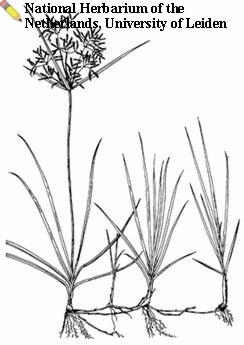 | Cyperus rotundus L. - habit of flowering plant with young plantlets |
Growth and Development
Most Cyperus rotundus plants originate from a tuber; seed production is possible but unimportant. The sprouting tuber produces a rhizome which terminates as a green aerial shoot. While emerging from the soil a swelling appears on the rhizome, often near the surface, but up to 20 cm depth, usually called a 'basal bulb'. On the basal bulb roots are formed and rhizomes grow out from it for a distance of 1—30 cm horizontally before the tip turns up to produce a new aerial shoot with another basal bulb, or, alternatively, to form a subterranean tuber from which another rhizome appears at the apical end, thus forming chains of tubers. The basal bulb and aerial shoot population may increase fivefold in the first 4 weeks after a tuber has been planted. It is believed that there are no buds at the nodes of the rhizomes and that no new plants can grow from rhizome fragments. Rhizomes and tubers are white and fleshy when young and some become firmly packed with starch. On aging they darken, harden, and most of the tissue exterior to the endodermis of the rhizomes sloughs off to give a wiry structure resistant to desiccation and decay. Short photoperiods stimulate flowering, and the period from emergence to flowering varies between 3—8 weeks. Short photoperiods might also stimulate tuber formation and it is believed that tubers do not form until flowering begins. Flowers are cross-pollinated, mostly by wind. Although many seeds are formed, viable seeds are rare. Seed germination averages 1—5%. Most tubers are found in the top 15 cm of the soil, and when planted at 90 cm depth, they are unable to grow to the surface. In cultivated areas starch reserves are highest in tubers that are below the disturbed layer, in non-cultivated land in tubers near the soil surface.
The development of Cyperus esculentus is practically the same. Flowering, however, is stimulated by photoperiods of 12—14 hours and the viability of the seed produced is much higher than in Cyperus rotundus, e.g. above 50%. In the weedy forms seed propagation is much more important.
The development of Cyperus esculentus is practically the same. Flowering, however, is stimulated by photoperiods of 12—14 hours and the viability of the seed produced is much higher than in Cyperus rotundus, e.g. above 50%. In the weedy forms seed propagation is much more important.
Other Botanical Information
Some differences exist between the wild weedy forms of Cyperus esculentus and the cultivated ones. Cultivated chufa has grey-orange tubers (weedy chufa grey-brown), which are less fibrous and borne on short rhizomes (longer in the weedy forms); shoots arising directly from the tubers are ascending and rarely flower (in weedy chufa they are erect and flower easily), and are sensitive to frost (weedy chufa is frost resistant to a certain degree). It has been correctly proposed to classify the cultivated forms into the cultivar group Chufa.
In Cyperus rotundus 2 subspecies are distinguished: subsp. rotundus and subsp. retzii (Nees) Kük. Subsp. retzii (synonym: Cyperus retzii Nees) differs from subsp. rotundus by its stouter habit (stem 50—75 cm tall), the somewhat broader spikelets (about 2.5 mm wide when ripe) and the paler elliptical-oblong glumes (3.5—4 mm long). It appears in moist locations, sometimes as a weed, but never as a pest; it is often confused with Cyperus esculentus, which has glumes with 7—9 prominent veins and ovoid tubers with a grey tomentum. Cyperus rotundus can be recognized by its usually dark brown rhizomes, which may produce several tubers in a chain. Cyperus esculentus has yellowish rhizomes which end in a single tuber.
Another tuber-bearing species, Cyperus stoloniferus Retzius, is also widespread in South-East Asia, growing on coastal sands. It acts as a sandbinder and might, although not reported, provide food in times of food scarcity.
In Cyperus rotundus 2 subspecies are distinguished: subsp. rotundus and subsp. retzii (Nees) Kük. Subsp. retzii (synonym: Cyperus retzii Nees) differs from subsp. rotundus by its stouter habit (stem 50—75 cm tall), the somewhat broader spikelets (about 2.5 mm wide when ripe) and the paler elliptical-oblong glumes (3.5—4 mm long). It appears in moist locations, sometimes as a weed, but never as a pest; it is often confused with Cyperus esculentus, which has glumes with 7—9 prominent veins and ovoid tubers with a grey tomentum. Cyperus rotundus can be recognized by its usually dark brown rhizomes, which may produce several tubers in a chain. Cyperus esculentus has yellowish rhizomes which end in a single tuber.
Another tuber-bearing species, Cyperus stoloniferus Retzius, is also widespread in South-East Asia, growing on coastal sands. It acts as a sandbinder and might, although not reported, provide food in times of food scarcity.
Ecology
Most Cyperus species are hygrophilous and grow in moist or wet locations at low and medium altitudes, only a few occurring above 1600 m altitude in the tropics.
Cyperus bulbosus grows on dry sandy soils, in Malesia only near the sea.
Cyperus esculentus grows in seasonally wet grassland, in irrigated crops, in damp grassland and along watercourses. It is also quite drought resistant but does not tolerate shade. Optimum average temperatures are 27—30°C, and optimum rainfall varies between 600—1200 mm. Preferred soils are light sandy loams with pH 5.5—6.5, but it grows on any kind of soil provided it is well drained. It is also quite tolerant of saline soils. Short photoperiods of 8—12 hours favour tuber formation, long photoperiods favour other vegetative growth.
Cyperus rotundus is found in cultivated fields, on roadsides, in neglected areas, at the edges of woods, along irrigation canals and streams, all over the world in both hemispheres up to about 50° latitude where cold limits its further expansion. It grows without problems at any elevation, humidity, in almost any soil type, soil moisture and pH, and can survive very high temperatures. Only low temperatures, shade, and soils with high salt content can limit its growth, and the tubers can remain dormant for a long time to carry the plant through the most extreme conditions of heat, drought, flooding or lack of aeration.
Cyperus bulbosus grows on dry sandy soils, in Malesia only near the sea.
Cyperus esculentus grows in seasonally wet grassland, in irrigated crops, in damp grassland and along watercourses. It is also quite drought resistant but does not tolerate shade. Optimum average temperatures are 27—30°C, and optimum rainfall varies between 600—1200 mm. Preferred soils are light sandy loams with pH 5.5—6.5, but it grows on any kind of soil provided it is well drained. It is also quite tolerant of saline soils. Short photoperiods of 8—12 hours favour tuber formation, long photoperiods favour other vegetative growth.
Cyperus rotundus is found in cultivated fields, on roadsides, in neglected areas, at the edges of woods, along irrigation canals and streams, all over the world in both hemispheres up to about 50° latitude where cold limits its further expansion. It grows without problems at any elevation, humidity, in almost any soil type, soil moisture and pH, and can survive very high temperatures. Only low temperatures, shade, and soils with high salt content can limit its growth, and the tubers can remain dormant for a long time to carry the plant through the most extreme conditions of heat, drought, flooding or lack of aeration.
Agronomy
Cyperus esculentus cv. group Chufa is propagated by tubers which are first soaked in water for 2—3 days before being planted. Freshly harvested tubers may show a dormancy period, which can be broken by a cold treatment (e.g. in temperate climates by overwintering). Planting distance varies, usually in rows 60—90 cm apart, at 10—15 cm intervals, 2.5—4 cm deep, at wider spacings usually with 2 tubers per hole. A spacing of 15 cm in 75—90 cm distant rows requires 35—45 kg tubers per ha as planting material. Farmyard manure and NPK (6:6:8, up to 1000 kg/ha) is recommended in Spain.
No serious diseases and pests are known. In the United States negrobug (Corimelaena pilicaria) punctures the tubers; sometimes harm is done by root-knot nematodes (Meloidogyne spp.). The tubers reach maturity in 3—4 months; they are harvested manually or mechanically at the end of the dry season when the plants begin to wither. Average yields of tubers on sandy soils range from 800—900 kg/ha; under optimum conditions 8—14 t/ha can be obtained. Harvested tubers are cleaned, washed, and dried before being graded and stored in thin layers under shelter.
Cyperus rotundus may produce up to 40 t subterraneous plant material per ha per year. It is a serious weed of rice, sugar cane, maize and vegetables in South-East Asia. It has been reported as a host plant for Rhizoctonia disease and for root-knot nematodes (Meloidogyne spp.). Digging up all rhizome parts and/or the planting of crops that cause several years of continuous shade can eradicate it. Biological control methods have not yet been successful, but promising results have been obtained with the rust Puccinia canaliculata for the weedy forms of Cyperus esculentus.
No serious diseases and pests are known. In the United States negrobug (Corimelaena pilicaria) punctures the tubers; sometimes harm is done by root-knot nematodes (Meloidogyne spp.). The tubers reach maturity in 3—4 months; they are harvested manually or mechanically at the end of the dry season when the plants begin to wither. Average yields of tubers on sandy soils range from 800—900 kg/ha; under optimum conditions 8—14 t/ha can be obtained. Harvested tubers are cleaned, washed, and dried before being graded and stored in thin layers under shelter.
Cyperus rotundus may produce up to 40 t subterraneous plant material per ha per year. It is a serious weed of rice, sugar cane, maize and vegetables in South-East Asia. It has been reported as a host plant for Rhizoctonia disease and for root-knot nematodes (Meloidogyne spp.). Digging up all rhizome parts and/or the planting of crops that cause several years of continuous shade can eradicate it. Biological control methods have not yet been successful, but promising results have been obtained with the rust Puccinia canaliculata for the weedy forms of Cyperus esculentus.
Genetic Resources and Breeding
No germplasm collections and breeding programmes are known.
Prospects
Compared to the efforts to eradicate Cyperus weeds in cultivated land, the cultivation of Cyperus esculentus cv. group Chufa is of no importance. It is expected that in South-East Asia Cyperus will primarily remain a weed problem for which effective herbicides and biological control methods still have to be found.
Literature
Bulman, J.C., 1989. Cyperus rotundus L. In: Westphal, E. & Jansen, P.C.M. (Editors): Plant Resources of South-East Asia. A selection. Pudoc, Wageningen, the Netherlands. pp. 108-109.
Burkill, I.H., 1935. A dictionary of the economic products of the Malay Peninsula. 2 Vols. Crown Agents for the Colonies, London, United Kingdom. 2402 pp. (slightly revised reprint, 1966. 2 Vols. Ministry of Agriculture and Cooperatives, Kuala Lumpur, Malaysia. 2444 pp.). pp. 742-747.
de Vries, F.T., 1991. Chufa (Cyperus esculentus, Cyperaceae): a weedy cultivar or a cultivated weed? Economic Botany 45: 27-37.
FAO, 1988. Traditional food plants. Food and Nutrition Paper 42. Food and Agriculture Organization of the United Nations, Rome, Italy. pp. 239-242.
Holm, L.G., Plucknett, D.L., Pancho, J.V. & Herberger, J.P., 1977. The world's worst weeds, distribution and biology. East-West Center, University Press of Hawaii, United States. pp. 8-24, 125-133.
Kern, J.H., 1974. Cyperaceae. In: van Steenis, C.G.G.J. (Editor): Flora Malesiana, Series 1, Vol. 7(3). Noordhoff International Publishing, Leyden, the Netherlands. pp. 604-607.
Nguyen Van Duong, 1993. Medicinal plants of Vietnam, Cambodia and Laos. Mekong Printing, Vietnam. pp. 155-156.
Burkill, I.H., 1935. A dictionary of the economic products of the Malay Peninsula. 2 Vols. Crown Agents for the Colonies, London, United Kingdom. 2402 pp. (slightly revised reprint, 1966. 2 Vols. Ministry of Agriculture and Cooperatives, Kuala Lumpur, Malaysia. 2444 pp.). pp. 742-747.
de Vries, F.T., 1991. Chufa (Cyperus esculentus, Cyperaceae): a weedy cultivar or a cultivated weed? Economic Botany 45: 27-37.
FAO, 1988. Traditional food plants. Food and Nutrition Paper 42. Food and Agriculture Organization of the United Nations, Rome, Italy. pp. 239-242.
Holm, L.G., Plucknett, D.L., Pancho, J.V. & Herberger, J.P., 1977. The world's worst weeds, distribution and biology. East-West Center, University Press of Hawaii, United States. pp. 8-24, 125-133.
Kern, J.H., 1974. Cyperaceae. In: van Steenis, C.G.G.J. (Editor): Flora Malesiana, Series 1, Vol. 7(3). Noordhoff International Publishing, Leyden, the Netherlands. pp. 604-607.
Nguyen Van Duong, 1993. Medicinal plants of Vietnam, Cambodia and Laos. Mekong Printing, Vietnam. pp. 155-156.
Author(s)
P.C.M. Jansen & N.O. Aguilar
Correct Citation of this Article
Jansen, P.C.M. & Aguilar, N.O., 1996. Cyperus L.. In: Flach, M. & Rumawas, F. (Editors): Plant Resources of South-East Asia No 9: Plants yielding non-seed carbohydrates. PROSEA Foundation, Bogor, Indonesia. Database record: prota4u.org/prosea

All texts are licensed under a Creative Commons Attribution-Noncommercial-Share Alike 3.0 Netherlands License
This license does not include the illustrations (Maps,drawings,pictures); these remain all under copyright.