Record Number
3311
PROSEA Handbook Number
1: Pulses
Taxon
Phaseolus acutifolius A. Gray
Protologue
Pl. Wright. 1: 43 (1852).
Family
LEGUMINOSAE
Chromosome Numbers
2n = 22
Synonyms
Phaseolus tenuifolius Woot. & Standley (1913).
Vernacular Names
Tepary bean (En).
Origin and Geographic Distribution
The tepary bean is native to south-western USA and Mexico. Now it is introduced and also cultivated in Africa, Asia and Australia. Cultivation is most important in Mexico and Arizona (USA).
Uses
Tepary beans are used mainly as dry shelled beans, in Mexico and Uganda to prepare a soup. In the United States, the plants have been tried as a hay and cover crop. In areas of poor rainfall, tepary bean has possibilities as a catch-crop where a rapid food supply is needed. On storage, the dry seeds become very hard and take a very long time to cook.
Production and International Trade
Growing of tepary beans is mainly confined to Mexico and Arizona. In tropical Africa they are grown year- round as a food crop. No data are available.
Properties
Per 100 g edible product tepary beans contain about: water 10 g, protein 22—25 g, fat 1.5 g, carbohydrates 60—65 g, fibre 3—4 g, ash 4 g. The energetic value averages 1588 kJ/100 g. Seed weight is 15 g/100 seeds.
Botany
A sub-erect annual herb up to 30 cm high, bushy on poor land, otherwise recumbent, spreading or twining to 2 m length. Leaves trifoliolate; leaflets ovate, 4—8 cm x 2—5 cm. Inflorescences axillary with 2—5 white or pale lilac flowers. Pods straight or slightly curved, compressed, 5—9 cm x 0.8—1.3 cm, 2—7-seeded, rimmed on margins, sharp beaked, hairy when young. Seeds roundish to oblong, about 8 x 6 mm, white, yellow, brown or deep violet, sometimes variously flecked. The seeds absorb water very easily. Germination is epigeal. First pair of leaves is simple. Tepary bean is presumably self-fertilized. It gives a crop in as short a time as 2 months, but some cultivars need up to 4 months.
At present two varieties are distinguished:
- var. acutifolius (the wild forms; seeds small and greyish; leaflets very variable from ovate to linear; northern Mexico, southern United States);
- var. latifolius Freeman (the cultivated bean; seeds larger and variously coloured; preferably grouped as cv.- group).
At present two varieties are distinguished:
- var. acutifolius (the wild forms; seeds small and greyish; leaflets very variable from ovate to linear; northern Mexico, southern United States);
- var. latifolius Freeman (the cultivated bean; seeds larger and variously coloured; preferably grouped as cv.- group).
Image
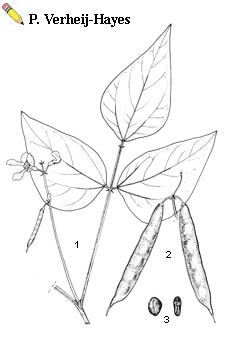 | Phaseolus acutifolius A. Gray - 1, flowering branch with young fruit; 2, fruits; 3, seeds |
Ecology
Tepary beans are short-day or day-neutral plants. They withstand heat and dry atmosphere and are quite drought-resistant. They are very susceptible to waterlogging and frost and are not suited to the wet tropics.
Temperature may not drop below 8 °C. Annual mean temperature should be between 17—26 °C. It can grow in areas with annual rainfall of 500—600 mm, in areas up to 1700 mm. It can be grown on poor shallow soils, ranging in pH from 5—7. In areas with average rainfall of 1000 mm/year or more, the plant usually makes excessive vegetative growth at the expense of seed yield.
Temperature may not drop below 8 °C. Annual mean temperature should be between 17—26 °C. It can grow in areas with annual rainfall of 500—600 mm, in areas up to 1700 mm. It can be grown on poor shallow soils, ranging in pH from 5—7. In areas with average rainfall of 1000 mm/year or more, the plant usually makes excessive vegetative growth at the expense of seed yield.
Agronomy
Tepary bean is propagated by seed. Seeds may be broadcast at rate of 28—33 kg/ha or drilled 2—10 cm deep, in rows of 90 x 45 cm, at rate of 11—17 kg/ha; sometimes they are planted on hills, 45 cm apart with 2—4 seeds per hill. When grown for hay it is usually seeded at more than 60 kg/ha.
Rhizobium strains that nodulate lima beans and Canavalia species also cause nitrogen fixation in tepary beans.
The crop may be irrigated, but is not usually done. It is sensitive to salty water and soils. It is often grown as a catch-crop and requires little weeding if grown as end-of-season crop. Tepary bean responds favourably to applications of N and 75 kg/ha of K2O.
Tepary bean is practically disease-free under savanna conditions. In Burma it was susceptible to attack from a root rot, Rhizoctonia sp.
As soon as the first pods start to ripen whole plants are pulled up, dried and threshed. Yield averages 500—800 kg/ha under dry farming conditions, 900—1700 kg/ha under irrigation. Yields up to 5000 kg dry beans/ha are reported. Yield of oven-dry hay is about 5—10 t/ha.
Rhizobium strains that nodulate lima beans and Canavalia species also cause nitrogen fixation in tepary beans.
The crop may be irrigated, but is not usually done. It is sensitive to salty water and soils. It is often grown as a catch-crop and requires little weeding if grown as end-of-season crop. Tepary bean responds favourably to applications of N and 75 kg/ha of K2O.
Tepary bean is practically disease-free under savanna conditions. In Burma it was susceptible to attack from a root rot, Rhizoctonia sp.
As soon as the first pods start to ripen whole plants are pulled up, dried and threshed. Yield averages 500—800 kg/ha under dry farming conditions, 900—1700 kg/ha under irrigation. Yields up to 5000 kg dry beans/ha are reported. Yield of oven-dry hay is about 5—10 t/ha.
Prospects
Tepary bean is reported to exhibit tolerance to disease, drought, heat, sand, slope and virus. It produces crop under conditions where other beans fail completely. In South-East Asia it has possibilities as a catch-crop where a rapid food supply is needed in areas of poor rainfall.
Literature
Duke, J.A., 1981. Handbook of legumes of world economic importance. Plenum Press, New York. p. 187-189.
Kay, D.E., 1979. Crop and product digest No. 3 - Food Legumes. Tropical Products Institute, London. p. 371-376.
Kay, D.E., 1979. Crop and product digest No. 3 - Food Legumes. Tropical Products Institute, London. p. 371-376.
Author(s)
P.C.M. Jansen
Correct Citation of this Article
Jansen, P.C.M., 1989. Phaseolus acutifolius A. Gray. In: van der Maesen, L.J.G. & Somaatmadja, S. (Editors): Plant Resources of South-East Asia No 1: Pulses. PROSEA Foundation, Bogor, Indonesia. Database record: prota4u.org/prosea

All texts are licensed under a Creative Commons Attribution-Noncommercial-Share Alike 3.0 Netherlands License
This license does not include the illustrations (Maps,drawings,pictures); these remain all under copyright.