Record Number
34
PROSEA Handbook Number
5(3): Timber trees; Lesser-known timbers
Taxon
Maniltoa R. Scheffer
Protologue
Ann. Jard. Bot. Buitenzorg 1: 20 (1876).
Family
LEGUMINOSAE
Chromosome Numbers
x = unknown; 2n = unknown
Vernacular Names
Papua New Guinea: maniltoa (En).
Origin and Geographic Distribution
Maniltoa comprises about 20 species and is distributed in India, Bangladesh, Burma (Myanmar), Cambodia, Peninsular Malaysia, Sulawesi, the Moluccas, New Guinea, the Solomon Islands, northern Australia, the Caroline Islands and Polynesia (Fiji and Tonga). Some species are cultivated in Java and northern Sumatra. New Guinea is by far richest in species (about 12).
Uses
The wood of Maniltoa is used for general construction, furniture, joinery, flooring, cladding, panelling, decking, lining, turnery, sliced veneer, tool handles and truck bodies. It makes good charcoal.
An extraction of the wood has been reported to be used to dye wool and silk yellow to reddish; it dyes only slightly. The trees are locally esteemed as ornamentals, e.g. in Java.
An extraction of the wood has been reported to be used to dye wool and silk yellow to reddish; it dyes only slightly. The trees are locally esteemed as ornamentals, e.g. in Java.
Production and International Trade
Limited amounts of Maniltoa timber are exported to Japan from Papua New Guinea and the Solomon Islands. In 1996 Papua New Guinea exported a fair volume of 6855 m³ of Maniltoa logs at an average free-on-board (FOB) price of US$ 99/m³.
Properties
Maniltoa yields a medium-weight to heavy hardwood with a density of 740-1120 kg/m³ at 15% moisture content. Heartwood brown or red-brown, sometimes with golden lustre, distinct but becoming indistinct from the straw-coloured or yellow-white sapwood, which turns grey-brown or brown upon exposure; grain straight or slightly interlocked; texture moderately fine to moderately coarse. Growth rings indistinct; vessels small to medium-sized, solitary and in radial multiples of up to 4, visible to barely visible to the naked eye; parenchyma paratracheal vasicentric, sometimes aliform and confluent, mostly apotracheal in bands both wider and narrower than the vessels; rays fine; ripple marks absent.
The wood is moderately hard to hard and fairly strong. It is moderately durable, but not suitable for use in contact with the ground. The heartwood is resistant to pressure impregnation. The sapwood is susceptible to Lyctus.
See also the tables on microscopic wood anatomy and wood properties.
The wood is moderately hard to hard and fairly strong. It is moderately durable, but not suitable for use in contact with the ground. The heartwood is resistant to pressure impregnation. The sapwood is susceptible to Lyctus.
See also the tables on microscopic wood anatomy and wood properties.
Botany
Small to large trees up to 40(-48) m tall; bole branchless for up to 19 m, up to 90(-120) cm in diameter, sometimes with buttresses up to 2 m high; bark surface smooth but often lenticellate or with numerous pustules, pale grey, greyish-brown, reddish-brown to blackish, inner bark greenish-brown, greyish-brown or red-brown, non-fibrous. Buds large, covered by 2-ranked brown scales. Leaves developing in white or pink tassels, arranged spirally, paripinnate, (1-)2-15-jugate; leaflets opposite, asymmetrical; stipules small, caducous. Flowers in an axillary, sessile, dense and contracted raceme, usually with sturdy rachis and scale-like, usually persistent bracts; receptacle campanulate or tubular; sepals 4(-5), imbricate; petals 5, free, glabrous; stamens numerous, filaments often connate at base; ovary superior, sessile or stalked, unilocular with 1(-2) ovules, style slender. Fruit a short, broad, woody, indehiscent pod, 1-seeded. Seed globose, smooth.
Flowering may start at a very young age. In Java Maniltoa browneoides is found flowering throughout the year, whereas its seeds are reported to be dispersed by bats. In Papua New Guinea its leaf shedding an new leaf flushes were associated with stress.
Maniltoa is usually placed in the tribe Detarieae of the subfamily Caesalpinioideae, formerly in the tribe Cynometreae. It is closely related to (and perhaps even congeneric with) Cynometra, which may look very similar. It differs from the latter genus in the more numerous stamens.
Flowering may start at a very young age. In Java Maniltoa browneoides is found flowering throughout the year, whereas its seeds are reported to be dispersed by bats. In Papua New Guinea its leaf shedding an new leaf flushes were associated with stress.
Maniltoa is usually placed in the tribe Detarieae of the subfamily Caesalpinioideae, formerly in the tribe Cynometreae. It is closely related to (and perhaps even congeneric with) Cynometra, which may look very similar. It differs from the latter genus in the more numerous stamens.
Image
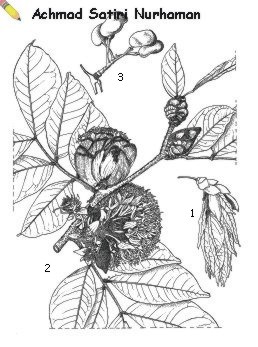 | Maniltoa schefferi K. Schumann – 1, young flush of leaves; 2, flowering twig; 3, infructescence. |
Ecology
Maniltoa occurs in primary lowland forest up to 500(-1300) m altitude, often in swampy localities and is shade-tolerant. In New Guinea it is relatively common although never gregarious.
Silviculture and Management
Maniltoa may be raised from seed. Maniltoa browneoides has about 190 dry seeds/kg. The seeds can be sown in full sunlight as well as in shade. Seeds germinate readily with about 95% germination; germination starts after 10 days, and 15 days after sowing 80% of the germinating seeds have appeared. It seems to thrive best in a mixture of loam, peat and sand. In lowland forest in New Guinea a density of 0.5-2.1 trees of over 35 cm diameter per ha has been recorded.
Genetic Resources and Breeding
Although Maniltoa trees are often common in New Guinea, they are virtually restricted to primary lowland forest. Moreover, several species are probably rare. Therefore, there is evidence to suspect that they are rather vulnerable to genetic erosion.
Prospects
Little is known of the wood quality of Maniltoa in other parts of South-East Asia, but the timber is well-known in Papua New Guinea and Fiji. Maniltoa browneoides may have potential as an ornamental or shade tree.
Literature
All Nippon Checkers Corporation, 1989. Illustrated commercial foreign woods in Japan. Tokyo, 262 pp.
Backer, C.A. & Bakhuizen van den Brink Jr., R.C., 1963-1968. Flora of Java. 3 volumes. Wolters-Noordhoff, Groningen.
Balai Penjelidikan Kehutanan, 1950. Daftar ichtisar aturan berketjambah, penjimpanan dan pengiriman bidji dari beberapa djenis pohon dan pupuk hidjau [Tabular summary of the best ways to germinate, store and send seed of some tree and green manure species]. Laporan No 42. Balai Penjelidikan Kehutanan, Bogor. 23 pp.
Bolza, E. & Kloot, N.H., 1966. The mechanical properties properties of 81 New Guinea timbers. Technological Paper No 41. Division of Forest Products, CSIRO, Melbourne. 39 pp.
Burkill, I.H., 1966. A dictionary of the economic products of the Malay Peninsula. 2nd edition. Ministry of Agriculture and Co-operatives, Kuala Lumpur. Vol. 1 (A-H) pp. 1-1240. Vol. 2 (I-Z) pp. 1241-2444.
Eddowes, P.J., 1977. Commercial timbers of Papua New Guinea, their properties and uses. Forest Products Research Centre, Department of Primary Industry, Porst Moresby. xiv + 195 pp.
Eddowes, P.J., 1995-1997. The forests and timbers of Papua New Guinea. (unpublished data).
Flore du Cambodge, du Laos et du Viêtnam (various editors), 1960-. Muséum National d'Histoire Naturelle, Paris.
Forest Products Research Centere, 1967. Properties and uses of Papua and New Guinea timbers. Forest Products Research Centre, Post Moresby. 30 pp.
Hardjowasono, M.S., 1942. Gewicht en volume van verschillende vruchten zaadsoorten [Weight and volume of various fruits and seeds]. Korte Mededeelingen No 20. Bosbouwproefstation, Buitenzorg. 172 pp.
Ilic, J., 1990. The CSIRO macro key for hardwood identification. CSIRO, Highett. 125 pp.
Keating, W.G. & Bolza, E., 1982. Characteristics, properties and uses of timbers. Vol. 1. South-East Asia, northern Australia and the Pacific. Inkata Press Proprietary Ltd., Melbourne, Sydney & London. 362 pp.
Knaap-van Meeuwen, M.S., 1970. A revision of four genera of the tribe Leguminosae - Caesalpinioideae - Cynometreae in Indomalesia and the Pacific. Blumea 18: 1-52.
National Academy of Sciences, 1979. Tropical legumes. Resources for the future. National Academy Press, Washington, D.C. 331 pp.
Oey Djoen Seng, 1951. De soortelijke gewichten van Indonesische houtsoorten en hun betekenis voor de praktijk [Specific gravity of Indonesian woods and its significance for practical use]. Rapport No 46. Bosbouwproefstation, Bogor. 183 pp.
Sastrapradja, S. (Editor), 1977. Tanaman hias [Ornamental plants]. LBN 5/SDE 38. Lembaga Biologi Nasional - LIPI, Bogor. 135 pp.
Siaguru, P., 1992. Effect of shade on growth of lowland forest tree seedlings in Papua New Guinea. PhD Thesis. University of Aberdeen, Scotland. 227 pp.
Uji, T., 1980. Pohon saputangan (Maniltoa gemmipara Scheff. ex Back.) sebagai tanaman hias dan peneduh [The handkerchief tree (Maniltoa gemmipara Scheff. ex Back.) as ornamental and shade plant]. Bulletin Kebun Raya 4(5): 161-164.
van der Pijl, L., 1957. The dispersal of plants by bats (chiropterochory). Acta Botanica Neerlandica 6: 291-315.
Verdcourt, B., 1977. New taxa of Leguminosae from New Guinea. Kew Bulletin 32(1): 225-251.
Verdcout, B., 1979. A manual of New Guinea legumes. Botany Bulletin No 11. Office of Forests. Division of Botany, Lae. 645 pp.
Whitmore, T.C. & Ng, F.S.P. (Editors), 1972-1989. Tree flora of Malaya. A manual for foresters. 4 volumes. Malayan Forest Records No 26. Longman Malaysia Sdn. Berhad, Kuala Lumpur & Petaling Jaya.
Backer, C.A. & Bakhuizen van den Brink Jr., R.C., 1963-1968. Flora of Java. 3 volumes. Wolters-Noordhoff, Groningen.
Balai Penjelidikan Kehutanan, 1950. Daftar ichtisar aturan berketjambah, penjimpanan dan pengiriman bidji dari beberapa djenis pohon dan pupuk hidjau [Tabular summary of the best ways to germinate, store and send seed of some tree and green manure species]. Laporan No 42. Balai Penjelidikan Kehutanan, Bogor. 23 pp.
Bolza, E. & Kloot, N.H., 1966. The mechanical properties properties of 81 New Guinea timbers. Technological Paper No 41. Division of Forest Products, CSIRO, Melbourne. 39 pp.
Burkill, I.H., 1966. A dictionary of the economic products of the Malay Peninsula. 2nd edition. Ministry of Agriculture and Co-operatives, Kuala Lumpur. Vol. 1 (A-H) pp. 1-1240. Vol. 2 (I-Z) pp. 1241-2444.
Eddowes, P.J., 1977. Commercial timbers of Papua New Guinea, their properties and uses. Forest Products Research Centre, Department of Primary Industry, Porst Moresby. xiv + 195 pp.
Eddowes, P.J., 1995-1997. The forests and timbers of Papua New Guinea. (unpublished data).
Flore du Cambodge, du Laos et du Viêtnam (various editors), 1960-. Muséum National d'Histoire Naturelle, Paris.
Forest Products Research Centere, 1967. Properties and uses of Papua and New Guinea timbers. Forest Products Research Centre, Post Moresby. 30 pp.
Hardjowasono, M.S., 1942. Gewicht en volume van verschillende vruchten zaadsoorten [Weight and volume of various fruits and seeds]. Korte Mededeelingen No 20. Bosbouwproefstation, Buitenzorg. 172 pp.
Ilic, J., 1990. The CSIRO macro key for hardwood identification. CSIRO, Highett. 125 pp.
Keating, W.G. & Bolza, E., 1982. Characteristics, properties and uses of timbers. Vol. 1. South-East Asia, northern Australia and the Pacific. Inkata Press Proprietary Ltd., Melbourne, Sydney & London. 362 pp.
Knaap-van Meeuwen, M.S., 1970. A revision of four genera of the tribe Leguminosae - Caesalpinioideae - Cynometreae in Indomalesia and the Pacific. Blumea 18: 1-52.
National Academy of Sciences, 1979. Tropical legumes. Resources for the future. National Academy Press, Washington, D.C. 331 pp.
Oey Djoen Seng, 1951. De soortelijke gewichten van Indonesische houtsoorten en hun betekenis voor de praktijk [Specific gravity of Indonesian woods and its significance for practical use]. Rapport No 46. Bosbouwproefstation, Bogor. 183 pp.
Sastrapradja, S. (Editor), 1977. Tanaman hias [Ornamental plants]. LBN 5/SDE 38. Lembaga Biologi Nasional - LIPI, Bogor. 135 pp.
Siaguru, P., 1992. Effect of shade on growth of lowland forest tree seedlings in Papua New Guinea. PhD Thesis. University of Aberdeen, Scotland. 227 pp.
Uji, T., 1980. Pohon saputangan (Maniltoa gemmipara Scheff. ex Back.) sebagai tanaman hias dan peneduh [The handkerchief tree (Maniltoa gemmipara Scheff. ex Back.) as ornamental and shade plant]. Bulletin Kebun Raya 4(5): 161-164.
van der Pijl, L., 1957. The dispersal of plants by bats (chiropterochory). Acta Botanica Neerlandica 6: 291-315.
Verdcourt, B., 1977. New taxa of Leguminosae from New Guinea. Kew Bulletin 32(1): 225-251.
Verdcout, B., 1979. A manual of New Guinea legumes. Botany Bulletin No 11. Office of Forests. Division of Botany, Lae. 645 pp.
Whitmore, T.C. & Ng, F.S.P. (Editors), 1972-1989. Tree flora of Malaya. A manual for foresters. 4 volumes. Malayan Forest Records No 26. Longman Malaysia Sdn. Berhad, Kuala Lumpur & Petaling Jaya.
Author(s)
I. Samsoedin (general part), E. Boer (general part), R.H.M.J. Lemmens (general part)
Maniltoa browneoides
Maniltoa cynometroides
Maniltoa lenticellata
Maniltoa plurijuga
Maniltoa polyandra
Maniltoa psilogyne
Maniltoa schefferi
Maniltoa cynometroides
Maniltoa lenticellata
Maniltoa plurijuga
Maniltoa polyandra
Maniltoa psilogyne
Maniltoa schefferi
Correct Citation of this Article
Samsoedin, I., Boer, E., Lemmens, R.H.M.J., 1998. Maniltoa R. Scheffer. In: Sosef, M.S.M., Hong, L.T. and Prawirohatmodjo, S. (Editors): Plant Resources of South-East Asia No 5(3): Timber trees; Lesser-known timbers. PROSEA Foundation, Bogor, Indonesia. Database record: prota4u.org/prosea
Selection of Species
The following species in this genus are important in this commodity group and are treated separatedly in this database:
Maniltoa browneoides
Maniltoa cynometroides
Maniltoa lenticellata
Maniltoa plurijuga
Maniltoa polyandra
Maniltoa psilogyne
Maniltoa schefferi
Maniltoa browneoides
Maniltoa cynometroides
Maniltoa lenticellata
Maniltoa plurijuga
Maniltoa polyandra
Maniltoa psilogyne
Maniltoa schefferi

All texts are licensed under a Creative Commons Attribution-Noncommercial-Share Alike 3.0 Netherlands License
This license does not include the illustrations (Maps,drawings,pictures); these remain all under copyright.