Record Number
340
PROSEA Handbook Number
12(1): Medicinal and poisonous plants 1
Taxon
Mentha arvensis L.
Protologue
Sp. pl. 2: 577 (1753).
Family
LABIATAE
Chromosome Numbers
2n = 36, 72, 96
Vernacular Names
Mint, field mint (En). Baume des champs (Fr). Indonesia: daun poko (general), bijanggut (Sundanese), janggot (Javanese). Malaysia: pohok. Philippines: polios (Sp, Tagalog). Singapore: pokok kepari. Cambodia: chi poho. Thailand: min indoneesia (Bangkok). Vietnam: b[aj]c h[af], b[aj]c h[af] nam.
Origin and Geographic Distribution
Mentha includes about 30 species and numerous hybrids, and mainly occurs in the temperate parts of the northern hemisphere; the centres of diversity are located in Europe and northern and central Asia. Mint has been known as a kitchen herb and medicinal plant since ancient times. It has been found in pyramids in Egypt and is described in old Chinese literature. Only Mentha arvensis occurs in South-East Asia, but some other species and hybrids are cultivated in kitchen gardens and in pots.
Mentha arvensis is native to Europe and northern and central Asia and is cultivated in many parts of the world. Var. arvensis has also been introduced in Malesia from Europe. The Spaniards introduced it in the Philippines, where its cultivation is now widespread, but where it does not flower; it is also cultivated as a pot-herb in Peninsular Malaysia and Singapore. It is cultivated throughout Vietnam, whereas wild forms of Mentha arvensis are also found in northern Vietnam. Var. javanica (Blume) Hook.f. (synonym: Mentha javanica Blume) occurs in Sri Lanka and the Malesian area (Peninsular Malaysia, Sumatra, Java, Timor, north-eastern Sulawesi, Banda in the Moluccas and the Philippines). It is often cultivated.
Var. piperascens Malinv. ex Holmes (Japanese mint) has been introduced into northern Thailand where since 1973 it has been grown on a commercial scale, mainly in Nan Province, for the extraction of mint oil.
Mentha arvensis is native to Europe and northern and central Asia and is cultivated in many parts of the world. Var. arvensis has also been introduced in Malesia from Europe. The Spaniards introduced it in the Philippines, where its cultivation is now widespread, but where it does not flower; it is also cultivated as a pot-herb in Peninsular Malaysia and Singapore. It is cultivated throughout Vietnam, whereas wild forms of Mentha arvensis are also found in northern Vietnam. Var. javanica (Blume) Hook.f. (synonym: Mentha javanica Blume) occurs in Sri Lanka and the Malesian area (Peninsular Malaysia, Sumatra, Java, Timor, north-eastern Sulawesi, Banda in the Moluccas and the Philippines). It is often cultivated.
Var. piperascens Malinv. ex Holmes (Japanese mint) has been introduced into northern Thailand where since 1973 it has been grown on a commercial scale, mainly in Nan Province, for the extraction of mint oil.
Uses
Most Mentha species are very fragrant and used as a condiment, medicinal plant and as a source of essential oil. The most important use of mints today on a world scale, is as a source of essential oil, which is used in medicinal preparations (ointments, itch-relieving creams, cough syrups, cough lozenges, tablets), as a flavouring agent in toothpastes, mouthwashes, confectionery, candies, chewing gums, beverages and cigarettes, and in the perfume industry (for lotions, soap and cologne). In South-East Asia, however, mints are mainly used to flavour food and for medicinal purposes. However, commercial mint oil production is developing as well, e.g. in Thailand and Indonesia (West Java).
Leaves, whole plants and the oil extracted from Mentha arvensis are all reported as having medicinal properties. They are used as a carminative, stomachic, antispasmodic, stimulant, sedative, sudorific, emmenagogue, astringent (externally) and refrigerant (externally) all over the world. They are administered internally to treat indigestion, flatulence, gastro-intestinal atony, colic and diarrhoea, or externally in the treatment of colds, influenza, fever, sinusitis, nose and throat complaints (all e.g. as nasal drops), headache, facial neuralgia and insect stings (e.g. as rubefacient). In Indonesia, pounded leaves are used externally against headache, and an infusion of the leaves as sudorific and expectorant to treat cough, as a carminative, and as antispasmodic in gastro-enteritis. Although the main use in the Philippines is reportedly as a culinary herb, an infusion of the leafy stems is also used as carminative, and pounded leaves are used to treat insect stings. Mint leaves in the form of tea or tablets are used in the Philippines as an analgesic, particularly in dental surgery. In Thailand, Mentha is widely used as a culinary herb but also as a medicine for its carminative, stomachic and expectorant properties.
Compared with other Mentha spp., South-East Asian mint is usually mild in flavour and the young leaves are also eaten raw as a side dish; except those of Japanese mint (Mentha arvensis var. piperascens), which are rich in menthol.
Leaves, whole plants and the oil extracted from Mentha arvensis are all reported as having medicinal properties. They are used as a carminative, stomachic, antispasmodic, stimulant, sedative, sudorific, emmenagogue, astringent (externally) and refrigerant (externally) all over the world. They are administered internally to treat indigestion, flatulence, gastro-intestinal atony, colic and diarrhoea, or externally in the treatment of colds, influenza, fever, sinusitis, nose and throat complaints (all e.g. as nasal drops), headache, facial neuralgia and insect stings (e.g. as rubefacient). In Indonesia, pounded leaves are used externally against headache, and an infusion of the leaves as sudorific and expectorant to treat cough, as a carminative, and as antispasmodic in gastro-enteritis. Although the main use in the Philippines is reportedly as a culinary herb, an infusion of the leafy stems is also used as carminative, and pounded leaves are used to treat insect stings. Mint leaves in the form of tea or tablets are used in the Philippines as an analgesic, particularly in dental surgery. In Thailand, Mentha is widely used as a culinary herb but also as a medicine for its carminative, stomachic and expectorant properties.
Compared with other Mentha spp., South-East Asian mint is usually mild in flavour and the young leaves are also eaten raw as a side dish; except those of Japanese mint (Mentha arvensis var. piperascens), which are rich in menthol.
Production and International Trade
World production of Mentha oil is estimated at 6500-8000 t/year. Japanese mint (Mentha arvensis var. piperascens) contributes the greatest part, with 4000-4500 t/year (and a value of about US$ 43 million/year) in the period 1990-1995. The main producing countries are China, Brazil and India. Small amounts of mint oil are produced in Thailand and Vietnam; the current production in Vietnam is about 100 t/year, and the production in Thailand in 1975 was estimated at about 15 t. The world production of peppermint oil is 2000-2500 t/year, with the United States as the main producer. World production of spearmint oil is about 1000 t/year.
Properties
Mint oil is a complex mixture of numerous constituents. In general, the different Mentha species contain characteristic monoterpenes as main components, but several species also have divergent chemotypes. The characteristic 'cool taste' is due to (-)-menthol ((1R,3R,4S)-menthol), a monoterpenoid alcohol; other optically active isomers of menthol (e.g. (1R,3S,4S)-neomenthol) do not have the same organoleptic characteristics.
Mint oil is obtained from the flowering tops of Japanese mint (Mentha arvensis var. piperascens); leaves can contain over 5% (in general 1-1.8%), but at least 0.8% V/w of essential oil on a moisture-free basis according to the Chinese Pharmacopoeia. Japanese mint oil can contain as much as 92.5% (-)-menthol. Very slow cooling of the essential oil (e.g. from 35°C to 5°C at 2°C/day) induces part of the menthol to crystallize. An additional quantity of menthol can be recovered by saponifying (-)-menthyl acetate and by hydrogenating (-)-menthone.
After some of the menthol has been removed, the average composition of the essential oil (referred to as 'rectified' or more often 'dementholized') used for e.g. pharmaceutical or cosmetic products is 30-45% (-)-[1R,3R,4S]-menthol, 17-35% (-)-[1R,4S]-menthone, 5-13% (+)-[1R,1R]-isomenthone, 2-7% menthyl acetate (mainly (-)- or (1R,3R,4S)-), 1.5-7% limonene and 2.5-4% (+)-[1R,3S,4S]-neomenthol. About 30 minor terpenoid constituents have also been identified. They include piperitone (0.5-4%), pulegone (0.2-3.5%), 'BETA'-caryophyllene (2-5%), 'BETA'-caryophyllene-epoxide (0.5-2%), 'ALFA'-pinene (2-4%), 'BETA'-pinene (2-4%), germacrene D (0.1-1.3%), 1,8-cineole (<1%), linalool (<1%), menthofuran (<1%) and camphene (<1%). The oil of Mentha arvensis var. javanica from Java has been reported as bitter with a low menthol content and a high pulegone content, but with an agreeable aromatic odour.
The pharmacology of Mentha drugs has not been explored much. Mint oil showed a significant in vitro spasmolytic activity on isolated guinea-pig ileum. It is possible that this activity is linked to an inhibition of calcium entry into the cells. The usefulness of the essential oil in cases of 'irritable colon' has been demonstrated in some studies, but in others there was no improvement. Although the oil is the major constituent of several over-the-counter remedies for symptoms of irritable bowel syndrome (a common disorder with a psychophysiological basis), its role in the symptomatic treatment has so far not been established beyond reasonable doubt. Oil from Indian mint showed strong in vitro fungitoxic activity against the dermatophytes Trichophyton rubrum and Microsporum gypseum, and also against Aspergillus spp.
The oil was able to cure experimentally induced ringworm in guinea-pigs within 2 weeks. Antibacterial activity of mint oil was also demonstrated in vitro and in foods to which the oil had been added; the growth of Salmonella and Listeria bacteria was inhibited. In tests in Taiwan an aqueous extract of Mentha arvensis markedly inhibited the growth of both gram-positive and gram-negative bacteria too.
Mint oil is not without toxicity. High doses of menthol are toxic; there is a risk of spasm of the glottis (asphyxia) in young children and asthmatic patients.
The traditional use of Mentha arvensis as carminative and stomachic has been verified by pharmacological evidence of the carminative effect of the essential oil and antispasmodic and choleretic activity. In tests with rats in India a 50% ethanolic extract of mint leaves has been found to reduce the fructose synthesis in seminal vesicles: male sterility occurred until 30 days after the last treatment. Subcutaneous administration to rats in early pregnancy caused a significant number of abortions.
Peppermint oil showed anti-inflammatory effect in xylene-induced ear oedema in mice and in a cotton pellet granuloma test in rats. Moreover, it showed anti-nociceptive effect against acetic acid-induced writhing and hot plate-induced thermal stimulation in mice. Tablets of 'yerba buena' (Mentha xcordifolia Opiz ex Fresen) tested in the Philippines did not possess direct DNA damaging capacity. They were not mutagenic before and after metabolic activation and they did not possess chromosome-breaking effects. They exhibited antimutagenic effects against dimethylnitrosamine, mitomycin C, N-nitrosopyrrolidine and tetracycline; they reduced the formation of micronucleated polychromatic erythrocytes induced by these compounds.
Mint oil was found to be effective as a fumigant against rice weevil (Sitophilus oryzae) in stored sorghum grain, without affecting the germination capacity of the grain. However, it did affect the taste of boiled sorghum.
Mint oil is obtained from the flowering tops of Japanese mint (Mentha arvensis var. piperascens); leaves can contain over 5% (in general 1-1.8%), but at least 0.8% V/w of essential oil on a moisture-free basis according to the Chinese Pharmacopoeia. Japanese mint oil can contain as much as 92.5% (-)-menthol. Very slow cooling of the essential oil (e.g. from 35°C to 5°C at 2°C/day) induces part of the menthol to crystallize. An additional quantity of menthol can be recovered by saponifying (-)-menthyl acetate and by hydrogenating (-)-menthone.
After some of the menthol has been removed, the average composition of the essential oil (referred to as 'rectified' or more often 'dementholized') used for e.g. pharmaceutical or cosmetic products is 30-45% (-)-[1R,3R,4S]-menthol, 17-35% (-)-[1R,4S]-menthone, 5-13% (+)-[1R,1R]-isomenthone, 2-7% menthyl acetate (mainly (-)- or (1R,3R,4S)-), 1.5-7% limonene and 2.5-4% (+)-[1R,3S,4S]-neomenthol. About 30 minor terpenoid constituents have also been identified. They include piperitone (0.5-4%), pulegone (0.2-3.5%), 'BETA'-caryophyllene (2-5%), 'BETA'-caryophyllene-epoxide (0.5-2%), 'ALFA'-pinene (2-4%), 'BETA'-pinene (2-4%), germacrene D (0.1-1.3%), 1,8-cineole (<1%), linalool (<1%), menthofuran (<1%) and camphene (<1%). The oil of Mentha arvensis var. javanica from Java has been reported as bitter with a low menthol content and a high pulegone content, but with an agreeable aromatic odour.
The pharmacology of Mentha drugs has not been explored much. Mint oil showed a significant in vitro spasmolytic activity on isolated guinea-pig ileum. It is possible that this activity is linked to an inhibition of calcium entry into the cells. The usefulness of the essential oil in cases of 'irritable colon' has been demonstrated in some studies, but in others there was no improvement. Although the oil is the major constituent of several over-the-counter remedies for symptoms of irritable bowel syndrome (a common disorder with a psychophysiological basis), its role in the symptomatic treatment has so far not been established beyond reasonable doubt. Oil from Indian mint showed strong in vitro fungitoxic activity against the dermatophytes Trichophyton rubrum and Microsporum gypseum, and also against Aspergillus spp.
The oil was able to cure experimentally induced ringworm in guinea-pigs within 2 weeks. Antibacterial activity of mint oil was also demonstrated in vitro and in foods to which the oil had been added; the growth of Salmonella and Listeria bacteria was inhibited. In tests in Taiwan an aqueous extract of Mentha arvensis markedly inhibited the growth of both gram-positive and gram-negative bacteria too.
Mint oil is not without toxicity. High doses of menthol are toxic; there is a risk of spasm of the glottis (asphyxia) in young children and asthmatic patients.
The traditional use of Mentha arvensis as carminative and stomachic has been verified by pharmacological evidence of the carminative effect of the essential oil and antispasmodic and choleretic activity. In tests with rats in India a 50% ethanolic extract of mint leaves has been found to reduce the fructose synthesis in seminal vesicles: male sterility occurred until 30 days after the last treatment. Subcutaneous administration to rats in early pregnancy caused a significant number of abortions.
Peppermint oil showed anti-inflammatory effect in xylene-induced ear oedema in mice and in a cotton pellet granuloma test in rats. Moreover, it showed anti-nociceptive effect against acetic acid-induced writhing and hot plate-induced thermal stimulation in mice. Tablets of 'yerba buena' (Mentha xcordifolia Opiz ex Fresen) tested in the Philippines did not possess direct DNA damaging capacity. They were not mutagenic before and after metabolic activation and they did not possess chromosome-breaking effects. They exhibited antimutagenic effects against dimethylnitrosamine, mitomycin C, N-nitrosopyrrolidine and tetracycline; they reduced the formation of micronucleated polychromatic erythrocytes induced by these compounds.
Mint oil was found to be effective as a fumigant against rice weevil (Sitophilus oryzae) in stored sorghum grain, without affecting the germination capacity of the grain. However, it did affect the taste of boiled sorghum.
Adulterations and Substitutes
Several other Labiatae have essential oil with similar or related compounds and with similar applications, i.e. mainly for minor digestive disturbances, in dermatology and hygiene, and in perfumery, cosmetology and confectionery. Examples include the genera Lavandula, Ocimum and Salvia.
Description
An aromatic, stoloniferous herb up to 60 cm tall, often rooting on lowest stem parts; stem prostrate, quadrangular, pubescent with appressed hairs. Leaves decussately opposite, simple, lanceolate to broadly lanceolate, 2.5-4.5(-7) cm x 1-2.5(-3) cm, long-cuneate at base, acute at apex, serrate but entire at base, membranaceous, sparingly hairy above, glabrous beneath; petiole 0.5-1 cm long; stipules absent. Inflorescence consisting of short, fascicled cymes in the axils of the leaves forming a verticillaster; bracts linear or subulate. Flowers small, bisexual; pedicel 2-2.5 mm long; calyx tubular-campanulate, 2-3 mm long, 5-toothed, appressed hairy; corolla funnel-shaped, 4.5-5 mm long, 4-lobed, faintly 2-lipped due to the broader, emarginate upper lobe, puberulent outside, violet or lilac; stamens 4, slightly didynamous, filaments inserted on the corolla tube, erect, anthers 2-celled; disk entire and uniform; ovary superior, consisting of 2 carpels each of which is 2-celled, style with 2 short branches.
Fruit consisting of 4 dry 1-seeded schizocarpous nutlets enclosed in the persistent calyx; nutlets ellipsoid, about 1 mm long, finely granular, often pointed at apex and with a large lateral scar below. Seedling with epigeal germination; cotyledons petiolate, circular-oblong, rounded to truncate at apex; hypocotyl elongate, epicotyl nearly absent.
Fruit consisting of 4 dry 1-seeded schizocarpous nutlets enclosed in the persistent calyx; nutlets ellipsoid, about 1 mm long, finely granular, often pointed at apex and with a large lateral scar below. Seedling with epigeal germination; cotyledons petiolate, circular-oblong, rounded to truncate at apex; hypocotyl elongate, epicotyl nearly absent.
Image
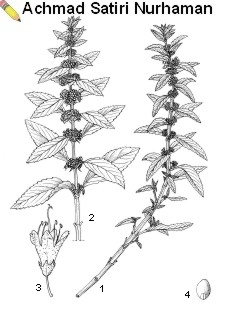 | Mentha arvensis L. — 1, flowering plant; 2, upper part of flowering stem; 3, flower; 4, nutlet |
Growth and Development
In Vietnam, new shoots of Mentha arvensis normally arise from cuttings within 5-10 days after planting. Flowering starts 80-100 days after planting, and although plants usually blossom profusely they rarely set seed. Except for Mentha arvensis, all Mentha spp. in the Malesian region do not flower, or flower rarely.
Other Botanical Information
Mentha is taxonomically rather complex. Identification is often difficult since, apart from their phenotypic plasticity and genetic variability, most species hybridize easily with each other; polyploidy is common. Mentha arvensis is a complex species with a very large area of distribution, which has resulted in a confusing infraspecific taxonomy. The widespread var. javanica is reported as possibly indigenous to the Malesian region. Var. javanica differs from var. arvensis mainly in the almost filiform or mucronate calyx teeth, which are separated by wide bays; the calyx teeth of var. arvensis are triangular without distinct mucronate apices. The assumption that var. javanica is of hybrid origin and was originally imported from Europe, just like var. arvensis, has not been proved. The relationship between Mentha arvensis var. javanica and other taxa such as Mentha haplocalyx Briq. (synonym: Mentha arvensis subsp. haplocalyx (Briq.) Briq.), Mentha canadensis L. and Mentha arvensis var. piperascens Malinv. ex Holmes is still unclear, but all these are at least closely related.
A hybrid, named Mentha x cordifolia Opiz ex Fresen, is also cultivated in Java, the Philippines and Thailand. The correct name might be Mentha x villosa Huds., which is a hybrid between Mentha spicata L. and Mentha suaveolens Ehrh. It originates from northern temperate regions, never flowers and is propagated vegetatively. It can be distinguished from Mentha arvensis by its rounded to truncate or shallowly cordate leaf bases and less hairy stems. Mentha xcordifolia is commonly cultivated for medicinal purposes and for use as flavouring throughout the Philippines and Thailand. It is likely that this taxon has been often confused with varieties of Mentha arvensis, particularly in the Philippines where they all appear to occur.
Mentha pulegium L. (pennyroyal), also a native of northern temperate regions, is cultivated locally in gardens in Java as a culinary herb. Mentha aquatica L. (water mint) is cultivated in Vietnam and Thailand. Mentha xpiperita L. (peppermint, a hybrid between Mentha aquatica and Mentha spicata) is cultivated for its essential oil throughout the temperate regions of the world; it has been introduced very locally in Indonesia (Java, Timor). Mentha xrotundifolia (L.) Huds. (apple-mint, a hybrid between Mentha longifolia L. and Mentha suaveolens) is cultivated and naturalized in Vietnam. Mentha spicata L. (spearmint) is a well-known medicinal plant in India, used to treat fever, bronchitis and aphthae; it is not reported for South-East Asia.
A hybrid, named Mentha x cordifolia Opiz ex Fresen, is also cultivated in Java, the Philippines and Thailand. The correct name might be Mentha x villosa Huds., which is a hybrid between Mentha spicata L. and Mentha suaveolens Ehrh. It originates from northern temperate regions, never flowers and is propagated vegetatively. It can be distinguished from Mentha arvensis by its rounded to truncate or shallowly cordate leaf bases and less hairy stems. Mentha xcordifolia is commonly cultivated for medicinal purposes and for use as flavouring throughout the Philippines and Thailand. It is likely that this taxon has been often confused with varieties of Mentha arvensis, particularly in the Philippines where they all appear to occur.
Mentha pulegium L. (pennyroyal), also a native of northern temperate regions, is cultivated locally in gardens in Java as a culinary herb. Mentha aquatica L. (water mint) is cultivated in Vietnam and Thailand. Mentha xpiperita L. (peppermint, a hybrid between Mentha aquatica and Mentha spicata) is cultivated for its essential oil throughout the temperate regions of the world; it has been introduced very locally in Indonesia (Java, Timor). Mentha xrotundifolia (L.) Huds. (apple-mint, a hybrid between Mentha longifolia L. and Mentha suaveolens) is cultivated and naturalized in Vietnam. Mentha spicata L. (spearmint) is a well-known medicinal plant in India, used to treat fever, bronchitis and aphthae; it is not reported for South-East Asia.
Ecology
Most Mentha spp. originate from temperate regions and grow best under cool conditions. They are probably quantitative long-day plants and usually do not flower in tropical regions, although some species have been found flowering at higher altitude. Mentha arvensis var. javanica occurs in open, mostly humid localities, e.g. in borders of rice fields, at 150-1200 m altitude. It is found flowering throughout the year. At least some cultivars of Japanese mint (Mentha arvensis var. piperascens) are better adapted to tropical climates. In greenhouse experiments, this species even came into flower under the minimum photoperiod of 10 hours, which is much less than for other species such as peppermint (Mentha xpiperita) and spearmint (Mentha spicata). In northern Thailand, cv. So Wo 1 of Japanese mint outyielded spearmint and peppermint production (in both dry matter and mint oil production) in the lowlands, but in the highlands other cultivars of Japanese mint and a cultivar of spearmint performed better. Unfavourable climatic conditions can cause excessive levels of undesirable compounds or low levels of desirable compounds in the oil of commercially grown mint taxa, resulting in oil of poor quality.
In peppermint (Mentha xpiperita), for instance, it is known that long days and cool nights lead to higher yields of oil and to an increase in the menthofuran level, and that cold nights favour the formation of menthol. Japanese mint can thrive in the Philippines in well-watered, well-drained soils in the dry season (September to April). Mints grow best in deep soils rich in humus, with a pH of 6-7.5.
In peppermint (Mentha xpiperita), for instance, it is known that long days and cool nights lead to higher yields of oil and to an increase in the menthofuran level, and that cold nights favour the formation of menthol. Japanese mint can thrive in the Philippines in well-watered, well-drained soils in the dry season (September to April). Mints grow best in deep soils rich in humus, with a pH of 6-7.5.
Propagation and planting
Mints are usually propagated vegetatively by stolons. Cuttings should preferably be taken from one-year-old plants, and cut into pieces of 4-5 cm long with 3-4 nodes. Japanese mint is usually planted in northern Vietnam in January-April (spring). The cuttings are planted 12-20 cm apart in shallow furrows 7-10 cm deep and 45-60 cm apart. For planting one ha, 400-450 kg of stolons are required.
Tissue culture of mints is possible. Callus cultures of Japanese mint have been established in India, using standard medium with some modifications. The plantlets produced were transplanted to soil and had a high rate of survival. Before planting, the land should be cleaned as thoroughly as possible. In Thailand, Japanese mint is intercropped with teak (Tectona grandis L.f.) seedlings.
The crop responds favourably to the application of 20-30 t/ha of manure or compost to the field before planting. Green manuring may also be practised.
Tissue culture of mints is possible. Callus cultures of Japanese mint have been established in India, using standard medium with some modifications. The plantlets produced were transplanted to soil and had a high rate of survival. Before planting, the land should be cleaned as thoroughly as possible. In Thailand, Japanese mint is intercropped with teak (Tectona grandis L.f.) seedlings.
The crop responds favourably to the application of 20-30 t/ha of manure or compost to the field before planting. Green manuring may also be practised.
In Vitro Production of Active Compounds
A suspension culture of Mentha has been established from callus formed on the tips of young shoots. Cells were grown in B-5 liquid medium supplemented with 1 mg/l 2,4-dichlorophenoxy acetic acid in the dark, and subcultured at intervals of 2 weeks. The cell suspension has been maintained for up to 4 years. The culture released a large amount of extracellular polysaccharides.
Husbandry
Although a peppermint crop can be ratooned for 3 years, Japanese mint is usually planted every year. Weeding should be carried out regularly. When plants are grown for oil production it is especially important to avoid contamination with weeds, because of the risk of off-flavours. The crop should be watered liberally to support the profuse vegetative growth. Application of fertilizers (up to 160 kg N and 60 kg P2O5 per ha under northern Vietnamese conditions) increases crop and essential oil yields.
Diseases and Pests
Mint crops are affected by a number of fungal diseases, particularly when grown in regions with a warm and humid climate. Severe leaf shedding is caused by the mint rust Puccinia menthae and Fusarium spp. Powdery mildew caused by Erysiphe cichoracearum appears to be the most serious problem in India. Verticillium wilt is the major disease in peppermint and spearmint crops in the United States. Collar rot developed in an experimental plantation of Japanese mint in Papua New Guinea, resulting in the wilting and death of shoots; it was caused by Marasmiellus epochnous. Mints are reported to be attacked by a large number of insect pests, the most serious of which are moths.
Harvesting
In Vietnam, 2-3 harvests per year can be obtained from Japanese mint. The first harvest is 100-130 days after planting, when the lower leaves turn yellow and the crop is flowering, the second harvest is carried out 80-100 days after the first, and the third 80-90 days after the second. If harvesting is delayed and leaves start falling, oil yields will be lower. The oil content decreases rapidly after the full bloom stage.
Yield
A good crop of Japanese mint may produce 40-45 t/ha of fresh material in 2 cuttings. Fresh plant material contains 0.4-0.8% essential oil, but the oil yield and quality largely depend on field conditions, plant age, and the presence of weeds, diseases and pests. In India the highest yields of fresh mint (53 t/ha) and oil (270 kg/ha) were obtained when the crop was planted at 60 cm row spacing and fertilized with 240 kg N/ha.
The yield of oil from Mentha arvensis cv. Jombang in Indonesia is reported at 30.5 l/ha.
In India, tetraploid plants of Japanese mint contain more oil than diploid ones. However, the menthol content of oil from tetraploid Japanese mint was lower and the menthone content higher. Moreover, it was inferior in growth habit and more susceptible to diseases, which made the quality and total yield of oil lower compared with diploid plants.
In the Philippines, oil yield of Mentha xcordifolia reaches a peak in the period March-June, with a secondary peak in December. Heavy rains in July-September depress growth and oil yield.
The yield of oil from Mentha arvensis cv. Jombang in Indonesia is reported at 30.5 l/ha.
In India, tetraploid plants of Japanese mint contain more oil than diploid ones. However, the menthol content of oil from tetraploid Japanese mint was lower and the menthone content higher. Moreover, it was inferior in growth habit and more susceptible to diseases, which made the quality and total yield of oil lower compared with diploid plants.
In the Philippines, oil yield of Mentha xcordifolia reaches a peak in the period March-June, with a secondary peak in December. Heavy rains in July-September depress growth and oil yield.
Handling After Harvest
Mint oil is obtained by distillation of fresh or slightly dried plant material. The crop should not be excessively dried in the sun. To obtain good quality oil, the herb is distilled as rapidly as possible to prevent hydrolysis of esters and alteration of other constituents by excessively long exposure to steam. It usually takes 1.5-2 hours to complete the process of distillation in a well-designed still with good steam pressure. In the case of small-scale farming a direct-fired still can be used, but the oil yield depends on the efficiency of distillation equipment.
Genetic Resources and Breeding
In recent years, Mentha germplasm has been collected in Russia, Ukraine, China, Japan, India, United States and Brazil. In India, breeding work is done at the Central Institute of Medicinal and Aromatic Plants in Lucknow, with the aim of developing cultivars that combine excellent oil quality and a wide range of maturity dates with resistance against diseases.
Prospects
Successful mint cultivation in South-East Asia partly depends on the availability and maintenance of certified plant material. However, the climatological conditions are a serious drawback for commercial mint growing. Some regions at the edge of South-East Asia, such as northern Vietnam and northern Thailand, may have promissing prospects for large-scale production of good-quality mint oil. In the Malesian region, the role of mint will probably remain limited to the use of imported mint oil and to grow plants as a pot herb or occasionally as a medicinal herb. However, when better adapted cultivars become available, which do not suffer a decrease in oil quality in tropical conditions, there might also be a future for commercial mint oil production in Malesia. Recent developments are encouraging.
Literature
Bruneton, J., 1995. Pharmacognosy, phytochemistry, medicinal plants. Lavoisier Publishing, Paris, France. pp. 431-437.
Cantoria, M., 1980. Physiology and biochemistry of the volatile oils of Mentha species (Fam. Labiatae) grown in the Philippines. Transactions of the National Academy of Science and Technology 2: 163-190.
Chomchalow, N., Buranasilpin, P., Pichitakul, N., Euraree, A. & Pangspa, A., 1976. Hill-tribe mint production and processing. Thai Journal of Agricultural Sciences 9(3): 127-144.
Do Tat Loi, 1995. Medicinal plants and drugs of Vietnam. Science and Technics Publishing House, Hanoi, Vietnam. pp. 747-750 (in Vietnamese).
Ellis, N.K.., 1968. Production of essential oil from mint. In: Essential oils production in developing countries. Papers presented at the conference held in London, 15-19 May 1967. Tropical Products Institute, London, United Kingdom. pp. 1-10.
Keng, H., 1978. Labiatae. In: van Steenis, C.G.G.J. (General editor): Flora Malesiana. Series 1, Vol. 8. Sijthoff & Noordhoff International Publishers, Alphen aan den Rijn, the Netherlands. pp. 343-344.
Kishore, N., Mishra, A.K. & Chansouria, J.P., 1993. Fungitoxicity of essential oils against dermatophytes. Mycoses 36(5-6): 211-215.
Kykreja, A.K., Phawan, O.P., Ahuja, P.S., Sharma, S. & Mathus, A.K., 1992. Genetic improvement of mints: On the qualitative traits of essential oil of in-vitro derived clones of Japanese mint (Mentha arvensis L. var. piperascens Holmes). Journal of Essential Oil Research 4(6): 623-629.
Lim-Sylianco, C.Y., Blanco, F.R.B. & Lim, C.M., 1986. Mutagenicity, clastogenicity and antimutagenicity of medicinal plant tablets produced by the NSTA pilot plant. I. Yerba buena tablets. Philippine Journal of Science 115(4): 299-305.
Visuttipitakul, S., Britten, E.J. & Chaimongkol, S., 1990. Comparative oil production of varieties of Japanese mint, spearmint and peppermint at low and medium elevations in the tropics. Thai Journal of Agricultural Science 23(3): 233-241.
Cantoria, M., 1980. Physiology and biochemistry of the volatile oils of Mentha species (Fam. Labiatae) grown in the Philippines. Transactions of the National Academy of Science and Technology 2: 163-190.
Chomchalow, N., Buranasilpin, P., Pichitakul, N., Euraree, A. & Pangspa, A., 1976. Hill-tribe mint production and processing. Thai Journal of Agricultural Sciences 9(3): 127-144.
Do Tat Loi, 1995. Medicinal plants and drugs of Vietnam. Science and Technics Publishing House, Hanoi, Vietnam. pp. 747-750 (in Vietnamese).
Ellis, N.K.., 1968. Production of essential oil from mint. In: Essential oils production in developing countries. Papers presented at the conference held in London, 15-19 May 1967. Tropical Products Institute, London, United Kingdom. pp. 1-10.
Keng, H., 1978. Labiatae. In: van Steenis, C.G.G.J. (General editor): Flora Malesiana. Series 1, Vol. 8. Sijthoff & Noordhoff International Publishers, Alphen aan den Rijn, the Netherlands. pp. 343-344.
Kishore, N., Mishra, A.K. & Chansouria, J.P., 1993. Fungitoxicity of essential oils against dermatophytes. Mycoses 36(5-6): 211-215.
Kykreja, A.K., Phawan, O.P., Ahuja, P.S., Sharma, S. & Mathus, A.K., 1992. Genetic improvement of mints: On the qualitative traits of essential oil of in-vitro derived clones of Japanese mint (Mentha arvensis L. var. piperascens Holmes). Journal of Essential Oil Research 4(6): 623-629.
Lim-Sylianco, C.Y., Blanco, F.R.B. & Lim, C.M., 1986. Mutagenicity, clastogenicity and antimutagenicity of medicinal plant tablets produced by the NSTA pilot plant. I. Yerba buena tablets. Philippine Journal of Science 115(4): 299-305.
Visuttipitakul, S., Britten, E.J. & Chaimongkol, S., 1990. Comparative oil production of varieties of Japanese mint, spearmint and peppermint at low and medium elevations in the tropics. Thai Journal of Agricultural Science 23(3): 233-241.
Other Selected Sources
[79] Atta, A.H. & Alkofahi, A., 1998. Anti-nociceptive and anti-inflammatory effects of some Jordanian medicinal plant extracts. Journal of Ethnopharmacology 60(2): 117-124.
[178] Bradu, B.L., Agarval, S.G., Vashist, V.N. & Atal, C.K., 1971. Comparative performance of diploid and tetraploid Mentha arvensis and evaluation of their oils. Planta Medica 20(3): 219-222.
[179] Brain, B.B. & Smith, R.C.G., 1980. Potential for mint production in Australia: a preliminary study. The Journal of the Australian Institute of Agricultural Science 46: 207-213.
[190] Brown, W.H., 1951-1957. Useful plants of the Philippines. Reprint of the 1941-1943 edition. 3 volumes. Technical Bulletin 10. Department of Agriculture and Natural Resources. Bureau of Printing, Manila, the Philippines. Vol. 1 (1951) 590 pp., Vol. 2 (1954) 513 pp., Vol. 3 (1957) 507 pp.
[202] Burkill, I.H., 1966. A dictionary of the economic products of the Malay Peninsula. Revised reprint. 2 volumes. Ministry of Agriculture and Co-operatives, Kuala Lumpur, Malaysia. Vol. 1 (A-H) pp. 1-1240. Vol. 2 (I-Z) pp. 1241-2444.
[211] Cantoria, M., 1974. Studies on the physiology of Philippine mint (Mentha cordifolia Opiz). III. Variation in oil yield. Philippine Journal of Science 103(1): 67-77.
[212] Cantoria, M., 1980. Studies on the growth and development of Mentha and Datura in the Philippines. NRCP Bulletin No 9: 2-10.
[231] Chanda Bhaumik (Modal) & Datta, P.C., 1989. Development of Japanese mint tissue culture method. Indian Perfumer 33(3): 165-168.
[332] de Padua, L.S., Lugod, G.C. & Pancho, J.V., 1977-1983. Handbook on Philippine medicinal plants. 4 volumes. Documentation and Information Section, Office of the Director of Research, University of the Philippines at Los Baños, the Philippines.
[350] Dharma, A.P., 1981. Indonesische geneeskrachtige planten [Indonesian medicinal plants]. De Driehoek, Amsterdam, the Netherlands. 168 pp.
[382] Duriyaprapan, S. & Britten, E.J., 1986. The effect of photoperiod on flowering and oil production of Japanese mint under controlled environmental conditions. Thai Journal of Agricultural Science 19(4): 313-320.
[431] Franz, Ch., 1993. Genetics. In: Hay, R.K.M. & Waterman, P.G. (Editors): Volatile oil crops. Longman, Burnt Mill, Harlow, Essex, United Kingdom. pp. 63-96.
[513] Guenther, E., 1949. The essential oils. Vol. 3. Van Nostrand, New York, United States. 777 pp.
[526] Gupta, R., 1991. Agrotechnology of medicinal plants. In: Wijesekera, R.O.B. (Editor): The medicinal plant industry. CRC Press, Boca Raton, United States. pp. 43-57.
[534] Hadipoentyanti, E., 1990. Analisis stabilitas hasil dan mutu minyak Mentha spp. [Analysis of oil yield stability and quality of Mentha spp.]. Pemberitaan Penelitian Tanaman Industri 16(1): 18-23.
[549] Hänsel, R. et al. (Editors), 1992. Hagers Handbuch der Pharmazeutishe Praxis [Hagers handbook of the practice of pharmacology]. Springer Verlag, Berlin, Germany. 1209 pp.
[580] Heyne, K., 1950. De nuttige planten van Indonesië [The useful plants of Indonesia]. 3rd Edition. 2 volumes. W. van Hoeve, 's-Gravenhage, the Netherlands/Bandung, Indonesia. 1660 + CCXLI pp.
[803] La Dinh Moi et al., 1988. First results of research on selection and acclimatization of the two mint (Mentha arvensis L.) cultivars NV-74 and NV-76. Proceedings of the Seminar on Technology of Essential oils (6-9 December, 1988), Hanoi. pp. 67-77. (in Vietnamese)
[858] Lim-Sylianco, C.Y., Concha, J.A., Jocano, A.P. & Lim, C.M., 1986. Antimutagenic effects of eighteen Philippine plants. Philippine Journal of Science 115(4): 293-298.
[900] Mansfeld, R., 1986. Verzeichnis landwirtschaflicher und gaertnerischer Kulturpflanzen (ohne Zierpflanzen) [Register of agricultural and horticultural plants (withouth ornamentals)]. 2nd Edition, revised by J. Schultze-Motel. 4 volumes. Springer Verlag, Berlin, Germany. 1998 pp.
[1035] Nguyen Van Duong, 1993. Medicinal plants of Vietnam, Cambodia and Laos. Mekong Printing, Santa Ana, California, United States. 528 pp.
[1126] Perry, L.M., 1980. Medicinal plants of East and Southeast Asia. Attributed properties and uses. MIT Press, Cambridge, Massachusetts, United States & London, United Kingdom. 620 pp.
[1142] Pittler, M.H. & Ernst, E., 1998. Peppermint oil for irritable bowel syndrome: a critical review and metaanalysis. American Journal of Gatroenterology 93(7): 1131-1135.
[1178] Quisumbing, E., 1978. Medicinal plants of the Philippines. Katha Publishing Co., Quezon City, the Philippines. 1262 pp.
[1387] Soetopo, D., Sufiani, S. & Hamid A., 1990. Tanaman mentha (Mentha piperita L. dan Mentha arvensis L.). [Mentha (Mentha piperita L. and Mentha arvensis L.)]. Penelitian Tanaman Rempah dan Obat 6(1): 38-44.
[1482] Uchiyama, T., Numata, M., Terada, S. & Hosino, T., 1993. Production and composition of extracellular polysaccharide from cell suspension cultures of Mentha. Plant Cell, Tissue and Organ Culture 32: 153-159.
[1508] van Steenis-Kruseman, M.J., 1953. Select Indonesian medicinal plants. Bulletin No 18. Organization for Scientific Research in Indonesia, Djakarta, Indonesia. 90 pp.
[1534] Vu Xuan Phuong, 1995. Family Lamiaceae L. in Flora of Vietnam. Journal of Biology 17(4): 33-46. (in Vietnamese)
[178] Bradu, B.L., Agarval, S.G., Vashist, V.N. & Atal, C.K., 1971. Comparative performance of diploid and tetraploid Mentha arvensis and evaluation of their oils. Planta Medica 20(3): 219-222.
[179] Brain, B.B. & Smith, R.C.G., 1980. Potential for mint production in Australia: a preliminary study. The Journal of the Australian Institute of Agricultural Science 46: 207-213.
[190] Brown, W.H., 1951-1957. Useful plants of the Philippines. Reprint of the 1941-1943 edition. 3 volumes. Technical Bulletin 10. Department of Agriculture and Natural Resources. Bureau of Printing, Manila, the Philippines. Vol. 1 (1951) 590 pp., Vol. 2 (1954) 513 pp., Vol. 3 (1957) 507 pp.
[202] Burkill, I.H., 1966. A dictionary of the economic products of the Malay Peninsula. Revised reprint. 2 volumes. Ministry of Agriculture and Co-operatives, Kuala Lumpur, Malaysia. Vol. 1 (A-H) pp. 1-1240. Vol. 2 (I-Z) pp. 1241-2444.
[211] Cantoria, M., 1974. Studies on the physiology of Philippine mint (Mentha cordifolia Opiz). III. Variation in oil yield. Philippine Journal of Science 103(1): 67-77.
[212] Cantoria, M., 1980. Studies on the growth and development of Mentha and Datura in the Philippines. NRCP Bulletin No 9: 2-10.
[231] Chanda Bhaumik (Modal) & Datta, P.C., 1989. Development of Japanese mint tissue culture method. Indian Perfumer 33(3): 165-168.
[332] de Padua, L.S., Lugod, G.C. & Pancho, J.V., 1977-1983. Handbook on Philippine medicinal plants. 4 volumes. Documentation and Information Section, Office of the Director of Research, University of the Philippines at Los Baños, the Philippines.
[350] Dharma, A.P., 1981. Indonesische geneeskrachtige planten [Indonesian medicinal plants]. De Driehoek, Amsterdam, the Netherlands. 168 pp.
[382] Duriyaprapan, S. & Britten, E.J., 1986. The effect of photoperiod on flowering and oil production of Japanese mint under controlled environmental conditions. Thai Journal of Agricultural Science 19(4): 313-320.
[431] Franz, Ch., 1993. Genetics. In: Hay, R.K.M. & Waterman, P.G. (Editors): Volatile oil crops. Longman, Burnt Mill, Harlow, Essex, United Kingdom. pp. 63-96.
[513] Guenther, E., 1949. The essential oils. Vol. 3. Van Nostrand, New York, United States. 777 pp.
[526] Gupta, R., 1991. Agrotechnology of medicinal plants. In: Wijesekera, R.O.B. (Editor): The medicinal plant industry. CRC Press, Boca Raton, United States. pp. 43-57.
[534] Hadipoentyanti, E., 1990. Analisis stabilitas hasil dan mutu minyak Mentha spp. [Analysis of oil yield stability and quality of Mentha spp.]. Pemberitaan Penelitian Tanaman Industri 16(1): 18-23.
[549] Hänsel, R. et al. (Editors), 1992. Hagers Handbuch der Pharmazeutishe Praxis [Hagers handbook of the practice of pharmacology]. Springer Verlag, Berlin, Germany. 1209 pp.
[580] Heyne, K., 1950. De nuttige planten van Indonesië [The useful plants of Indonesia]. 3rd Edition. 2 volumes. W. van Hoeve, 's-Gravenhage, the Netherlands/Bandung, Indonesia. 1660 + CCXLI pp.
[803] La Dinh Moi et al., 1988. First results of research on selection and acclimatization of the two mint (Mentha arvensis L.) cultivars NV-74 and NV-76. Proceedings of the Seminar on Technology of Essential oils (6-9 December, 1988), Hanoi. pp. 67-77. (in Vietnamese)
[858] Lim-Sylianco, C.Y., Concha, J.A., Jocano, A.P. & Lim, C.M., 1986. Antimutagenic effects of eighteen Philippine plants. Philippine Journal of Science 115(4): 293-298.
[900] Mansfeld, R., 1986. Verzeichnis landwirtschaflicher und gaertnerischer Kulturpflanzen (ohne Zierpflanzen) [Register of agricultural and horticultural plants (withouth ornamentals)]. 2nd Edition, revised by J. Schultze-Motel. 4 volumes. Springer Verlag, Berlin, Germany. 1998 pp.
[1035] Nguyen Van Duong, 1993. Medicinal plants of Vietnam, Cambodia and Laos. Mekong Printing, Santa Ana, California, United States. 528 pp.
[1126] Perry, L.M., 1980. Medicinal plants of East and Southeast Asia. Attributed properties and uses. MIT Press, Cambridge, Massachusetts, United States & London, United Kingdom. 620 pp.
[1142] Pittler, M.H. & Ernst, E., 1998. Peppermint oil for irritable bowel syndrome: a critical review and metaanalysis. American Journal of Gatroenterology 93(7): 1131-1135.
[1178] Quisumbing, E., 1978. Medicinal plants of the Philippines. Katha Publishing Co., Quezon City, the Philippines. 1262 pp.
[1387] Soetopo, D., Sufiani, S. & Hamid A., 1990. Tanaman mentha (Mentha piperita L. dan Mentha arvensis L.). [Mentha (Mentha piperita L. and Mentha arvensis L.)]. Penelitian Tanaman Rempah dan Obat 6(1): 38-44.
[1482] Uchiyama, T., Numata, M., Terada, S. & Hosino, T., 1993. Production and composition of extracellular polysaccharide from cell suspension cultures of Mentha. Plant Cell, Tissue and Organ Culture 32: 153-159.
[1508] van Steenis-Kruseman, M.J., 1953. Select Indonesian medicinal plants. Bulletin No 18. Organization for Scientific Research in Indonesia, Djakarta, Indonesia. 90 pp.
[1534] Vu Xuan Phuong, 1995. Family Lamiaceae L. in Flora of Vietnam. Journal of Biology 17(4): 33-46. (in Vietnamese)
Author(s)
La Dinh Moi
Correct Citation of this Article
La Dinh Moi, 1999. Mentha arvensis L.. In: de Padua, L.S., Bunyapraphatsara, N. and Lemmens, R.H.M.J. (Editors): Plant Resources of South-East Asia No 12(1): Medicinal and poisonous plants 1. PROSEA Foundation, Bogor, Indonesia. Database record: prota4u.org/prosea

All texts are licensed under a Creative Commons Attribution-Noncommercial-Share Alike 3.0 Netherlands License
This license does not include the illustrations (Maps,drawings,pictures); these remain all under copyright.